
The X enforce age rule has officially launched in Indonesia, marking a turning point for social media regulation. To align with the government’s new “PP Tunas” regulation, the platform formerly known as Twitter is now restricting access for all users under 16. This drastic measure follows the enactment of Government Regulation No. 17/2025, which aims to enhance child protection across all electronic systems within the nation.
The Ministry of Communication and Digital Affairs announced that accounts failing to meet this age requirement will be deactivated in stages. While no widespread suspensions have been reported in the first few hours, the ministry is monitoring X’s backend systems closely to ensure compliance. This policy shift represents one of the most aggressive stances on digital youth safety in Southeast Asia to date. Officials are now urging all other global digital platforms to follow suit immediately.
In this significant shift for Indonesian digital policy, X is identifying accounts that fall below the 16-year threshold. These users face a phased deactivation strategy that could permanently alter the country’s social media landscape. Although the enforcement has just begun, the government has signaled that this is a broad mandate. All social media and digital service providers are expected to update their terms of service to match this new national standard.
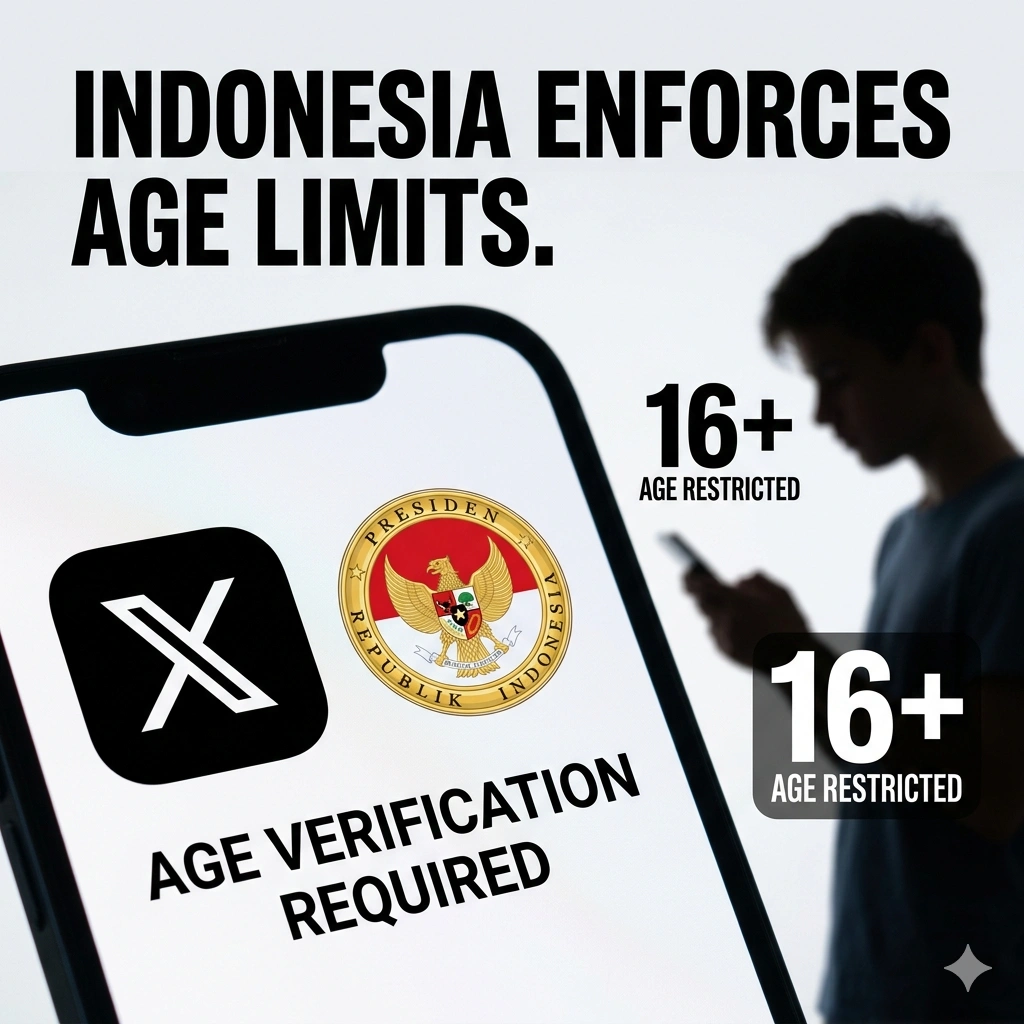
X Enforce Age Rule
The implementation of the X enforce age rule is the first major test of the PP Tunas regulation on a global tech giant. By raising the minimum age from 13 to 16, Indonesia is setting a precedent for how sovereign nations can dictate safety standards to Silicon Valley. X has integrated new identity verification prompts for Indonesian IP addresses to confirm the birth dates of existing account holders. This process is designed to filter out millions of underage users who previously navigated the platform without restriction.
Furthermore, the X enforce age rule includes a mandate for more robust parental consent features for those nearing the age of majority. The Ministry of Communication and Digital Affairs highlighted that X is currently utilizing AI-driven age estimation tools to identify bad actors. These tools analyze posting patterns and profile data to flag accounts that may have provided false birth dates during registration. This multi-layered approach is intended to close loopholes that younger children often use to bypass basic age gates.
The government has also warned that failure to strictly maintain the X enforce age rule could result in heavy administrative fines or even a total block of the service. Currently, the platform is cooperating fully with Indonesian authorities to avoid such a crisis. This cooperation is seen as a strategic move by X to maintain its market share in one of the world’s most active social media populations. The eyes of the global tech community are now on Jakarta to see if this enforcement model actually works.
Understanding the PP Tunas Regulation
The Government Regulation No. 17/2025, popularly known as PP Tunas, is the legal backbone of the current crackdown. This law was drafted after a series of high-profile cases involving online exploitation and data privacy breaches affecting Indonesian minors. The primary goal of PP Tunas is to create a “walled garden” for children under 16, keeping them away from unregulated social algorithms. The X enforce age rule is merely the first step in a much larger national digital cleanup.
Under PP Tunas, digital platforms are held legally responsible for the content served to minors. By forcing the X enforce age rule, the government is effectively removing younger teens from a platform that often hosts mature or sensitive discussions. The Ministry believes that 16 is a more appropriate age for individuals to handle the complexities of public digital discourse. This regulation also mandates that any data collected from minors must be deleted upon the deactivation of their accounts.
The “Tunas” in the regulation’s name refers to “young shoots,” symbolizing the protection of the nation’s future generation. The law covers not just social media but also gaming platforms, streaming services, and educational apps. However, the X enforce age rule is receiving the most attention due to the platform’s role as a primary source of news and political debate. The government remains firm that child safety must take priority over platform growth or user engagement metrics.
Impact on the Indonesian Creator Economy
The X enforce age rule is expected to have a significant impact on the burgeoning creator economy in Indonesia. Many young influencers, particularly those in the 13-to-15 age bracket, may find their accounts deactivated overnight. This loss of digital real estate could disrupt sponsorship deals and audience growth for a generation of digital natives. Agencies are already advising young creators to transition their content to platforms that may still allow parental supervision models.
Marketing experts suggest that the X enforce age rule will shift advertising budgets toward platforms that cater to older demographics. Brands that target young teens will now have to find new ways to reach their audience outside of the X ecosystem. This could lead to a resurgence in traditional media or a pivot toward niche, age-compliant local apps. The economic ripple effects of this regulation are being studied by the Indonesian Chamber of Commerce to prepare for a market shift.
- Young creators are losing access to global audiences and real-time networking tools.
- Brands must re-verify the age demographics of their current influencer partnerships.
- The X enforce age rule might encourage the development of local, age-restricted alternatives.
- Educational influencers may need to move to platforms with stricter “Education Only” filters.
Phased Implementation Strategy
The Ministry of Communication and Digital Affairs has emphasized that the X enforce age rule will not be an “instant kill” switch. Instead, a phased implementation strategy is being used to allow users to archive their data before deactivation. This approach is intended to reduce public backlash and give families time to discuss digital safety boundaries. X has started sending in-app notifications to flagged users, requesting valid government identification to prove they are 16 or older.
During this transition period, the X enforce age rule allows for a grace period where accounts are restricted but not yet deleted. Restricted users can download their post history and media but cannot post new content or interact with others. This “read-only” mode is a compromise to ensure that personal memories are not lost during the enforcement of PP Tunas. The ministry has praised this measured approach as a sign of responsible corporate citizenship by the platform.
The final phase of the X enforce age rule will involve the permanent deactivation of all unverified accounts by the end of the second quarter of 2026. Data suggests that hundreds of thousands of accounts could be affected in this final sweep. The government is providing a dedicated helpdesk for parents who have questions about the deactivation process. This structured rollout is being used as a case study for other digital regulations currently under debate in the Indonesian parliament.
Technical Challenges of Age Verification
One of the biggest hurdles for the X enforce age rule is the technical difficulty of verifying age in a country with varying levels of digital ID penetration. While many urban Indonesians have digital identity cards, those in rural areas may find it harder to provide immediate proof. X is currently exploring partnerships with local telecommunications companies to verify age through SIM card registration data. This cross-sector collaboration is essential for the success of the PP Tunas mandate.
Privacy advocates have raised concerns about the amount of personal data being collected during the X enforce age rule process. They argue that requiring government IDs for social media access could lead to potential data leaks or state surveillance. The Ministry has responded by stating that all ID data submitted to X must be encrypted and deleted once the verification is complete. Third-party audits are being planned to ensure that X adheres to these strict privacy protocols.
- AI-based age estimation is being used as a secondary verification layer.
- SIM card registration data provides a high-confidence check for mobile-first users.
- Credit card verification is less effective in Indonesia due to low credit card usage.
- The X enforce age rule must balance strict security with ease of use for legitimate users.
Global Precedents for Age Restrictions
Indonesia is not the only country moving toward stricter age controls, but the X enforce age rule is among the most rigid. Similar laws have been proposed in parts of Europe and the United States, but they often face heavy legal opposition. Indonesia’s move is unique because it ties social media access directly to a specific government regulation with clear penalties. Other nations are watching the X enforce age rule to see if it sets a viable template for their own legislative agendas.
In the past, platforms like TikTok and Instagram have faced fines for failing to protect young users, but they rarely raise the minimum age globally. The X enforce age rule proves that a localized approach is possible even for platforms that operate on a global scale. This “geofencing” of age requirements allows X to stay compliant with Indonesian law while maintaining different standards elsewhere. This flexibility is likely the future of international social media management.
The success of the X enforce age rule could embolden other governments in the ASEAN region to pass similar laws. Countries like Vietnam and Thailand have already expressed interest in the PP Tunas model for their own digital protection acts. The regional conversation is shifting from “if” children should be restricted to “how” those restrictions can be effectively enforced. Indonesia is currently leading this conversation through its bold actions with X.
Public and Parental Reaction
The reaction to the X enforce age rule in Indonesia has been largely split between safety concerns and freedom of expression. Many parents have welcomed the move, citing the platform’s often toxic environment as a reason to keep young children away. They believe the X enforce age rule will reduce instances of cyberbullying and exposure to inappropriate content. Educational groups have also voiced support, hoping it will lead to better focus on studies among teenagers.
On the other hand, many young people feel that the X enforce age rule is a violation of their right to information and community. For many 14 and 15-year-olds, X is a place to find support for niche interests or to learn about global events. They argue that the government should focus on better digital literacy rather than outright bans. This debate has sparked a wider conversation in Indonesian society about the role of the state in parenting in the digital age.
- Supportive parents cite “digital detox” benefits for their children.
- Skeptical youth are moving to VPNs to bypass the X enforce age rule.
- Civil society groups are calling for clearer definitions of “harmful content.”
- The X enforce age rule has triggered a surge in interest for local, moderated forums.
Future of Digital Governance in Indonesia
The X enforce age rule is just the beginning of a new era of digital governance in Indonesia. The government is currently working on a “White List” of approved apps that are safe for children under 16. These apps will likely have built-in time limits and strict content moderation fueled by local language AI. The X enforce age rule serves as a clear warning to all tech companies that they must prioritize the local legal framework over global corporate policy.
As the ministry looks toward 2027, they plan to expand the PP Tunas requirements to include mandatory digital ethics training for all users. This would mean that before an Indonesian user reaches 16 and gains access via the X enforce age rule, they must complete a short course. This holistic approach aims to create a more responsible and informed digital citizenry. The goal is not just to restrict access but to improve the quality of the online experience for everyone.
International tech companies are now hiring more local compliance officers in Jakarta to navigate these changing tides. The X enforce age rule has shown that having a local presence and understanding of the law is no longer optional. The Indonesian digital economy is too large for global players to ignore, making compliance a business necessity. The relationship between the state and big tech is being redefined in real-time under the shadow of PP Tunas.
Ensuring Compliance and Monitoring
The Ministry of Communication and Digital Affairs has established a dedicated monitoring unit to oversee the X enforce age rule. This unit uses automated tools to scan for Indonesian accounts that show signs of being operated by minors. If a platform is found to be lax in its enforcement, it will receive a “Yellow Card” warning. Three such warnings could lead to the total revocation of the platform’s operating license in Indonesia, a move that would be catastrophic for X.
X has responded by increasing its local moderation team to better understand Indonesian slang and cultural nuances used by young people. This is a critical part of the X enforce age rule, as age estimation AI often struggles with local dialects. The platform is also working with local NGOs to promote digital safety awareness among those who are allowed to remain on the site. This partnership is a key part of the social responsibility mandate included in PP Tunas.
The government also encourages citizens to report accounts that they suspect belong to children under 16. This “crowdsourced” monitoring adds another layer of pressure to the X enforce age rule. While this has led to some false reports, the ministry believes it creates a culture of collective responsibility. The goal is to make the Indonesian segment of X a safer, more mature space for all legitimate users.
Conclusion: A Safer Digital Future
The X enforce age rule marks a historic moment for child protection in the digital age. By taking a firm stand against the early exposure of children to complex social algorithms, Indonesia is prioritizing the mental health of its youth. The PP Tunas regulation provides the necessary legal teeth to ensure that these changes are not just cosmetic. As X continues its phased deactivation of underage accounts, the world will be watching the long-term social impact.
The transition may be difficult for the creator economy and for young people seeking connection, but the government remains convinced it is the right path. The X enforce age rule is a clear message that digital platforms must be safe spaces, not just profitable ones. With the cooperation of global tech giants and the vigilance of local authorities, a new standard for digital safety is being built. The journey toward a more secure internet in Indonesia has officially begun.
Ultimately, the success of this policy will depend on the continuous evolution of verification technologies and public education. The X enforce age rule is a tool, but the goal is a culture of safety and respect online. As 2026 progresses, the impact of these changes will become clearer, potentially leading to a more stable and healthy digital environment for all Indonesians. The “young shoots” of the nation now have a stronger digital fence to protect their growth.
For more details & sources visit: Tech in Asia
Read more about Indonesia news on 360 News Orbit – Indonesia.