
The China-Pakistan tech ties have reached an unprecedented milestone during the prestigious Zhongguancun Forum 2026 held in Beijing. This annual event has officially transformed into a vital hub for deepening technological cooperation between the two neighboring nations. This year’s gathering features a record number of Pakistani researchers and entrepreneurs who are actively exploring cutting-edge industrial integration. High-level discussions throughout the week focused on building robust innovation ecosystems to support long-term economic stability.
Running from March 25 to 29, the Zhongguancun Forum 2026 serves as a premier stage for international scientific exchange and policy alignment. A specific focus was placed on the China-Pakistan International Industrial Academic Integration Alliance, which seeks to modernize manufacturing sectors. Muhammad Ammar, the alliance’s Secretary General, noted that the forum effectively bridges the critical gap between laboratory research and real-world industrial application. This synergy is expected to accelerate the deployment of smart technologies in Pakistani factories over the next decade.
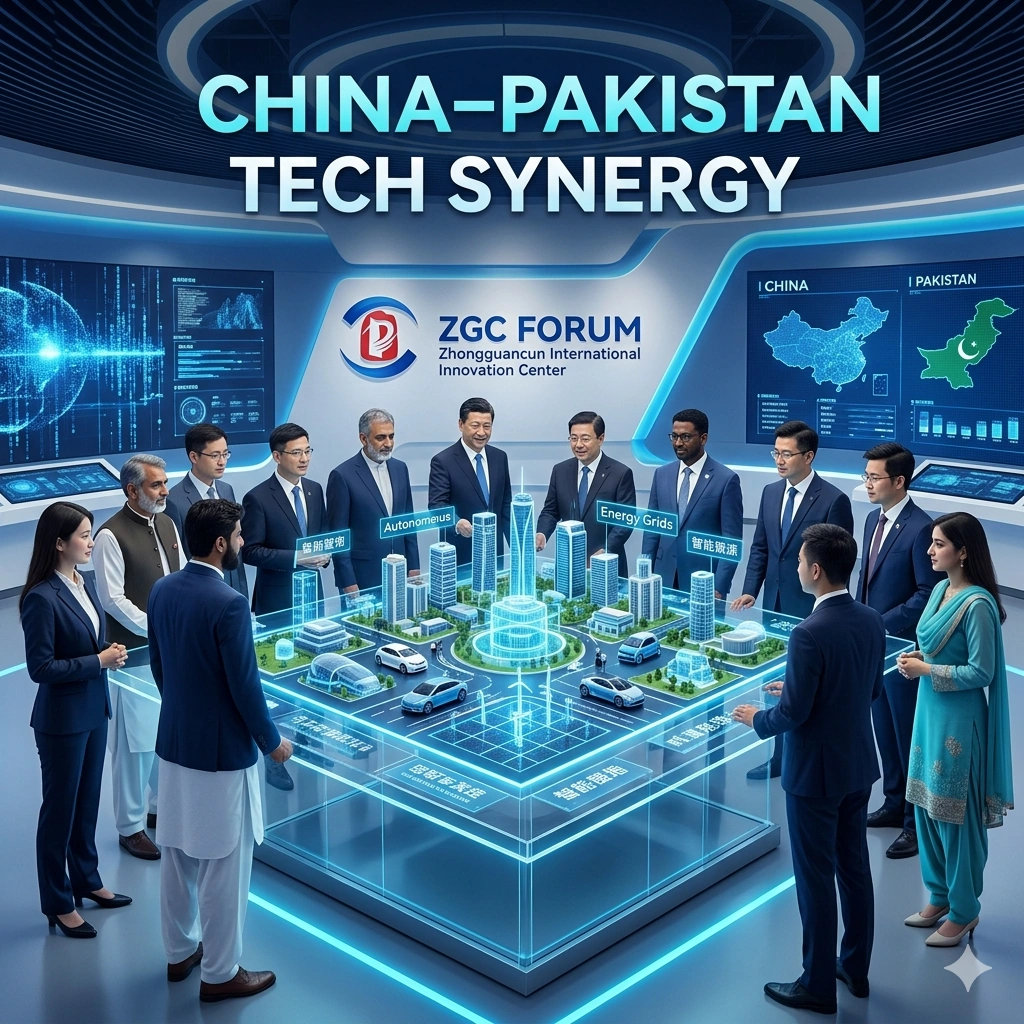
China-Pakistan Tech Ties
The formalization of China-Pakistan tech ties at this forum represents a strategic shift toward high-tech manufacturing and digital services. Government officials from both sides emphasized that the era of simple infrastructure projects has evolved into a sophisticated partnership involving artificial intelligence and biotechnology. The Zhongguancun Forum 2026 provided a neutral ground for private sector leaders to sign several multi-million dollar agreements. These deals are specifically designed to upgrade Pakistan’s technological landscape through direct knowledge transfer and collaborative research.
One of the most significant outcomes of the China-Pakistan tech ties is the establishment of joint research centers in Islamabad and Beijing. These centers will focus on renewable energy solutions and agricultural technology, which are critical for Pakistan’s climate resilience. By sharing patent data and engineering expertise, China is helping Pakistan leapfrog traditional industrial hurdles. This collaborative spirit was praised by international observers as a model for South-South cooperation in the 21st century.
Furthermore, the China-Pakistan tech ties are being strengthened through the “Open Science International Cooperation Action Plan.” This initiative encourages the free exchange of scientific data between universities in both countries to solve regional challenges. Pakistani scholars at the forum expressed excitement about accessing China’s massive data processing capabilities to enhance their own local research projects. This level of openness is unprecedented and signals a deep level of trust between the two scientific communities.
Industrial Academic Integration Alliance
The Secretary General of the China-Pakistan International Industrial Academic Integration Alliance highlighted the forum’s role in human capital development. He stated that the primary goal is to ensure that academic curriculum in Pakistan matches the rapidly evolving needs of the Chinese industrial sector. This alignment is crucial for the thousands of Pakistani students currently studying engineering and computer science in Chinese universities. The alliance serves as the connective tissue between these graduates and high-paying jobs in emerging tech industries.
Through this alliance, several vocational training programs were launched during the Zhongguancun Forum 2026 to upskill the Pakistani workforce. These programs focus on robotics, cloud computing, and advanced materials science, ensuring that workers are ready for the fourth industrial revolution. The China-Pakistan tech ties are therefore not just about hardware, but about empowering people with the skills of the future. The alliance is also working on a “Green Corridor” for tech startups to easily register and operate in both jurisdictions.
The integration model also includes a venture capital component where Chinese investors can identify promising Pakistani tech firms. This financial support is vital for startups that have great ideas but lack the capital to scale their operations globally. By providing a platform for these pitches, the forum has become a launchpad for the next generation of Pakistani unicorns. The China-Pakistan tech ties are creating a sustainable cycle of innovation, investment, and industrial growth.
Global Engineering Frontiers Report
The unveiling of the “2025 Global Engineering Frontiers” report was a major milestone for the delegates attending the forum. This document identifies the top ten areas of engineering that will dominate the global economy over the next five years. For the practitioners of China-Pakistan tech ties, the report serves as a strategic roadmap for allocating resources and funding. Key areas identified include carbon-neutral construction techniques and high-speed rail innovations that are already being implemented in CPEC projects.
Pakistani engineers at the forum participated in specialized workshops to dissect the report’s findings and apply them to local contexts. They discussed how modular construction could solve housing shortages in urban centers like Karachi and Lahore. The China-Pakistan tech ties allow for the rapid adoption of these frontier technologies, saving years of independent trial and error. This knowledge sharing is a cornerstone of the bilateral relationship, ensuring that both nations remain competitive on the world stage.
Moreover, the report emphasizes the importance of cybersecurity in the modern engineering landscape. As industrial systems become more connected, the need for robust defense mechanisms grows exponentially. The China-Pakistan tech ties now include a dedicated track for joint cybersecurity drills and protocol development. This proactive approach ensures that the digital infrastructure being built today is resilient against the threats of tomorrow.
Blueprint for Systematic Innovation Hubs
The study of the Beijing-Tianjin-Hebei development model provided the Pakistani delegation with a masterclass in urban planning and tech clusters. They observed how a coordinated approach to regional development can turn stagnant areas into vibrant economic powerhouses. The China-Pakistan tech ties aim to replicate this success by creating similar clusters along the main arteries of the China-Pakistan Economic Corridor. These hubs will house research labs, factories, and logistics centers in a single, integrated environment.
- The model emphasizes the relocation of non-essential functions to satellite cities to reduce urban congestion.
- It prioritizes the use of high-speed digital connectivity to link different nodes of the innovation ecosystem.
- Local governments are empowered to create tax incentives for tech companies that relocate to these new hubs.
- The focus on environmental sustainability ensures that industrial growth does not come at the cost of air and water quality.
By adopting this blueprint, Pakistan can move away from fragmented development toward a more cohesive national strategy. The China-Pakistan tech ties are providing the theoretical framework and the practical tools to make this transition possible. Delegates noted that the success of these hubs will depend on strong local leadership and continued support from Chinese technical experts. The forum provided the necessary networking opportunities to cement these long-term institutional partnerships.
Open Science International Cooperation Action Plan
The “Open Science International Cooperation Action Plan” is a bold step toward democratizing scientific knowledge in the region. This plan advocates for open access to research publications and the sharing of laboratory equipment between member nations. For the China-Pakistan tech ties, this means that a researcher in Faisalabad can collaborate in real-time with a scientist in Shenzhen. This level of connectivity breaks down the traditional barriers of distance and cost that have historically hindered Pakistani science.
Under this plan, several joint databases have been created to track climate patterns and water resources in the Indus River basin. This data is vital for disaster management and agricultural planning in both countries. The China-Pakistan tech ties are thus producing tangible benefits that go beyond the tech sector and into the daily lives of citizens. Open science promotes transparency and accelerates the pace of discovery by allowing multiple teams to work on the same problem simultaneously.
The action plan also includes provisions for the protection of intellectual property while still encouraging collaboration. This delicate balance is essential for attracting private sector investment into open-source projects. The China-Pakistan tech ties are setting a new standard for how nations can work together in an era of global challenges. The forum concluded with a commitment to review the progress of this action plan annually to ensure its goals are being met.
Impact on the China-Pakistan Economic Corridor (CPEC)
As CPEC enters its second phase, the focus has shifted heavily toward industrialization and social welfare. The China-Pakistan tech ties are the engine driving this transition, moving the corridor beyond roads and power plants. New agreements signed at the forum will see the establishment of smart tech parks along the CPEC route. these parks will serve as incubators for local businesses to integrate into the global supply chains of Chinese tech giants.
The integration of advanced logistics technology will also make CPEC a more efficient trade route for the entire region. Blockchain-based tracking and automated port operations are some of the technologies discussed during the high-level sessions. These China-Pakistan tech ties are making the trade corridor more transparent and less prone to delays. The long-term goal is to create a seamless digital and physical link between the Arabian Sea and Western China.
Furthermore, the social impact of these tech ties is being felt through improved healthcare and education delivery. Telemedicine platforms developed through bilateral cooperation are now reaching remote areas of Gilgit-Baltistan and Balochistan. The China-Pakistan tech ties are proving that technology can be a powerful tool for social equity. By bringing high-quality services to underserved populations, the partnership is building a stronger foundation for national stability.
Strengthening the Innovation Ecosystem
A robust innovation ecosystem requires a combination of talent, capital, and a supportive regulatory environment. The China-Pakistan tech ties are addressing all three of these pillars through systematic interventions. The forum hosted a series of “Policy Dialogues” where regulators from both countries discussed ways to harmonize tech standards. This harmonization makes it easier for Pakistani tech products to enter the Chinese market and vice versa.
- Joint scholarship programs are increasing the pool of high-skilled talent available to tech firms.
- New venture capital funds are providing the necessary “patient capital” for long-term R&D projects.
- Special tech zones are offering simplified licensing and lower operational costs for startups.
- Regular exchange programs for entrepreneurs are fostering a culture of risk-taking and innovation.
The China-Pakistan tech ties are essentially building a bridge over the “valley of death” that many tech startups face. By providing a comprehensive support system, the two nations are ensuring that good ideas become successful businesses. The delegates left the forum with a clear understanding that innovation is a team sport. The partnership between China and Pakistan is now one of the most dynamic teams in the global tech arena.
Future Engineering Trends and Global Needs
The forum’s focus on future engineering trends ensures that the China-Pakistan partnership remains relevant in a fast-changing world. Technologies such as 6G communication, quantum computing, and advanced genomics were all on the agenda. The China-Pakistan tech ties are positioning both countries to be leaders rather than followers in these emerging fields. By investing in these technologies today, they are securing the economic prosperity of future generations.
Pakistani entrepreneurs are particularly interested in how these trends can be applied to solve local problems. For example, using drone technology for precision agriculture could revolutionize the country’s farming sector. The China-Pakistan tech ties provide the platform for these innovative applications to be tested and scaled. The global industrial needs of the future will be defined by efficiency and sustainability, and this partnership is focused on both.
As the forum drew to a close, there was a sense of optimism about the trajectory of the relationship. The China-Pakistan tech ties have moved beyond rhetoric into concrete actions and measurable results. The “Strategic Roadmap” developed during the event will guide bilateral projects for the next decade. Both nations are committed to a future where technology serves as the primary driver of their “All-Weather Strategic Cooperative Partnership.”
Success Stories of Pakistani Entrepreneurs in Beijing
The forum also highlighted several success stories of Pakistani entrepreneurs who have successfully integrated into China’s tech ecosystem. These individuals serve as ambassadors for the China-Pakistan tech ties, demonstrating what is possible with hard work and cooperation. One such entrepreneur has developed an AI-based translation tool that helps Chinese engineers communicate with Pakistani workers on construction sites. This simple yet effective tool has significantly improved efficiency and safety across multiple CPEC projects.
Another success story involves a joint venture that is producing affordable electric motorcycles for the Pakistani market. By combining Chinese battery technology with Pakistani design and assembly, they have created a product that is both eco-friendly and economical. These China-Pakistan tech ties are creating real value for consumers while also reducing the carbon footprint of urban transport. These stories inspired many of the younger delegates to pursue their own cross-border business ventures.
The forum provided a platform for these entrepreneurs to share their experiences and mentor others. They emphasized the importance of cultural understanding and language skills in building successful partnerships. The China-Pakistan tech ties are as much about people-to-people connections as they are about code and hardware. This human element is what makes the partnership resilient and adaptable to new challenges.
Collaborative Research in Biotechnology and Health
The healthcare sector has seen some of the most profound benefits from the China-Pakistan tech ties in recent years. Joint research on vaccine development and genomic medicine is helping to tackle some of the region’s most pressing health issues. During the forum, a new agreement was signed to establish a regional center for infectious disease control. This center will use advanced data analytics to predict and prevent future outbreaks, protecting the health of millions.
- Joint clinical trials are accelerating the approval process for new life-saving medications.
- Shared research on traditional medicine is leading to the development of new hybrid treatments.
- Mobile health clinics powered by Chinese tech are providing screenings in rural Pakistan.
- Training programs for Pakistani doctors in Chinese hospitals are improving the quality of specialized care.
These initiatives are a testament to the depth of the China-Pakistan tech ties and their focus on human welfare. The use of AI in medical imaging is another area where bilateral cooperation is making a difference. Pakistani hospitals are now adopting Chinese AI software to help radiologists detect early signs of cancer more accurately. This technology transfer is saving lives and improving the overall efficiency of the Pakistani healthcare system.
Sustainable Energy and the Green Tech Revolution
The transition to sustainable energy is a top priority for both nations as they grapple with the effects of climate change. The China-Pakistan tech ties are at the forefront of this green tech revolution, with massive investments in solar and wind power. The forum featured a dedicated track on “Green Energy Solutions” where experts shared the latest innovations in battery storage and grid management. These technologies are essential for stabilizing Pakistan’s energy supply and reducing its dependence on fossil fuels.
Chinese companies are already helping to build some of the largest solar parks in the world in Pakistan’s desert regions. The China-Pakistan tech ties are now focusing on making these projects more efficient through the use of smart sensors and AI-driven maintenance. This “Digital Green” approach ensures that every kilowatt of energy produced is used effectively. The partnership is also exploring the potential of green hydrogen as a clean fuel for the future.
The environmental benefits of these tech ties extend beyond energy production to include water conservation and waste management. Smart irrigation systems developed through bilateral research are helping Pakistani farmers save up to 40% more water. The China-Pakistan tech ties are proving that technological innovation is the key to balancing economic growth with environmental protection. The forum reaffirmed both nations’ commitment to the Paris Agreement and their shared vision for a green future.
Conclusion: A New Era of Strategic Tech Cooperation
The Zhongguancun Forum 2026 has marked the beginning of a new era in China-Pakistan tech ties. The sheer scale of participation and the depth of the discussions signal a permanent shift toward a knowledge-based partnership. By building a robust innovation ecosystem and aligning with global engineering frontiers, both nations are ready to face the challenges of the future. The roadmap developed here will serve as a guiding light for years to come.
As the delegates return home, they carry with them the blueprints for new hubs, the plans for open science, and the spirit of collaboration. The China-Pakistan tech ties are no longer just a diplomatic talking point; they are a living, breathing reality that is transforming lives. The success of this forum is a tribute to the enduring friendship and shared aspirations of the two peoples. The future of this partnership is bright, digital, and full of infinite possibilities.
The integration of industry and academia remains the most promising path for Pakistan’s economic revitalization. With China’s support, the dream of a high-tech Pakistan is closer than ever to becoming a reality. The China-Pakistan tech ties will continue to evolve, adapt, and grow, ensuring that the “Iron Brotherhood” remains strong in the digital age. The world will be watching as this unique tech alliance reshapes the landscape of South Asia and beyond.
For more details & sources visit: China Economic Net
Read more about Pakistan news on 360 News Orbit – Pakistan.