
Philippine Defense Secretary Gilberto Teodoro and French Minister Catherine Vautrin have finalized the landmark Visiting Forces Agreement in Paris to strengthen maritime security. The Philippines and France have established a Visiting Forces Agreement (VFA) to allow joint military training on each other’s soil, marking a transformative shift in Indo-Pacific relations. This strategic partnership comes at a critical moment, just one day after a Chinese missile frigate reportedly performed unsafe maneuvers near Thitu Island. As Manila faces increasing maritime friction with Beijing, this deal provides a legal framework for joint operations between their respective armed forces. Consequently, the Philippines and France sign military pact to ensure a rules-based international order and protect vital global supply chains.
The timing of this agreement is particularly significant given the heightened tensions within the South China Sea. China continues to claim nearly the entire maritime region, despite a 2016 international ruling that invalidated those expansive claims. By securing this pact, Manila is aggressively expanding its network of defense allies beyond its traditional Western partners. France now joins an elite group of security partners, including the United States, Australia, Japan, and New Zealand. The Philippines and France sign military pact as a clear signal that European powers are increasingly invested in Asian maritime stability. This collaboration aims to deter further provocations and ensure that international law remains the guiding principle in the region.
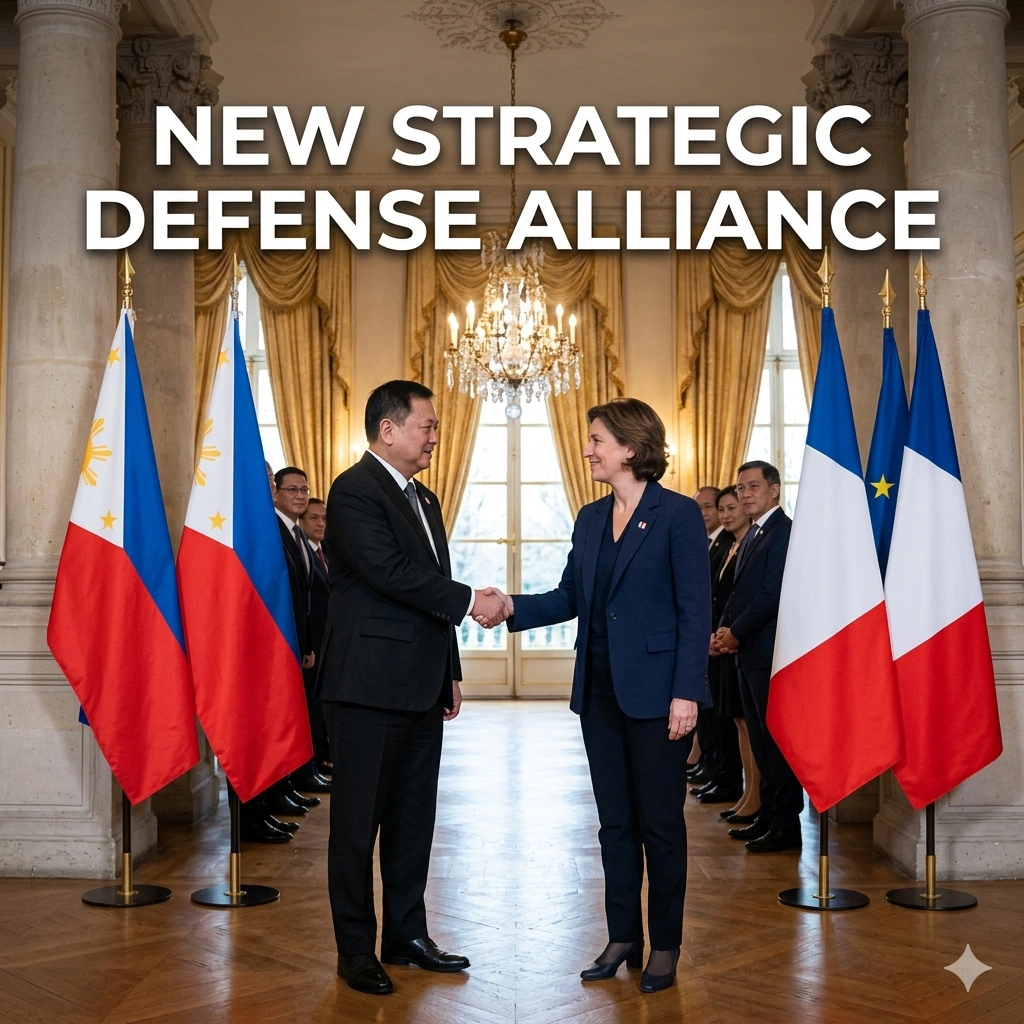
Philippines and France Sign Military Pact
The formal signing ceremony in Paris represents a major diplomatic victory for President Ferdinand Marcos Jr.’s administration. By establishing a Visiting Forces Agreement, both nations can now conduct large-scale military exercises on each other’s sovereign territory. This level of cooperation was previously restricted by legal hurdles that have now been cleared by the new defense framework. The Philippines and France sign military pact to enhance tactical interoperability between their navies and air forces. Such training is essential for responding to humanitarian crises and potential military flashpoints in the busy shipping lanes of the South China Sea.
Furthermore, the agreement includes provisions for the transfer of defense technology and intelligence sharing between the two ministries. France, a leading global arms producer, is well-positioned to assist in the modernization of the Philippine Armed Forces. The Philippines and France sign military pact to explore the acquisition of advanced submarines and maritime patrol aircraft. This modernization is crucial for a nation that oversees a vast archipelago with limited self-defense capabilities. By deepening these ties, France secures a more prominent role in the security architecture of the Indo-Pacific region. Both nations have expressed a long-term commitment to maintaining this high level of military integration.
Addressing Maritime Provocations in 2026
Recent incidents near Thitu Island have highlighted the urgent need for robust security alliances in the region. A Chinese missile frigate’s reported maneuvers were seen as a direct threat to Philippine sovereignty and regional safety. In response, the Philippines and France sign military pact to provide a united front against such aggressive gray-zone tactics. These maneuvers often involve using non-military vessels to harass Filipino fishermen and resupply missions. The new pact allows for more frequent French naval presence in the area, serving as a deterrent to unilateral actions.
Marine security experts suggest that the presence of European naval assets could complicate the strategic calculus for regional aggressors. When the Philippines and France sign military pact, it introduces a new variable into the South China Sea dispute. This internationalization of the conflict makes it more difficult for any single nation to dominate the waterway through intimidation. France’s commitment to a free and open Indo-Pacific is now backed by a concrete legal agreement with a frontline state. This move reinforces the idea that maritime security is a global responsibility rather than a local disagreement. The pact is a direct answer to the calls for greater international involvement in Asian security.
Protecting Global Trade Routes
The South China Sea is a vital artery for global commerce, with over $3 trillion in trade passing through its waters annually. Any disruption to these routes could have a catastrophic impact on the global economy and local markets. The Philippines and France sign military pact to prioritize the protection of these essential maritime trade routes. Ensuring the unhindered flow of goods is a primary objective for both the European Union and the ASEAN bloc. This agreement focuses on anti-piracy operations and the safeguarding of commercial vessels from harassment.
By coordinating their naval patrols, the two countries can more effectively monitor large swaths of the ocean. The Philippines and France sign military pact to share real-time maritime domain awareness data. This information is vital for identifying suspicious vessel movements and responding to emergencies at sea. Resilient supply chains depend on the stability of these primary transit corridors, making this defense deal a matter of economic security. Both nations emphasize that the freedom of navigation is a non-negotiable right under international law. Their joint efforts will focus on maintaining the transparency and safety of the maritime environment for all nations.
Strengthening Rules-Based International Order
At the heart of this agreement is a shared commitment to a rules-based international order. Both Paris and Manila have repeatedly called for the peaceful resolution of disputes through legal channels like UNCLOS. The Philippines and France sign military pact to reaffirm their adherence to these international standards. This stands in stark contrast to the unilateral actions that have characterized the regional disputes over the last decade. By forming this alliance, both nations are advocating for a world where might does not necessarily make right.
The defense pact also serves as a model for how medium-sized powers can collaborate to balance regional dynamics. When the Philippines and France sign military pact, they demonstrate that security is built on a foundation of mutual respect and legal parity. This partnership is not aimed at any specific nation but rather at upholding the principles that govern global interactions. It provides a blueprint for other nations in the region who may be seeking to diversify their security portfolios. The emphasis remains on stability, transparency, and the prevention of armed conflict through proactive diplomacy. This agreement is a significant step toward a more multilateral approach to Indo-Pacific security.
Tactical Training and Operational Synergy
The VFA allows for a variety of joint training scenarios, ranging from amphibious landings to cyber defense. This operational synergy is designed to prepare both militaries for the complexities of modern warfare and disaster response. The Philippines and France sign military pact to facilitate the exchange of best practices in maritime surveillance. French officers will provide training on advanced radar systems and drone technology to their Filipino counterparts. In return, the Philippines offers unique geographical contexts for French troops to practice tropical and littoral operations.
These exercises are expected to become a regular feature of the bilateral relationship in the coming years. As the Philippines and France sign military pact, they pave the way for more integrated command structures during joint drills. This level of familiarity is essential for effective coordination during real-world crises. The training will also focus on search and rescue operations, which are frequently needed in the typhoon-prone Philippine archipelago. By working together, the two nations can enhance their collective capacity to save lives and protect property at sea. The pact ensures that both forces are ready for any eventuality in the maritime domain.
France’s Growing Role in the Indo-Pacific
France is a unique European power in that it has significant sovereign territory and citizens in the Indo-Pacific. This geographical presence gives Paris a direct stake in the region’s long-term stability and security. The Philippines and France sign military pact as part of a broader French strategy to protect its overseas interests. With over 1.6 million French citizens living in the Indo-Pacific, the safety of regional waters is a domestic priority for France. This agreement allows France to project its influence more effectively from its bases in the Indian and Pacific Oceans.
Furthermore, France’s role as a permanent member of the UN Security Council adds weight to this bilateral defense deal. When the Philippines and France sign military pact, it elevates the South China Sea issue within the highest levels of international diplomacy. France can now speak with greater authority on behalf of its Southeast Asian partner in global forums. This diplomatic support is just as valuable to Manila as the tactical military training provided by the VFA. The partnership signifies a deepening of the “strategic autonomy” that France often promotes on the global stage. It shows that France is willing to take concrete steps to support its allies in distant theaters.
Modernizing the Philippine Armed Forces
The Philippine government has embarked on a multi-year modernization program to address long-standing gaps in its defense posture. Partnering with a technologically advanced nation like France is a key component of this strategy. The Philippines and France sign military pact to open doors for significant defense acquisitions and joint ventures. France’s expertise in naval engineering, particularly in the construction of Scorpène-class submarines, is of great interest to Manila. These assets would provide the Philippines with a credible underwater deterrent for the first time in its history.
In addition to hardware, the pact emphasizes the importance of human capital development through education and training. The Philippines and France sign military pact to establish scholarship programs for Filipino officers at French military academies. This exchange of personnel fosters long-term institutional ties and cultural understanding between the two defense establishments. A more professional and well-equipped military is better able to fulfill its constitutional mandate of protecting the state. This modernization effort is seen as a defensive necessity rather than an offensive build-up. It aims to provide the Philippines with the “minimum credible defense” required to monitor its vast maritime borders.
Philippines and France Sign Military Pact
As the world watches the evolving situation in the South China Sea, the importance of this new alliance cannot be overstated. The Philippines and France sign military pact as a decisive response to the changing security landscape of 2026. This agreement bridges the gap between European and Asian security, proving that the challenges of one region are the concerns of another. The commitment to joint training and maritime protection will likely yield dividends for years to come. Manila has found a reliable and capable partner in Paris, further diversifying its strategic options.
The international community generally views this development as a positive step toward regional equilibrium. When the Philippines and France sign military pact, it discourages unilateral changes to the status quo through the threat of force. Instead, it promotes a collaborative environment where nations work together to solve common problems. The focus on rules-based order and freedom of navigation serves the interests of all trading nations. As the VFA is implemented, the sight of French and Filipino flags flying together on joint exercises will become a symbol of this new era of cooperation. The pact is a clear victory for diplomacy and international law.
Strategic Implications for Regional Stability
The long-term strategic implications of this pact will likely influence the decisions of other ASEAN nations. By successfully negotiating a VFA with France, the Philippines has set a precedent for other countries seeking similar security arrangements. The Philippines and France sign military pact to demonstrate that high-level defense cooperation is possible without compromising national sovereignty. This could lead to a more networked security environment in Southeast Asia, where multiple overlapping alliances provide a safety net. Such a network would be more resilient than a single, centralized security architecture.
Furthermore, the pact encourages France to maintain a persistent and predictable presence in the region. This predictability is essential for market confidence and political stability in the Indo-Pacific. When the Philippines and France sign military pact, it reduces the likelihood of miscalculation by providing clear channels of communication and cooperation. The agreement also includes provisions for disaster relief, which is a frequent necessity in Southeast Asia. This humanitarian aspect ensures that the military cooperation has a direct and positive impact on local populations. The alliance is thus both a security necessity and a humanitarian asset for the region.
Diplomatic Context of the Paris Agreement
The diplomatic effort required to reach this agreement involved months of intense negotiations and high-level meetings. The Philippines and France sign military pact only after both sides were satisfied with the legal and operational protections provided. This careful approach ensures that the VFA is robust enough to withstand political changes in either country. The agreement also reflects the personal rapport established between the defense ministers and their respective heads of state. This human element is often the catalyst for significant shifts in international relations.
The signing of the VFA in Paris also highlights the city’s role as a center for global diplomacy. By choosing Paris as the venue, the Philippines emphasized the global nature of its security concerns. The Philippines and France sign military pact amidst a backdrop of increasing European interest in Asian affairs. This interest is driven by the realization that European prosperity is inextricably linked to the stability of Asian markets. The agreement is a physical manifestation of this interconnectedness and a commitment to protecting shared interests. It marks a new chapter in the centuries-old relationship between the two nations.
Summary of the Philippines-France Defense Deal
The establishment of the Visiting Forces Agreement between the Philippines and France is a landmark event in 2026. By allowing for joint military training and enhanced maritime cooperation, the deal addresses the immediate security needs of the Philippines. The Philippines and France sign military pact to safeguard the $3 trillion in trade that flows through the South China Sea each year. This partnership underscores the importance of a rules-based international order and provides a framework for defense modernization. As tensions continue to rise, this alliance stands as a pillar of stability in the Indo-Pacific.
For more details & sources visit: Reuters
Read more about France news on 360 News Orbit – France.