
The global economic catastrophe predicted by European leaders is rapidly becoming a reality as the conflict in the Middle East enters its second month. Germany and the United Kingdom are currently at the forefront of this financial downturn, facing severe economic downgrades that threaten to destabilize the entire Eurozone. As the military confrontation between the U.S.-Israel coalition and Iran intensifies, international markets are reacting with unprecedented volatility and fear. This instability is not merely a localized issue; it is a systemic shock that is reverberating through every sector of the modern global economy.
Furthermore, the global economic catastrophe is being fueled by the most significant energy crisis the world has seen in several decades. German officials have been blunt in their assessment, labeling the current trajectory as a definitive collapse of previous growth models. The lack of a clear exit strategy for the ongoing war has created a vacuum of certainty, leading to a massive withdrawal of investment from high-risk markets. This atmosphere of dread is compounded by the fact that internal European fiscal policies are being tightened exactly when the public needs the most support. Consequently, the global economic catastrophe is now the primary concern for policymakers from Berlin to London.
Slashing the UK Growth Forecast
The OECD has taken the drastic step of slashing the United Kingdom’s growth forecast for 2026, citing the direct impact of the global economic catastrophe. By cutting the forecast by half a percentage point, the organization has sent a clear signal that the British economy is uniquely vulnerable to rising energy costs. This adjustment reflects the harsh reality of fiscal tightening measures that were already in place before the conflict escalated in the Middle East. As prices for basic goods continue to climb, the average British household is feeling the squeeze of a rapidly contracting economy.
In addition to reduced growth, the global economic catastrophe is driving inflation rates to levels not seen in years across the British Isles. The UK’s reliance on international maritime trade routes makes it particularly susceptible to the disruptions currently occurring in the Strait of Hormuz. When shipping lanes are compromised, the cost of importing essential components for manufacturing and energy production skyrockets. This chain reaction is a textbook example of how a localized conflict can trigger a global economic catastrophe. Analysts warn that if the war persists, further downgrades to the UK’s economic health are almost inevitable.
Energy Markets Under Intense Pressure
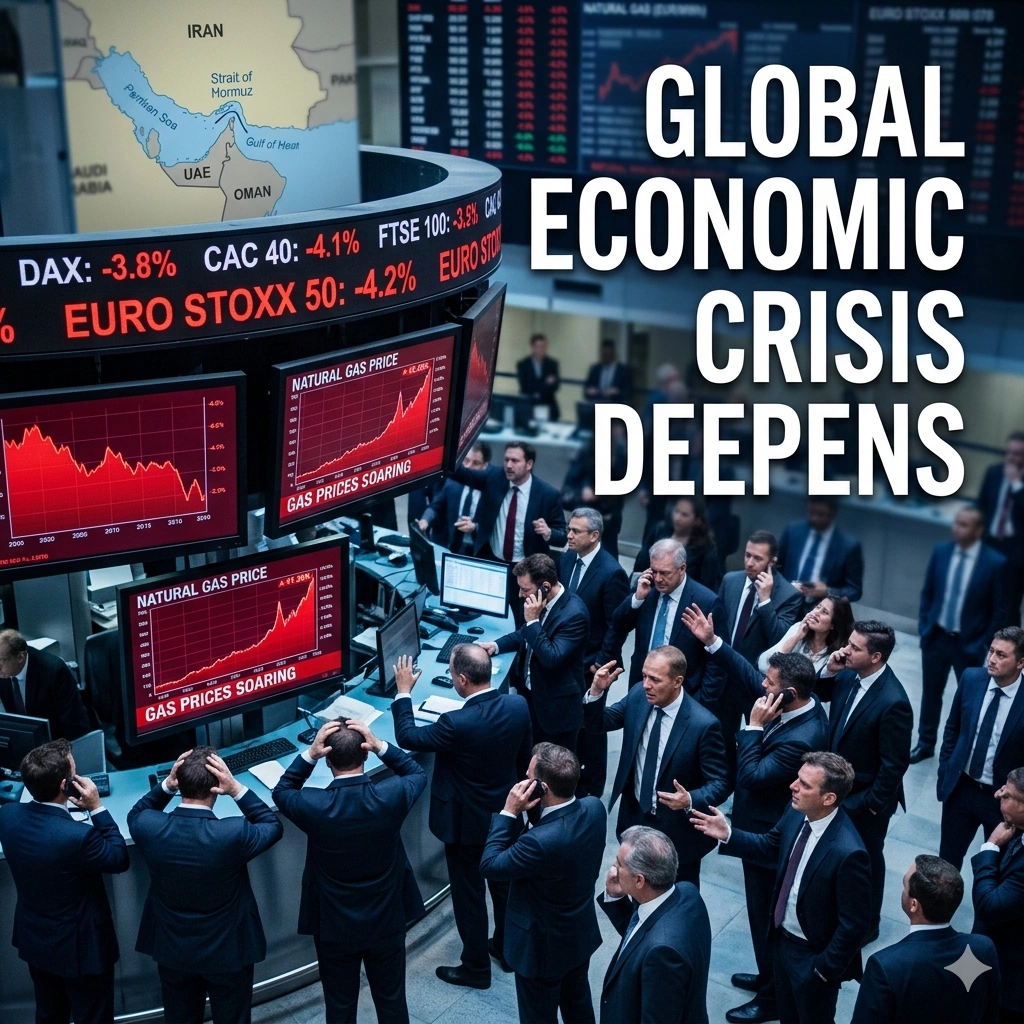
The global economic catastrophe is most visible in the sudden and violent spike in natural gas prices across the European Union. Following targeted attacks on critical gas fields in Iran and Qatar, EU gas prices surged by over 30 percent in a single trading session. This volatility makes it nearly impossible for industrial giants in Germany to plan for future production, leading to widespread layoffs and factory closures. The energy security that Europe worked so hard to build over the last decade is being dismantled in a matter of weeks by the global economic catastrophe.
Moreover, the closure of vital maritime routes has created a bottleneck that prevents liquefied natural gas from reaching European ports efficiently. As the conflict nears the one-month mark, the scarcity of fuel is driving up the cost of electricity for both commercial and residential consumers. This energy-driven global economic catastrophe is forcing governments to consider emergency rationing measures to ensure that essential services remain functional through the spring. The interconnectedness of global energy supplies means that a strike on a field in the Middle East is felt instantly in the heating bills of a family in Madrid or Paris.
Germany Warns of Clear Economic Damage
German Defence Minister Boris Pistorius has been vocal about the “evident” damage that the global economic catastrophe is inflicting on the world’s most powerful nations. Germany, often considered the engine of the European economy, is seeing its industrial output falter as the cost of raw materials and energy becomes unsustainable. The minister noted that the current conflict lacks any foreseeable resolution, which only deepens the long-term impact of the global economic catastrophe. Without a diplomatic breakthrough, the structural damage to the German manufacturing sector could take years to repair.
The sentiment in Berlin is one of deep concern, as the global economic catastrophe threatens to erase the gains made during the post-pandemic recovery. German officials are struggling to balance the need for military readiness with the requirement to protect their domestic economy from total collapse. As the U.S.-led coalition continues its operations, the secondary effects on trade and currency stability are becoming harder to ignore. This global economic catastrophe is proving to be a transformative event that is redefining the geopolitical landscape of the twenty-first century. Germany’s warning serves as a somber reminder that no nation is immune to the fallout of modern warfare.
Comparing the Crisis to 2003
Spanish Prime Minister Pedro Sanchez has compared the current global economic catastrophe to the 2003 Iraq War, stating that the present situation is “far worse.” Unlike previous conflicts, the current war involves direct strikes on the world’s most sensitive energy infrastructure, leading to an immediate global economic catastrophe. The scope of the current military engagement includes major world powers and regional heavyweights, making the potential for escalation much higher than it was two decades ago. This heightened risk level is what is driving the extreme reactions in the global financial markets.
The comparison to 2003 highlights the evolution of global trade and how much more integrated the world has become. A disruption today causes a global economic catastrophe much faster than it would have in the past due to just-in-time manufacturing and interconnected digital finance. Prime Minister Sanchez emphasized that the collapse of traffic through the Strait of Hormuz is a “red line” for global energy security that has already been crossed. As long as this vital artery remains blocked or threatened, the global economic catastrophe will continue to expand in scope and severity. European leaders are now forced to navigate a crisis that has no modern precedent in terms of economic complexity.
Fiscal Tightening and Social Impact
As part of the response to the global economic catastrophe, many European nations are being forced into a period of extreme fiscal tightening. This means cutting public spending at a time when inflation is already devaluing the currency held by everyday citizens. The social impact of the global economic catastrophe is becoming a major political hurdle for leaders who must explain why energy costs are tripling while social services are being reduced. This tension is creating fertile ground for political instability within Europe itself, adding another layer to the global economic catastrophe.
The OECD’s report suggests that these fiscal measures, while intended to stabilize national debts, may actually be worsening the global economic catastrophe by stifling domestic demand. When people stop spending because they are afraid of the future, the economy enters a downward spiral that is difficult to break. This cycle is currently visible in the retail and service sectors across Europe, which are seeing a sharp decline in activity. The global economic catastrophe is thus not just a matter of stock market numbers; it is a lived experience of hardship for millions of people across the continent. Governments are caught between the need for fiscal responsibility and the demand for social protection.
Global Economic Catastrophe
The term global economic catastrophe is being used with increasing frequency by economists who see no end in sight to the current military hostilities. The sheer scale of the disruption to the Strait of Hormuz means that nearly twenty percent of the world’s oil supply is currently at risk or delayed. This bottleneck is the primary driver behind the global economic catastrophe, as it impacts everything from transportation to the production of plastics. As the conflict moves into its second month, the probability of a full-scale global recession triggered by this global economic catastrophe is nearing 100 percent.
Analysts are also watching the reaction of the Asian markets, which are starting to feel the secondary effects of the global economic catastrophe. While the initial shock was centered in Europe and the Middle East, the rising cost of fuel is now slowing down factory output in China and India. This synchronization of economic decline is the defining characteristic of a true global economic catastrophe. If the major economies of the world all contract at the same time, the recovery process will be significantly longer and more painful. The global economic catastrophe is a stark reminder of the fragile threads that hold the modern world together.
Diplomatic Failures and Market Fear
The persistence of the global economic catastrophe is largely attributed to the total breakdown of diplomatic communication between the U.S.-Israel coalition and Iran. Without a dialogue, the markets assume the worst-case scenario, which is a prolonged war that permanently damages energy infrastructure. This fear is the “invisible hand” behind the global economic catastrophe, driving investors to seek safety in gold and other stable assets. As long as the military rhetoric remains heated, the global economic catastrophe will continue to drain wealth from the productive economy.
International organizations like the UN have attempted to intervene, but their efforts have yet to mitigate the global economic catastrophe. The geopolitical stakes are simply too high for the involved parties to back down, even as their own economies begin to suffer. This paradox—where nations continue a war that is causing a global economic catastrophe for themselves—is one of the most troubling aspects of the current crisis. It suggests that the world has entered a phase where ideological and security concerns completely override economic logic. Until this dynamic changes, the global economic catastrophe will remain the dominant force in world affairs.
Summary of the Economic Impact
The global economic catastrophe of 2026 is a multifaceted crisis that began with a regional conflict and exploded into a worldwide financial emergency. The primary drivers of this global economic catastrophe include the spike in energy prices, the disruption of major trade routes, and the slashing of growth forecasts for major economies like the UK. European leaders are warning that the damage is already “evident” and potentially worse than any crisis seen in the last twenty years. As the war continues, the global economic catastrophe is expected to deepen, leading to significant social and political shifts across the globe.
For more details & sources visit: Al Jazeera
Read more about UK news on 360 News Orbit – UK.