
The Anbar military clinic strike has ignited a new wave of regional instability following the targeted bombardment of a medical facility in Iraq’s western desert. On Wednesday morning, an airstrike coupled with heavy artillery fire decimated a healthcare unit and an engineering wing at the Habbaniyah base. This operation resulted in the tragic deaths of seven personnel, including a high-ranking military doctor, and left thirteen others with severe injuries. The Iraqi Ministry of Defense has formally condemned the act as a “heinous crime,” citing a direct violation of international laws that protect medical institutions during wartime. As the conflict between major powers intensifies, Iraq finds itself increasingly caught in a crossfire that threatens its national sovereignty and internal security.
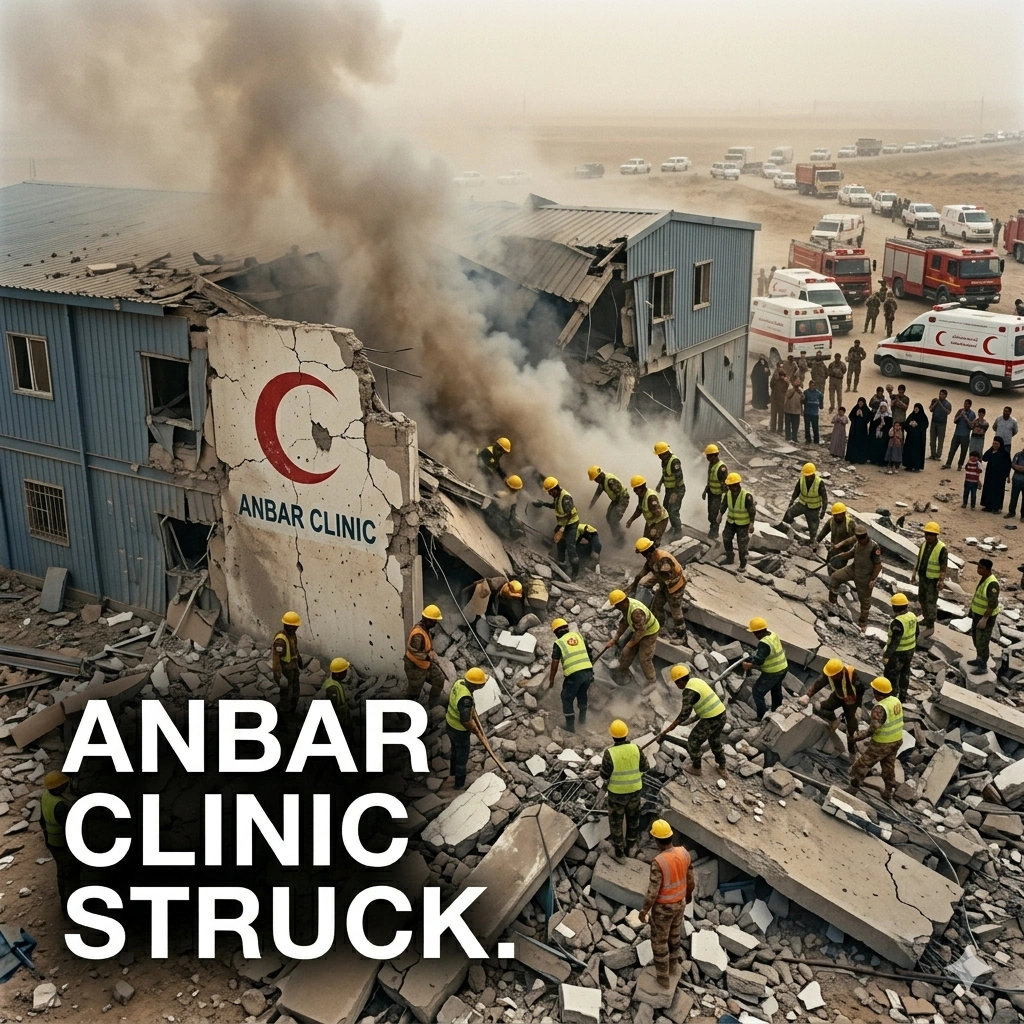
Anbar military clinic strike and the Habbaniyah base
The Anbar military clinic strike occurred at approximately 9:00 a.m. local time, sending shockwaves through the Iraqi security establishment. The Habbaniyah base, which houses both regular army units and Popular Mobilization Forces (PMF), was the primary target of this sophisticated aerial assault. Witnesses reported that the medical wing was leveled almost instantly, making rescue efforts extremely difficult for the first responders on the scene. This specific facility was crucial for providing frontline surgical care to soldiers stationed in the volatile western province.
Military analysts believe the timing of the Anbar military clinic strike was intentional, occurring just 48 hours after another major raid in the same region. That previous attack on Tuesday claimed the lives of 15 PMF members, including their senior operations commander for the Anbar sector. By targeting the medical infrastructure so soon after a combat loss, the attackers have effectively degraded the Iraqi military’s ability to treat its wounded. This pattern of behavior suggests a strategy aimed at breaking the morale of the local defense forces.
The Iraqi government has reacted with visible fury to the Anbar military clinic strike, labeling it a “blatant aggression” against the state. Prime Minister Mohammed Shia al-Sudani convened an emergency meeting of the National Security Council to discuss the implications of the Habbaniyah breach. Baghdad has officially reserved the right to respond to these repeated violations of its airspace and sovereign territory. The diplomatic fallout is also growing, as Iraq seeks to distance itself from the broader U.S.-Israel-Iran war.
Violation of international humanitarian law
The Anbar military clinic strike is being viewed by legal experts as a significant breach of the Geneva Conventions, which strictly prohibit attacks on medical facilities. Even when located within a military base, a clinic is considered a protected site if it is clearly marked and used for the care of the sick and wounded. The Iraqi Ministry of Health has pointed out that the senior military doctor killed in the blast was a non-combatant providing essential services. This loss of medical expertise will have a long-term impact on the health outcomes of the garrison.
Human rights organizations have joined the Iraqi government in calling for a transparent investigation into the Anbar military clinic strike. They argue that the use of artillery fire in conjunction with an airstrike indicates a high level of kinetic force that was likely to cause civilian or non-combatant casualties. The “heinous crime” designation by the Defense Ministry reflects the belief that the target was chosen specifically to inflict maximum psychological pain. Such tactics are often used to provoke a state into a reactive stance that could further escalate the regional conflict.
In response to the Anbar military clinic strike, the Iraqi Ministry of Foreign Affairs has summoned the U.S. chargé d’affaires to deliver a formal protest. Baghdad is also preparing a file for the United Nations Security Council, seeking a resolution that condemns the targeting of healthcare sites. This diplomatic offensive is designed to show the international community that Iraq will not remain silent while its soldiers and doctors are killed. The goal is to secure international guarantees that sovereign military sites will no longer be targeted.
The role of the Popular Mobilization Forces
The presence of PMF fighters at the site of the Anbar military clinic strike adds a complex layer to the security narrative. The PMF is an umbrella organization of various paramilitary groups that were officially integrated into the Iraqi state security apparatus years ago. However, because some of these groups maintain close ties with Tehran, they have become frequent targets for those opposing Iranian influence. The strike on Habbaniyah highlights how these units are now at the center of the regional power struggle.
Security sources confirmed that while the Anbar military clinic strike killed regular soldiers, it also targeted fighters who were recovering from previous engagements. This blending of forces makes it difficult for the Iraqi government to claim complete neutrality in the ongoing regional war. Critics of the government argue that the presence of PMF units in proximity to sensitive medical sites makes those sites inevitable targets. Conversely, supporters of the PMF view the strike as an attack on the very people who liberated Anbar from extremist groups in the past.
- The PMF provides significant manpower for border security in western Iraq.
- Many units operate independently of the central military command.
- They are often viewed as a proxy force by international actors.
- Their casualties in the Anbar military clinic strike have led to calls for retaliation.
The loss of the Anbar operations commander on Tuesday, followed by the clinic strike on Wednesday, represents a massive blow to the PMF leadership. This vacuum in the chain of command could lead to unauthorized retaliatory strikes against foreign bases in Iraq. The central government is currently working to restrain these groups to prevent a total collapse of the fragile peace. The Anbar military clinic strike has effectively pushed the PMF toward a more aggressive stance.
Impact on local military medical capacity
The Anbar military clinic strike has left a gaping hole in the medical support network for the entire western region of Iraq. With the Habbaniyah facility out of commission, wounded soldiers must now be transported over long distances to Baghdad for life-saving surgery. This “golden hour” for trauma care is often lost during the transit, leading to higher mortality rates among the troops. The destruction of specialized engineering equipment at the site also hinders the military’s ability to repair infrastructure damaged in the strikes.
Healthcare workers in Anbar are now operating under a cloud of fear, wondering if their clinics will be the next targets. The Anbar military clinic strike has forced several other medical units in the province to relocate or go underground. This disruption of services affects not only the soldiers but also the civilian contractors and families living near the bases. The Iraqi government is scrambling to deploy mobile medical units to fill the gap, but these lack the surgical capabilities of the permanent Habbaniyah facility.
The visual of a destroyed military clinic serves as a grim reminder of the high stakes of modern warfare in Iraq. The government has prioritized the reconstruction of the Habbaniyah wing, but the threat of follow-up strikes makes contractors hesitant to begin work. This paralysis of infrastructure development is a secondary goal of the aggressors, ensuring that Iraq remains militarily weak. The Anbar military clinic strike is thus a multi-faceted attack on the state’s functional capacity.
Escalation of the regional spillover
The Anbar military clinic strike is a clear symptom of the regional spillover that has plagued Iraq since late February 2026. As the conflict between the United States, Israel, and Iran intensifies, Iraq’s geography makes it an ideal battlefield for proxy engagements. The western desert of Anbar is particularly vulnerable due to its proximity to the Syrian border and the presence of various armed factions. This “spillover” is no longer a theoretical risk but a daily reality for the Iraqi people.
Military analysts point out that the Anbar military clinic strike is part of a broader trend of “decapitation” and “degradation” strikes. By removing senior commanders and medical staff, the opposition aims to make the PMF and Iraqi army ineffective in the border regions. This creates a security vacuum that could be exploited by other militant groups or foreign powers. The Iraqi government’s struggle to maintain its sovereignty is becoming more desperate with each passing week of the regional war.
- Iraq’s airspace is frequently violated by foreign drones and jets.
- Diplomatic protests have so far failed to stop the kinetic actions.
- The domestic political pressure on Prime Minister al-Sudani is reaching a boiling point.
- Public sentiment is turning sharply against foreign military presence in the country.
The Anbar military clinic strike has galvanized the Iraqi parliament, with several blocs demanding the immediate withdrawal of all foreign troops. They argue that the presence of international forces is the primary catalyst for the strikes on Iraqi soil. However, the government is wary of a sudden withdrawal that could lead to a resurgence of extremist groups. Balancing these competing interests has become nearly impossible in the wake of the Habbaniyah “heinous crime.”
Security situation in Anbar province
Anbar province has long been a flashpoint for conflict, and the Anbar military clinic strike has only added to its turbulent history. The province’s vast, open terrain makes it difficult to defend against aerial threats and long-range artillery. Despite the presence of advanced radar systems, the sudden nature of the Habbaniyah attack suggests a failure in the early warning network. This has led to an internal investigation within the Iraqi Air Defense Command to identify potential lapses in communication.
Local residents in the towns surrounding the Habbaniyah base report a state of constant anxiety since the Anbar military clinic strike. The sound of jets overhead often triggers panic, as people fear that civilian areas might be targeted next. The provincial government has declared a state of high alert, and many non-essential businesses have closed their doors. The economic impact on Anbar is significant, as the military presence was a major driver of local commerce and employment.
The Iraqi military is currently reinforcing its positions in Anbar to prevent further incursions following the Anbar military clinic strike. Additional anti-aircraft batteries have been spotted moving toward the western border, though their effectiveness against modern stealth technology remains a question. The “right to respond” mentioned by the Ministry of Defense could manifest as a tightening of border controls or a more aggressive posture toward unauthorized aircraft. For the people of Anbar, the future remains uncertain as the shadow of war grows longer.
Anbar military clinic strike
The Anbar military clinic strike is a watershed moment for Iraq’s involvement in the 2026 regional conflict. The loss of seven lives at the Habbaniyah base has transformed the national conversation from one of neutral observation to one of active defense. This “heinous crime” against a medical facility has unified various political factions in their condemnation of the foreign aggression. The Iraqi government is now under immense pressure to deliver more than just diplomatic protests to protect its citizens and soldiers.
- Target: Habbaniyah base medical and engineering units.
- Casualties: 7 dead (including a senior doctor), 13 wounded.
- Time: 9:00 a.m. local time, Wednesday, March 25.
- Outcome: Formal protest at the UN and summoning of foreign diplomats.
As the smoke clears from the Anbar military clinic strike, the focus remains on the survivors and the families of the fallen. The military doctor who was killed is being hailed as a national hero, a symbol of the selfless service of the Iraqi medical corps. His death has sparked protests in several Iraqi cities, with citizens demanding an end to the “violation of international law.” The tragedy at Habbaniyah will likely be remembered as the point where Iraq’s patience with regional spillover finally ran out.
International response and UN investigation
The call for a United Nations Security Council investigation into the Anbar military clinic strike has received mixed support from the international community. While some nations have echoed Iraq’s condemnation, others have remained silent, reflecting the deep divisions caused by the U.S.-Iran war. Baghdad is hoping that a formal UN report will confirm the protected status of the Habbaniyah clinic at the time of the attack. Such a finding would provide the legal basis for future reparations or international sanctions.
Diplomatic sources in New York indicate that the Iraqi file on the Anbar military clinic strike is being reviewed by the human rights council. They are looking for evidence of “proportionality” and “distinction,” two key pillars of international military law. If the strike is found to have intentionally targeted the medical wing, it could be classified as a war crime. This would put significant pressure on the responsible parties to change their rules of engagement in the Iraqi theater.
The Anbar military clinic strike has also prompted the International Red Cross to issue a statement reminding all combatants of their obligations to protect medical personnel. They emphasize that the neutrality of healthcare must be respected to prevent the total collapse of humanitarian systems in conflict zones. The Iraqi government is leveraging these international voices to build a coalition of support for its sovereign rights. Whether this diplomatic pressure can translate into a cessation of strikes remains to be seen.
Future of Iraq’s sovereignty
The long-term impact of the Anbar military clinic strike on Iraq’s sovereignty cannot be overstated. Each time a foreign power conducts a strike on Iraqi soil without the government’s consent, the authority of the state is weakened. The Anbar military clinic strike is particularly damaging because it occurred at a major military installation that should have been a safe zone. This vulnerability forces the Iraqi leadership to reconsider its security partnerships and its place in the regional hierarchy.
There are growing calls within the country to diversify Iraq’s military suppliers and defense agreements to reduce dependence on the West. Some factions suggest looking toward regional powers or Eastern nations to provide the technology needed to defend Iraqi airspace. The Anbar military clinic strike has accelerated this debate, making it a central issue for the upcoming parliamentary sessions. The quest for true sovereignty is now the defining challenge for the current administration in Baghdad.
- Strengthening the national air defense network is a top priority.
- Re-evaluating the presence of foreign military advisers on Iraqi bases.
- Increasing the autonomy of the Iraqi Ministry of Defense in security decisions.
- Pursuing a “Iraq First” policy that avoids entanglement in proxy wars.
The Anbar military clinic strike serves as a painful reminder that neutrality is difficult to maintain when bombs are falling within your borders. Iraq’s path forward will require a delicate mix of high-level diplomacy and a credible military deterrent. The memory of the seven personnel lost at Habbaniyah will serve as a constant motivation for those seeking to protect the nation’s future. The world is watching to see how Iraq will rise from this “blatant aggression” and reclaim its role as a stable, sovereign state.
Conclusion and call for peace
As Iraq mourns the victims of the Anbar military clinic strike, the international community must recognize the urgent need for de-escalation. The targeting of medical facilities and the loss of non-combatant lives is an unacceptable cost of the regional conflict. Baghdad’s “right to respond” should be interpreted as a call for a return to the rule of law and the respect of national borders. The Habbaniyah base should be a place of training and healing, not a site of destruction and “heinous crime.”
The Anbar military clinic strike has left a mark on the history of the 2026 war that will not easily be erased. It is a story of heroism, tragedy, and the ongoing struggle for peace in a land that has seen too much violence. For the thirteen wounded survivors, the road to recovery will be long, but their resilience is a testament to the Iraqi spirit. We can only hope that their sacrifice leads to a renewed global effort to end the regional spillover before more lives are lost.
In finality, the Anbar military clinic strike stands as a stark warning to the world: when the rules of war are ignored, everyone loses. The Iraqi government’s pursuit of justice through the United Nations is a necessary step toward accountability. As the sun sets over Anbar province, the hope for a more secure and peaceful Iraq remains, fueled by the memory of those who fell at Habbaniyah. The nation stands united in its grief and its determination to ensure that such an atrocity never happens again on its soil.
For more details & sources visit: Ynetnews (citing Reuters/AFP)
Read more about Iraq news on 360 News Orbit – Iraq.