
Jordan Condemns Iranian Strike on Bahrain after a missile attack, resulted in the tragic death of a Moroccan civilian contractor. This escalation has drawn sharp criticism from King Abdullah, who emphasized that Arab states did not initiate the current cycle of violence in the Middle East. The strike, which also injured personnel from the UAE and Bahraini armed forces, marks a dangerous expansion of the conflict. As Iran targets multiple nations following U.S. and Israeli operations, the Jordanian government is calling for an immediate cessation of hostilities to prevent a regional collapse. The Ministry of Foreign Affairs described the act as a “brazen” violation of sovereignty that threatens the delicate balance of power in the Gulf.
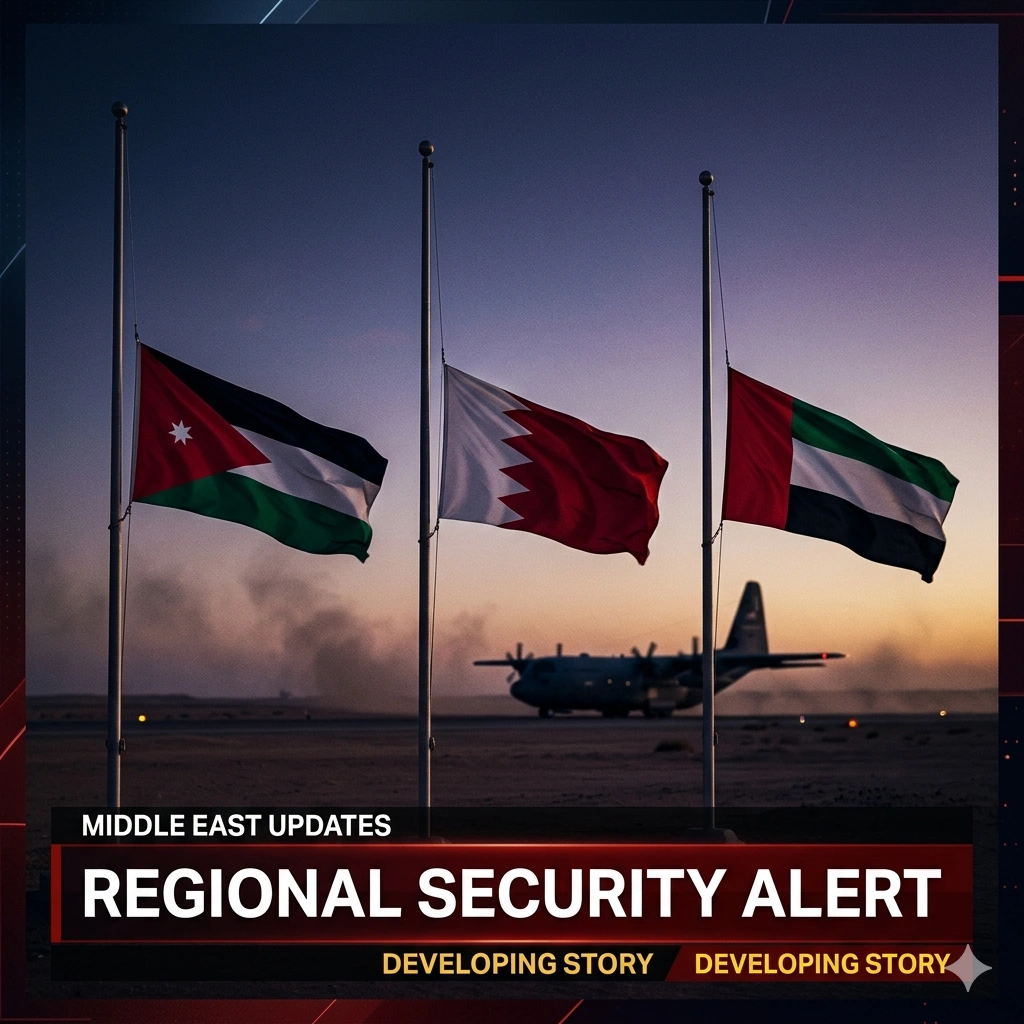
The Diplomatic Fallout as Jordan Condemns Iranian Strike
The moment Jordan Condemns Iranian Strike, it signals a unified front among Arab nations that have sought to remain neutral in the U.S.-Iran confrontation. King Abdullah has been vocal about the fact that Jordan and its neighbors are being caught in the crossfire of a war they did not start. The death of a Moroccan contractor working with the UAE Armed Forces has added a layer of pan-Arab grief to the political tension. This incident has forced Amman to harden its diplomatic stance against Tehran to protect its own national interests. The kingdom is now leading a coalition of voices demanding international intervention to safeguard non-combatant nations.
The official statement where Jordan Condemns Iranian Strike was released shortly after the UAE Ministry of Defence confirmed the casualties. Five UAE personnel and several Bahraini troops were wounded in the same incident, highlighting the high physical cost of the current instability. Jordan has pledged its full support for any security measures taken by Manama and Abu Dhabi to defend their territories. This solidarity is crucial for maintaining the “Arab consensus” during a time of extreme geopolitical fragmentation. The diplomatic mission in Amman is currently coordinating with regional partners to draft a formal complaint to the United Nations Security Council.
Furthermore, the context in which Jordan Condemns Iranian Strike is rooted in the events that began on February 28. Following U.S. and Israeli strikes on Iranian military leadership, Tehran has retaliated against ten different countries in the region. Jordan’s condemnation is a plea for the international community to recognize that Arab nations are not participating in the U.S.-led strikes. By distancing itself from the primary combatants, Jordan hopes to shield its population from further kinetic engagement. However, the loss of life on Bahraini soil makes such neutrality increasingly difficult to maintain as the conflict reaches deeper into the Gulf.
Jordan Condemns Iranian Strike
The specific language used when Jordan Condemns Iranian Strike reflects a deep concern for the erosion of international law. The Ministry of Foreign Affairs used the word “heinous” to describe the targeting of civilian contractors and military personnel on a routine mission. This rhetoric is intended to isolate Iran diplomatically by highlighting the lack of military justification for the attack on Bahrain. The death of the Moroccan national has specifically galvanized North African support for the Jordanian position. This cross-continental alignment is a testament to the wide-reaching impact of the current Middle Eastern crisis.
As Jordan Condemns Iranian Strike, the focus remains on the “routine mission” that was interrupted by the missile fire. The UAE personnel were engaged in training and support roles that are standard for regional security cooperation. By targeting these units, the strike sent a message that no military presence in the Gulf is safe from Iranian reach. This has prompted a massive review of security protocols for all foreign contractors operating in the region. The Jordanian military has also increased its alert levels along its own borders to prevent similar “sovereignty violations” on its soil.
The economic implications of the period following the Jordan Condemns Iranian Strike are already being felt in the regional insurance and logistics markets. Shipping and service contracts now carry a “conflict premium” that reflects the increased risk of working in Bahrain and the UAE. For the families of the victims, the political condemnation offers little comfort, but it sets the stage for potential reparations in the future. Jordan’s role as a mediator is currently being tested as it tries to de-escalate the situation while simultaneously demanding accountability. The kingdom’s unique position as a Western ally with deep Arab roots makes its voice particularly influential in this crisis.
The Impact on Regional Military Cooperation
The military significance of why Jordan Condemns Iranian Strike lies in the disruption of the “Arab Shield” cooperation framework. The UAE and Bahrain have been working closely to integrate their defense systems against drone and missile threats. This strike was a direct test of those integrated defenses, and the resulting casualties suggest a need for rapid technological upgrades. Jordan has offered its expertise in border surveillance and intelligence to its Gulf partners to help close these gaps. This cooperation is essential for preventing the conflict from spreading to the Mediterranean or the Red Sea.
Security analysts believe that the Jordan Condemns Iranian Strike statement was a necessary precursor to new military deployments. While Jordan has not joined the offensive against Iran, it is bolstering its defensive posture to ensure its airspace is not used for unauthorized transit. The presence of Moroccan contractors in the UAE’s military ecosystem shows the complexity of modern Arab defense networks. A strike on one is effectively an attack on the labor and resources of several different nations. This interconnectedness is both a strength and a vulnerability during a multi-theater war.
- Moroccan contractors provide essential logistics and technical support across the Gulf.
- UAE personnel are often involved in joint training exercises with Bahraini forces.
- Jordan maintains one of the most professionalized military intelligence units in the Arab world.
The aftermath of the Jordan Condemns Iranian Strike will likely see an increase in the deployment of advanced missile defense batteries around key infrastructure. The “routine mission” mentioned in the Arab News report was likely a target of opportunity for Iranian forces looking to project power. By responding with a strong diplomatic rebuke, Jordan is trying to raise the political cost of such opportunistic strikes. The goal is to create a “diplomatic deterrent” that complements the physical one. Whether this will be enough to stop the barrage of missiles remains the most pressing question for regional leaders.
King Abdullah’s Call for Neutrality and Peace
A central theme in the message where Jordan Condemns Iranian Strike is the reassertion of Arab neutrality. King Abdullah has been consistent in his message that the Arab world should not be the battleground for a Western-Iranian proxy war. He has repeatedly told international media that his country’s priority is the safety of its citizens and the stability of its economy. This strike on Bahrain makes his job harder, as it brings the violence directly to his doorstep through his allies. The King’s condemnation is as much a message to Washington and Jerusalem as it is to Tehran.
The humanitarian aspect of the Jordan Condemns Iranian Strike cannot be ignored, as the victim was a civilian just trying to make a living. The Moroccan contractor represents the thousands of expatriates who keep the Gulf’s infrastructure running during peace and war. His death has sparked a debate about the ethical responsibilities of hiring firms during times of active conflict. Jordan has called for better international protections for such workers, who are often the first to suffer when tensions boil over. This human-centric approach to diplomacy is a hallmark of the Hashemite monarchy’s foreign policy.
- Expatriate workers in the Gulf are now facing unprecedented physical risks.
- The “Unity of Arab Security” is being tested by external kinetic interventions.
- Jordan is advocating for a regional de-escalation zone to protect civilian life.
The political survival of regional governments depends on their ability to manage the fallout from the Jordan Condemns Iranian Strike era. Public opinion in Jordan is heavily skewed toward staying out of the conflict, yet the desire to protect fellow Arabs is strong. King Abdullah must navigate these conflicting sentiments with extreme care to avoid internal unrest. By framing the condemnation around “sovereignty” and “heinous acts,” he is able to tap into a universal sense of justice. This allows him to lead the diplomatic charge without committing his soldiers to a foreign front.
The Widening Net of Iranian Retaliation
The fact that Jordan Condemns Iranian Strike comes after Iran has targeted ten different countries shows the scale of the crisis. From the Levant to the Gulf, no country seems to be beyond the reach of Tehran’s missile and drone wings. This “scorched earth” approach to retaliation is designed to force the U.S. and Israel to stop their operations by making the entire region uninhabitable for tech and finance. Jordan is particularly vulnerable due to its geography, sitting directly between the major combatants. The strike on Bahrain is a warning that distance from the original strike zone offers no guaranteed safety.
The Ministry of Foreign Affairs’ statement as Jordan Condemns Iranian Strike also touched on the timing of the escalation. Since the February 28 strikes, the frequency and intensity of Iranian responses have increased weekly. The strike on March 25 is seen as a peak in this activity, signaling that Tehran is not yet ready to back down. For Jordan, this means preparing for a long-term period of instability that will affect trade, tourism, and energy prices. The kingdom’s economy is already under pressure, and a prolonged war in the Gulf would be catastrophic for its recovery plans.
Jordanian officials are now working with the Arab League to ensure that the Jordan Condemns Iranian Strike sentiment is echoed by all member states. A unified Arab League statement would carry significant weight in the halls of power in Europe and Asia. The goal is to create enough international pressure to force a ceasefire or at least a reduction in the targeting of non-belligerent nations. This diplomatic “full-court press” is the only tool currently available to Amman to influence the outcome of the war. The success of this strategy depends on the willingness of major powers to listen to the concerns of the Arab street.
Conclusion: A Region on the Brink
The announcement that Jordan Condemns Iranian Strike is a somber reminder of how quickly the Middle East can slide into chaos. The death of the Moroccan contractor and the injuries to UAE and Bahraini troops are not just statistics; they are a call to action. Jordan has done its part by standing up for international law and the sovereignty of its neighbors. Now, the rest of the world must decide if it will allow the conflict to consume the remaining bastions of stability in the region. The “digital strongholds” and financial hubs of the Gulf cannot survive in an environment of constant missile fire.
As the news of the Jordan Condemns Iranian Strike spreads, it should serve as a wake-up call for those who believe the conflict can be contained. The interconnectivity of the modern world means that a strike in Bahrain is felt in Amman, Abu Dhabi, and Rabat. The Arab nations have made their position clear: they want peace, but they will not stand by while their people are killed. King Abdullah’s leadership during this crisis has been steady, but even the most skilled diplomat cannot stop a missile once it is in the air. The future of the region depends on a return to the negotiating table before the damage becomes irreversible.
The legacy of the Jordan Condemns Iranian Strike event will be defined by what happens next. If the international community fails to act, we could see a total collapse of the regional security order. If, however, this tragedy leads to a new understanding of the need for collective defense and diplomatic restraint, then the lives lost will not have been in vain. For today, Jordan stands in mourning with Bahrain, the UAE, and Morocco. Tomorrow, it continues the difficult work of trying to pull the region back from the brink of a total, multi-national war.
For more details & sources visit: Arab News
Read more about Jordan news on 360 News Orbit – Jordan.