
Taiwan Insurance Risks have surged to the forefront of global financial discussions as S&P Global Ratings issues a stern warning regarding the sector’s massive exposure to Middle Eastern markets. Taiwanese life insurers hold an estimated $56 billion in assets across volatile regions, including Israel, Saudi Arabia, and the UAE. This exposure represents a significant portion of the industry’s total adjusted capital, making it a potential flashpoint for earnings volatility if regional conflicts persist. While the majority of these holdings are currently categorized as high-quality bonds, the sheer scale of the investment creates a unique vulnerability. Analysts are now closely monitoring how these firms manage their capital buffers to prevent a systemic shock to the island’s financial stability.
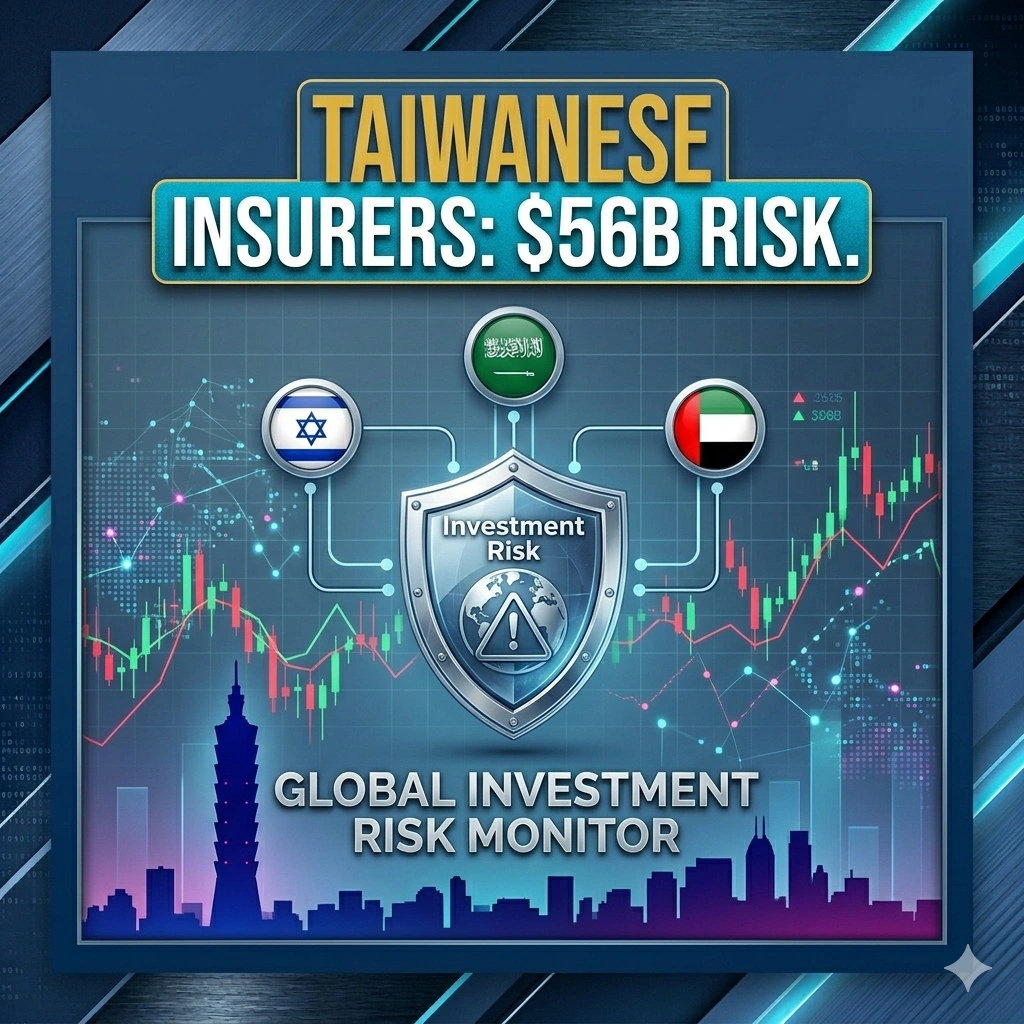
The Scale of Middle Eastern Investment Portfolios
The magnitude of Taiwan Insurance Risks is best understood by looking at the total investment volume, which reached approximately NT$1.77 trillion by the end of 2025. This figure, roughly equivalent to $54–56 billion, marks a strategic shift where insurers sought higher yields in Middle Eastern sovereign and corporate debt.
Unlike previous exposure to Russian assets, which was relatively contained, the current concentration in the Middle East is significantly higher and more complex. These investments are spread across several key nations, including Qatar and Saudi Arabia, which are central to global energy markets.
Because these assets account for roughly 22.1% of the insurers’ total adjusted capital, any significant devaluation could have a ripple effect across the entire Taiwanese economy. Financial regulators in Taipei are now demanding more frequent reporting to ensure that the liquidity of these portfolios remains intact during periods of high geopolitical tension.
S&P Global Ratings and Stress Test Results
According to recent evaluations by S&P Global Ratings, the immediate threat level associated with Taiwan Insurance Risks is currently deemed manageable, though the outlook remains cautious. Stress tests performed by the agency suggest that most major insurers possess enough surplus to absorb a 15% impairment on their Middle Eastern holdings.
This 15% benchmark is based on the historical losses observed during the initial stages of the Russia-Ukraine conflict, providing a realistic framework for current risk assessment. However, the agency notes that while the “A” rated status of 99% of these bonds offers some protection, it does not provide absolute immunity against market panic.
Companies with thinner capital margins are being placed under intense monitoring to ensure they do not breach regulatory solvency requirements. The ability of these firms to maintain high capital adequacy ratios will be the primary determinant of their resilience as the regional conflict in the Middle East evolves throughout 2026.
Comparing Russia-Ukraine Losses to Current Exposure
When analyzing Taiwan Insurance Risks, it is helpful to compare the current situation to the industry’s experience with Russian assets in 2022. The current $56 billion exposure is far more substantial than the exposure held prior to the invasion of Ukraine, indicating a much larger potential for balance sheet disruption.
While the Russian write-offs were painful, they did not threaten the fundamental solvency of the Taiwanese insurance sector because the total sums involved were relatively small. In contrast, a similar percentage loss in the Middle East would involve tens of billions of dollars, requiring much more aggressive intervention from the central bank.
The high-quality nature of Middle Eastern bonds—mostly rated “A” or higher—is the main factor preventing a total downgrade of the sector’s credit outlook at this stage. Nevertheless, the transition from a localized conflict to a broader regional war remains the “black swan” event that keeps risk managers awake at night.
Taiwan Insurance Risks
Addressing Taiwan Insurance Risks requires a multi-faceted approach involving both internal corporate governance and external regulatory oversight. Life insurers are now being forced to re-evaluate their geographic concentration limits to prevent over-reliance on any single volatile region in the future.
The focus has shifted from simple yield-seeking to a more defensive posture that prioritizes capital preservation and liquidity over short-term earnings growth. This transition is essential for maintaining the trust of policyholders, who rely on these companies to meet long-term obligations regardless of global political shifts.
The exact phrase Taiwan Insurance Risks has become a shorthand in Taipei’s boardrooms for the broader challenge of managing global assets in an increasingly fractured geopolitical landscape. Without proactive measures, the industry could face a prolonged period of stagnant growth as it works to repair damaged capital buffers.
Regulatory Responses and New Hedging Strategies
In response to the growing Taiwan Insurance Risks, the Financial Supervisory Commission (FSC) is expected to introduce stricter hedging requirements for foreign-denominated assets. Insurers are being encouraged to diversify their portfolios away from conflict zones and into more stable, albeit lower-yielding, Western markets.
Increased use of currency and interest rate swaps is being implemented to mitigate the volatility that typically accompanies regional wars and energy price shocks. These hedging strategies come with their own costs, which will likely weigh on the net profit margins of major life insurers in the coming quarters.
Furthermore, the FSC is considering a revision of the risk-based capital (RBC) framework to better account for geopolitical stressors that traditional models might overlook. By raising the cost of holding assets in high-risk zones, regulators hope to naturally incentivize a more balanced and secure investment distribution.
Impacts on Policyholders and Premium Costs
While the primary concern regarding Taiwan Insurance Risks is institutional solvency, there are inevitable downstream effects for individual policyholders across the island. If insurers are forced to set aside more capital to cover potential losses, they may reduce the bonus rates on participating policies or increase premiums for new products.
The volatility in earnings could also lead to a slowdown in the development of innovative insurance products as firms focus on core survival strategies. Policyholders are being advised to review the financial strength of their providers, paying close attention to those with the highest levels of Middle Eastern debt exposure.
Despite these concerns, the high level of government oversight in Taiwan means that a total collapse of a major insurer remains highly unlikely. The goal of current interventions is to manage a soft landing where the industry absorbs losses without triggering a wider financial crisis for the public.
- Insurers are currently holding $56 billion in assets across Israel, Saudi Arabia, and the UAE.
- Stress tests indicate that a 15% asset impairment is the current “likely” worst-case scenario.
- Regulatory bodies are demanding increased transparency and more robust hedging practices.
- 99% of the bonds held are high-quality “A” rated, providing a significant safety net.
Geopolitical Volatility and Asset Valuation Pressure
The core of the Taiwan Insurance Risks lies in the unpredictable nature of Middle Eastern geopolitics, where a single escalation can lead to immediate valuation drops. As long as the threat of a total regional war looms, the market value of bonds issued by Middle Eastern entities will remain under significant pressure.
Insurers must mark these assets to market in their financial statements, which can lead to large paper losses even if the bonds are intended to be held until maturity. This “valuation trap” is particularly dangerous for firms that need to liquidate assets to meet unexpected policyholder withdrawals or other short-term obligations.
The psychological impact on the market cannot be ignored, as fear often drives prices lower than the underlying fundamentals would suggest. Professional analysts are keeping a close watch on the credit default swap (CDS) spreads of Middle Eastern sovereigns as a leading indicator of trouble for Taiwanese portfolios.
Long-Term Portfolio Diversification Plans
Moving forward, the management of Taiwan Insurance Risks will involve a permanent shift in how local firms view international investment. There is a growing consensus that the era of seeking high yields in emerging or volatile markets must be tempered by a much stricter adherence to geographic limits.
We are likely to see a gradual divestment from Middle Eastern assets over the next 24 to 36 months as contracts mature and funds are reallocated to safer havens. Southeast Asia and domestic Taiwanese infrastructure projects are being discussed as potential alternatives that offer moderate returns with significantly lower geopolitical risk profiles.
This diversification will not happen overnight, as sudden mass selling would only worsen the valuation pressure the industry is trying to avoid. Instead, a disciplined and staged exit from over-concentrated positions will be the hallmark of a successful risk mitigation strategy in the post-conflict era.
The Role of High-Quality Bond Ratings
One of the few saving graces in the current assessment of Taiwan Insurance Risks is the high credit quality of the underlying assets. Because 99% of the investments are in “A” rated bonds, the risk of a total default is statistically lower than it was with Russian assets.
These bonds are often backed by the massive sovereign wealth funds of nations like Qatar and Saudi Arabia, which have substantial reserves to honor their debts even during a crisis. This provides a “floor” to the potential losses that Taiwanese life insurers might face, preventing a complete wipeout of adjusted capital.
However, “high quality” does not mean “no risk,” especially when liquidity dries up during a major war. If there are no buyers for these bonds in a panicked market, their theoretical rating becomes secondary to the practical reality of being unable to convert them into cash.
Monitoring Weak Capital Buffers
Not all firms are created equal when it comes to facing Taiwan Insurance Risks, as some smaller or mid-sized insurers have much thinner capital buffers than the industry leaders. These companies are the most vulnerable to a 15% impairment, as such a hit could push their capital adequacy ratios below the legal minimum.
S&P Global Ratings has specifically highlighted these “weaker hands” as the primary focus for intensified monitoring by both rating agencies and local regulators. Investors and policyholders should look for firms that have recently raised additional capital or issued subordinated debt to strengthen their balance sheets.
The ability to weather this storm will depend largely on the foresight of management teams who built up reserves during the profitable years leading up to 2026. For those who didn’t, the current Middle Eastern crisis serves as a harsh reminder of the importance of maintaining robust capital cushions at all times.
- Smaller insurers face the highest risk of regulatory intervention if asset values drop significantly.
- Capital adequacy ratios are the most important metric for assessing individual company safety.
- High-quality ratings provide some protection against default, but not against market illiquidity.
Strategic Asset Allocation in a Post-War World
The resolution of the current crisis will eventually lead to a new standard for asset allocation, where Taiwan Insurance Risks are minimized through algorithmic and AI-driven monitoring. Firms are investing heavily in predictive analytics to better understand how regional conflicts might impact specific asset classes in real-time.
This technological leap will allow for faster decision-making and more effective “stop-loss” triggers that can protect portfolios before a crisis reaches its peak. The lessons learned in 2026 will likely be codified into new industry standards that prioritize stability and predictability over raw investment performance.
By the time the Middle Eastern conflict subsides, the Taiwanese insurance industry will likely emerge as a more resilient and sophisticated global investor. However, the path to that future requires navigating the current $56 billion minefield with extreme care and professional precision.
Investor Sentiment and Stock Market Reactions
The broader impact of Taiwan Insurance Risks is also being felt in the stock market, where shares of major financial holding companies have seen increased volatility. Investors are pricing in the potential for lower dividend payouts as insurers retain more earnings to bolster their capital positions against Middle Eastern losses.
This cooling of investor sentiment could make it more expensive for these companies to raise new capital if they need it in the future. Financial analysts are recommending a cautious “wait and see” approach until the full extent of the impairment becomes clear in the mid-year financial reports.
Clear communication from corporate leadership regarding their exposure and mitigation plans will be vital for stabilizing stock prices and maintaining market confidence. Transparency is the best antidote to the rumors and speculation that can often cause more damage than the actual financial losses themselves.
Final Assessment of Sector Stability
In conclusion, while the Taiwan Insurance Risks are substantial and require immediate attention, the sector remains fundamentally stable for the time being. The combination of high-quality assets, significant existing buffers, and proactive regulation provides a strong defense against the current geopolitical storm.
The industry’s experience with the Russia-Ukraine war has served as a valuable dress rehearsal, ensuring that most firms were not caught completely off guard. However, the sheer size of the $56 billion exposure means there is no room for complacency or errors in judgment by financial leaders.
The coming months will test the mettle of Taiwan’s financial system as it works to shield its insurers from a conflict thousands of miles away. If successful, the industry will have proven its ability to manage global risks on a scale few other nations could handle with such composure.
For more details & sources visit: Asia Insurance Review (citing S&P Global Ratings)
Read more on Taiwan news: 360 News Orbit – Taiwan.