
Russian AI Sovereignty is the central pillar of a new legislative push by Moscow to regulate the digital frontier. The Ministry for Digital Development has introduced a series of sweeping restrictions aimed at global artificial intelligence platforms. These measures are designed to integrate AI tools into the nation’s existing “sovereign internet” framework, ensuring all generated content aligns with state-sanctioned narratives and traditional values.
The move marks a significant escalation in Russia’s effort to decouple its digital ecosystem from Western influence. By targeting platforms like ChatGPT, Claude, and Gemini, the government seeks to eliminate what it perceives as ideological bias inherent in foreign algorithms. This shift suggests that the era of open access to international AI within Russian borders may be coming to a definitive end, replaced by a strictly controlled and monitored environment.
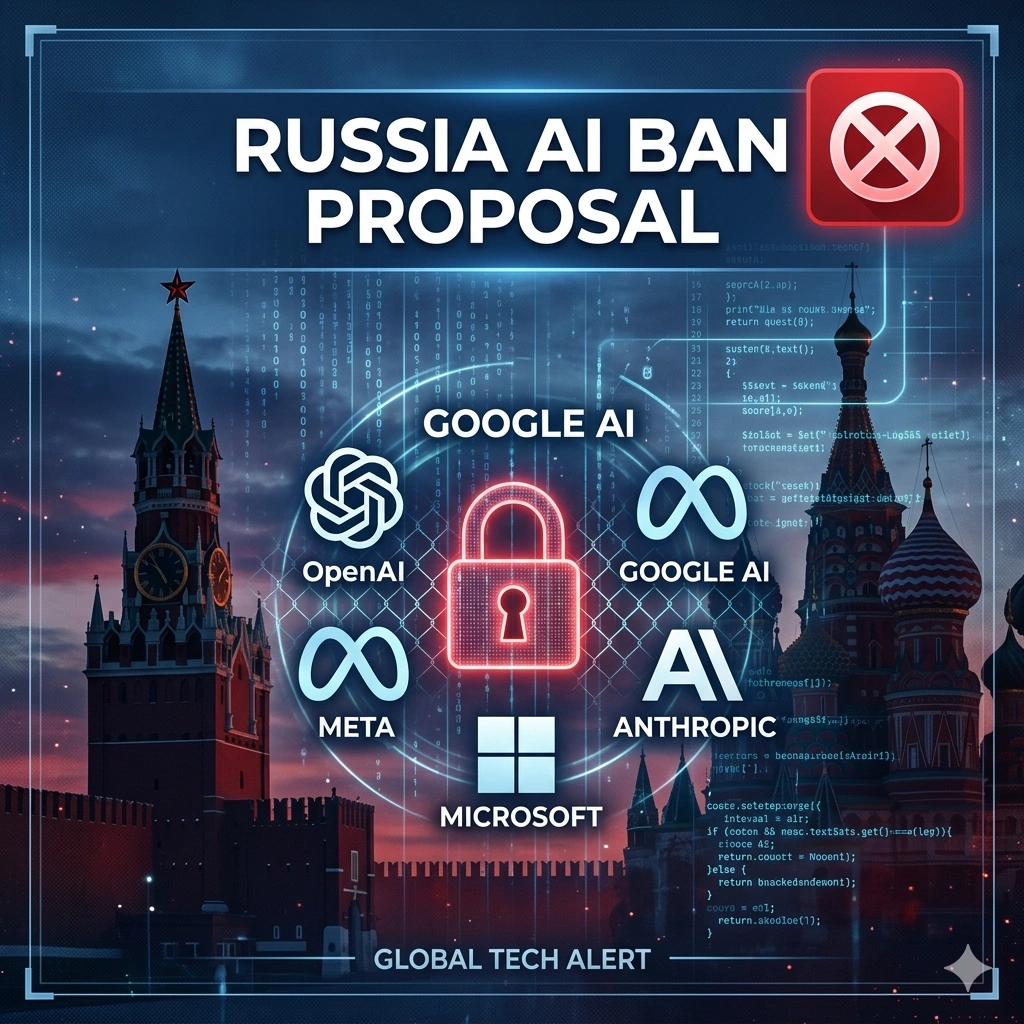
Russian AI Sovereignty and the New Digital Iron Curtain
The introduction of Russian AI Sovereignty protocols represents a fundamental shift in how the Kremlin views the role of data and automated intelligence. Government officials argue that foreign models often propagate “anti-Russian” sentiment or fail to respect the cultural nuances of the Federation. To counter this, the new proposal mandates that any AI operating within the country must undergo a rigorous certification process overseen by state regulators.
This certification is not merely a technical formality but a deep ideological audit of the model’s training data and output logic. The Ministry for Digital Development wants to ensure that AI does not provide information that contradicts official history or current political directives. Failure to adhere to these “moral and spiritual” standards would result in immediate blocking by federal censors, effectively silencing global AI voices.
Furthermore, the legislation demands that foreign developers localize their server infrastructure and provide the government with “backdoor” access for monitoring purposes. While Moscow claims this is for national security, international observers see it as a tool for mass surveillance. Russian AI Sovereignty thus becomes a mechanism for extending the state’s reach into the very thought processes and creative outputs of its citizens.
Impacts of Russian AI Sovereignty on Global Tech
The global technology sector is currently reeling from the implications of these new Russian mandates. One of the most immediate impacts is the potential for a complete blackout of leading generative models across eleven time zones. If companies like OpenAI or Google refuse to hand over their source codes or filtering logic, millions of Russian users will lose access to world-class productivity tools overnight.
Another major concern is the fragmentation of the global internet, often referred to as “splinternet.” When a major power like Russia enforces such strict localized rules, it encourages other nations to follow suit, creating a patchwork of incompatible digital zones. This trend undermines the original vision of a unified, borderless web where information flows freely across all geographic and political boundaries.
Additionally, the economic fallout for Russian startups that rely on foreign APIs could be devastating. Many local developers use Western AI backends to power their own applications, from customer service bots to data analysis tools. Under the Russian AI Sovereignty laws, these dependencies become a liability, forcing a rapid and potentially unstable migration to domestic platforms like Yandex’s Alice or Sberbank’s GigaChat.
- Loss of access to cutting-edge research and development tools for local scientists.
- Increased operational costs for foreign firms attempting to maintain a Russian presence.
- A surge in the use of specialized VPNs and “underground” AI access points.
- The creation of a localized “truth” that differs significantly from international consensus.
Russian AI Sovereignty
The core of the new legislative package is the formalization of Russian AI Sovereignty as a legal requirement for all digital service providers. This specific phrase is now being used by the Ministry to describe the state’s absolute right to control the algorithmic output generated within its territory. By codifying this, the government moves away from ad-hoc bans toward a systematic regulatory regime.
Legal experts note that the wording of the proposal is intentionally broad to allow for maximum flexibility in enforcement. Any content deemed “harmful to the public interest” can be flagged, and the AI provider held liable. This puts an immense burden on developers to create near-perfect filters that can predict and block any content that might offend the Kremlin’s evolving sensitivities.
The implementation of Russian AI Sovereignty also involves a mandate for “algorithmic transparency,” though only for the state’s eyes. While Western companies guard their proprietary weights and training sets as trade secrets, Moscow is demanding full disclosure. This requirement is likely the “poison pill” that will drive the final exit of American and European AI firms from the Russian market.
Strategic Objectives Behind the Sovereign Internet Expansion
The expansion of the sovereign internet to include AI is a logical step in Russia’s long-term strategic planning. For years, the government has invested in hardware and software that can isolate the domestic web from the global backbone. Now that AI has become the primary interface for information retrieval, controlling it is seen as a matter of existential importance for the regime.
By enforcing Russian AI Sovereignty, the Kremlin can ensure that the domestic population is only exposed to curated information. This is particularly vital for maintaining public support during times of geopolitical tension or domestic economic hardship. If the AI only echoes state media, the risk of a “digital uprising” fueled by independent information is significantly mitigated.
The strategy also aims to foster a self-sufficient tech sector that can survive even under the most extreme international sanctions. By forcing a move to domestic AI, the government is effectively subsidizing its own tech giants. This protectionist approach ensures that the capital and data generated by Russian users stay within the country, fueling the growth of a loyal, state-aligned technology industry.
Technical Barriers to Implementing State-Mandated AI Filters
Implementing the technical requirements of Russian AI Sovereignty is far from a simple task for any developer. AI models are notoriously “black boxes,” and forcing them to adhere to specific, often contradictory, ideological guidelines can degrade their overall performance. A model that is too heavily censored often becomes less useful, providing bland or nonsensical answers to complex queries.
Moreover, the requirement for real-time monitoring by state authorities introduces significant latency and security risks. If every prompt and response must pass through a government gateway, the speed and privacy that users expect from AI are completely compromised. This creates a technical environment where the very features that make AI valuable are stripped away in favor of security and control.
Foreign firms also face the risk of intellectual property theft if they comply with the demand to host servers locally. In an environment where the rule of law is often secondary to state interests, proprietary algorithms could be seized or copied by domestic competitors. This makes the price of achieving Russian AI Sovereignty too high for many of the world’s leading innovators to consider.
- Developing fine-tuned models that understand the nuances of Russian censorship laws.
- Establishing secure, state-monitored data centers within the Russian Federation.
- Managing the “hallucination” risks associated with overly constrained training data.
The Role of Traditional Values in Algorithmic Regulation
A unique aspect of the Russian AI Sovereignty push is the explicit mention of “traditional Russian spiritual and moral values.” This phrase is frequently used in Russian law to justify the restriction of LGBTQ+ content, religious minorities, and Western liberal ideologies. By applying this to AI, the state is effectively creating a “moral compass” for software that is inherently different from Western standards.
This move suggests that the future of Russian AI will be characterized by a high degree of cultural protectionism. The Ministry for Digital Development believes that AI should not just be a tool for efficiency, but a guardian of national identity. This means that models will be trained to prioritize “patriotic” education and to discourage any questioning of established social or political hierarchies.
The challenge for the Kremlin will be finding a balance between ideological purity and functional utility. If the AI becomes nothing more than a digital mouthpiece for the state, it may lose its appeal even to the most loyal citizens. However, under the current trajectory of Russian AI Sovereignty, it appears the government is willing to sacrifice some level of technological sophistication for the sake of absolute ideological security.
Global Reactions to Moscow’s AI Power Grab
The international community has reacted with a mixture of concern and resignation to the latest news regarding Russian AI Sovereignty. Human rights organizations have warned that these measures will further erode the freedom of expression and access to information for millions of people. They argue that AI is being weaponized as a tool of digital authoritarianism, setting a dangerous precedent for other regimes.
Technologically, the move is seen as a major setback for the concept of an open and collaborative AI research community. Russia has historically contributed significant talent to the field of mathematics and computer science. By walling off its researchers and data, the Russian AI Sovereignty policy may slow down progress not just within Russia, but in the global community that benefits from cross-border exchange.
Western governments are also considering whether to retaliate with further sanctions targeting Russia’s domestic AI development. If the Kremlin insists on banning Western tools, the West may respond by cutting off the high-performance chips and hardware necessary to run large-scale domestic models. This escalatory cycle threatens to turn the field of artificial intelligence into the primary battleground of a new, high-tech Cold War.
Future Outlook for Domestic Russian AI Alternatives
Despite the challenges, the push for Russian AI Sovereignty has provided a massive boost to domestic players. Companies like Yandex and Sber have been working tirelessly to close the gap with their Western counterparts. With the threat of foreign competition removed by legislative fiat, these firms are now the only game in town for 140 million people.
These domestic models are being integrated into every facet of Russian life, from banking and healthcare to the education system. Because they are built from the ground up to comply with local laws, they do not face the same regulatory hurdles as foreign platforms. This integration ensures that the principles of Russian AI Sovereignty are baked into the very infrastructure of the country’s future digital economy.
However, the long-term viability of an isolated AI ecosystem remains an open question. Innovation often thrives on competition and the free exchange of ideas. By creating a protected monopoly, the Russian government may inadvertently stifle the very creativity it seeks to harness. Whether a “sovereign” AI can ever truly match the capabilities of a global one is a test that will play out over the coming decade.
- Expansion of GigaChat into the public school system for automated tutoring.
- Integration of Yandex’s neural networks into municipal “Smart City” surveillance.
- Development of specialized AI for the energy sector to bypass Western software.
- Creation of a national AI ethics board to oversee “moral” compliance.
Impact on the Russian Tech Workforce and Brain Drain
One of the unintended consequences of enforcing Russian AI Sovereignty is the potential acceleration of the “brain drain” among top-tier developers. The most talented engineers often prefer to work on the most advanced systems with the fewest restrictions. If the Russian tech environment becomes a closed loop of censorship and monitoring, many of these professionals may choose to relocate to tech hubs in Dubai, Belgrade, or Western Europe.
The government has tried to counter this by offering various incentives, such as tax breaks and exemptions from military service for IT workers. While these measures have had some success, they do not address the fundamental desire for creative and intellectual freedom. For an AI researcher, the constraints imposed by Russian AI Sovereignty can be a major deterrent to remaining in the country.
Consequently, the success of the sovereign AI project depends heavily on the state’s ability to train a new generation of engineers who are comfortable working within these boundaries. The education system is currently being overhauled to emphasize “patriotic” tech development. This long-term bet on human capital will ultimately determine if the Russian AI Sovereignty initiative is a sustainable path or a recipe for technological stagnation.
Comparisons with the Great Firewall of China
Observers often compare the Russian AI Sovereignty strategy to the Great Firewall of China. While there are similarities in the desire for control, the Russian approach is unique in its focus on “traditional values” and its response to existing international sanctions. Unlike China, which built its digital walls during the early stages of the internet, Russia is attempting to retrofit them onto a society that has already experienced decades of open access.
This makes the enforcement of Russian AI Sovereignty much more difficult and disruptive. The Russian public is accustomed to using global platforms, and there is a high degree of technical literacy that allows many to bypass basic blocks. The Ministry for Digital Development must therefore use much more aggressive tactics than their Chinese counterparts to achieve the same level of information containment.
Despite these difficulties, Moscow appears committed to the Chinese model of a bifurcated internet. By establishing Russian AI Sovereignty, they are signaling that they no longer view the Western-led digital order as a viable or desirable future. This alignment between Moscow and Beijing on digital governance could lead to a formal “Eastern” tech bloc that stands in direct opposition to the Silicon Valley-centric world.
Conclusion and Final Thoughts on the AI Sovereignty Era
The transition toward Russian AI Sovereignty is a watershed moment in the history of the 21st-century internet. It signals the end of the naive hope that technology alone would inevitably lead to more open and democratic societies. Instead, we are seeing that the most advanced tools of our age can be effectively harnessed to reinforce traditional power structures and national borders.
For the average Russian user, the immediate future will likely involve a narrowing of digital horizons. While domestic AI tools will continue to improve, they will operate within a predefined set of boundaries that limit their potential for discovery and dissent. The promise of AI as a universal assistant is being replaced by the reality of AI as a nationalized utility.
As the world watches the implementation of Russian AI Sovereignty, the lesson for other nations is clear. The digital world is no longer a neutral space, and the battle for control over the “brains” of our computer systems is only just beginning. Whether this leads to a safer domestic environment or a more fractured and dangerous world remains to be seen, but the era of global AI unity is officially over.
For more details & sources visit: Reuters
Read more about Russia news on 360 News Orbit – Russia