
The Iranian airspace attacks have plunged the Gulf’s aviation sector into a state of unprecedented chaos following direct strikes on sovereign territory. Kuwait has formally denounced these aggressive maneuvers, which targeted both its national airspace and the critical infrastructure of Kuwait International Airport. This high-level protest to the International Civil Aviation Organization (ICAO) serves as a desperate plea for global intervention to halt a conflict that has already endangered thousands of civilian lives. The Kuwaiti government has characterized these actions as a blatant violation of long-standing international treaties designed to protect non-combatants in the skies.
Investigations into the Iranian airspace attacks reveal a calculated effort to cripple regional air travel and isolate the State of Kuwait from global markets. According to reports from the Directorate General of Civil Aviation (DGCA), the strikes involved a combination of sophisticated drones and ballistic missiles that directly impacted airport facilities. These “blatant breaches” of the Chicago Convention on International Civil Aviation have forced a total suspension of air traffic, leaving thousands of passengers stranded. The financial toll on the aviation sector is estimated to be in the hundreds of millions as carriers scramble to reroute flights.
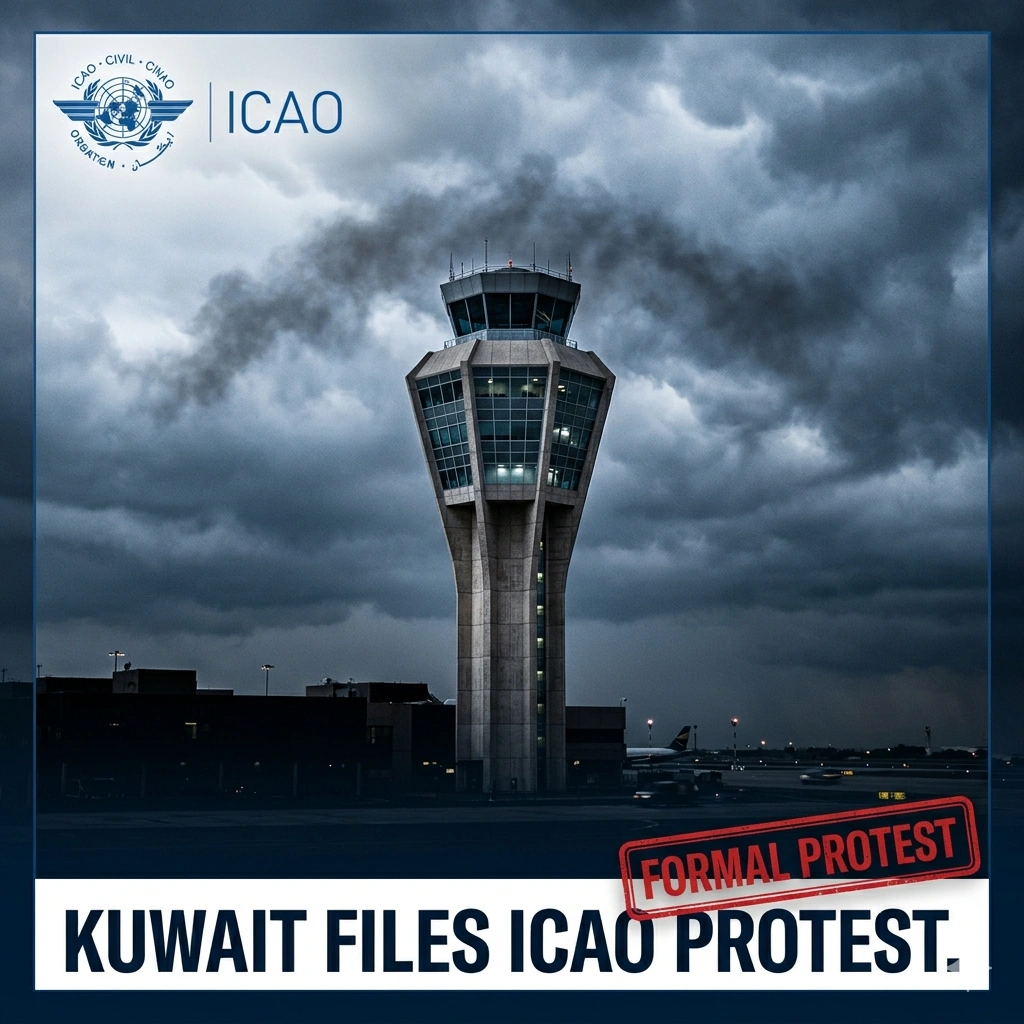
Kuwait Cites Blatant Breaches of Aviation Conventions
The DGCA has meticulously documented every instance of the Iranian airspace attacks to build a comprehensive legal case for the ICAO. These documents outline how the strikes deliberately targeted civilian air corridors, creating a “no-fly zone” by sheer force of violence. Kuwaiti officials have emphasized that such actions are not merely regional skirmishes but represent a systemic threat to the safety of global civil aviation. By filing this protest, Kuwait aims to hold the perpetrators accountable under the full weight of international law and aviation safety standards.
The protest letter specifically mentions that the Iranian airspace attacks have caused significant infrastructure damage, including hits to fuel storage tanks and passenger terminals. These facilities are strictly civilian in nature, making their targeting a war crime in the eyes of many legal experts. The Kuwaiti government has reaffirmed its right to take further sovereign actions to defend its borders if the international community fails to act. Security around Kuwait International Airport remains at its highest level as technical teams work to assess the long-term viability of the damaged runways.
Iranian Airspace Attacks
The Iranian airspace attacks were part of a broader wave of regional escalations that have seen multiple Gulf nations come under fire. In Kuwait, the intensity of the strikes reached a peak earlier this month when drone waves overwhelmed local defense systems near the capital. The DGCA reported that the suspension of all flights was a necessary measure to prevent a mid-air catastrophe involving commercial jetliners. This complete halt of operations has sent shockwaves through the Middle East’s logistics and travel industries, which rely heavily on Kuwait as a transit hub.
Detailed logs of the Iranian airspace attacks show that the strikes were often launched during peak travel hours to maximize disruption and psychological impact. The use of explosive-laden drones against an international airport is a tactic that has been roundly condemned by aviation bodies worldwide. Kuwait’s appeal to the UN-affiliated ICAO demands immediate intervention to establish a protected corridor for civilian flights. Without such guarantees, the restoration of regular flight schedules remains a distant prospect for the embattled national carrier and foreign airlines alike.
Human Toll and Infrastructure Damage at the Airport
Beyond the financial losses, the Iranian airspace attacks have resulted in numerous human injuries among airport staff and travelers. Medics reported that shrapnel from intercepted projectiles fell on an emergency center and residential areas surrounding the airport, causing panic and physical harm. The psychological trauma inflicted on the civilian population is immense, as the sounds of explosions have become a frequent occurrence in Kuwait City. Government officials have promised full compensation and medical support for those affected by these “unlawful aggressions.”
The infrastructure damage caused by the Iranian airspace attacks includes a major fire at the airport’s fuel depot, which took hours for civil defense teams to extinguish. Such a strike targets the very lifeblood of aviation operations, as without a secure fuel supply, no aircraft can depart or land safely. Engineers are currently working under heavy guard to repair the localized damage and reinforce sensitive areas against future strikes. The resilience of the Kuwaiti people has been tested, but the government remains steadfast in its commitment to restoring normalcy through diplomatic and legal channels.
Regional Response to the Aviation Crisis
Allies of Kuwait have been quick to respond to the Iranian airspace attacks, offering both diplomatic support and technical assistance in tracking the origins of the strikes. Saudi Arabia and the UAE have expressed their full solidarity, noting that the security of Kuwait’s airspace is inextricably linked to their own. This unified Gulf front is essential for pressuring the ICAO to take decisive action against the violations of international norms. Joint air defense coordination has been intensified to protect the remaining open corridors in the northern Persian Gulf.
- Kuwait has demanded a formal investigation by the ICAO into the specific missile trajectories.
- Regional neighbors have shared radar data to help identify launch sites in western Iran.
- International airlines have temporarily moved their regional hubs to safer locations in the south.
- The UN has been briefed on the humanitarian impact of the sudden air travel suspension.
The Iranian airspace attacks have also prompted a rethink of how civil aviation is protected in high-conflict zones. There are growing calls for the implementation of new satellite-based tracking systems that can provide earlier warnings of incoming threats to commercial pilots. Kuwait is leading the charge for these innovations, hoping that better technology can prevent a repeat of the current crisis. The collaboration between the DGCA and international safety experts is a silver lining in an otherwise dark chapter for the region.
Economic Repercussions for the Aviation Sector
The Iranian airspace attacks have caused a massive financial deficit for Kuwait’s national economy, particularly within the tourism and logistics sectors. With the airport closed, the flow of goods and people has ground to a halt, affecting everything from oil industry personnel transfers to the delivery of medical supplies. The aviation sector is the backbone of Kuwait’s connectivity to the world, and its disruption is felt in every corner of the domestic market. Economists warn that a prolonged closure could lead to a significant contraction in GDP growth for the fiscal year.
- Insurance premiums for flights over the Persian Gulf have skyrocketed by over 300 percent.
- Local businesses that depend on airport foot traffic are facing an immediate liquidity crisis.
- Supply chains for fresh produce and time-sensitive cargo have been diverted to overland routes.
The Iranian airspace attacks are not just a military issue; they are a direct assault on the economic prosperity of the State of Kuwait. By targeting the airport, the perpetrators are attempting to “strangle” the nation’s ability to engage in global trade. This form of economic warfare is exactly what the ICAO protest aims to highlight as a violation of the spirit of international cooperation. Kuwait is calling for the global community to impose sanctions on any entity found to be providing the technology used in these aerial strikes.
Legal Path and Sovereignty Rights
Kuwait’s government has emphasized that the Iranian airspace attacks represent a violation of its sovereign rights and territorial integrity. Under international law, a nation has the absolute right to control its own airspace and protect its citizens from external threats. The DGCA’s letter to the ICAO is the first step in a multi-pronged legal strategy that may eventually lead to the International Court of Justice. Kuwait reserves the right to take “all necessary measures” to ensure its security, a phrase that suggests a wide range of potential responses.
Legal experts analyzing the Iranian airspace attacks point out that Iran is a signatory to several aviation treaties that it is now accused of violating. If the ICAO finds that these treaties were indeed breached, Kuwait could seek billions in reparations for the damages and lost revenue. This legal pressure is a vital tool for a smaller nation facing a larger aggressor, as it leverages the rules-based international order. The world is watching to see if these institutions have the teeth to enforce their own regulations in the face of state-sponsored violence.
Future Security Measures and Air Traffic Restoration
Restoring air traffic after the Iranian airspace attacks will require more than just physical repairs; it will require a complete overhaul of security protocols. The Kuwaiti government is considering the installation of advanced anti-missile systems specifically designed to protect civilian airports. These systems would operate independently of the military’s broader defense network to provide a dedicated shield for the “Gateway to Kuwait.” Additionally, new vetting processes for all ground staff are being implemented to ensure that no internal vulnerabilities exist that could be exploited by external actors.
The Iranian airspace attacks have taught the DGCA that the old “business as usual” approach is no longer sufficient in a region prone to rapid escalations. Future flight paths may be permanently adjusted to stay further away from volatile borders, even if it means longer travel times and higher fuel costs. The goal is to create a “risk-proof” aviation environment that can withstand even the most sophisticated external threats. Kuwait is determined to reopen its skies, but only when the safety of every passenger can be absolutely guaranteed by both domestic and international authorities.
Impact on Global Travel and Connectivity
The ripple effects of the Iranian airspace attacks are being felt as far away as London, New York, and Tokyo. Kuwait is a major link in the air bridge between Europe and Asia, and the closure of its airspace has caused massive delays for hundreds of daily flights. Airlines are forced to fly longer, more expensive routes over Iraq or Saudi Arabia, increasing the carbon footprint of the industry and the cost of tickets for consumers. This global impact is why the ICAO’s response is so critical; the stability of the entire international air transport system is at stake.
The Iranian airspace attacks serve as a stark reminder of the vulnerability of our interconnected world. When a single major hub is taken offline by violence, the entire network suffers. International travel bodies have expressed deep concern over the precedent being set by these strikes. If a state can target a civilian airport with impunity, then no airport in the world is truly safe. Kuwait’s protest is therefore a defense of the collective rights of all nations to enjoy safe and secure air travel without the fear of state-sponsored terrorism.
The Role of Technology in Airspace Defense
As part of the response to the Iranian airspace attacks, Kuwait is investing heavily in “smart” defense technologies that can distinguish between civilian aircraft and hostile drones. These systems use advanced algorithms to track small, low-flying objects that traditional radar often misses. By integrating these tools into the airport’s infrastructure, authorities hope to prevent any future projectiles from reaching their targets. This technological upgrade is a key part of the “Build Back Better” strategy for the national aviation sector.
- AI-driven radar systems are being deployed to monitor for low-RCS (radar cross-section) drones.
- Electronic jamming technology is being tested to neutralize incoming drone signals without affecting aircraft.
- New laser-based interception systems are under consideration for terminal-phase defense.
The Iranian airspace attacks have accelerated the adoption of these futuristic technologies in the Gulf. What was once considered “science fiction” is now a necessary reality for the protection of civilian life. Kuwait’s leadership in this area will likely set the standard for other nations facing similar threats. The commitment to using technology for peace and security is a central pillar of the nation’s vision for the year 2026 and beyond.
International Intervention and UN Involvement
The appeal to the ICAO regarding the Iranian airspace attacks is closely coordinated with a broader diplomatic push at the United Nations. Kuwait’s permanent representative to the UN has been meeting with members of the Security Council to brief them on the escalating situation. The goal is to secure a resolution that condemns the attacks and calls for an immediate cessation of hostilities targeting civil infrastructure. This multi-track approach ensures that the issue remains at the top of the global agenda until a resolution is reached.
Following the Iranian airspace attacks, there have been calls for the establishment of an international monitoring mission to oversee the security of Gulf airspace. Such a mission could involve observers from neutral nations who would verify violations and provide an unbiased account of events. While difficult to implement, this could provide the level of transparency needed to deter future aggressions. Kuwait has indicated that it is open to any proposal that genuinely enhances the safety of its passengers and the integrity of its sovereign borders.
Conclusion: A Determined Stance for Peace
The Iranian airspace attacks have left deep scars on the nation of Kuwait, but they have not broken its spirit. The formal protest to the ICAO is a testament to the country’s belief in the power of law over the power of force. By documenting the violations and demanding accountability, Kuwait is standing up for the principle that civilian life must always be protected. The path to a full recovery will be long and challenging, but the foundation of a more secure future is being laid today through these decisive diplomatic actions.
As the investigation into the Iranian airspace attacks continues, the people of Kuwait look toward a day when their skies are once again filled with the sounds of commerce rather than conflict. The government’s priority remains the safety and security of all who visit or reside in the country. With the support of the international community and the strength of its own convictions, Kuwait will overcome this crisis and emerge as a stronger, more resilient hub for global aviation. The lessons of March 2026 will not be forgotten as the nation builds a safer tomorrow for the world.
For more details & sources visit: Arab News
Read more about Kuwait news on 360 News Orbit – Kuwait.