
Formula 1 Cancels Bahrain and Saudi Arabian events for the 2026 season due to the intensifying regional conflict. This drastic measure comes after the FIA and Formula 1 management conducted extensive safety evaluations regarding the ongoing war. Formula 1 Cancels Bahrain and Saudi Arabian races to prioritize the safety of the paddock, drivers, and fans. The decision reflects the grave nature of the security situation in the Middle East as the 2026 season faces an unprecedented interruption. Fans and teams are now preparing for a massive shift in the racing calendar as high-level discussions continue behind the scenes.
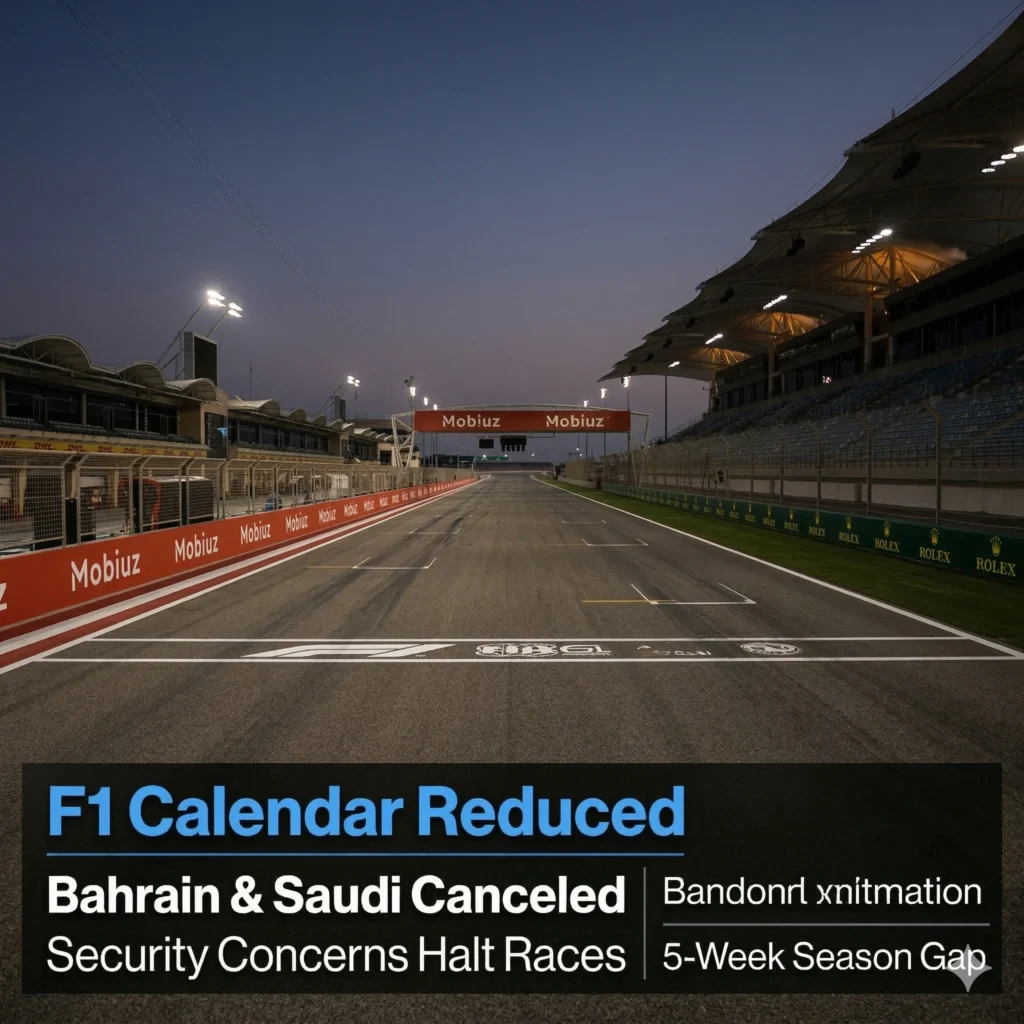
Global Impact of Formula 1 Cancels Bahrain and Saudi Arabian Events
The announcement that Formula 1 Cancels Bahrain and Saudi Arabian races has sent shockwaves through the sporting world. This move effectively reduces the 2026 calendar to 22 races, leaving a significant void in the early season schedule. Consequently, teams are now grappling with the logistical and financial fallout of losing two high-profile events. The cancellation is not merely a scheduling tweak but a response to genuine security threats near the venues.
Stakeholders have noted that the proximity of the conflict to the Sakhir and Jeddah circuits made hosting the events impossible. Formula 1 Cancels Bahrain and Saudi Arabian rounds after intelligence reports suggested increased risks to infrastructure. Furthermore, the closure of regional airspace has made the transport of cars and equipment nearly impossible for the European-based teams. This disruption marks one of the most significant calendar changes since the global pandemic era.
As the news broke, the Formula 1 Cancels Bahrain and Saudi Arabian decision was met with a mix of disappointment and relief. While fans lose two exciting night races, the safety of the personnel remains the primary focus for CEO Stefano Domenicali. The sport must now navigate a complex geopolitical landscape while maintaining its commercial integrity. Engineers and team principals are already pivoting their development programs to account for this unexpected five-week break.
Financial Consequences of the Middle East Race Cancellations
The commercial impact of the news that Formula 1 Cancels Bahrain and Saudi Arabian events is estimated to exceed £100 million. Both nations pay some of the highest hosting fees on the entire calendar to secure their spots. Therefore, the loss of these contracts represents a massive hit to the sport’s annual revenue projections. Investors are closely monitoring how the FIA will mitigate these losses over the remainder of the year.
Beyond the hosting fees, the Formula 1 Cancels Bahrain and Saudi Arabian decision affects local tourism and hospitality sectors significantly. Thousands of international fans had already booked travel and accommodation for the double-header in April. Now, those businesses face a wave of cancellations and lost income during what should have been a peak period. The ripple effect of this decision extends far beyond the paddock walls into the regional economy.
Sponsorship agreements are also being scrutinized following the announcement that Formula 1 Cancels Bahrain and Saudi Arabian races. Many brands have specific activation plans centered around the Middle Eastern market which must now be scrapped. However, the force majeure nature of the conflict likely protects the sport from certain legal liabilities. Teams will still receive their prize money distributions, though the total pool may be slightly reduced.
Formula 1 Cancels Bahrain and Saudi Arabian
The official statement confirming Formula 1 Cancels Bahrain and Saudi Arabian races was released early this morning. It clarified that these events will not be replaced by alternative venues like Portimão or Istanbul Park. The logistics of organizing a Grand Prix on such short notice proved to be an insurmountable hurdle for the FIA. As a result, the 2026 season will feature a glaring five-week gap between Japan and Miami.
This specific decision to leave the gap empty was made to avoid further logistical strain on the teams. Formula 1 Cancels Bahrain and Saudi Arabian rounds because the current cargo routes are heavily congested due to the conflict. Diverting freight to Europe and then back to North America would have been a nightmare for team managers. The extra time will instead be used for car development under the new 2026 technical regulations.
During this period, the Formula 1 Cancels Bahrain and Saudi Arabian situation allows for a deeper look at the new engine rules. Since the 2026 power units have faced early criticism, this break offers a chance for the FIA to implement minor tweaks. Honda and Red Bull Powertrains are expected to be the most vocal during these technical working group meetings. The season’s competitive balance could shift dramatically during this unexpected hiatus in the racing action.
Security Concerns and Naval Base Proximity in Manama
Safety was the ultimate factor when the news arrived that Formula 1 Cancels Bahrain and Saudi Arabian events. The Bahrain International Circuit is located in close proximity to a major U.S. naval base in Manama. Given the escalating regional tensions, the base is considered a potential target for hostile actions. Organizers could not guarantee the absolute safety of the thousands of people attending the event.
In a similar vein, the Jeddah Corniche Circuit has faced security threats in the past, most notably in 2022. Formula 1 Cancels Bahrain and Saudi Arabian races to avoid a repeat of the anxiety felt by drivers during previous incidents. The risk of missile or drone strikes targeting energy infrastructure near the track was deemed too high. Consequently, the drivers’ union was briefed on these risks before the final decision was made public.
The FIA’s security experts spent weeks monitoring the situation before recommending that Formula 1 Cancels Bahrain and Saudi Arabian rounds. They emphasized that modern sporting events are high-visibility targets that require total environmental control. Without that control, the liability for the sport would be catastrophic in the event of an incident. Everyone involved agreed that no race is worth risking human lives under these volatile conditions.
Technical Development Opportunities During the Season Break
One silver lining of the fact that Formula 1 Cancels Bahrain and Saudi Arabian races is the extra development time. Teams are currently struggling with the massive regulation changes introduced for the 2026 season. This five-week gap provides a rare “spring break” that can be used to refine aerodynamic packages. Designers at Mercedes and Ferrari are reportedly already adjusting their wind tunnel schedules to maximize this window.
- Teams will focus on improving the efficiency of the new active aerodynamics systems.
- Engine manufacturers can analyze data from the opening rounds to improve hybrid deployment.
- Software updates for the complex energy recovery systems will be prioritized during the gap.
- Weight-saving measures can be implemented on chassis that arrived at the first race overweight.
Because Formula 1 Cancels Bahrain and Saudi Arabian events, the pressure to produce spare parts is temporarily relieved. Teams often struggle with inventory during the flyaway rounds at the start of a new era. Now, they have the luxury of returning to their factories to build up a healthy stock of components. This could lead to a much more reliable and competitive grid when the season resumes in Miami.
Driver Reactions to the Modified 2026 Race Calendar
Many drivers have expressed their support for the news that Formula 1 Cancels Bahrain and Saudi Arabian events. While they enjoy the challenge of the Jeddah street circuit, their personal safety remains a top priority. Max Verstappen and Lewis Hamilton have both commented on the importance of peace and stability in the regions the sport visits. Their influence was likely a factor in the final decision-making process by the FIA.
The drivers also recognize that Formula 1 Cancels Bahrain and Saudi Arabian rounds gives them a chance to rest. The 2026 season was planned to be the longest in history, putting immense strain on the athletes’ physical and mental health. A five-week mid-season break in the spring is an unprecedented opportunity for recovery. Most drivers will use this time to maintain their fitness levels while avoiding the burnout associated with constant travel.
However, some younger drivers are concerned that Formula 1 Cancels Bahrain and Saudi Arabian events will break their rhythm. Building momentum is crucial in a new car, and a long break can be detrimental to a rookie’s progression. They will likely spend more time in the simulators to stay sharp before the Miami Grand Prix. The grid remains united, however, in the belief that the right call was made for the sport.
Logistics and Airspace Challenges in the Middle East
The logistical nightmare of the conflict played a huge role in why Formula 1 Cancels Bahrain and Saudi Arabian races. During the season opener in Australia, teams had to take massive detours to avoid closed airspace over the Middle East. These detours increased fuel costs and flight times by several hours for every single person in the paddock. Continuing this for two more rounds in the heart of the region was deemed unsustainable.
Formula 1 Cancels Bahrain and Saudi Arabian events because the freight ships carrying the “sea kits” were also at risk. Piracy and maritime attacks have increased in the Red Sea, which is the primary route for equipment heading to Jeddah. Protecting these assets would have required military-grade security that the sport is not equipped to provide. The risk of losing millions of dollars in equipment was a factor the teams could not ignore.
By confirming that Formula 1 Cancels Bahrain and Saudi Arabian rounds, the sport can now reroute all cargo directly to North America. This provides a more stable and predictable timeline for the logistical teams who work tirelessly behind the scenes. The carbon footprint of the sport will also be temporarily reduced due to the cancellation of these long-haul flights. Efficiency has become a key theme in the management of the 2026 season.
Future Outlook for Racing in the Gulf Region
Despite the fact that Formula 1 Cancels Bahrain and Saudi Arabian events this year, the long-term partnership remains. Officials from both Bahrain and Saudi Arabia have expressed their full support for the decision to cancel. They understand that the current climate is not conducive to hosting an international spectacle of this magnitude. Both nations have reaffirmed their commitment to returning to the calendar in 2027.
- Saudi Arabia continues to develop its new purpose-built facility at Qiddiya for future races.
- Bahrain remains the spiritual home of testing and early-season racing in the Middle East.
- Contractual extensions are being discussed to compensate for the lost races in 2026.
- The FIA is working on a contingency plan for future regional instabilities to ensure calendar stability.
The move to ensure Formula 1 Cancels Bahrain and Saudi Arabian events was a proactive step to protect the sport’s reputation. It demonstrates that the leadership is willing to put ethics and safety above financial gain when necessary. This stance will likely strengthen the relationship between the sport and its global fanbase in the long run. For now, the focus turns to the remaining 22 races and the fight for the 2026 World Championship.
Summary of the 2026 Calendar Revision
The revised schedule following the news that Formula 1 Cancels Bahrain and Saudi Arabian races is now set. The Japanese Grand Prix will conclude the first leg of the season on March 29. After that, the sport will enter a dormant period until the Miami Grand Prix on May 3. This massive shift has forced broadcasters and sponsors to quickly rewrite their marketing strategies for the spring.
Formula 1 Cancels Bahrain and Saudi Arabian rounds but the excitement for the 2026 regulations remains high. The opening races showed that the new cars are capable of close racing, despite the engine concerns. This break might actually help the trailing teams close the gap to the frontrunners. Everyone is eager to see how the pecking order changes once the cars hit the track in Florida.
Ultimately, the decision where Formula 1 Cancels Bahrain and Saudi Arabian races will be remembered as a turning point for the sport. It proves that F1 is not immune to the realities of global politics and conflict. The safety of the community will always come first, even if it means losing some of the most lucrative races on the schedule. The 2026 season continues, but with a new perspective on what truly matters in international sport.
For more details & sources visit: BBC Sport
Read more about Behrain news on 360 News Orbit-Behrain.