
Iran World Cup Withdrawal has stunned the global football community as the Iranian Sports Minister, Ahmad Donyamali, officially pulled the national team from the 2026 tournament. This unprecedented move follows the confirmed death of Supreme Leader Ayatollah Ali Khamenei during heavy military strikes by the United States and Israel. The geopolitical crisis has now bled into the world of sports, leaving FIFA scrambling to address a major vacancy in Group G just months before the opening whistle. Minister Donyamali cited the total impossibility of ensuring player safety and the profound national mourning as the primary drivers behind this difficult decision.
The national team, known as Team Melli, was scheduled to play high-profile matches in Los Angeles and Seattle, cities with large Iranian diaspora populations. However, the escalation of regional conflict and the assassination of the nation’s highest leader have rendered professional sports a secondary concern for Tehran. As the nation grapples with internal instability and external military pressure, the Iranian Football Federation has echoed the government’s stance. This withdrawal marks a dark chapter in the history of the 2026 World Cup, highlighting how deeply regional warfare can disrupt global cultural events.
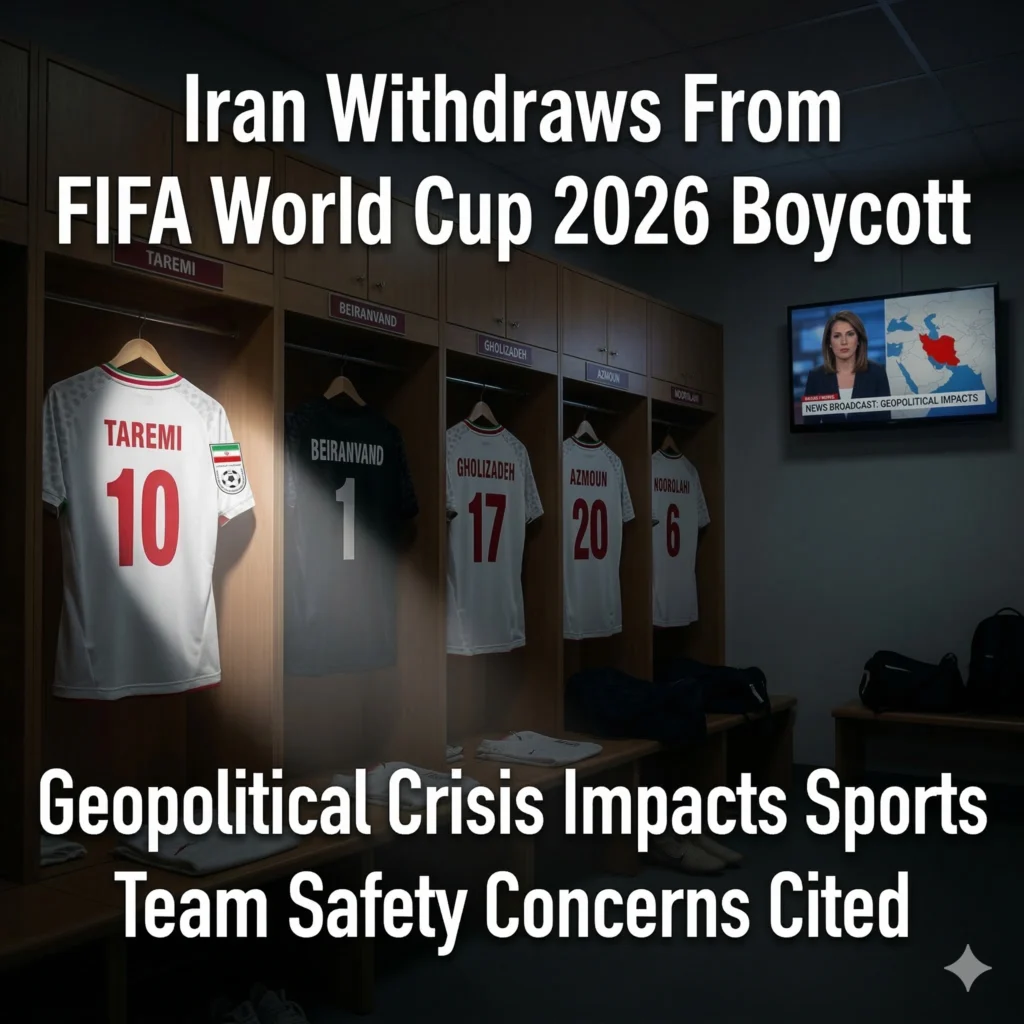
Tragic Catalyst Behind the Iran World Cup Withdrawal
The immediate cause of the Iran World Cup Withdrawal is the catastrophic loss of Supreme Leader Ayatollah Ali Khamenei. Following joint U.S. and Israeli airstrikes on Tehran, the political structure of the country has been thrown into disarray. Sports Minister Donyamali emphasized that the “martyrdom” of their leader has created a security and emotional environment where competing on the world stage is unthinkable. The government has declared a period of extended mourning, prioritizing national defense over international athletic participation.
Military analysts suggest that the strikes on February 28 targeted key command centers, leading to the death of the leader and several high-ranking officials. In response, Iran launched a series of missile and drone attacks against regional targets, further entrenching the nation in a state of total war. Under such volatile conditions, the logistics of transporting a national team to North America became a secondary impossibility. The safety of the athletes, who are often seen as symbols of the state, could not be guaranteed amidst the ongoing threats of further strikes.
FIFA Reacts to the Vacancy in Group G
The sudden Iran World Cup Withdrawal has left FIFA President Gianni Infantino in a challenging position as he manages the first 48-team tournament. Group G, which featured Iran alongside major footballing nations, now has a significant gap that must be filled to maintain the integrity of the bracket. While FIFA has contingency plans for team withdrawals, the timing of this announcement—just months before the June kickoff—creates a logistical nightmare for organizers. Infantino had previously expressed optimism about Iran’s participation, noting that President Donald Trump had welcomed the team to U.S. soil.
- FIFA is currently reviewing the qualification rankings to determine a replacement team.
- The vacancy affects scheduled matches in Los Angeles and Seattle specifically.
- Ticketing and travel packages for thousands of fans are now in a state of limbo.
- Broadcasting partners are demanding clarity on the revised match schedules.
Despite the international assurances of safety provided by the host nations, the Iranian government remained firm. The political optics of playing in the United States while blaming Washington for the death of their Supreme Leader were likely a major factor in the decision. This withdrawal creates a ripple effect that touches everything from stadium security protocols to global television rights, proving that sports cannot truly be separated from the realities of war.
Iran World Cup Withdrawal
The Iran World Cup Withdrawal is more than just a sports story; it is a manifestation of a nation in total crisis. For the Iranian people, Team Melli has historically been a source of immense pride and a rare unifying force. Removing them from the world’s biggest stage is a somber admission that the country is currently unable to function in the international community. Minister Donyamali pointed out that thousands of Iranians have been “martyred” in recent months, making the celebration of a football tournament feel disrespectful to the grieving populace.
The logistics of the withdrawal are also tied to the domestic security situation within Iran. With the death of Khamenei, the IRGC and other military factions are on high alert, and many athletes may face travel restrictions or be required for national service duties. The Football Federation had already expressed concerns about the safety of their players while traveling abroad, fearing both external threats and potential defections. By pulling out entirely, the regime maintains tighter control over its citizens during this period of extreme vulnerability and political transition.
Security Concerns in North American Host Cities
A significant factor in the Iran World Cup Withdrawal was the concern over the safety of the players in the United States. With matches planned for Los Angeles and Seattle, the Iranian government feared that the environment would be hostile or that players would be targeted by intelligence agencies. Even though FIFA and the U.S. government promised high-level security, the Iranian Sports Ministry argued that no guarantee was sufficient given the “assassination” of their Supreme Leader. The psychological weight of the conflict made the prospect of a friendly competition impossible for the athletes.
In Seattle and Los Angeles, the news has been met with a mixture of disappointment and relief. While fans were eager to see the talent of Team Melli, the potential for massive protests or security incidents was a looming shadow over Group G. Local law enforcement agencies had been preparing for complex security scenarios involving the Iranian delegation. The withdrawal simplifies the security landscape for the host cities but leaves a void for the vibrant Iranian-American community that was looking forward to supporting their home country on American soil.
Impact on the 48-Team Tournament Structure
The 2026 World Cup was designed to be the largest in history, and the Iran World Cup Withdrawal forces a rethink of the expanded format. With 48 teams, the tournament relies on a delicate balance of groups to ensure a fair path to the knockout stages. If a replacement is not found quickly, Group G could be reduced to three teams, which would fundamentally change the points requirement for advancement. This creates an unfair advantage or disadvantage for the remaining teams in that group, potentially leading to formal complaints from other national federations.
- A replacement team must be selected based on the highest-ranked non-qualified nation.
- Logistical arrangements for a new team must be finalized in record time.
- Training facilities in the Pacific Northwest must be reassigned to the newcomer.
- FIFA may face legal challenges regarding sponsorship agreements tied to specific regions.
This situation highlights the fragility of large-scale international events when faced with sudden geopolitical shifts. The 2026 tournament was supposed to be a celebration of North American unity, but it will now be remembered for the absence of a major Middle Eastern power. The precedent set by this withdrawal may influence how other nations handle participation in events hosted by geopolitical rivals in the future.
The Death of Khamenei and National Identity
The core of the Iran World Cup Withdrawal lies in the seismic shift in Iranian national identity following the death of the Supreme Leader. Ayatollah Ali Khamenei had been the central figure of the Islamic Republic for decades, and his sudden removal via foreign airstrikes has left a vacuum of power. The national football team is often used as a tool for state propaganda, and without a clear leader to represent, the regime may have felt the team’s presence abroad would be counterproductive or even dangerous to their grip on power.
The Iranian Sports Minister’s statement was laden with religious and political terminology, framing the withdrawal as an act of defiance and piety. By choosing not to participate, the government is signaling to its people and the world that the “current political and security conditions” are their only priority. This move isolates Iran further from the global community, potentially ending a generation of footballing progress that had seen the country become a consistent competitor in the World Cup finals.
Global Oil Prices and Regional Warfare
While the sports world focuses on the Iran World Cup Withdrawal, the underlying cause—the war—is wreaking havoc on global markets. The strikes that killed Khamenei and targeted Iranian infrastructure have sent oil prices to four-year highs. This economic pressure is part of a “maximum pressure” strategy that has now culminated in kinetic warfare. The U.S. administration, led by President Trump, has maintained that these actions are necessary to prevent nuclear proliferation, even as the human and cultural costs continue to mount.
The conflict has also made travel in and out of the Middle East extremely hazardous. International airlines have canceled flights to Tehran and surrounding regions, making the logistics of a World Cup campaign nearly impossible. The Iranian sports ministry noted that the “environment is unsuitable for professional sports,” a sentiment that is shared by many international observers who fear the conflict could expand into a larger regional or even global war. The football vacancy is merely a symptom of a much deeper and more dangerous international crisis.
Potential Replacements for Team Melli
Following the Iran World Cup Withdrawal, the search for a replacement team is underway. Rumors suggest that Italy or a high-ranking Asian team that narrowly missed qualification could be invited to fill the slot. However, the “lucky loser” system is complicated by travel requirements and the short timeframe remaining. Any team that enters now will have significantly less time to prepare, scout their opponents in Group G, and acclimatize to the North American summer.
The Asian Football Confederation (AFC) is also concerned about the loss of one of its strongest representatives. Iran’s absence weakens the continental showing and could affect future slot allocations for Asian teams. The decision to withdraw is seen by some as a blow to the sport’s growth in the region, as millions of young Iranians will now miss the opportunity to see their heroes compete against the world’s best. The geopolitical fallout has effectively robbed an entire nation of its most beloved pastime.
The Role of US-Israel Military Coordination
The Iran World Cup Withdrawal cannot be discussed without acknowledging the unprecedented military coordination between the United States and Israel. The February 28 strikes were a turning point in the long-standing shadow war between the nations. By targeting the capital and successfully assassinating the Supreme Leader, the coalition has signaled a move toward total regime destabilization. This has forced the Iranian government to retract all international engagements, including the World Cup, to focus on survival.
- The strikes were conducted using advanced stealth technology to bypass Tehran’s defenses.
- Israel provided critical intelligence on the location of high-level meetings.
- The U.S. provided the heavy munitions required to neutralize hardened bunkers.
- This coordination has drawn sharp rebukes from Russia and China at the UN.
This level of military engagement makes the idea of a sports team traveling to the “enemy’s” soil for a game seem far-fetched. The Sports Minister’s comments about the “safety of players” likely refer to the fear of the team being held as political pawns or facing immense pressure while in the United States. The war has effectively destroyed the bridge that sports once provided between these conflicting cultures.
Humanitarian Crisis and Sports
The Iran World Cup Withdrawal is framed by the Sports Minister as a response to the “thousands of Iranians killed or martyred.” The humanitarian toll of the recent strikes and subsequent retaliations has been immense. Hospitals in Tehran and other major cities are reportedly overwhelmed, and the infrastructure for daily life is crumbling. In such a scenario, the resources required to fund and support a World Cup team are better directed toward emergency services and national defense.
Critics of the regime argue that the withdrawal is a way to prevent the players from speaking out on the international stage. In previous tournaments, Iranian players have used their platform to support domestic protests, and the government may fear a repeat of such actions during a time of national instability. Regardless of the motive, the result is the same: the 2026 World Cup will proceed without one of its most passionate and talented participants, serving as a reminder of the human cost of 2026’s escalating global tensions.
Conclusion and Future Outlook
The Iran World Cup Withdrawal is a landmark event that proves even the most popular sport in the world is not immune to the ravages of war and the death of world leaders. As the 2026 tournament approaches, the absence of Team Melli will be felt by fans across the globe. The focus now shifts to how FIFA will fill the void and how the Iranian people will cope with their isolation during a period of profound national grief. The death of Ayatollah Ali Khamenei has changed the world, and the sports world is just the latest to feel the shockwaves.
For more details & sources visit: BBC Sport
Read more on Iran news: 360 News Orbit – Iran.