
Turkish Economy Crisis is reaching a critical tipping point as the escalating regional conflict between the United States, Israel, and Iran sends shockwaves through Ankara’s financial heart. The geopolitical instability has triggered a massive exodus of foreign capital, leaving the nation’s markets in a state of high alert. As investors scramble for the safety of the U.S. dollar, the Turkish lira faces renewed pressure that threatens to undo months of stabilization efforts. This sudden shift in market sentiment highlights the extreme vulnerability of emerging markets to localized military escalations and global energy fluctuations.
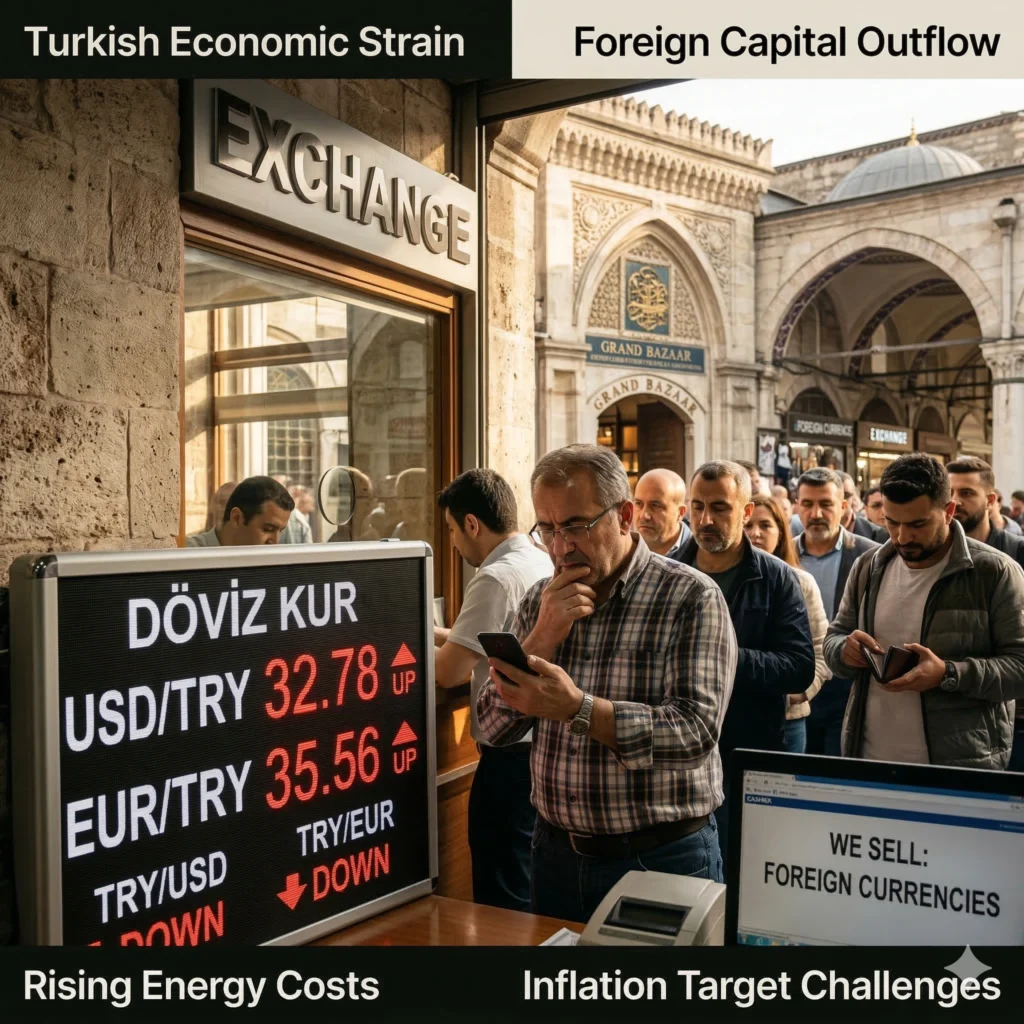
The Magnitude of the Turkish Economy Crisis
The scale of the capital flight is staggering, with foreign investors offloading an estimated 25 billion to 30 billion dollars in Turkish assets in a matter of weeks. This mass departure is driven by the fear that the conflict will spill further across borders, particularly following the recent Iranian missile attacks on Adana province. Such incidents do more than just rattle bond markets; they strike at the heart of investor confidence in Türkiye’s long-term stability. The Turkish Economy Crisis is no longer just a matter of monetary policy but a direct consequence of the deteriorating security landscape in the Middle East.
Central Bank Governor Fatih Karahan has been forced into an aggressive defensive posture, deploying approximately 25 billion dollars in reserves over a ten-day period. These interventions are designed to prevent a total collapse of the lira, yet they come at a high cost to the country’s already strained foreign exchange cushions. The decision to halt the rate-cutting cycle and set the overnight lending rate at forty percent signals a return to “crisis mode” management. For a nation that was just beginning to see signs of recovery, the Turkish Economy Crisis represents a significant setback that may take years to resolve.
Furthermore, the domestic population is feeling the weight of these macroeconomic shifts through skyrocketing consumer prices. Inflation in February alone rose by nearly three percent, pushing the twelve-month average to over thirty-three percent. This rate is more than double the official government target, creating a cost-of-living squeeze that is fueling social and political anxiety. The Turkish Economy Crisis is thus manifesting as a twin threat: a drain on national reserves and a daily struggle for the average citizen to afford basic necessities in an increasingly expensive environment.
Turkish Economy Crisis
The surging cost of energy is perhaps the most immediate and damaging component of the current Turkish Economy Crisis. As a net energy importer, Türkiye is uniquely exposed to the volatility caused by threats to the Strait of Hormuz and global oil supply chains. Each ten-dollar increase in the price of oil widens the national current account deficit by over five billion dollars, creating a mathematical hurdle that is nearly impossible to overcome through traditional trade. The Turkish Economy Crisis is being fueled by an external “oil shock” that the government has very little power to control or mitigate.
Finance Minister Mehmet Simsek has attempted to provide a buffer for consumers by reviving a complex fuel tax mechanism. While this may temporarily cushion the blow at the pump, it adds another layer of complexity to the national budget and reduces the funds available for other critical infrastructure. The Turkish Economy Crisis is forcing the leadership to make difficult choices between short-term public relief and long-term fiscal responsibility. As long as the regional conflict continues to drive oil prices higher, these stop-gap measures will likely fall short of providing true economic stability.
The threat to the tourism sector also looms large over the Turkish Economy Crisis, as Adana and other provinces face the direct physical impact of the conflict. Tourism is a vital source of foreign currency for Türkiye, and any disruption to the summer season could be catastrophic for the balance of payments. If international travelers perceive the region as unsafe, the resulting loss of revenue will further deplete the reserves that the Central Bank is working so hard to protect. The Turkish Economy Crisis is, therefore, inextricably linked to the perception of safety within its own borders.
Investor Flight and Market Volatility
The psychological impact of the Turkish Economy Crisis has led many institutional investors to opt for cash holdings in U.S. dollars rather than maintaining exposure to volatile regional assets. This “risk-off” environment makes it increasingly expensive for the Turkish government to borrow money on international markets. The credit default swaps (CDS) for Türkiye have spiked, reflecting a heightened probability of default in the eyes of global lenders. In this climate, the Turkish Economy Crisis becomes self-fulfilling as high borrowing costs further strain the national treasury.
- Massive sell-off of Turkish stocks and government bonds by European and American funds.
- Shift toward safe-haven currencies like the U.S. Dollar and Swiss Franc.
- Increased demand for gold as a hedge against regional military escalation.
- Significant reduction in long-term foreign direct investment (FDI) projects.
This lack of investment is stalling critical industrial projects that were intended to modernize the Turkish manufacturing sector. The Turkish Economy Crisis is essentially pausing the country’s development goals as all available resources are diverted to currency defense and energy subsidies. Analysts warn that if the outflow of capital does not stabilize by the second quarter of 2026, the government may be forced to implement even more drastic capital controls. Such a move would be a clear admission that the Turkish Economy Crisis has moved beyond the control of standard market mechanisms.
The role of the Central Bank has never been more scrutinized than it is during this current Turkish Economy Crisis. Governor Karahan’s use of 25 billion dollars in just ten days has sparked a debate about the sustainability of this interventionist strategy. While it has successfully prevented a “black swan” event for the lira so far, the depletion of reserves leaves the country with very little dry powder for future shocks. The Turkish Economy Crisis is testing the limits of the nation’s financial fortress, and the walls are beginning to show cracks under the pressure of regional warfare.
Energy Markets and the Strait of Hormuz
The strategic importance of the Strait of Hormuz cannot be overstated when discussing the Turkish Economy Crisis. Any threat to this maritime chokepoint sends immediate ripples through the Turkish energy grid, raising the cost of natural gas and electricity for industrial users. Manufacturers in cities like Istanbul and Izmir are reporting that their production costs have risen by twenty percent in the last month alone. The Turkish Economy Crisis is thus being exported into the global supply chain as Turkish-made goods become more expensive and less competitive on the world stage.
- Escalation of naval tensions leading to increased shipping insurance premiums.
- Disruption of tanker traffic causing localized fuel shortages in the Mediterranean.
- Secondary inflation as transport costs for food and consumer goods rise.
- Pressure on the Turkish government to find alternative, more expensive energy suppliers.
The domestic response to the Turkish Economy Crisis has seen a shift in consumer behavior, with many households cutting back on non-essential spending. This reduction in domestic demand is slowing the overall GDP growth rate, leading to fears of stagflation—a situation where inflation remains high while the economy stagnates. The Turkish Economy Crisis is a multi-front war, requiring the government to fight rising prices, falling growth, and external military threats all at the same time. The complexity of this situation is unprecedented in the country’s modern economic history.
Impact on the 2026 Summer Tourism Season
Economists are particularly worried about the upcoming summer months, which traditionally provide a massive influx of “hard currency” to the Turkish Economy Crisis recovery efforts. The missile attacks on Adana have created a sense of unease among European and Russian tour operators, who are now considering alternative destinations. If the Turkish Economy Crisis results in a 20% drop in tourism revenue, the current account deficit will become unmanageable without significant external help. The government is currently launching a global PR campaign to reassure travelers that the major tourist hubs remain secure and operational.
However, the reality of the Turkish Economy Crisis is hard to hide from the savvy international traveler who sees headlines about 40% interest rates and regional missile strikes. The hospitality industry is already reporting a slowdown in early bookings for the June-August period compared to 2025. This downturn is a direct symptom of the Turkish Economy Crisis, as the industry relies on a stable and peaceful regional image to attract high-spending visitors. Without a de-escalation of the Iran-Israel conflict, the “tourism buffer” may not be enough to save the lira this year.
- Hotels in the Mediterranean region report a 15% increase in cancellation inquiries.
- Travel agencies are shifting focus to internal domestic tourism to fill the gap.
- Airlines are adjusting flight paths to avoid conflict zones, increasing operational costs.
The link between regional peace and the Turkish Economy Crisis is now clearer than ever before. Every diplomatic failure in the Middle East translates into a financial loss for the Turkish shopkeeper and the hotelier. This dependency makes the Turkish Economy Crisis a regional issue that requires a regional solution. Until there is a credible path to peace between the primary combatants, the Turkish financial markets will continue to trade with a “war premium” that hampers growth and deters the very investors the country needs.
Long-Term Outlook for Financial Stability
Looking ahead, the resolution of the Turkish Economy Crisis depends on a combination of disciplined internal policy and external de-escalation. Finance Minister Simsek remains committed to a “rational” economic framework, but the external shocks are making it increasingly difficult to stay the course. The Turkish Economy Crisis has highlighted the need for the country to diversify its energy sources and reduce its reliance on foreign capital for short-term liquidity. Moving toward a more self-sufficient model is a long-term goal, but the current crisis requires immediate, high-stakes decisions.
The international community is watching the Turkish Economy Crisis closely, as a collapse of the Turkish market could have contagion effects across other emerging economies in Eastern Europe and the Middle East. Some analysts suggest that a formal support package from international financial institutions may be necessary if the reserve drain continues at its current pace. However, the Turkish government has expressed a strong desire to manage the Turkish Economy Crisis independently to maintain its sovereign policy-making power. This tug-of-war between independence and the need for support will define the next six months of the nation’s financial history.
Ultimately, the Turkish Economy Crisis is a test of resilience for a nation that sits at the crossroads of East and West. The ability to weather this storm will depend on whether the Central Bank can maintain the lira’s value without completely exhausting its ammunition. The public’s patience is also a factor, as the high-interest-rate environment makes it difficult for small businesses to survive and for families to manage debt. The Turkish Economy Crisis is a reminder that in a globalized world, a conflict in one corner of the map can quickly become a financial disaster in another.
As we move deeper into 2026, the focus will remain on the oil markets and the geopolitical maneuvers of the major powers. If the conflict stabilizes, the Turkish Economy Crisis may begin to recede, allowing for a gradual return of the foreign investors who fled in February. If not, the country may have to prepare for a prolonged period of economic hardship and structural realignment. The “Harfuch-style” popularity seen in other regional leaders is not currently reflected in the economic sphere, where the numbers tell a much more sobering story. The path forward is narrow, but with the right mix of diplomacy and fiscal grit, there is still a way out of the darkness.
For more details & sources visit: Middle East Eye
Read more on Turkey news: 360 News Orbit – Turkey