
The US Kharg Island Strike represents a dramatic and sudden escalation in the long-standing conflict between Washington and Tehran. Following a direct missile attack on the United States Embassy in Baghdad, President Donald Trump authorized a devastating precision strike on military installations located on this strategic Iranian hub. This move signals a shift from defensive posturing to a more aggressive campaign aimed at dismantling Iranian tactical capabilities in the Persian Gulf. As regional tensions reach a fever pitch, the international community is bracing for the potential fallout of this high-stakes military intervention.
The US Kharg Island Strike was officially confirmed by the White House as a direct response to the violation of American sovereign territory in Iraq. The embassy attack, which targeted a helipad and caused significant alarm, was the catalyst for this massive retaliation. By striking Kharg Island, the administration is targeting one of Iran’s most vital strategic locations, situated off the southwest coast of the mainland. This operation is widely viewed as an attempt by the Pentagon to regain strategic control and deter further aggression from Iranian-backed groups across the Middle East.
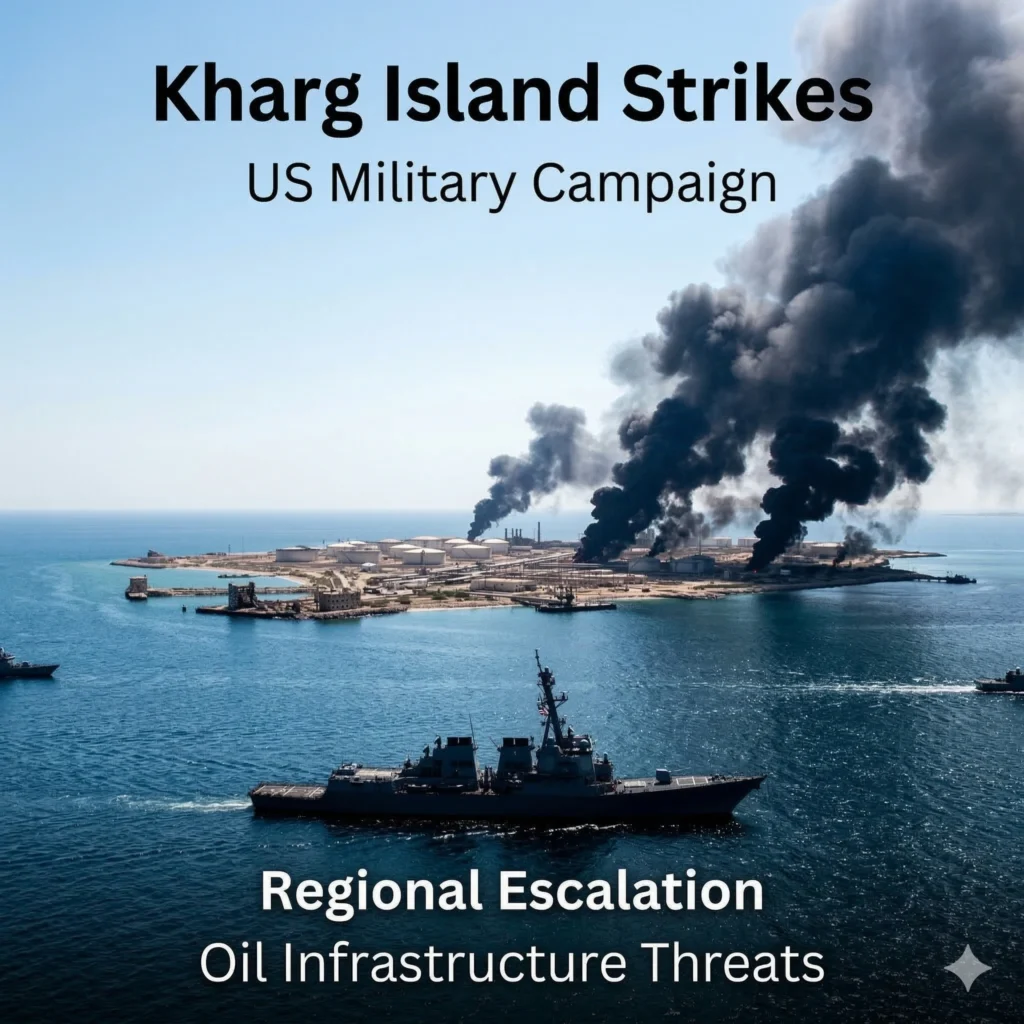
Strategic Significance of the US Kharg Island Strike
The geography of the US Kharg Island Strike is crucial for understanding its impact on Iranian regional influence. Kharg Island serves as a central point for both military naval operations and the vast majority of Iran’s crude oil exports. By obliterating military targets in this specific zone, the US has effectively neutralized the defensive perimeter that protects Iran’s primary economic lifeline. This surgical approach demonstrates the advanced capabilities of American air and sea power in the modern era of conflict.
Within the framework of the US Kharg Island Strike, the Pentagon has utilized its most advanced precision-guided munitions to minimize unintended casualties while maximizing the destruction of hardened bunkers. These installations were known to house surveillance equipment and fast-attack craft that have frequently harassed international shipping lanes. The removal of these assets is intended to restore freedom of navigation in the Strait of Hormuz. However, military analysts warn that such a significant blow may provoke a symmetric response from the Iranian Revolutionary Guard Corps.
Moreover, the US Kharg Island Strike serves as a psychological maneuver to test the resilience of the Iranian leadership. Despite years of sanctions and previous tactical strikes, the government in Tehran has remained defiant in its regional ambitions. This latest escalation is designed to prove that the United States is willing to target core strategic assets if its diplomatic personnel remain under threat. The coming weeks will reveal whether this “maximum pressure” tactic leads to a diplomatic opening or a full-scale regional conflagration.
US Kharg Island Strike
The US Kharg Island Strike has forced a total reevaluation of security protocols for American interests across the Middle East. Following the destruction of the military sites, the Pentagon signaled its intention to ramp up the military campaign should hostilities continue to escalate. This indicates that the strike on Kharg was not an isolated event but the opening chapter of a broader strategy to diminish Iranian power. Military experts are closely watching for signs of mobilization in both the US Central Command and the Iranian naval forces.
During the US Kharg Island Strike, the coordination between various branches of the US military was reportedly seamless, involving both carrier-based aircraft and long-range missile systems. This demonstration of force was meant to remind regional adversaries of the overwhelming technological advantage possessed by American forces. However, critics of the operation argue that such a public display of “obliteration” could backfire by galvanizing nationalist sentiment within Iran. The political risks of this mission are as significant as the military rewards.
The US Kharg Island Strike also coincides with increased activity from Iranian-aligned groups like Hezbollah, who claimed responsibility for rocket attacks on northern Israel. This multi-front instability makes the situation on Kharg Island even more precarious, as the US must now manage several flashpoints simultaneously. Ground operations on the island are currently considered high-risk due to the potential for defensive fire from remaining Iranian coastal batteries. As a result, the Pentagon is likely to maintain a strategy of aerial and naval dominance for the immediate future.
Economic Consequences of the US Kharg Island Strike
One of the most immediate fears following the US Kharg Island Strike is the impact on global fuel prices. Kharg Island is the heart of Iran’s oil export industry, and any damage to its piers or storage tanks would lead to a massive deficit in global supply. Even though the military targets were the primary focus this time, the mere threat of hitting the oil infrastructure has caused oil futures to spike. This “risk premium” is already being felt at gas stations across the globe, creating a new economic crisis for world leaders to manage.
The US Kharg Island Strike has put the administration in a difficult position regarding its energy policy. While the goal is to punish the Iranian government, the unintended consequence could be a significant increase in domestic energy costs for American consumers. Economic analysts suggest that the President must balance his military objectives with the need to keep the global economy stable. If the conflict expands to include a total blockade of Kharg Island, the resulting price shock could rival the energy crises of the 1970s.
- Potential for record-high crude oil prices if the conflict expands to oil facilities.
- Global shipping insurance rates have increased for vessels traveling through the Persian Gulf.
- Market volatility is being driven by the uncertainty of the Iranian counter-response.
- The US Strategic Petroleum Reserve may be utilized to mitigate the impact of supply disruptions.
Regional Instability Following the US Kharg Island Strike
The US Kharg Island Strike has triggered a wave of violence and political unrest across neighboring countries. In Iraq, the embassy attack was just one part of a broader series of skirmishes between US-aligned forces and local militias. The Kharg operation was intended to send a message to these groups that their backers in Tehran are not invulnerable. However, the immediate result has been an increase in the frequency of rocket and drone attacks on US bases in the region.
In Lebanon and Israel, the US Kharg Island Strike has exacerbated an already fragile border situation. Hezbollah’s decision to target Israeli border towns like Odaisseh and Blida is seen as a show of solidarity with Iran. This creates a dangerous scenario where a strike in the Persian Gulf can lead to a full-scale war in the Levant. The diplomatic challenge for the United States is to contain the conflict to Kharg Island while preventing a wider Mediterranean war that would draw in more allies.
- Hezbollah launched overnight rocket attacks directed at northern Israeli border towns.
- US Embassy officials in Baghdad remain on high alert following the helipad missile hit.
- Israeli soldiers have been placed on maximum readiness in border villages.
- Regional leaders are calling for an immediate de-escalation to prevent a wider war.
Pentagon Policy and the US Kharg Island Strike
Following the US Kharg Island Strike, the Pentagon has been forced to defend its choice of targets to both Congress and international bodies. Officials emphasize that the installations on Kharg were legitimate military objectives that posed a direct threat to US naval vessels. The “obliteration” of these targets was necessary to ensure that Iran could not launch a surprise attack during the ongoing diplomatic crisis. This legal and tactical justification is central to the administration’s defense of the mission.
The US Kharg Island Strike marks a significant turning point in the Pentagon’s rules of engagement for the 2026 theater. Previously, the US had focused on “proportional” responses, but the strike on Kharg suggests a shift toward a more decisive and overwhelming force. This strategy aims to break the cycle of tit-for-tat violence by delivering a blow so significant that the adversary is forced to reconsider its entire approach. Whether this “shock and awe” tactic works against the decentralized nature of modern Iranian influence remains to be seen.
- The Pentagon is preparing for an extended military campaign if Tehran retaliates.
- Advanced drones and satellite surveillance are being used to monitor Kharg in real-time.
- Rules of engagement have been broadened to allow for pre-emptive strikes on missile sites.
- Congressional leaders are demanding a full briefing on the long-term goals of the mission.
Future Projections for the US Kharg Island Strike Campaign
As the dust settles from the initial US Kharg Island Strike, the focus turns to what comes next. If Iran chooses to retaliate through its proxy network, the US is likely to expand its list of targets to include more mainland installations. This escalatory ladder could eventually lead to the destruction of the very oil infrastructure that the President has already threatened. Such a move would be a “nuclear option” in terms of global economic impact, forever changing the energy landscape of the 21st century.
The US Kharg Island Strike has also opened the door for a potential naval blockade of the island. By controlling the waters around Kharg, the US could effectively shut down the Iranian economy without firing another shot. However, such a blockade would be a massive logistical undertaking and would likely lead to direct naval confrontations with the Iranian Navy. The strategic experts at the Pentagon are currently weighing the pros and cons of this long-term containment strategy versus continued surgical strikes.
- The administration may seek to build a “Coalition of the Willing” for a Gulf naval blockade.
- Iranian leadership is expected to prioritize the repair of its coastal defense systems.
- International peace talks are being proposed by the UN to avoid a total energy crisis.
- The 2026 conflict is being characterized as the most dangerous moment in US-Iran history.
Military Risks Involved in the US Kharg Island Strike
The US Kharg Island Strike was not without its risks, and future operations on the island will be even more dangerous. Iranian forces have spent decades fortifying the island with anti-aircraft batteries and hidden missile launchers. Any attempt at a ground operation or a prolonged aerial presence would face a high-risk environment with potential for American casualties. The “obliteration” of the primary targets does not mean that the island is now safe for US forces to occupy or navigate freely.
In addition to physical risks, the US Kharg Island Strike carries a heavy burden of intelligence risk. If the US miscalculates the location of a target or the intent of an Iranian movement, it could lead to an accidental escalation that neither side wants. The reliance on remote-controlled systems and satellite data is high, but the “fog of war” is always present in the Persian Gulf. Maintaining accurate, real-time intelligence is the most difficult part of the ongoing US campaign against Iranian military targets.
- Surface-to-air missile systems on the Iranian mainland remain a threat to US jets.
- Cyber warfare attacks from Iranian groups have targeted US military networks.
- The potential for “swarm” attacks by small Iranian boats remains a naval concern.
- Accurate damage assessment is difficult due to the hardened nature of the island’s bunkers.
Global Reaction to the US Kharg Island Strike
The reaction to the US Kharg Island Strike has been deeply divided along geopolitical lines. While some allies have expressed support for the US right to defend its embassies, others have warned that this “shock” to the system could destabilize the entire global order. European leaders, in particular, are concerned about the impact on the 2026 energy market and the potential for a new wave of refugees fleeing a wider Middle East war. The diplomatic fallout from the strike is just beginning to be felt in various world capitals.
At the United Nations, the US Kharg Island Strike has led to emergency sessions of the Security Council. Russia and China have condemned the action as a violation of international law, while the US representative argued that it was a necessary act of self-defense. This diplomatic stalemate mirrors the military situation on the ground, with both sides dug in and unwilling to compromise. The US Kharg Island Strike has effectively ended any hope of a return to the nuclear deal in the near future.
- Protests have broken out in several Middle Eastern capitals following the strike.
- Some regional partners are quietly providing logistics support to the US Navy.
- International humanitarian groups are preparing for potential civilian impacts in Iran.
- Global stock markets have shown significant volatility as the conflict intensifies.
Conclusion: The Legacy of the US Kharg Island Strike
The US Kharg Island Strike will be remembered as a pivotal moment in the 2026 regional crisis. By choosing to target a high-value strategic asset like Kharg Island, the United States has redefined the boundaries of its conflict with Iran. This move was a clear message that the days of ignoring attacks on American embassies are over. However, the destruction of military targets is only the beginning of what promises to be a long and unpredictable struggle for regional dominance.
As the US military campaign continues, the world will be watching to see if the Iranian leadership chooses the path of de-escalation or defiance. The US Kharg Island Strike has shown the world the power of American precision, but it has also revealed the fragility of global peace in the face of persistent regional rivalries. Whether this operation leads to a more stable Middle East or a catastrophic global conflict is a question that only time will answer. For now, the fires on Kharg Island serve as a stark reminder of the cost of modern war.
For more details & sources visit: Al Jazeera
For the latest updates from the United States, visit our U.S. news page.