
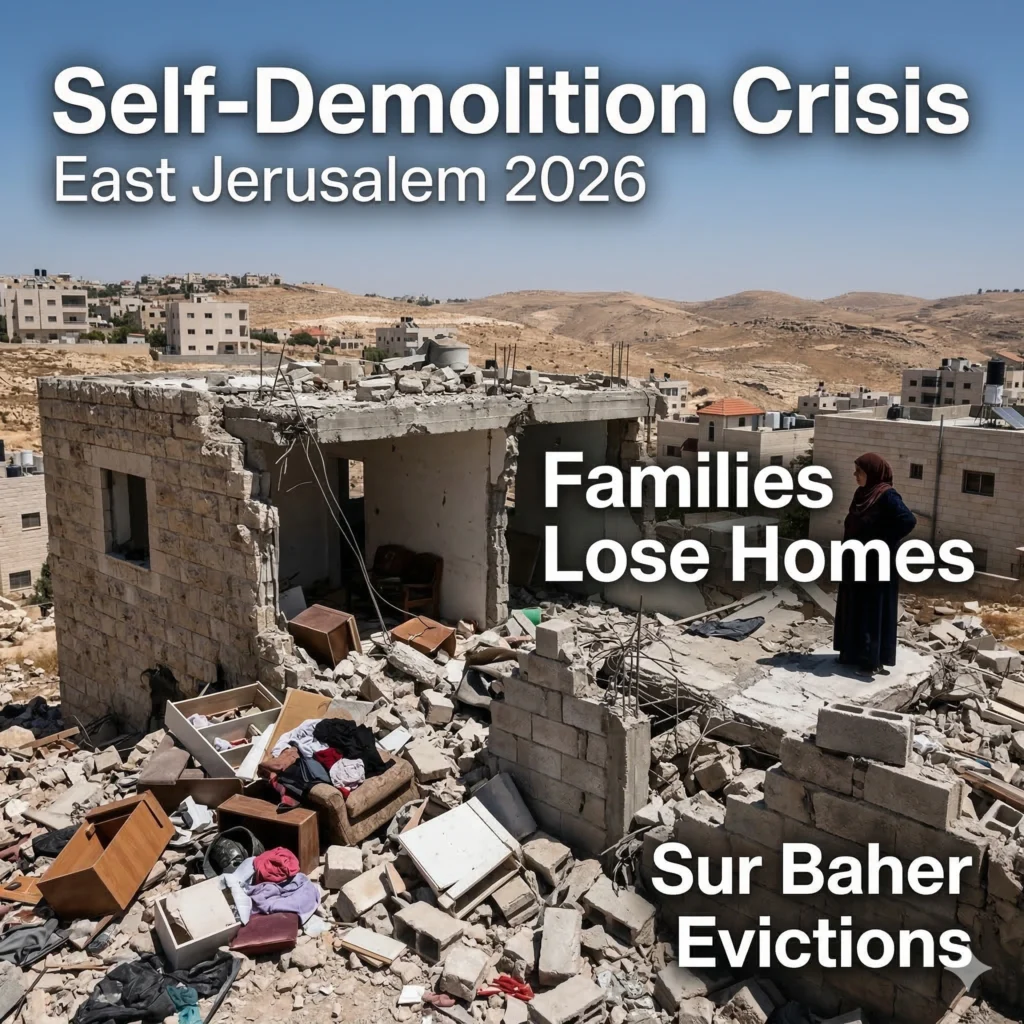
The East Jerusalem demolitions have reached a devastating peak as families are forced to dismantle their own heritage under the threat of crippling financial penalties. This systematic displacement in neighborhoods like Sur Baher represents a profound human rights challenge that has intensified throughout 2026. For residents like Basema and Raed Dabash, the choice is between destroying their own sanctuary or facing municipal fines that would ensure their lifelong poverty. As the international community watches, these forced self-demolitions highlight a legal framework that makes it nearly impossible for Palestinian residents to secure building permits. The psychological toll on children watching their bedrooms crumble is immeasurable and permanent.
The Financial Pressure of East Jerusalem Demolitions
The economic logic behind East Jerusalem demolitions is designed to trap families in a cycle of debt and displacement. When the Israeli municipality issues a demolition order, the resident is given a choice to either hire a private contractor to destroy the home or wait for the city bulldozers to arrive. If the city performs the task, the homeowner is billed for the equipment, the labor, and the police security detail required for the operation.
These costs frequently exceed 100,000 shekels, which translates to approximately $32,000 in modern currency. For a family already struggling under the weight of administrative fees, such a sum is absolutely catastrophic. Consequently, most residents choose the agonizing path of self-demolition to save their remaining assets. Even then, they are often saddled with fines for the original “illegal” construction that must be paid over several years.
This financial mechanism ensures that even after a family loses their shelter, they remain tethered to the municipal system through debt. The Dabash family, for instance, must continue paying 45,000 shekels in installments until 2029, despite the fact that their home no longer exists. This creates a scenario where the victim pays for their own displacement. It is a calculated pressure point that forces residents to be the instruments of their own dispossession.
Legal Barriers and the Permit Crisis
At the heart of the East Jerusalem demolitions lies a restrictive zoning policy that prevents Palestinian growth while encouraging expansion elsewhere. Statistics show that while the Palestinian population has grown significantly since 1967, the land allocated for their residential use has remained stagnant. This creates an environment where building without a permit becomes the only option for growing families.
The application process for a building permit is notoriously difficult, expensive, and often ends in a rejection after years of waiting. Residents spend thousands of dollars on architects and legal fees only to be told that the land is designated as a “green zone” or a public space. This legal gridlock leaves thousands of homes vulnerable to demolition orders at any given moment.
When a home is built without these elusive permits, it is labeled as a code violation. This technicality provides the legal cover for the municipality to issue eviction notices. For the residents of Sur Baher, the law is not a shield but a weapon used to enforce a specific demographic reality. The result is a landscape of uncertainty where every new brick laid is a potential financial liability.
East Jerusalem Demolitions
The East Jerusalem demolitions represent more than just the loss of physical structures; they signify the erasure of Palestinian presence in the holy city. In the Sur Baher neighborhood, the sight of families wielding sledgehammers against their own walls has become a frequent and traumatic occurrence. Authorities often demand photographic evidence of the internal destruction before they consider the order “satisfied” by the resident.
This requirement adds a layer of psychological cruelty to the process, forcing parents to document the ruin of their children’s lives. The Dabash family had to destroy two separate housing units that accommodated eight people, including three young children. Once the internal walls are down, the exterior must be leveled to ensure the structure is completely uninhabitable according to municipal standards.
Human rights organizations argue that this practice violates international law, which prohibits the destruction of property by an occupying power. However, the municipal courts maintain that these are simple administrative actions related to urban planning. This disconnect between international legal standards and local administrative practice leaves families with no viable path for appeal or protection within the system.
Psychological Impact on Families and Children
The mental health consequences of East Jerusalem demolitions are profound, particularly for the youngest members of the community. Children who witness their parents destroying their own home often experience severe trauma, anxiety, and a loss of fundamental security. The home, which should be a place of safety, becomes a site of state-mandated destruction and family despair.
Basema and Raed Dabash have spoken about the difficulty of explaining to their children why they had to take hammers to their own bedrooms. This forced participation in the destruction of one’s own life creates a sense of helplessness that can last for generations. It shatters the traditional role of the parent as a protector and provider in the eyes of the child.
Social workers in the region report high levels of post-traumatic stress disorder among families who have undergone self-demolition. The process is slow and agonizing, unlike the swift destruction by a bulldozer, prolonging the emotional distress. This psychological warfare is a key component of the displacement strategy, aiming to discourage residents from remaining in the city.
Sur Baher and the Struggle for Sovereignty
Sur Baher has become a primary flashpoint for East Jerusalem demolitions due to its strategic location and the resilience of its community. The neighborhood is surrounded by expanding infrastructure that often hem in the Palestinian residents, limiting their ability to expand naturally. As the city grows, the pressure on these border neighborhoods intensifies, leading to a surge in eviction notices.
The community in Sur Baher has attempted to organize legal defenses, but they are often met with a wall of administrative bureaucracy. The local leadership emphasizes that their struggle is not just about houses, but about the right to exist in their ancestral lands. Each demolished home represents a victory for those seeking to alter the demographic balance of the city.
- Families often lose their life savings during the legal battle before the demolition even begins.
- Community solidarity is high, with neighbors often helping to move furniture and salvage materials.
- Temporary shelters are often set up on the ruins, as families refuse to leave the land they own.
- The lack of alternative housing options leads to severe overcrowding in the remaining structures.
Despite the destruction, the residents of Sur Baher continue to assert their connection to the land. They view the ruins of their homes as a testament to their endurance rather than a sign of defeat. This spirit of “sumud,” or steadfastness, is what keeps the community together in the face of such overwhelming administrative and military pressure.
International Reactions to the Housing Crisis
The global response to East Jerusalem demolitions has been characterized by frequent condemnations but little material change on the ground. United Nations officials have repeatedly called for a halt to the practice, labeling it a violation of the Fourth Geneva Convention. However, these statements rarely translate into diplomatic pressure that would influence municipal policy.
Many international observers point out that the policy of self-demolition is a unique and particularly coercive form of urban planning. They argue that the threat of exorbitant fines is a form of duress that invalidates any claim that the residents are acting “voluntarily.” The practice is viewed as a bypass of international scrutiny by making the victims the primary actors in the destruction.
Foreign consulates in the city often visit the sites of demolitions to document the damage and speak with affected families. These visits provide a temporary sense of visibility for the residents, but they do not stop the bulldozers or the fines. The gap between international rhetoric and the reality of the Sur Baher streets remains a source of deep frustration for Palestinians.
Strategic Urban Planning and Displacement
The overarching goal of East Jerusalem demolitions is often tied to the “Master Plan” for the city, which aims to maintain a specific demographic ratio. By limiting Palestinian construction and aggressively enforcing demolition orders, the municipality effectively pushes residents toward the outskirts or into the West Bank. This spatial engineering is a central component of the ongoing conflict over the city’s future.
Zoning laws are frequently used to create “national parks” on land owned by Palestinians, which automatically makes any existing or future structures illegal. This tactic has been used extensively in areas surrounding the Old City and Silwan, as well as Sur Baher. It turns the landscape itself into a tool for displacement, where trees and parks are used to displace human inhabitants.
- Strategic green zones are often placed specifically to block Palestinian neighborhood expansion.
- New highways and infrastructure projects frequently require the clearing of Palestinian-owned land.
- The disparity in municipal services between East and West Jerusalem remains a stark reminder of the inequality.
- Administrative demolitions can occur years after a structure is completed, keeping families in constant fear.
This use of urban planning as a tool of control is a sophisticated method of achieving political goals through technical means. It allows the state to frame the issue as one of “law and order” rather than one of political or ethnic conflict. However, for those living in the shadow of a demolition order, the political nature of the law is painfully clear.
Cultural Heritage and the Loss of History
Beyond the economic and political implications, East Jerusalem demolitions result in the loss of significant cultural and family history. Many of these homes are built on land that has been in the same family for generations. The destruction of a house is the destruction of a physical link to the past and a planned future for the next generation.
In Sur Baher, the architecture often reflects the history of the families who live there, with additions made as children marry and have their own families. When a home is destroyed, the archives of a family’s life—photos, heirlooms, and memories—are often buried in the rubble. The act of self-demolition forces the family to be the ones to break these physical links to their ancestors.
The loss of these structures alters the character of the neighborhoods, replacing vibrant residential areas with ruins or empty lots. This transformation of the urban fabric is a deliberate attempt to change the identity of East Jerusalem. It is a process of un-making a city to fit a specific ideological vision, one house at a time.
Future Outlook for the Residents of East Jerusalem
The trend of East Jerusalem demolitions shows no signs of slowing down as we move deeper into 2026. The municipality continues to issue notices at a record pace, and the pressure on neighborhoods like Sur Baher is at an all-time high. Without a significant change in zoning policy or a shift in the political landscape, more families will be forced to pick up sledgehammers.
The resilience of the Palestinian community remains the primary obstacle to the total displacement envisioned by some planners. Families continue to rebuild, stay on their land, and fight for their right to live in their city. However, the cost of this resistance is high, measured in debt, trauma, and the loss of physical security.
- Increased use of technology by the municipality for aerial surveillance of “illegal” construction.
- Growing international awareness and grassroots movements supporting Palestinian housing rights.
- The potential for legal challenges in international courts regarding the coercive nature of self-demolitions.
- The ongoing need for humanitarian aid to support families who have lost their homes and savings.
The story of the Dabash family is a microcosm of the larger struggle for East Jerusalem. It is a story of a family caught between a love for their home and the crushing weight of a system designed to move them out. As they continue to pay off their fines for a home that is no longer there, their struggle serves as a stark reminder of the realities of life in a divided city.
Conclusion and Call for Awareness
Understanding the East Jerusalem demolitions is essential for anyone following the complexities of the Middle East. It is not merely a series of isolated building code violations but a systematic policy with profound human consequences. The families of Sur Baher are asking the world to see the hammers and the ruins for what they truly are: symbols of a struggle for the basic human right to a home.
As long as the permit system remains skewed and the fines remain a tool of coercion, the cycle of destruction will continue. The global community must look beyond the technical justifications and see the faces of the children whose lives are being upended. Awareness is the first step toward the pressure needed to bring about a more equitable urban policy in the holy city.
The resilience of these families is remarkable, but they should not have to face such choices alone. The future of East Jerusalem depends on whether the city can become a place for all its residents, or if it will continue to be a landscape of ruins and forced self-demolitions. Supporting the rights of these families is a call for justice in one of the world’s most contested urban environments.
For more details & sources visit: Al Jazeera
For the latest updates from Palestine, visit our Palestine news page.