
Malaysia Prime Minister Term Limit fails to pass in a historic parliamentary session that has sent shockwaves through the nation’s political landscape today. This legislative stalemate marks a significant turning point for the current administration as it attempts to navigate the complex waters of constitutional reform. The government’s inability to secure the necessary support highlights the delicate balance of power within the current coalition framework.
The proposed amendment was a cornerstone of the reformist agenda promised to the electorate during the last general election cycle. By seeking to restrict the tenure of the nation’s top executive, proponents hoped to usher in a new era of accountability and fresh leadership. However, the narrow margin of defeat suggests that deep-seated political divisions remain a formidable obstacle to systemic change.
As the news of the vote spreads, citizens and political analysts alike are dissecting the implications for the future of Malaysian democracy. This failure is not merely a procedural hiccup but a reflection of the intense negotiations occurring behind closed doors in the halls of power. The following sections provide an in-depth analysis of the events leading up to this vote and what lies ahead for the administration.
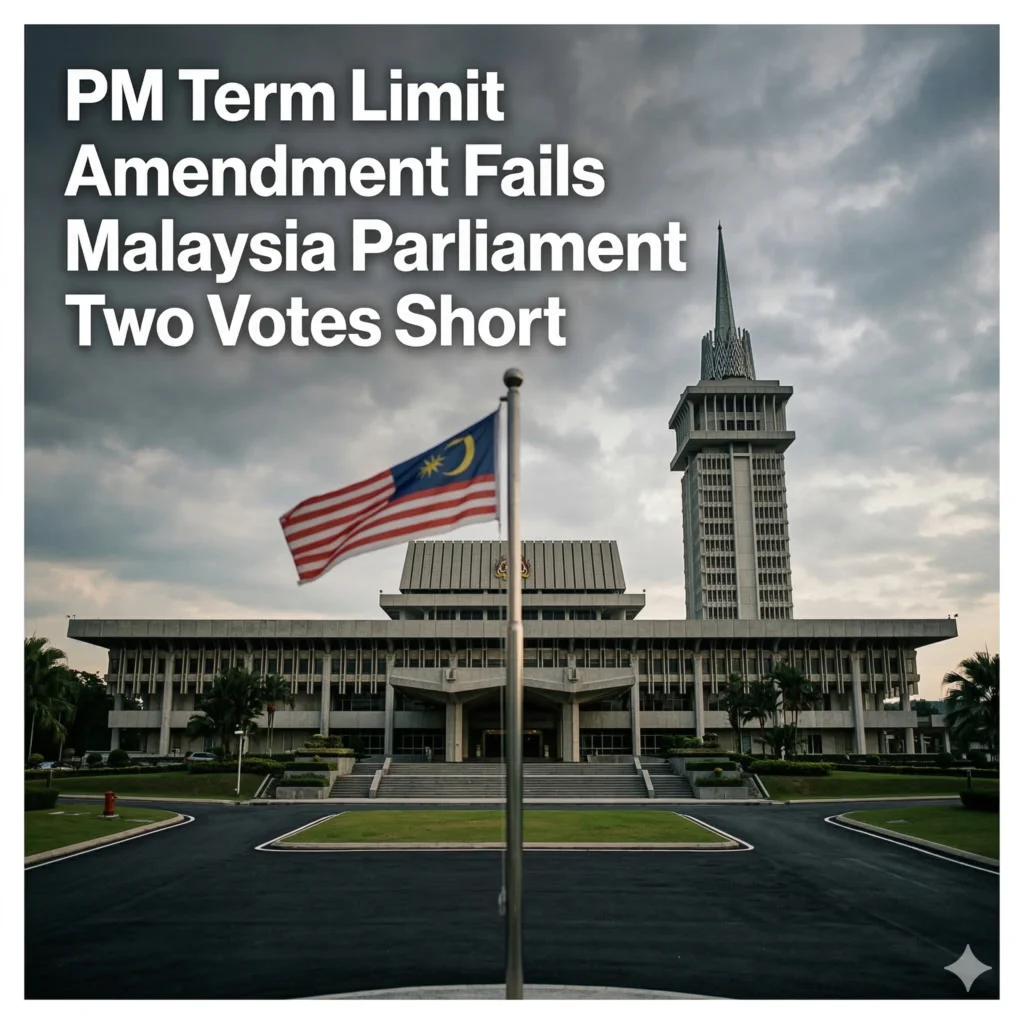
The Historic Vote on Malaysia Prime Minister Term Limit
The atmosphere in the Dewan Rakyat was thick with anticipation as lawmakers gathered to cast their votes on the controversial constitutional amendment. This specific bill required a two-thirds majority to pass, representing a high bar for any sitting government to clear in a multi-party system. Despite weeks of lobbying and public discourse, the final tally fell just short of the 148 votes required for success.
The final count showed 146 members of parliament in favor, leaving the government only two votes shy of a landmark victory. Interestingly, there was no direct opposition recorded in the form of “no” votes, but the high number of abstentions and absences proved fatal. This tactical maneuver by certain factions allowed them to block the bill without publicly appearing to oppose popular democratic reforms.
Prime Minister Anwar Ibrahim, who has championed these reforms since taking office, expressed his disappointment following the announcement of the results. He noted that the amendment was intended to protect the country from the risks of prolonged incumbency and the potential for executive overreach. The failure of this bill now raises questions about the legislative strength of the Unity Government.
Political Setbacks for the Unity Government
The defeat of the Malaysia Prime Minister Term Limit amendment serves as a stark reminder of the fragile nature of the current ruling coalition. While the government technically holds a majority on paper, the absence of 32 lawmakers during such a critical vote indicates a lack of internal discipline. This absenteeism suggests that not all coalition partners are fully aligned with the reformist vision of the Pakatan Harapan core.
Several members of the Barisan Nasional coalition and smaller parties from East Malaysia were notably missing from the chamber when the bells rang. Their absence is being interpreted by many as a silent protest or a bargaining chip for future negotiations. Without the full and reliable cooperation of these blocs, the Prime Minister will struggle to pass any further constitutional changes.
Furthermore, this setback comes at a sensitive time as the country prepares for upcoming state elections in Melaka and Johor. The opposition is likely to seize upon this failure as evidence of a “lame duck” administration that cannot deliver on its core promises. Maintaining momentum in the face of such a public legislative loss will require a significant shift in political strategy.
Malaysia Prime Minister Term Limit
The core objective of the proposed law was to ensure that no individual could hold the office of Prime Minister for more than ten years. This cumulative limit was designed to apply regardless of whether the terms were served consecutively or in separate stints. By imposing this boundary, the government sought to decentralize power and encourage a more vibrant rotation of leadership within political parties.
Arguments in favor of the limit emphasized the importance of preventing the “cult of personality” that often develops around long-serving leaders. In many developing democracies, extended tenures have led to the erosion of institutional checks and balances. Supporters argued that a ten-year window provides ample time for a leader to implement a vision while ensuring they do not become entrenched.
However, the retroactive nature of the proposed amendment was a point of significant contention among veteran politicians. Some felt that applying the rule to current or past service was an attempt to sideline experienced leaders prematurely. This specific clause likely contributed to the hesitation seen among the older guard of the parliamentary membership during the voting process today.
Analyzing the Impact on Future Reforms
The rejection of the Malaysia Prime Minister Term Limit bill casts a long shadow over other pending governance reforms. The administration has promised a suite of changes, including the separation of the roles of the Attorney General and the Public Prosecutor. These shifts are intended to reduce political interference in the legal system and bolster the independence of the judiciary.
Additionally, a new Freedom of Information Act is currently in the drafting stages, aimed at increasing transparency within government departments. However, if the government cannot secure a two-thirds majority for a popular term limit bill, these other complex reforms may face even tougher climbs. Lawmakers may be increasingly hesitant to support changes that alter the traditional power dynamics of the state.
Political analysts suggest that the government must now focus on rebuilding trust and consensus within its own ranks before attempting another major vote. The upcoming mid-year session will be a crucial test of whether the Prime Minister can corral his diverse supporters. Failure to do so could result in a legislative stalemate that lasts for the remainder of the current parliamentary term.
Public Perception and Democratic Accountability
The public reaction to the failure of the Malaysia Prime Minister Term Limit has been a mixture of frustration and resignation. Many voters who supported the Unity Government did so with the expectation that systemic reforms would be the priority. For these citizens, the inability to pass a simple term limit is seen as a betrayal of the reformist mandate.
Civil society organizations have been quick to call out the lawmakers who abstained or were absent, labeling their actions as a disservice to the democratic process. They argue that if the government cannot reform itself, the prospects for wider societal change are dim. This pressure from the grassroots level may force some of the wayward lawmakers to reconsider their positions in the future.
On the other hand, some segments of the population remain wary of rapid constitutional changes, fearing they could lead to instability. The narrative of “stability over reform” is often used by conservative factions to justify maintaining the status quo. Bridging the gap between these two worldviews remains one of the greatest challenges for the current Malaysian leadership as they move forward.
Global Comparisons of Executive Term Limits
When looking at the Malaysia Prime Minister Term Limit in a global context, many successful democracies have similar restrictions in place. The United States, for example, has a strict two-term limit for its presidents, which has generally been credited with ensuring a regular infusion of new ideas. Similarly, many nations in Southeast Asia have experimented with limits to prevent the return of authoritarianism.
In parliamentary systems, term limits are less common because the Prime Minister serves at the pleasure of the legislature rather than through a direct mandate. However, the unique history of Malaysian politics, characterized by long-serving figures, makes the case for such a limit more compelling to many. The failure to align with this global trend of executive accountability may be viewed negatively by international observers.
Foreign investors often look for signs of institutional maturity and the rule of law when deciding where to allocate capital. A failure to pass governance reforms could be interpreted as a sign of political volatility or a lack of commitment to transparency. Ensuring that Malaysia remains competitive on the global stage requires a stable and predictable political environment backed by strong laws.
The Role of East Malaysian Parties in the Vote
The influence of parties from Sabah and Sarawak cannot be understated when discussing the Malaysia Prime Minister Term Limit outcome. These regions hold a significant number of seats and often act as the kingmakers in the federal parliament. Their concerns often center on regional autonomy and the fulfillment of the Malaysia Agreement 1963 (MA63) rather than federal governance structures.
It is speculated that some representatives from these states used the term limit vote as a leverage point to secure concessions on regional issues. If their specific demands regarding resource wealth or administrative independence were not met, they may have chosen to withhold their support. This regional dynamic adds a layer of complexity to any constitutional amendment process in the country.
To move forward, the federal government must find a way to address the specific grievances of East Malaysia while pursuing its national reform agenda. This “quid pro quo” style of politics is a necessary reality in a fragmented parliament. Whether the Prime Minister can satisfy these regional interests without compromising the integrity of his reforms remains to be seen in the coming months.
Strategies for Re-tabling the Term Limit Bill
The government has already signaled its intent to re-table the Malaysia Prime Minister Term Limit motion during the next parliamentary session. This proactive stance is an attempt to show that the administration is not giving up on its core promises. However, simply bringing the same bill back to the floor without changing the underlying political math is unlikely to produce a different result.
In the intervening months, a period of intense consultation and negotiation is expected to take place behind the scenes. The government may need to make adjustments to the retroactive clauses or offer other legislative incentives to win over the holdouts. Building a broader consensus will require a level of political maneuvering that has yet to be fully demonstrated by the current leadership.
There is also the possibility of a public awareness campaign to put pressure on individual members of parliament. By making the term limit a “litmus test” for democratic commitment, the government could make it politically costly for lawmakers to abstain again. However, this strategy carries the risk of further polarizing the legislature and making future cooperation even more difficult.
Looking Toward the Melaka and Johor State Elections
The fallout from the Malaysia Prime Minister Term Limit failure will undoubtedly spill over into the upcoming state elections. Candidates from the ruling coalition will likely face tough questions from voters about their ability to deliver on federal promises. These local contests often serve as a barometer for national sentiment and can influence the behavior of federal lawmakers.
If the ruling parties perform poorly in Melaka and Johor, it could embolden the internal critics of the Prime Minister, leading to further instability. Conversely, a strong showing could provide the political capital needed to force the term limit amendment through in the next session. The stakes for these state-level battles have been significantly raised by the recent events in parliament.
As the political parties gear up for the campaign trail, the narrative of reform versus tradition will be at the forefront. The government will need to craft a compelling message that explains the legislative setback while reinforcing its commitment to the long-term goal. The ability to connect federal policy failures to local concerns will be the key to winning over the undecided electorate in these critical regions.
Conclusion and the Path to Institutional Integrity
The failure of the Malaysia Prime Minister Term Limit amendment is a sobering moment for those who hoped for swift and decisive governance reform. It serves as a vivid illustration of the complexities inherent in modern Malaysian politics, where no single party holds absolute sway. The road to institutional integrity is rarely a straight line, and this defeat is just one chapter in a much larger story.
Ultimately, the success of the Malaysian democratic project depends on the ability of its leaders to put national interests above partisan gain. While the current vote was a setback, it has also sparked a necessary conversation about the nature of power and the importance of leadership turnover. The resilience of the administration will be judged by how it responds to this challenge and whether it can eventually secure the progress it promised.
For more details & sources visit: Fulcrum
Read more about Malaysia news on 360 News Orbit – Malaysia.