
The Hydrogen Retrofit Prototype was officially unveiled today as a landmark achievement in the decarbonization of the European rail industry. This ambitious project, spearheaded by the Latvian firm Digas and Ukraine’s Mikroluch, represents a pivotal shift away from traditional diesel reliance toward sustainable alternatives. By converting an existing DM90 multiple unit into a functional dual-fuel vessel, the engineering team has demonstrated that legacy infrastructure can be effectively integrated into a green future.
The presentation took place at a specialized depot in Zagorz, Poland, where industry experts gathered to witness the successful integration of hydrogen fuel systems within a standard passenger train. This prototype serves as a vital proof of concept for reducing the carbon footprint of non-electrified rail lines across the continent. With successful main line testing already completed, the initiative provides a clear roadmap for transit authorities seeking immediate environmental gains without the massive capital expenditure of entirely new rolling stock.
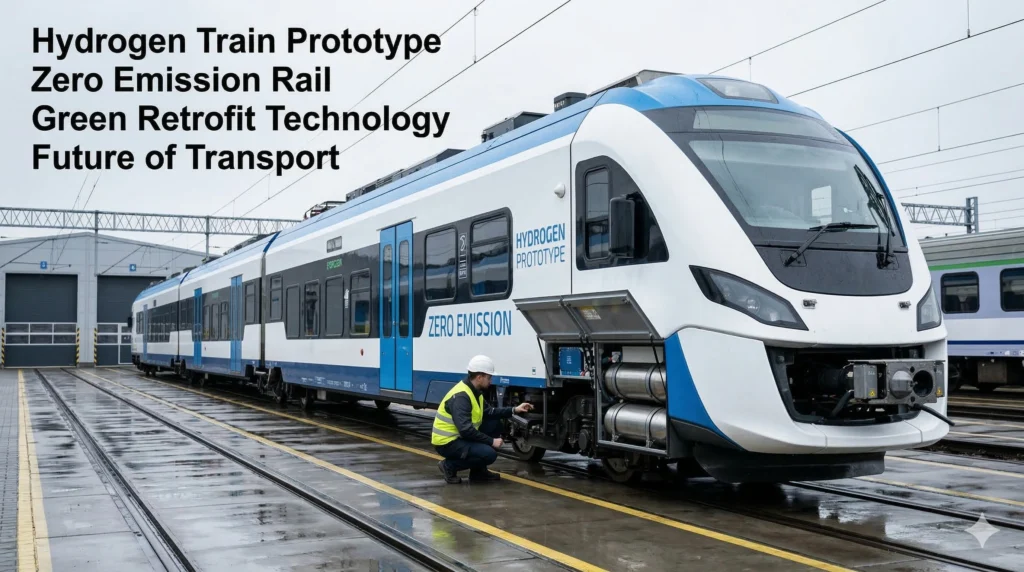
Hydrogen Retrofit Prototype
The engineering phase for this specific Hydrogen Retrofit Prototype was remarkably efficient, requiring only forty-five days for the physical conversion of the rolling stock. During this period, technical teams from Digas and Mikroluch worked meticulously to modify one car of a two-car DM90 unit while leaving the other car in its original diesel configuration. This asymmetrical setup allowed researchers to compare performance metrics directly between the two power sources under identical track conditions. Following the physical assembly, the team dedicated an additional two months to commissioning and rigorous track testing to ensure safety and stability.
The rapid development cycle of the Hydrogen Retrofit Prototype highlights the agility of modern retrofitting technologies compared to the decade-long timelines often associated with new locomotive manufacturing. By focusing on existing chassis, the project avoids the high carbon cost associated with producing new steel and electronic components from scratch. This approach is particularly relevant for regional rail networks in Eastern Europe, where budget constraints often limit the pace of modernization. The Zagorz demonstration proved that the internal combustion engine can be adapted to handle hydrogen without losing the mechanical reliability that diesel engines are known for.
Engineers noted that the control systems embedded within the Hydrogen Retrofit Prototype are the most sophisticated part of the entire conversion package. These systems manage the delicate balance of fuel injection to ensure that combustion remains stable across varying speeds and grades. Because hydrogen has a different energy density and ignition profile than diesel, the software must be highly adaptive to prevent engine knock or efficiency loss. The success of these trials suggests that the software developed by Digas is now ready for broader industrial scaling across different types of heavy machinery.
Environmental Impact of Clean Fuel
The environmental data collected during the testing of the Hydrogen Retrofit Prototype reveals a staggering improvement in air quality metrics. Specifically, nitrogen oxide emissions dropped by over eighty-three percent when the train transitioned from diesel to its hydrogen-rich fuel mode. This reduction is critical for urban areas where rail corridors pass close to residential zones, significantly lowering the public health risks associated with smog. The ability to achieve these results using existing engine blocks makes the technology an attractive bridge for immediate climate action.
Furthermore, the Hydrogen Retrofit Prototype managed to achieve a ninety-six percent reduction in particulate matter emissions during its trial runs. Particulate matter is one of the most stubborn pollutants in the rail sector, contributing to respiratory issues and environmental degradation near tracks. By substituting diesel with hydrogen, the exhaust stream becomes essentially water vapor, effectively eliminating the dark smoke traditionally associated with older DM90 units. This leap in cleanliness aligns perfectly with the European Green Deal’s ambitious goals for the transport sector.
Perhaps most impressively, the Hydrogen Retrofit Prototype entirely eliminated carbon dioxide exhaust during the periods it operated on hydrogen fuel alone. While the current prototype uses a dual-fuel approach for flexibility, the potential for zero-carbon transit is clearly visible in the data. As green hydrogen production increases across Poland and the Baltic states, the carbon intensity of rail travel will continue to plummet. This prototype serves as a tangible reminder that the technology to stop global warming already exists and is being refined today.
Technical Specifications and Range
The current configuration of the Hydrogen Retrofit Prototype includes three specialized hydrogen fuel tanks mounted to provide an initial operational range. Currently, the train can cover sixty kilometers on hydrogen power alone, which is sufficient for short regional hops or shunting operations. While sixty kilometers may seem modest, it provides the necessary data to validate the safety of the high-pressure storage systems under real-world vibration. The engineers have already designed the modular expansion system to increase this capacity for longer commercial routes.
To reach a full commercial standard, the Hydrogen Retrofit Prototype will eventually be equipped with twenty-two hydrogen tanks. This upgrade will extend the total operational range to approximately four hundred forty kilometers, making it suitable for major regional service lines. Such a range would allow the train to operate a full day of service without the need for midday refueling, which is a key requirement for rail operators. The transition from three tanks to twenty-two is a matter of physical space and weight distribution, both of which have been accounted for in the prototype’s design.
The refueling process for the Hydrogen Retrofit Prototype is also being streamlined to match the turnaround times of traditional diesel locomotives. By utilizing high-pressure pumping stations, the time required to fill the tanks can be minimized, ensuring that schedules remain uninterrupted. The collaboration between Polish infrastructure providers and the technical team is essential for creating the “hydrogen valleys” needed to support this tech. Without a robust refueling network, even the most advanced prototype would remain confined to experimental use.
Certification and Commercial Future
The Hydrogen Retrofit Prototype has already secured temporary authorization for main line operations, a significant milestone in the regulatory process. This temporary permit allows the team to gather data in diverse weather conditions and on different track gradients throughout the Polish rail network. Full certification is currently expected within the next six months, provided that all safety benchmarks continue to be met. Once certified, the retrofitted train will be eligible for standard passenger service, marking the start of a new era.
Project officials are already planning the introduction of the Hydrogen Retrofit Prototype into commercial service across various Polish rail corridors. The interest from regional governments is high, as they face increasing pressure to meet emission targets while managing tight budgets. Retrofitting existing trains is significantly cheaper than purchasing new hydrogen-powered fleets from major global manufacturers. This cost-effectiveness makes the Digas solution a prime candidate for rapid deployment across the European Union’s less affluent regions.
The economic viability of the Hydrogen Retrofit Prototype remains a topic of intense study by the Hyiptrain project partners. Currently, the price of green hydrogen is fluctuating, often remaining higher than subsidized diesel fuel in certain markets. However, as carbon taxes increase and the production of hydrogen scales up, the price gap is expected to close rapidly by the end of the decade. The prototype is essentially “future-proofing” the rail industry, ensuring that operators are ready to switch fuels the moment the economics become favorable.
Innovation in Engine Control
The success of the Hydrogen Retrofit Prototype is largely due to the innovative engine control systems developed by the Latvian firm Digas. These systems must monitor the combustion process in real-time, adjusting the air-to-fuel ratio thousands of times per second. Because hydrogen burns faster than diesel, the timing of the injection must be perfect to ensure maximum thermal efficiency. These refinements are what allow the Hydrogen Retrofit Prototype to maintain the same torque and pulling power as its original diesel version.
- Advanced sensors monitor the temperature of the exhaust manifold to prevent overheating during high-load operations.
- The control unit integrates with the existing train management system to provide seamless transitions between fuel types.
- Data logging features allow engineers to remotely monitor the health of the hydrogen fuel cells and storage tanks.
- Redundant safety valves are programmed to vent hydrogen safely in the event of a pressure spike or mechanical failure.
By focusing on the software layer, the team has created a portable technology package that can be applied to many different engine models. The Hydrogen Retrofit Prototype is just the first step in creating a library of digital engine profiles for various locomotives. This flexibility ensures that the project’s impact will be felt far beyond the specific DM90 units used in the Polish trials. As more data is gathered, the control algorithms will become even more efficient, further reducing fuel consumption.
Infrastructure and Regional Development
The deployment of the Hydrogen Retrofit Prototype in southeastern Poland is a strategic choice meant to boost regional development. Zagorz, being a key rail hub in the Podkarpackie Voivodeship, provides the perfect environment for testing regional rail solutions. By centering the project here, the Hyiptrain partners are helping to create a local ecosystem of high-tech jobs and green energy expertise. This regional focus ensures that the benefits of the energy transition are felt by local communities, not just major metropolitan centers.
- Local maintenance crews are being trained on the specific safety protocols required for handling high-pressure hydrogen systems.
- The presence of the prototype encourages local investment in hydrogen production facilities and distribution networks.
- Regional rail authorities can use the data from the Zagorz trials to plan their long-term fleet modernization strategies.
- Educational partnerships with local universities are being explored to foster the next generation of rail engineers.
As the Hydrogen Retrofit Prototype continues its test runs, it serves as a moving billboard for European innovation and cooperation. The partnership between Latvian, Ukrainian, and Polish entities demonstrates the power of cross-border collaboration in solving global challenges. This synergy is essential for creating a unified European rail area that is both efficient and environmentally responsible. The project proves that even in challenging economic times, significant progress can be made through clever engineering and shared vision.
Safety and Reliability Benchmarks
Safety was the primary concern during the development of the Hydrogen Retrofit Prototype, given the volatile nature of hydrogen fuel. The storage tanks are constructed from high-strength carbon fiber composites, designed to withstand extreme impacts and thermal stress. During the track testing phase, the prototype was subjected to various vibration and shock tests to ensure the integrity of the fuel lines. Every component of the Hydrogen Retrofit Prototype meets or exceeds the current European safety standards for rail transport.
- Automated leak detection systems are installed throughout the engine compartment and passenger areas to provide early warnings.
- The hydrogen tanks are located in a protected area of the car to minimize the risk of damage in the event of a collision.
- Emergency shutdown procedures have been simplified so that train operators can isolate the fuel system with a single command.
The reliability of the Hydrogen Retrofit Prototype has been equally impressive, with no major mechanical failures reported during the initial track trials. This stability is crucial for gaining the trust of rail operators who cannot afford disruptions to their daily schedules. By maintaining the core diesel engine architecture, the design provides a “fail-safe” mode where the train can continue to operate on diesel if the hydrogen system encounters an issue. This hybrid approach reduces the risk for early adopters of the technology.
Scalability and Future Outlook
The Hydrogen Retrofit Prototype is designed with scalability in mind, allowing for the conversion of entire fleets rather than just single units. The modular nature of the fuel system means that it can be adapted for larger freight locomotives or smaller shunting engines. As the Hyiptrain project enters its next phase, the focus will shift toward industrializing the conversion process to reduce costs and lead times. The ultimate goal is to make the Hydrogen Retrofit Prototype a standard option for rail operators worldwide.
The global market for rail retrofitting is expected to grow significantly as countries strive to meet their 2050 net-zero commitments. The Hydrogen Retrofit Prototype positions the project partners at the forefront of this emerging industry. By proving that hydrogen can be used safely and effectively in existing trains, they have removed one of the biggest barriers to the adoption of clean energy in the rail sector. The lessons learned in Poland will undoubtedly influence rail policy and engineering across the globe for years to come.
As the Hydrogen Retrofit Prototype moves toward its final certification, the excitement within the rail community is palpable. This project is more than just a technical exercise; it is a vision of a cleaner, quieter, and more efficient transport system. The sight of a refurbished DM90 unit gliding through the Polish countryside with zero emissions is a powerful symbol of what can be achieved when innovation meets determination. The Hydrogen Retrofit Prototype is truly the first of many steps toward a sustainable rail legacy.
Conclusion
The Hydrogen Retrofit Prototype represents a triumph of modern engineering and environmental stewardship. By successfully converting a diesel train to run on hydrogen, the Hyiptrain project has provided a viable solution for the greening of the rail industry. The significant reductions in harmful emissions and the preservation of existing assets make this a win-win scenario for both the environment and the economy. As we look toward the future, the success of the Hydrogen Retrofit Prototype will serve as a foundation for a new generation of clean transport.
The ongoing refinements to the Hydrogen Retrofit Prototype will ensure that it remains at the cutting edge of technology. With full commercial service on the horizon, the dream of zero-emission rail travel is becoming a reality. The partners involved in this project have shown that the path to a sustainable future is not just about new inventions, but about reimagining what we already have. The Hydrogen Retrofit Prototype is a testament to the fact that the rail industry is ready to lead the charge in the global fight against climate change.
In the coming months, as more data is released and the prototype achieves full certification, the world will be watching. The Hydrogen Retrofit Prototype has proven that the transition to green energy does not have to be slow or prohibitively expensive. It is a bold statement of intent from the European rail sector, signaling that the age of diesel is drawing to a close. We can all look forward to a future where the Hydrogen Retrofit Prototype is the rule, rather than the exception, on our railway tracks.
For more details & sources visit: International Railway Journal
Read more on Poland news: 360 News Orbit – Poland.