
The NATO Turkey Iran missile intercept incident has sent shockwaves through the international community as of March 9, 2026. This Monday, alliance systems successfully neutralized an Iranian ballistic missile that had breached Turkish national airspace, marking a dangerous escalation in regional hostilities. This event represents the second time in a single week that a projectile launched from Iran has been intercepted by the collective defense framework. Unlike the previous engagement, which occurred just outside of the border, this specific missile was downed directly over sovereign Turkish territory. The Turkish Defence Ministry has since issued a stern warning, promising to take all necessary measures to protect its citizens.
The NATO Turkey Iran missile intercept highlights the growing volatility along the alliance’s eastern flank. Debris from the destroyed weapon fell in a highly strategic region situated between a critical western airbase and an eastern radar installation. Both of these military facilities are currently utilized by United States and NATO forces to maintain regional security and monitor Iranian military movements. While the Turkish Defence Ministry reported no casualties or significant injuries from the falling fragments, the proximity to high-value military assets has raised the threat level significantly. Government officials in Ankara are now weighing their next strategic moves in response to these repeated incursions.
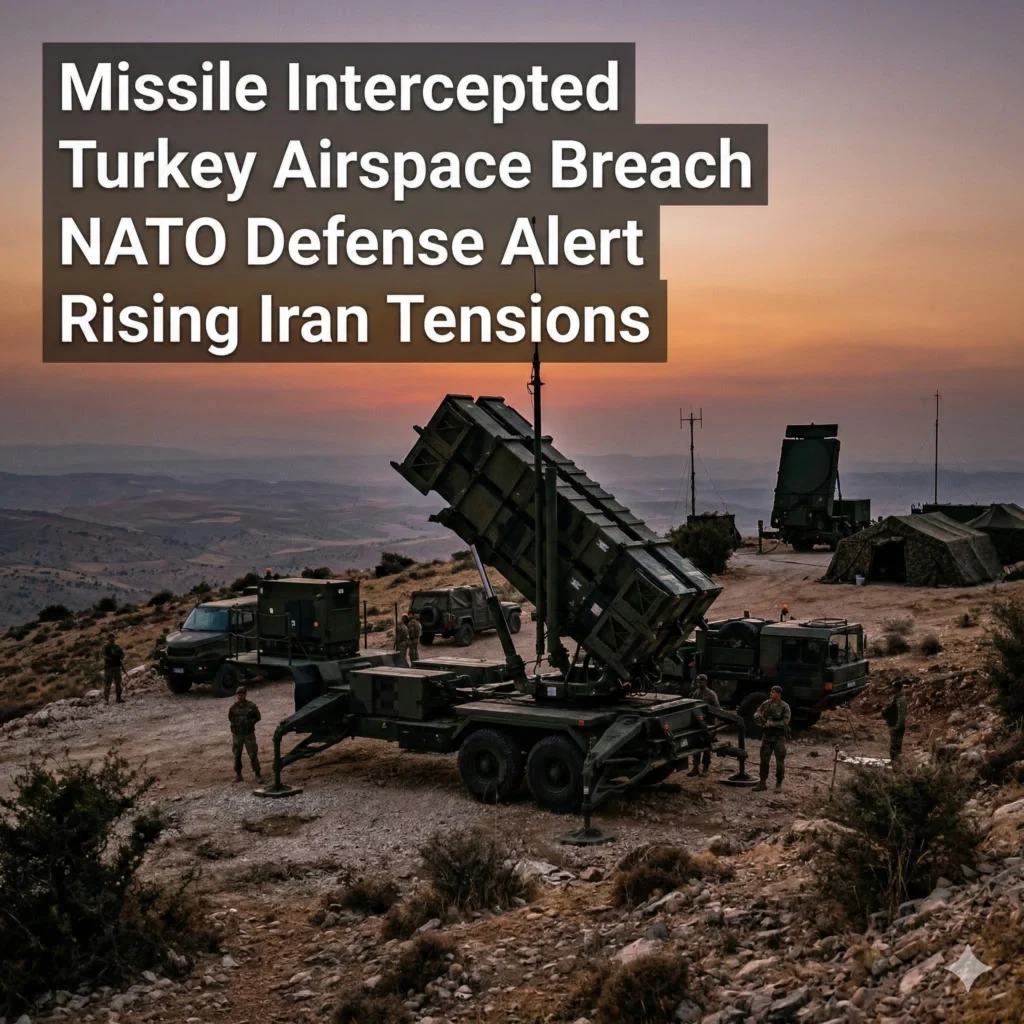
NATO Turkey Iran missile intercept
The NATO Turkey Iran missile intercept serves as a definitive test for the alliance’s integrated air and missile defense systems. By successfully tracking and destroying a high-speed ballistic target over a populated sovereign state, the alliance has demonstrated its technical readiness. Turkey, which possesses the second-largest army within NATO, remains a cornerstone of the Western defense strategy in the Middle East. The Ministry emphasized that any threat directed at the country’s territory will be met with immediate action without any hesitation. This “zero-tolerance” policy is designed to deter Tehran from testing the alliance’s resolve further in the coming days.
Observers note that the NATO Turkey Iran missile intercept is not just a military event but a profound diplomatic challenge. Despite the increasing frequency of these aerial incursions, Turkey has not yet formally requested additional “Article 5” protection from other member blocs. However, the Turkish government had previously warned Tehran on Saturday against conducting further attacks following the first incident earlier in the week. The fact that a second launch occurred so soon suggests a deliberate provocation by Iranian forces. The alliance now faces the difficult task of de-escalating the situation while maintaining a credible defensive posture.
Strategic Implications for Regional Security
The geographical location of the NATO Turkey Iran missile intercept is particularly sensitive due to its proximity to joint US-NATO facilities. These bases are essential for intelligence gathering and providing a rapid response to threats emerging from the Middle East conflict. If Iranian missiles continue to target or pass through this corridor, it may force NATO to deploy additional Patriot or SAMP/T batteries to the region. The Ministry of Defence in Ankara is currently conducting a full forensic analysis of the missile debris to determine the exact model and flight path. This data will be shared with alliance partners to refine future interception algorithms.
Furthermore, the NATO Turkey Iran missile intercept underscores the importance of the land border between Turkey and the Islamic Republic of Iran. This shared boundary makes Turkey the most vulnerable NATO member to direct Iranian aggression. The alliance’s spokesperson reaffirmed on Monday that NATO remains in a state of high readiness to defend the territorial integrity of all members. This statement is intended to reassure the Turkish public and signal to Tehran that the entire alliance stands behind Ankara. The military coordination between Turkish command and NATO’s air defense center in Germany has been described as seamless during both incidents.
Iranian Aggression and NATO Readiness
The motives behind the launches leading to the NATO Turkey Iran missile intercept remain a subject of intense debate among international observers. Some suggest that Iran is testing the response times and signature detection capabilities of NATO’s radar installations. Others believe these are stray projectiles intended for other regional targets that have malfunctioned or been miscalculated. Regardless of the intent, the result is a direct violation of Turkish sovereignty that NATO cannot ignore. The repeated nature of these events suggests that the initial warnings from Ankara were not sufficiently heeded by military commanders in Tehran.
- NATO utilizes a multi-layered defense shield involving Aegis ships and land-based interceptors.
- Turkish F-16s were scrambled during the NATO Turkey Iran missile intercept as a secondary precaution.
- The alliance’s “Persistent Eye” surveillance drones are now providing 24/7 coverage of the border.
- Public sentiment in Turkey is shifting toward a more muscular response to cross-border threats.
The readiness of the alliance was proven during the NATO Turkey Iran missile intercept, but the long-term sustainability of this defensive posture is being questioned. Frequent interceptions are costly and place a significant strain on personnel and hardware. If the launches continue, NATO may need to consider offensive counter-battery measures to neutralize launch sites before the missiles can reach alliance airspace. For now, the focus remains strictly on defensive operations and preventing any loss of life on Turkish soil. The Ministry of Defence continues to coordinate closely with the Turkish General Staff to monitor the situation.
Diplomatic Fallout and Ankara’s Warning
The diplomatic fallout from the NATO Turkey Iran missile intercept has been immediate, with several European capitals condemning the breach of airspace. Turkey’s position as a bridge between the East and West makes its security a priority for the entire global community. Government officials in Ankara have summoned the Iranian ambassador to deliver a formal protest and demand an immediate cessation of all missile activity near the border. The Turkish warning on Saturday was clear, yet the Monday incident proves that diplomatic channels may be failing to restrain the current escalation.
In the wake of the NATO Turkey Iran missile intercept, there are growing calls for a special North Atlantic Council meeting to discuss the Iranian threat. Such a meeting would allow member states to coordinate a unified political response and perhaps implement new sanctions against the Iranian missile program. Turkey’s role in NATO is more critical than ever, and its colleagues in Washington and Brussels are acutely aware of the risks Ankara is taking. The alliance’s unity is its greatest strength, and the successful interception on Monday is a visible manifestation of that collective power.
Technical Analysis of the Ballistic Intercept
The technical execution of the NATO Turkey Iran missile intercept involved a complex network of satellite sensors and ground-based radars. Upon detection of a launch in Iran, the NATO Integrated Air and Missile Defence System (NATINAMDS) calculated the trajectory in real-time. The decision to fire was made within seconds to ensure the target was neutralized while still at a high altitude. This precision is what prevented the debris from causing significant damage to the military installations or nearby civilian areas. The successful operation is a testament to the billions of dollars invested in alliance technology over the last decade.
- Trajectory calculation performed by the Ramstein Air Base command center.
- Interceptor missiles launched from a mobile battery in eastern Turkey.
- Use of X-band radar for high-resolution tracking of the ballistic warhead.
- Coordination with US naval assets in the Mediterranean for secondary tracking.
The NATO Turkey Iran missile intercept proves that the alliance’s hardware can handle modern ballistic threats. However, the density of the debris cloud following the explosion remains a concern for local environmental and safety agencies. Specialized teams have been deployed to the impact zone to recover as much of the missile as possible for intelligence purposes. Analyzing the guidance systems and fuel types used in these Iranian missiles provides invaluable information for future defense planning. This technical feedback loop is essential for maintaining the “overmatch” capability of the NATO alliance.
Future Outlook for the Turkish Border
As the week progresses, the situation following the NATO Turkey Iran missile intercept remains extremely tense. The Turkish army has reportedly increased its readiness levels at all border outposts and has moved additional armored units to the east. While Turkey has not yet asked for more NATO troops, the framework for such a request is already in place if the situation deteriorates further. The focus of the international community is now on whether Iran will heed the latest “immediate action” warning from the Turkish Defence Ministry. Any further incursion would likely trigger a much more severe response from both Ankara and the alliance.
Observers are also watching for any signs of a humanitarian impact if the conflict continues to spill over the border. For now, the NATO Turkey Iran missile intercept has protected the civilian population, but the psychological toll of living under a “missile umbrella” is significant. The Turkish government is working to reassure its citizens that their skies are safe and that the alliance is fully committed to their protection. The coming days will be a critical period for regional diplomacy and military posturing. The world is watching to see if the NATO Turkey Iran missile intercept remains an isolated incident or becomes the start of a broader confrontation.
NATO’s Readiness and Alliance Solidarity
The successful NATO Turkey Iran missile intercept has reinforced the concept of alliance solidarity during a time of global uncertainty. Each member state contributes to the collective defense, and the protection of Turkey is as important as the protection of any other sovereign member. The NATO spokesperson’s reaffirmation of readiness was more than just rhetoric; it was a statement of operational fact. The alliance’s ability to respond to a crisis in the Middle East while simultaneously managing other global tensions is a sign of its enduring relevance. The coordination seen on Monday is a model for future multi-national defense operations.
The NATO Turkey Iran missile intercept also sends a clear message to other potential aggressors that the alliance’s borders are not to be trifled with. The technology and training that went into this interception are the result of decades of cooperation and shared investment. As Turkey continues to modernize its own domestic defense industry, its integration with NATO systems will only become more robust. The current crisis is a stark reminder of why such alliances are necessary in a world where ballistic technology is becoming more accessible. The sky over Turkey remains guarded by the most advanced defense network in human history.
Conclusion and Final Assessment
In conclusion, the NATO Turkey Iran missile intercept on March 9, 2026, is a watershed moment for Mediterranean and Middle Eastern security. The double interception within a week proves that the threat is real and that the defense systems are operational. Turkey’s firm stance and NATO’s technical execution have combined to prevent a major escalation, but the underlying tension remains. The international community must now find a way to address the source of these launches to ensure that the Turkish people can live in peace. The alliance stands ready, the missiles are tracked, and the sovereignty of Turkey remains intact.
The NATO Turkey Iran missile intercept will be studied by military academies for years to come as a textbook example of ballistic defense in a high-stakes environment. The lessons learned from the debris and the radar data will inform the next generation of interceptor technology. For the people of Turkey, the events of Monday are a reminder of their nation’s strategic importance and the strength of their allies. The focus now shifts to the diplomatic arena, where the goal is to prevent a third incident from occurring. The resolve shown by NATO in the face of Iranian aggression remains the primary deterrent against a wider regional war.
For more details & sources visit: Reuters
Read more on Turkey news: 360 News Orbit – Turkey