
The Global Oil Crisis forced the Punjab provincial government to announce the immediate closure of all schools and universities this Monday morning to conserve dwindling national resources. This drastic decision impacts millions of students across schools, colleges, and universities as the administration attempts to address severe economic challenges and fuel shortages. Official statements from the provincial cabinet specifically linked this move to the escalating conflicts in the Middle East, which have disrupted traditional supply chains. Consequently, surging international prices have placed immense mounting pressure on the provincial economy, necessitating a total suspension of academic activities to limit non-essential travel across the region.
Government representatives stated that the Global Oil Crisis measures are designed to prioritize fuel for essential services like healthcare and food distribution. In addition to the educational shutdown, the administration has confirmed a mandatory reduction in fuel allowances provided to various categories of government employees. Officials emphasized that reducing consumption is the only way to navigate high procurement costs while international markets remain volatile. Students were seen vacating campuses shortly after the announcement, as faculty members expressed deep concerns regarding the long-term disruption to the academic calendar and upcoming examinations.
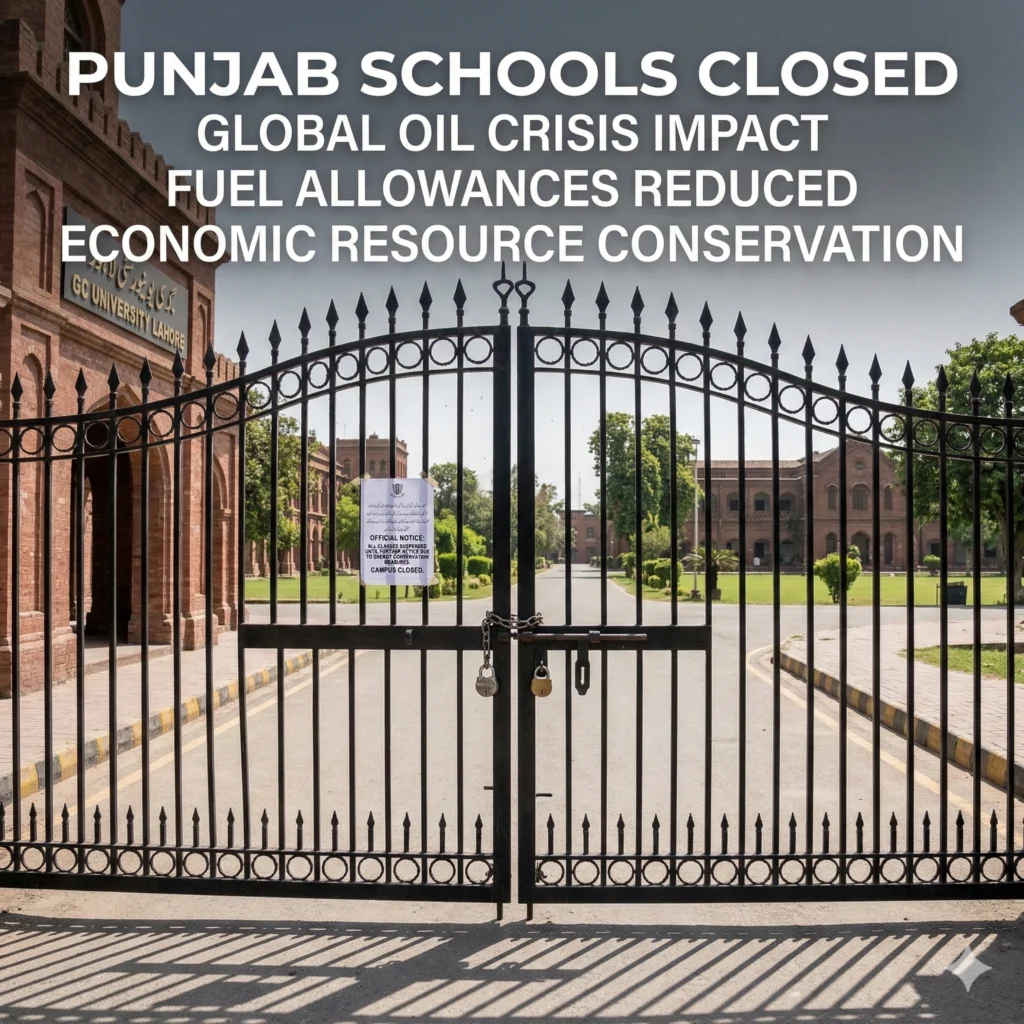
Global Oil Crisis Impact on Pakistan
The Global Oil Crisis has fundamentally altered the daily lives of citizens in Punjab as the government struggles to maintain a balance between demand and supply. Since the conflict in the Middle East intensified, the cost of importing refined petroleum products has nearly doubled, leading to a massive drain on foreign exchange reserves. To prevent a total blackout of the transportation sector, the provincial authorities decided that closing educational institutions was a necessary sacrifice. This policy aims to take thousands of school buses and private vans off the roads, effectively saving millions of liters of petrol and diesel on a weekly basis.
Furthermore, the Global Oil Crisis has triggered a ripple effect across the local market, with the prices of basic commodities rising due to increased transportation costs. The provincial government has not yet provided a specific date for when regular operations might resume, stating that they will conduct regular reviews based on international market stability. Authorities have urged the public to cooperate with these restrictive measures to ensure the efficient use of limited national resources during this period of uncertainty. Many experts suggest that without a diplomatic resolution to the Middle East hostilities, these austerity measures could become a semi-permanent feature of the local economy.
Mandatory Fuel Allowance Cuts
A key component of the provincial response to the Global Oil Crisis involves a significant reduction in the fuel quotas allocated to government officials and departments. This move is intended to show the public that the administration is willing to lead by example during times of extreme financial hardship. By cutting these allowances by 40%, the government hopes to save enough fuel to power emergency services for several additional weeks. This decision has met with some internal resistance, yet the cabinet remains firm that everyone must contribute to the national conservation effort to avoid a complete societal shutdown.
Moreover, the reduction in fuel allowances is being monitored through a new digital tracking system to ensure compliance across all provincial departments. This transparency is crucial for maintaining public trust as the Global Oil Crisis continues to take a toll on the average household’s budget. Officials have clarified that while administrative staff will face cuts, field officers involved in law enforcement and disaster management will receive a more flexible allocation. This targeted approach ensures that the most critical functions of the state are not compromised by the ongoing energy scarcity in the region.
Academic Disruption and Student Concerns
The sudden closure of schools and universities due to the Global Oil Crisis has left the academic community in a state of deep anxiety and confusion. Students who were preparing for final examinations now face an indefinite delay, which could push back graduation dates and impact future employment opportunities. Faculty members are currently exploring the possibility of transitioning to online learning, although the frequent power outages caused by the energy shortage make this a difficult task for many. The provincial education department is working on a contingency plan to provide recorded lectures to those without stable internet connections.
- Students in rural areas are particularly vulnerable to the digital divide, as they lack the hardware needed for remote education.
- Many private schools have expressed concern over the loss of tuition revenue, which may lead to staff layoffs if the closure persists.
- Higher education institutions are worried about the impact on research projects that require physical access to laboratories.
- The suspension of the school meal program in certain districts has raised concerns about the nutritional status of underprivileged children.
Despite these challenges, the government maintains that the Global Oil Crisis leaves them with no other viable alternative. The focus remains on physical safety and resource management until the international shipping lanes are cleared and oil prices stabilize. The psychological impact on students, who have already endured several years of interrupted learning due to various global events, is a major concern for child psychologists in Lahore. As the campuses remain empty, the long-term cost of this “educational pause” continues to be debated in every household across the province.
Economic Pressure on the Provincial Budget
The financial strain of the Global Oil Crisis on the Punjab budget has reached unprecedented levels, forcing the finance department to reallocate funds from development projects to fuel subsidies. The surging cost of energy has disrupted the provincial growth targets, as the manufacturing sector also faces reduced operating hours to save power. Economists warn that if the crisis continues for another quarter, the province could face a significant recession. The government is currently in talks with federal authorities to secure a special grant that would allow for the emergency purchase of oil shipments.
In the meantime, the Global Oil Crisis has forced a total freeze on new government hiring and a suspension of non-essential infrastructure projects. Every available rupee is being diverted toward maintaining the supply of electricity and gas to the industrial heartlands of the province. This “war footing” approach to economics is designed to prevent a total collapse of the supply chain, which would lead to food shortages and civil unrest. The provincial leadership is appealing to international lenders for flexible repayment terms to ease the immediate cash flow problem caused by the global energy market’s volatility.
Public Cooperation and Resource Management
As the Global Oil Crisis worsens, the provincial government has launched a massive public awareness campaign to encourage energy conservation at the grassroots level. Citizens are being asked to carpool, use public transport where available, and limit the use of air conditioning and heavy appliances during peak hours. The message is that individual actions, when combined across a population of over 100 million, can have a significant impact on the total fuel demand. This collective effort is seen as the only way to manage the limited reserves until new shipments arrive at the national ports.
- Local community leaders have been tasked with monitoring energy waste in their neighborhoods and reporting violations of austerity rules.
- The use of decorative lighting in commercial areas has been banned to reduce the load on the provincial power grid.
- Farmers are being encouraged to adopt more fuel-efficient irrigation techniques to protect the upcoming harvest.
- Public transport fleets are being prioritized for fuel delivery to ensure that essential workers can still commute to their jobs.
This spirit of cooperation is essential for navigating the Global Oil Crisis without resorting to even more restrictive measures. While the closure of schools is a heavy burden, the government hopes that by acting now, they can prevent a total collapse of the energy system later. The resilience of the people of Punjab is being tested once again, but the administration remains optimistic that a unified response will see the province through this difficult period. Regular updates are being provided through all media channels to keep the public informed of the latest developments in the global oil market.
Monitoring International Oil Market Stability
The Punjab government has established a special monitoring cell to track the Global Oil Crisis and its impact on the local economy in real-time. This cell coordinates with international energy analysts and the federal petroleum ministry to predict price movements and supply arrivals. Based on this data, the provincial cabinet meets every forty-eight hours to decide whether to extend the closure of educational institutions or allow for a partial reopening. The goal is to be as responsive as possible to the changing geopolitical landscape, ensuring that the restrictions are not kept in place longer than absolutely necessary.
The focus remains on the Middle East, where any de-escalation of the conflict would lead to an immediate drop in oil prices and an easing of the Global Oil Crisis. However, as long as the military engagements continue, the provincial administration is prepared for a long-term austerity regime. This includes the possibility of introducing a four-day work week for all sectors to further reduce the national fuel consumption. The monitoring cell also tracks the domestic reserves of petrol and diesel, providing a daily “dashboard” to the Chief Minister to guide the province’s energy policy.
Impact on the Transport and Logistics Sector
The logistics sector has been hit particularly hard by the Global Oil Crisis, with many trucking companies struggling to stay afloat as diesel prices soar. This has led to a slowdown in the movement of goods from the ports to the interior of Punjab, resulting in some empty shelves in the larger supermarkets. The government has responded by creating a “green lane” for essential cargo, ensuring that trucks carrying food and medicine receive priority access to fuel at the pump. This measure is crucial for preventing a secondary crisis of supply shortages during the energy emergency.
Furthermore, the Global Oil Crisis has forced many private transport operators to increase their fares, making it difficult for the average citizen to afford daily travel. To mitigate this, the provincial government is considering a temporary subsidy for public buses, although the budget for such a move is extremely limited. The disruption to the transport sector also means that even if schools were to reopen, many students would struggle to find affordable transportation to get to their campuses. The interconnected nature of the energy and transport sectors means that a solution to one is required to fix the other.
The Long-term Shift Toward Renewable Energy
If there is a silver lining to the Global Oil Crisis, it is the renewed focus on shifting the province’s energy mix toward more sustainable and domestic sources. The government has announced a new initiative to provide subsidized solar panels to schools and hospitals, ensuring that they can function independently of the national grid. By investing in renewable energy now, Punjab can protect itself from future international oil shocks and reduce its carbon footprint. This transition is a key part of the “Punjab Vision 2030” plan, which has been accelerated by the current crisis.
The Global Oil Crisis has made it clear that a heavy reliance on imported fossil fuels is a major strategic vulnerability for the province. Plans are also being drawn up to introduce electric buses in the major cities of Lahore, Faisalabad, and Multan to further decouple the transport sector from the oil market. While these changes will take years to fully implement, the current emergency has provided the political will needed to push through these difficult reforms. The transition to green energy is seen not just as an environmental goal, but as a fundamental pillar of national security and economic independence.
Conclusion and the Path Forward
In conclusion, the Global Oil Crisis has forced the Punjab government into a corner, necessitating the closure of educational institutions and the reduction of fuel allowances. While these measures are painful and disruptive, they are essential for managing the province’s limited resources during a time of global instability. The focus remains on protecting the most vulnerable sectors of the economy while waiting for the international oil market to stabilize. The resilience and cooperation of the public will be the deciding factor in how successfully Punjab navigates this challenging period.
As we look toward the future, the lessons learned from this Global Oil Crisis will undoubtedly shape the province’s energy and education policies for years to come. The move toward digital learning and renewable energy is no longer a choice but a necessity for a province that wants to thrive in the 21st century. The government’s commitment to transparency and lead-by-example leadership will be crucial in maintaining the social contract during this period of austerity. By working together, the people and the administration of Punjab can turn this crisis into an opportunity for lasting structural reform and a more secure energy future.
For more details & sources visit: Pakistan Today
For the latest updates from Pakistan, visit our Pakistan news page.