
The National Energy Conservation Plan was finalized by the Pakistani federal government on Tuesday to mitigate the catastrophic impact of potential fuel supply disruptions in the Strait of Hormuz. Prime Minister Shehbaz Sharif is scheduled to chair an emergency review meeting this afternoon to formally approve a series of aggressive austerity measures aimed at reducing the national import bill. This comprehensive strategy follows a period of extreme volatility in global energy markets triggered by ongoing military escalations in the Middle East. Under the new guidelines, the government will implement work-from-home policies and virtual schooling to drastically cut down on daily petroleum consumption across all major urban centers in the country.
Finance Minister Muhammad Aurangzeb noted that international oil price hikes could increase the national import bill by approximately 600 million dollars monthly if consumption is not immediately curtailed. Authorities are also prepared to launch a nationwide crackdown on the hoarding and smuggling of petroleum products to ensure that price stability is maintained for the general public.
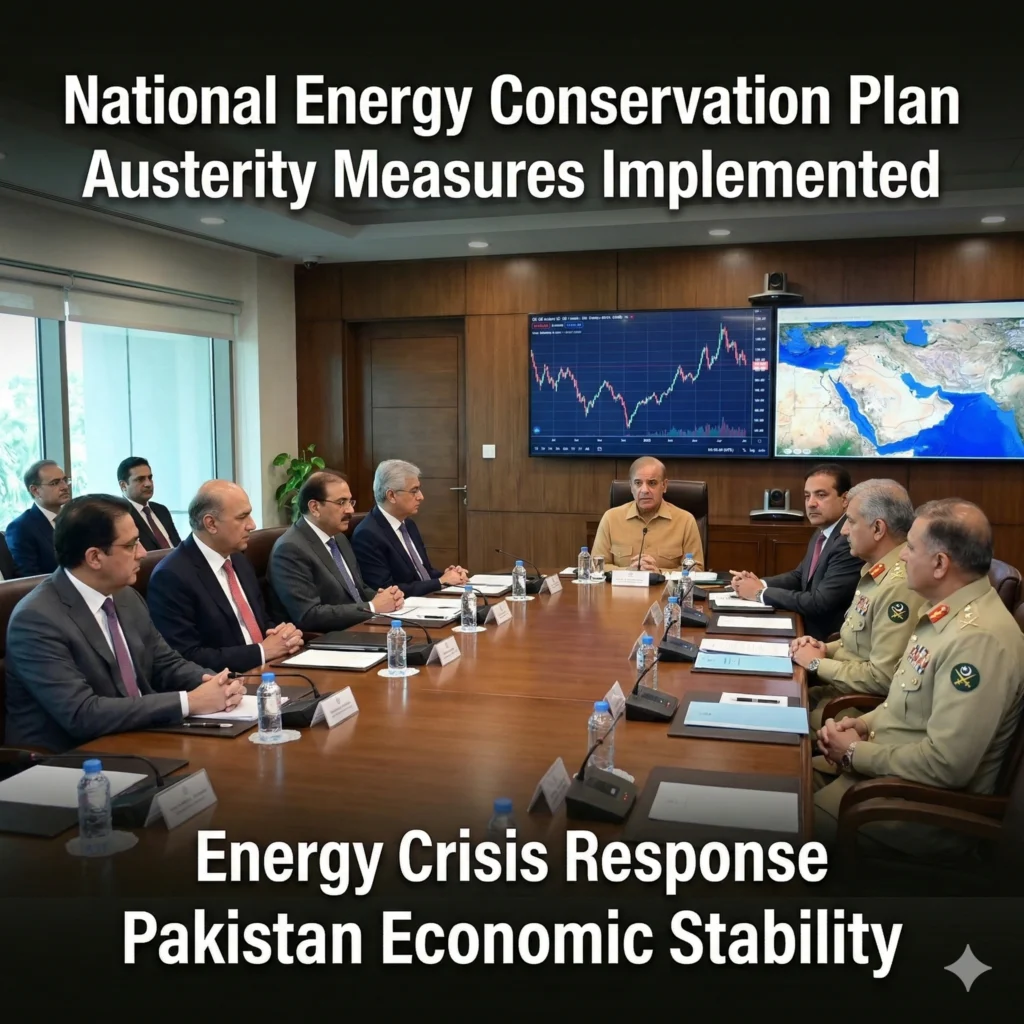
National Energy Conservation Plan
The National Energy Conservation Plan represents a three-phase approach designed to safeguard the Pakistani economy from external energy shocks while ensuring internal stability. In the initial phase, government buildings will enforce limited attendance and transition non-essential staff to remote work arrangements to save electricity and fuel. The second phase involves the corporate sector, where businesses are encouraged to adopt similar work-from-home models to reduce the load on the national grid and transportation networks. Finally, the third phase will see the implementation of virtual learning platforms for schools and universities to minimize the movement of vehicles on a daily basis.
Furthermore, the National Energy Conservation Plan ensures that essential sectors such as agriculture and large-scale manufacturing remain exempt from these austerity measures to protect domestic production. This strategic carve-out is intended to prevent a total economic slowdown while still achieving significant reductions in overall national energy demand. The Prime Minister has emphasized that the elite and privileged classes must take the lead in adopting these simplicity measures to foster a sense of national unity. By centralizing the monitoring of petroleum reserves through a new joint dashboard, the government aims to prevent the artificial shortages that often plague the market during times of international crisis.
Phased Strategy for Public Sector Austerity
The implementation of the National Energy Conservation Plan begins with the public sector, where immediate changes to working hours and office environments are expected to yield rapid results. Government departments have been instructed to reduce their cooling and lighting loads by 30% through the use of natural ventilation and optimized scheduling. Additionally, the use of official vehicles for non-essential travel has been strictly prohibited under the new federal guidelines. These internal reforms are viewed as a necessary precursor to asking the private sector and the general public to make similar sacrifices for the national interest.
By focusing on the public sector first, the government aims to demonstrate the feasibility of the National Energy Conservation Plan before moving into more sensitive areas of the economy. Officials have confirmed that the health sector and emergency services will be fully exempt from attendance restrictions to ensure that public safety is not compromised. This balanced approach is designed to maximize energy savings without disrupting the basic functions of the state. As the first week of implementation concludes, data from the new monitoring dashboard will be used to refine the strategy and address any logistical bottlenecks that may arise.
Corporate Sector and Virtual Learning Transitions
A major pillar of the National Energy Conservation Plan involves the transition of the corporate workforce and the educational system to digital platforms. By reintroducing the work-from-home models that were perfected during previous global emergencies, the government expects to save millions of liters of petrol every month. Large corporations in cities like Karachi, Lahore, and Islamabad are already preparing their IT infrastructures to support a fully remote or hybrid workforce starting next week. This shift not only saves fuel but also reduces the peak demand for electricity in commercial districts during the hottest parts of the day.
The education department is simultaneously preparing to launch virtual schooling for millions of students to further reduce the national carbon footprint and fuel usage. While this move has sparked some debate regarding the digital divide, the government has promised to provide subsidized internet packages for students in rural areas. The National Energy Conservation Plan views this as a temporary but necessary measure to navigate the current Middle East supply crisis. By keeping school buses and private vans off the road, the authorities can divert precious fuel reserves to the industrial and agricultural sectors where they are needed most for economic survival.
Curbing Smuggling and Market Hoarding
To support the National Energy Conservation Plan, the federal government has authorized a massive security operation to curb the smuggling of petroleum products across international borders. Intelligence reports suggest that illegal outflows have contributed significantly to the local supply crunch and price instability in recent weeks. Law enforcement agencies have been directed to establish new checkpoints and use drone surveillance to monitor known smuggling routes in the border regions. This crackdown is essential for ensuring that the fuel saved through austerity measures actually remains within the domestic market for legal consumption.
- Special task forces have been formed to conduct surprise inspections of petrol pumps and storage depots to detect illegal hoarding.
- Strict penalties, including the cancellation of business licenses, will be enforced against any entities found to be manipulating fuel prices.
- The National Energy Conservation Plan includes a public reporting hotline where citizens can report suspected smuggling or black-market activities.
- Daily price checks will be conducted by district administrations to ensure that the benefits of the conservation plan reach the end-consumers.
These enforcement measures are designed to complement the voluntary savings encouraged by the National Energy Conservation Plan. By eliminating the leakage in the supply chain, the government can maintain a more accurate picture of the national strategic reserves. Finance officials believe that a 10% reduction in smuggling could save the national exchequer nearly 50 million dollars a month in lost revenue and wasted imports. This multi-pronged approach ensures that the burden of the energy crisis is shared equitably across all sectors of society.
Impact on Global Import Bill and Finance
The economic rationale behind the National Energy Conservation Plan is rooted in the alarming rise of international oil prices following the unrest in the Strait of Hormuz. Finance Minister Muhammad Aurangzeb has warned that without immediate intervention, the national import bill could spiral out of control, threatening the country’s foreign exchange reserves. The goal is to create a “fiscal buffer” by reducing domestic demand, thereby allowing the government to purchase oil more strategically when prices are lower. This defensive financial posture is critical for maintaining macroeconomic stability in an increasingly unpredictable global environment.
- The plan aims to reduce the monthly petroleum import requirement by at least 15% through the proposed austerity measures.
- Savings generated from reduced fuel consumption will be redirected to support the social safety nets for the most vulnerable populations.
- The National Energy Conservation Plan is expected to improve the country’s trade balance by narrowing the gap between exports and energy imports.
This financial strategy has been developed in consultation with international monetary experts to ensure that it aligns with Pakistan’s broader economic reform agenda. By demonstrating a commitment to energy efficiency, the government also hopes to attract foreign investment in the renewable energy sector. The National Energy Conservation Plan is therefore not just a crisis management tool but a stepping stone toward a more sustainable and less import-dependent energy future. The success of this plan will be a key indicator of Pakistan’s resilience in the face of external geopolitical shocks.
Strategic Reserves and Shipment Monitoring
Despite the looming crisis, government officials have confirmed that the current strategic reserves of petrol and diesel are adequate for the immediate future. The National Energy Conservation Plan includes a sophisticated tracking system for incoming oil shipments to ensure that there are no gaps in the supply chain. This week alone, three large tankers are expected to arrive at the Port Qasim and Karachi Port facilities, providing a much-needed boost to the national inventory. The joint monitoring dashboard will allow federal and provincial authorities to see exactly where the fuel is located and how it is being distributed in real-time.
The real-time data provided by this dashboard is a cornerstone of the National Energy Conservation Plan, allowing for rapid adjustments to the distribution network. If one province faces a shortage, fuel can be redirected from areas with a surplus to prevent localized panic. This level of coordination between Sindh, Punjab, and the federal government is unprecedented and reflects the severity of the current energy landscape. By maintaining transparency regarding the state of the reserves, the government hopes to discourage panic-buying among the public, which often leads to artificial shortages at the pump.
Provincial Coordination and Implementation
The successful rollout of the National Energy Conservation Plan depends heavily on the cooperation of provincial governments, particularly in Sindh and Punjab. These provinces contain the country’s largest industrial hubs and urban centers, making their participation vital for achieving the targetted energy savings. Governors and Chief Ministers have already agreed to synchronize their local ordinances with the federal plan, ensuring a unified national response to the fuel crisis. This includes harmonizing the operating hours of markets and shopping malls to reduce the demand for electricity during the evening peak hours.
Provincial task forces have been established to oversee the implementation of the National Energy Conservation Plan at the district level. These teams will be responsible for enforcing the work-from-home mandates and monitoring the energy usage of public streetlights and commercial billboards. By decentralizing the enforcement, the federal government can ensure that the plan is adapted to the specific needs and climatic conditions of each province. This collaborative spirit is essential for navigating the complex logistical challenges posed by a nationwide transition to a more conservative energy model.
Long-term Transition to Renewable Energy
While the current National Energy Conservation Plan is a response to an immediate crisis, it also lays the groundwork for a long-term transition to renewable energy sources. The Prime Minister has directed the energy ministry to accelerate the solarization of government buildings as a permanent way to reduce the load on the traditional grid. By investing in solar and wind power now, Pakistan can reduce its vulnerability to future Middle East tensions and fluctuations in the global oil market. The conservation measures introduced today are seen as the first step in a broader cultural shift toward energy mindfulness and sustainability.
The National Energy Conservation Plan also includes incentives for the local assembly of electric vehicles (EVs) and the installation of charging infrastructure in major cities. By moving away from internal combustion engines, the country can permanently lower its petroleum import bill and improve urban air quality. The current crisis has provided the necessary political impetus to push these long-stalled reforms through the legislative process. Over the next five years, the government hopes to see a significant portion of the national energy mix coming from clean, domestic sources, making the National Energy Conservation Plan a historic turning point for the country.
Protection of Industry and Agriculture
A critical component of the National Energy Conservation Plan is the explicit protection of the industrial and agricultural sectors from the most stringent austerity measures. The government recognizes that these sectors are the lifeblood of the economy and any disruption to their energy supply could lead to widespread unemployment and food insecurity. Therefore, factories and farms will continue to receive priority access to electricity and fuel to maintain their production cycles. This targeted approach ensures that the “economic engine” of the country remains operational even as the rest of society moves toward a more conservative consumption model.
- Industrial zones will be exempt from the scheduled power outages that may be applied to residential areas during peak demand.
- Farmers will have access to subsidized diesel for irrigation pumps to ensure that the upcoming harvest is not compromised.
- The National Energy Conservation Plan includes a “productivity shield” that prevents any energy cuts from affecting export-oriented industries.
By shielding these sectors, the government is making a strategic bet that the country can “conserve its way” out of the crisis without falling into a deep recession. The industrial sector has welcomed these assurances, although many companies are already taking independent steps to improve their energy efficiency. This synergy between government policy and private sector initiative is exactly what the National Energy Conservation Plan aims to foster. As the global energy map continues to be redrawn by conflict, Pakistan’s focus on industrial resilience will be its greatest asset.
Public Awareness and Simplicity Campaigns
The final piece of the National Energy Conservation Plan is a massive public awareness campaign centered on the theme of “national simplicity.” The government is using television, social media, and local community leaders to educate the public on simple ways to save energy at home. This includes turning off unnecessary lights, using energy-efficient appliances, and carpooling to work whenever remote work is not possible. The message is clear: every unit of energy saved by an individual is a direct contribution to the country’s economic sovereignty and security.
The Prime Minister’s call for the elite to lead by example is a crucial part of this campaign, as it aims to reduce the social friction that can occur during times of austerity. When high-ranking officials and wealthy citizens adopt simpler lifestyles, it sets a powerful precedent for the rest of society to follow. The National Energy Conservation Plan is not just a set of technical rules; it is an appeal to the collective conscience of the nation. By fostering a culture of conservation, the government hopes to build a more resilient society that can withstand any future challenges in the international energy arena.
Monitoring and Review Mechanisms
The National Energy Conservation Plan is designed to be a “living document” that is reviewed and updated on a weekly basis by a high-level steering committee. This committee will analyze the data from the monitoring dashboard and the feedback from provincial authorities to make real-time adjustments to the plan. If the situation in the Strait of Hormuz improves, the austerity measures can be gradually relaxed to allow the economy to return to its normal rhythm. Conversely, if the crisis deepens, the committee is prepared to move into more advanced phases of the conservation strategy.
This flexibility is what makes the National Energy Conservation Plan a robust tool for crisis management. It allows the government to respond proportionally to the threat level without overreacting or underperforming. The final version of the plan, which will be unveiled following today’s consultations, will include clear triggers for each phase of implementation. This transparency ensures that businesses and citizens can plan ahead, reducing the uncertainty that often accompanies government policy changes. As the Prime Minister prepares to address the nation, the National Energy Conservation Plan stands as a comprehensive roadmap for navigating one of the most challenging energy periods in Pakistan’s history.
Conclusion and Future Outlook
In conclusion, the National Energy Conservation Plan is a vital intervention that addresses both the immediate threat of fuel shortages and the long-term need for energy efficiency. By combining austerity in the public sector with a transition to digital work and learning, the government is taking a proactive stance against the fallout of the Middle East conflict. The protection of industry and agriculture ensures that the economic foundations of the country remain strong, while the crackdown on smuggling protects the interests of the average consumer. The success of the plan will require a high level of national coordination and a shared commitment to the principles of simplicity and conservation.
As Pakistan enters this new phase of energy management, the lessons learned will undoubtedly shape the country’s energy policy for decades to come. The move toward digital infrastructure and renewable energy is no longer a luxury but a strategic necessity for national survival. The National Energy Conservation Plan is the first chapter in this new story of resilience and self-reliance. While the challenges ahead are significant, the unified response of the federal and provincial governments provides a strong reason for optimism. By working together, the nation can turn this period of crisis into an opportunity for lasting structural reform and a more secure energy future.
For more details & sources visit: The Express Tribune
For the latest updates from Pakistan, visit our Pakistan news page.