
Middle East flight crisis remains the most pressing concern for international travelers as regional instability reaches a critical peak this week. Tens of thousands of passengers find themselves trapped in transit hubs while military operations continue to reshape the geopolitical landscape. The sudden closure of major corridors has created a logistical nightmare for families and business professionals trying to navigate the shifting security protocols.
Government agencies are working tirelessly to coordinate evacuation efforts, yet the scale of the displacement exceeds current transport capacity. Many individuals are facing dwindling resources as they wait for updates on potential safe passage. The psychological toll on those caught in the crossfire of diplomatic breakdowns is becoming increasingly evident across major international terminals.
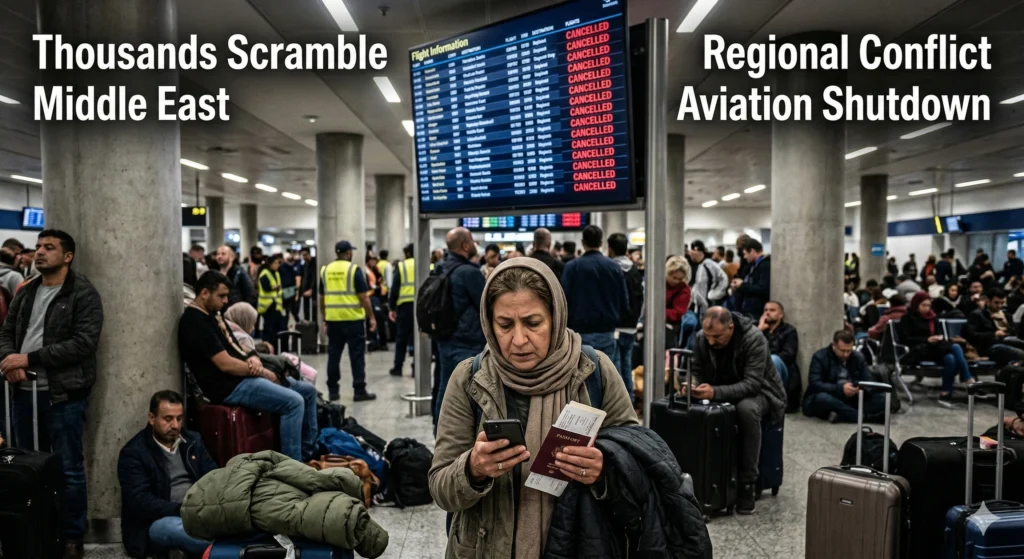
The Immediate Impact of Middle East Flight Crisis on Aviation
Middle East flight crisis has effectively paralyzed one of the busiest aerial intersections in the world, leading to unprecedented cancellations. Data from leading aviation analysts suggests that the current shutdown is more severe than previous disruptions seen in the last decade. Airlines are rerouting long-haul flights over African or Central Asian territories to avoid the active conflict zones.
These diversions are adding significant hours to travel times and causing a massive spike in fuel consumption for carriers. Passengers originally booked on direct routes now face multiple layovers in unfamiliar cities with no clear timeline for arrival. The financial implications for the global aviation industry are projected to reach billions of dollars if the closure persists.
Strategic Challenges in Executing Emergency Evacuation Procedures
Executing a safe exit during the Middle East flight crisis requires high-level coordination between military air traffic control and civilian authorities. Many governments have issued urgent advisories for their citizens to shelter in place rather than attempting to reach airports through contested land routes. The complexity of identifying safe windows for takeoff has slowed the pace of repatriation significantly.
Security screenings at open gateways like Dubai and Riyadh have become incredibly rigorous to prevent the movement of unauthorized personnel. This has resulted in massive queues and processing delays that stretch for several days in some instances. Despite these hurdles, a steady stream of chartered aircraft continues to prioritize the most vulnerable populations currently stranded.
Middle East Flight Crisis
The Middle East flight crisis is not just a logistical failure but a humanitarian challenge that tests the limits of international cooperation. With over 23,000 flights canceled, the backlog of passengers is creating a secondary crisis within airport terminals. Temporary housing and medical facilities are being established in transit zones to manage the influx of exhausted travelers.
International relief organizations are monitoring the situation closely as food and water supplies in some smaller regional airports begin to run low. The disparity between those who can afford private charters and those reliant on government aid is growing wider. This socioeconomic gap is creating tension among the crowds of people waiting for any available seat on an outbound plane.
Economic Repercussions for Regional Hubs and Global Trade
The Middle East flight crisis is sending shockwaves through the global economy due to the region’s role as a primary refueling and cargo node. Supply chains for electronics and perishable goods are experiencing major delays as freight carriers search for alternative paths. This disruption is expected to lead to temporary price hikes for consumers in Europe and North America.
Local economies in the Gulf, which rely heavily on transit tourism and high-volume foot traffic, are seeing a sharp decline in revenue. Luxury retail outlets and hospitality providers in major hubs are reporting record-low occupancy rates as the conflict deters all non-essential travel. The long-term recovery of these markets will depend entirely on the restoration of regional aerial security.
Private Charters and the Rise of Alternative Departure Routes
During the Middle East flight crisis, wealthy individuals are increasingly turning to private aviation firms to bypass the chaos of commercial terminals. These boutique companies are charging premium rates for guaranteed extraction from the region’s secondary airfields. However, even these flights are subject to the same strict airspace restrictions imposed by military command centers.
- Private jet bookings have seen a 400% increase in demand over the last week.
- Travelers are frequently pooling resources to share the cost of a single outbound flight to Europe.
- Risk assessment teams are being hired to scout land routes to safer coastal ports.
- Insurance premiums for regional travel have skyrocketed, making it impossible for many to secure coverage.
Diplomatic Efforts to Establish Humanitarian Air Corridors
Diplomats are currently negotiating the establishment of specific humanitarian corridors to alleviate the Middle East flight crisis for non-combatants. These corridors would allow for a limited number of civilian flights to operate under international protection during designated time windows. Such an agreement requires a level of trust between conflicting parties that has been difficult to achieve.
The United Nations has called for an immediate temporary ceasefire to facilitate the safe passage of foreign nationals and refugees. While some progress has been made in talks, the volatility on the ground makes any schedule highly unreliable. Travelers are encouraged to stay registered with their respective embassies to receive the most current information regarding these potential flight windows.
Security Concerns and Ground Logistics for Stranded Passengers
Maintaining order within overcrowded airports is a primary concern as the Middle East flight crisis enters its second week of intensity. Security personnel are on high alert for any signs of civil unrest or opportunistic crimes within the terminals. The presence of military hardware near civilian runways adds an extra layer of anxiety for those waiting to board.
- Ground transportation to airports is being monitored by local security forces to prevent ambushes.
- Communication networks in some areas are intermittent, making it hard for families to stay in touch.
- Many travelers are carrying only essential documents and minimal luggage to speed up boarding.
Future Outlook for Regional Air Travel and Security
The long-term effects of the Middle East flight crisis will likely result in a permanent shift in how international flight paths are calculated. Airlines may choose to permanently avoid certain sectors, leading to higher operational costs and longer flight durations for the foreseeable future. Trust in regional stability as a transit pillar has been significantly shaken by these events.
Technological advancements in real-time threat detection will be integrated more deeply into civilian aviation systems moving forward. This event serves as a stark reminder of how quickly global mobility can be halted by localized conflict. Analysts believe it could take months or even years for flight frequencies to return to their pre-conflict levels once the violence subsides.
Personal Accounts from the Frontlines of the Transit Standoff
Many individuals caught in the Middle East flight crisis describe scenes of confusion and desperation as flight boards turn entirely red with cancellations. One traveler reported waiting in a lounge for forty-eight hours with no clear information on when their airline would resume operations. These stories highlight the human cost of geopolitical strife on everyday citizens.
- Families with young children are facing the hardest conditions due to lack of specialized supplies.
- Elderly passengers are struggling with the physical demands of long waits and limited seating.
- Expatriate workers are worried about their legal status and job security while being unable to return.
Strategic Responses by Major International Carriers
Leading airlines are implementing flexible rebooking policies to manage the fallout from the Middle East flight crisis without bankrupting their operations. Most carriers are offering full refunds or open-ended credits to those whose travel plans have been obliterated. This financial buffer is essential for maintaining customer loyalty during a period of extreme uncertainty.
However, the logistical challenge of repositioning hundreds of aircraft and thousands of crew members is a task of Herculean proportions. Some planes remain grounded in high-risk zones, unable to take off due to the lack of available pilots or ground support. The industry is currently in a “wait and see” mode, hoping for a de-escalation that allows for a controlled resumption of service.
The Role of Technology in Managing Passenger Flow
In response to the Middle East flight crisis, digital platforms are being used to provide real-time updates and virtual queuing for stranded passengers. Apps that track airspace status and flight availability have become essential tools for anyone trying to find a way out. These technologies help reduce the physical crowding at service desks and provide a sense of agency to frustrated travelers.
AI-driven systems are also being used by governments to prioritize repatriation based on health needs and citizenship status. By streamlining the data collection process, authorities can fill every available seat on an evacuation flight with maximum efficiency. This digital infrastructure is proving to be a lifeline in a situation where traditional communication channels have failed.
Navigating the Legal and Insurance Landscape of the Crisis
The Middle East flight crisis has triggered complex legal questions regarding the liability of airlines and travel insurance providers. Many standard policies contain “act of war” exclusions that may prevent travelers from claiming compensation for their losses. Legal experts are currently debating how these clauses apply to the current hybrid conflict scenario.
Passengers are advised to document every interaction with their airline and keep meticulous records of any additional expenses incurred. This documentation will be vital for future claims or potential government-led compensation schemes. The legal fallout from this disruption is expected to fill courtrooms for years to come as parties seek to recoup their massive financial hits.
Government Repatriation Efforts and International Pressure
Public pressure on the Trump administration and European leaders to resolve the Middle East flight crisis is mounting as the number of stranded citizens grows. Critics argue that the response has been too slow and that more military assets should be used for civilian evacuation. Governments are responding by increasing the frequency of state-funded charter flights from secure regional perimeters.
- Over 20,000 Americans have been evacuated so far, but thousands more remain on waiting lists.
- The UK and France are coordinating joint flights to maximize the use of available landing slots.
- Germany has established a temporary transit base in Cyprus to process arrivals from the conflict zone.
Impact on Global Tourism and Long-Term Travel Sentiment
The Middle East flight crisis will likely have a chilling effect on global tourism trends for the remainder of the year. Travelers who once viewed the region as a safe and exotic destination may now choose to visit more stable environments in Asia or the Americas. This shift in sentiment could result in a permanent loss of market share for Middle Eastern tourism boards.
Even when the current conflict ends, the memory of the chaos at the airports will linger in the minds of international tourists. Rebuilding the image of the region as a welcoming and secure transit point will require a massive public relations effort and sustained peace. For now, the focus remains entirely on safety and the immediate exit of those still caught in the Middle East flight crisis.
Final Preparations for Travelers Seeking to Exit the Region
As the Middle East flight crisis continues, travelers must remain vigilant and prepared for sudden changes in their itinerary. Carrying extra batteries, physical copies of passports, and a small supply of non-perishable food is highly recommended. The situation is incredibly fluid, and what is a safe route today may be closed by tomorrow.
Staying informed through official channels rather than social media rumors is crucial for making sound decisions. The global community remains hopeful that a resolution is near, but until then, the Middle East flight crisis remains a dominant factor in international travel. Every successful flight out represents a victory for the logistics teams working behind the scenes to bring people home safely.
For more details & sources visit: Al Jazeera
Read more about UAE news: 360 News Orbit – UAE.