
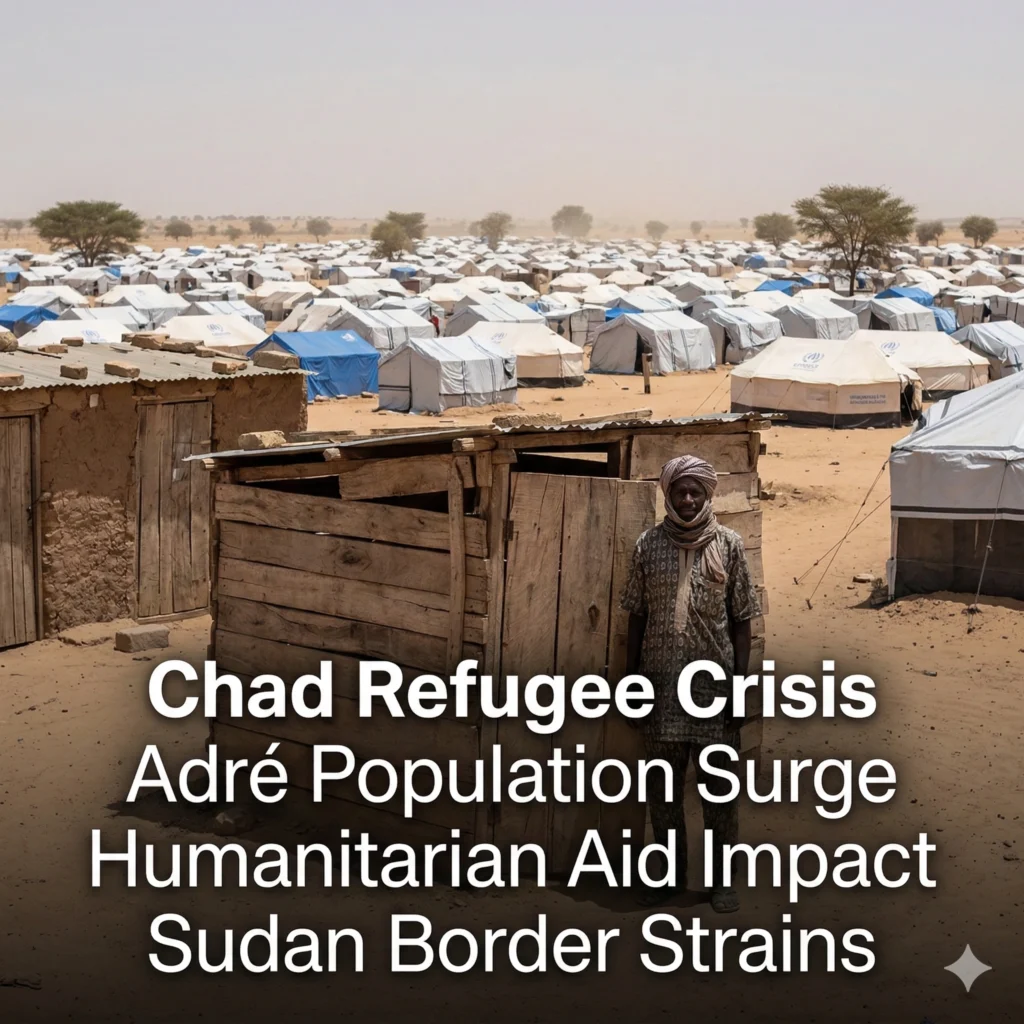
Sudanese Refugee Crisis impacts are reshaping the very foundation of the border city of Adré as the population swells beyond sustainable limits. This sudden demographic shift has transformed a quiet Chadian outpost into a bustling humanitarian hub, bringing both unprecedented challenges and modern services. While the influx of over 160,000 people has strained local resources, it has also attracted international attention to a region previously neglected by central authorities.
Local leaders now find themselves at the center of a complex socioeconomic transition that affects every household in the district. Understanding the Sudanese Refugee Crisis impacts requires a deep look into how traditional structures adapt to modern humanitarian pressures. As we explore the current state of eastern Chad, it becomes evident that the lives of both hosts and refugees are permanently intertwined through economic necessity and shared infrastructure.
Sudanese Refugee Crisis
The scale of the Sudanese Refugee Crisis impacts can be measured by the sheer speed at which the city of Adré has expanded. Originally home to approximately 40,000 residents, the area now supports a staggering 200,000 individuals, creating a high-density environment in a dry savannah landscape. This fivefold increase has turned the local office of the chef de canton into a critical administrative nerve center for the entire province.
Abdoulay Abdessalam, a prominent local leader, describes the situation as a double-edged sword that provides new opportunities while threatening social cohesion. The arrival of thousands of families daily from across the Sudanese border has forced the state administration to rethink its approach to regional security and resource management. Without the intervention of international non-governmental organizations, the local government would likely have collapsed under the weight of such a massive humanitarian requirement.
Every morning, new arrivals line the sandy outskirts of the city, seeking shelter and basic sustenance from overstretched aid agencies. These people bring with them stories of immense hardship, but they also bring a desperate need for integration into the local economy. Consequently, the Sudanese Refugee Crisis impacts are visible in the way the city’s footprint has pushed deep into the surrounding wilderness to accommodate sprawling reception camps.
Infrastructure Strains and Healthcare Evolution
Before the current emergency, Adré was a town where paved roads and running water were considered luxuries rather than standard rights. The Sudanese Refugee Crisis impacts have forced a rapid, albeit uneven, development of local infrastructure to prevent a total humanitarian catastrophe. International medical groups have established clinics that now serve both the refugee population and the long-suffering indigenous residents of the Wadai province.
While the presence of these global health organizations has improved mortality rates, the sheer volume of patients continues to test the limits of these facilities. Local residents, who once had to travel long distances for basic healthcare, now find free services at their doorstep, which is a rare silver lining. However, the lack of permanent electricity and stable water grids remains a significant hurdle for long-term clinical operations in the region.
The transformation of the local hospital system is perhaps the most visible evidence of the Sudanese Refugee Crisis impacts on the city’s physical landscape. New wards have been constructed using temporary materials, yet they house some of the most advanced diagnostic equipment the region has ever seen. This modernization, driven by emergency needs, creates a strange paradox where a crisis becomes the primary driver for technological advancement in a forgotten border town.
Economic Inflation and Market Volatility
The economic dimension of the Sudanese Refugee Crisis impacts is felt most acutely in the local marketplace, where the laws of supply and demand are in full force. Basic commodities that were once affordable for the average Chadian family have seen their prices skyrocket due to the increased competition for goods. For instance, the price of poultry and essential grains has more than doubled over the last three years, leaving many locals struggling to feed their families.
Traders in Adré report that while there is more cash circulating in the economy due to aid workers, the purchasing power of the local currency has diminished. This inflation is a direct result of the Sudanese Refugee Crisis impacts on the regional supply chain, which was never designed to support a population of 200,000. Farmers in the surrounding villages find it difficult to scale their production quickly enough to meet the needs of the growing urban center.
Despite the rising costs, some local entrepreneurs have found ways to benefit from the increased foot traffic and the presence of international staff. Small shops and service providers have cropped up to cater to the needs of the humanitarian community, creating a niche market that did not exist before. However, for the majority of the indigenous population, the Sudanese Refugee Crisis impacts represent a daily struggle against the rising cost of living.
Social Dynamics and Security Challenges
As the population density increases, the Sudanese Refugee Crisis impacts on social stability have become a primary concern for local elders and police. Abdoulay Abdessalam has noted a significant rise in petty theft and localized crime as people compete for limited resources within the city. The social fabric of Adré, once defined by close-knit tribal ties, is being stretched by the arrival of diverse groups with varying needs and backgrounds.
Instances of aggression are often linked to the frustrations of living in overcrowded reception camps where privacy is nonexistent and resources are scarce. The local leadership works tirelessly to mediate between the host community and the refugees to prevent these tensions from escalating into full-scale conflict. These efforts are a crucial part of managing the Sudanese Refugee Crisis impacts and ensuring that the city remains a safe haven for those fleeing violence.
The influx has also led to a shift in the traditional power structures of the Wadai province, as international agencies often hold more logistical power than local chiefs. This shift requires a delicate balancing act to ensure that the indigenous population does not feel sidelined in their own ancestral lands. Maintaining this balance is essential for the long-term success of the humanitarian mission and the continued stability of the Chadian border regions.
Regional Environmental Pressures
The environmental Sudanese Refugee Crisis impacts are often overlooked but are equally devastating to the long-term viability of the Adré region. With 200,000 people now living in a space designed for 40,000, the demand for firewood and charcoal has led to rapid deforestation in the surrounding savannah. This loss of vegetation accelerates soil erosion and threatens the already fragile agricultural output of the local Chadian farmers.
Water scarcity is another critical issue, as the underground aquifers are being tapped at an unsustainable rate to provide for the refugee camps. The Sudanese Refugee Crisis impacts on the water table could lead to long-term droughts that will affect the region for decades after the initial crisis has subsided. Aid organizations are attempting to drill deeper wells, but these are only temporary solutions to a growing ecological problem.
Sanitation also poses a significant risk to the environment and public health, as the waste management systems are not equipped for such a large population. Without proper intervention, the Sudanese Refugee Crisis impacts could include the contamination of local water sources, leading to outbreaks of waterborne diseases. Addressing these environmental concerns is a massive undertaking that requires coordination between the Chadian government and global environmental experts.
International Aid and Local Integration
The role of international organizations in mitigating the Sudanese Refugee Crisis impacts cannot be overstated, as they provide the bulk of food and medical supplies. These groups have turned Adré into a logistical hub, bringing in trucks and planes filled with life-saving equipment every single week. This presence has created jobs for locals who work as drivers, translators, and logistical assistants, providing a much-needed boost to some households.
However, the reliance on external aid creates a vulnerability that worries local leaders like Abdessalam, who fear what might happen if the world’s attention shifts elsewhere. The Sudanese Refugee Crisis impacts are so deep that the city’s economy is now fundamentally tied to the continuation of these humanitarian programs. Integrating the refugees into the local labor market is seen as a way to create a more sustainable future for the entire community.
Programs aimed at teaching vocational skills to both refugees and locals are starting to take root, helping to bridge the gap between the two populations. These initiatives are designed to turn the Sudanese Refugee Crisis impacts into a catalyst for long-term regional development rather than just a temporary emergency response. By fostering cooperation, the community hopes to build a more resilient Adré that can withstand future shocks.
Long-term Prospects for Adré
Looking ahead, the Sudanese Refugee Crisis impacts will likely define the history of Adré for the next generation. The city has transitioned from a remote border village to a significant urban center with international importance, a change that cannot be easily reversed. The state infrastructure that has been built during this period, such as improved healthcare facilities, will remain as a legacy of this era.
The challenge for the Chadian government will be to maintain these services once the emergency phase of the crisis has passed and aid budgets are reduced. Managing the Sudanese Refugee Crisis impacts in the long term requires a transition from humanitarian relief to sustainable development projects that benefit everyone. This includes building permanent schools and improving the road networks that connect Adré to the rest of the Wadai province.
The resilience shown by the people of Adré in the face of such overwhelming change is a testament to the strength of the Chadian spirit. Despite the rising prices and security concerns, many locals continue to welcome those fleeing the Sudanese conflict with open arms. These human connections are the most profound of all the Sudanese Refugee Crisis impacts, proving that even in the face of disaster, community and empathy can prevail.
Strengthening Community Resilience
To further mitigate the negative Sudanese Refugee Crisis impacts, local leaders are focusing on community-led initiatives that promote peace and shared growth. Weekly meetings between refugee representatives and local elders have become a standard practice to resolve disputes before they escalate. This grassroots approach is essential for managing the day-to-day Sudanese Refugee Crisis impacts that formal administration might miss.
Educational programs are also being expanded to ensure that the influx of children does not lead to a “lost generation” without proper schooling. By investing in the youth of both communities, Adré is preparing for a future where the Sudanese Refugee Crisis impacts lead to a more educated and capable workforce. These efforts are supported by various UN agencies that recognize the importance of education in maintaining long-term regional stability.
The path forward is fraught with difficulties, but the lessons learned in Adré provide a blueprint for other regions facing similar demographic shifts. The Sudanese Refugee Crisis impacts are a reminder of the interconnectedness of our global society and the need for proactive management of humanitarian emergencies. As the sun sets over the Wadai savannah, the city of Adré stands as a symbol of both the tragedy of displacement and the hope of human solidarity.
Sustaining the Humanitarian Response
As the situation evolves, the Sudanese Refugee Crisis impacts demand a continuous reassessment of the resources allocated to the Chadian border. The international community must remain engaged to ensure that the burden of the crisis does not fall solely on the shoulders of the local population. Sustained funding is required to manage the Sudanese Refugee Crisis impacts on the environment and to continue providing high-quality healthcare to the thousands in need.
Innovation in aid delivery, such as digital cash transfers, is being explored to help stabilize the local market and reduce the inflationary Sudanese Refugee Crisis impacts. These modern tools allow refugees to purchase goods directly from local vendors, stimulating the economy and fostering better relationships between the two groups. It is through these creative solutions that the long-term Sudanese Refugee Crisis impacts can be managed effectively.
Ultimately, the goal is to transform the Sudanese Refugee Crisis impacts from a narrative of struggle into one of transformation and progress. While the challenges are immense, the opportunity to build a more robust and inclusive society in eastern Chad is within reach. The people of Adré, with the support of the global community, are writing a new chapter in their history, one defined by resilience in the face of the Sudanese Refugee Crisis impacts.
Cultural Exchange and Social Integration
One of the most interesting Sudanese Refugee Crisis impacts is the cultural exchange occurring between the Sudanese and Chadian populations in Adré. Shared languages and similar traditions have facilitated a level of integration that is rarely seen in other major refugee contexts around the world. This cultural proximity helps soften the blow of the Sudanese Refugee Crisis impacts on the social fabric of the border city.
Joint marketplaces have become centers of cultural fusion, where traditional Sudanese crafts are sold alongside Chadian agricultural products. These interactions reduce the “othering” of refugees and help the local population see the newcomers as neighbors rather than burdens. The Sudanese Refugee Crisis impacts are thus fostering a unique cross-border identity that could strengthen regional ties for decades to come.
Music and storytelling sessions in the camps often involve local residents, creating a shared space for healing and mutual understanding. These soft-power Sudanese Refugee Crisis impacts are just as important as the physical infrastructure projects in building a stable future. By celebrating their shared heritage, the people of Adré and their Sudanese guests are creating a foundation for lasting peace in the Wadai province.
Summary of Regional Transformation
The Sudanese Refugee Crisis impacts have fundamentally altered the trajectory of Adré, turning a minor border crossing into a major humanitarian focal point. The population growth has spurred development while simultaneously creating economic and environmental pressures that require urgent attention. Navigating the Sudanese Refugee Crisis impacts will require a multi-year commitment from both local leaders and international partners.
- Population surge from 40,000 to 200,000 residents.
- Inflation of basic commodity prices like poultry and grain.
- Improvement of local healthcare through international NGO clinics.
- Increased security risks and rising petty crime rates.
As we conclude this analysis of the Sudanese Refugee Crisis impacts, it is clear that the situation remains fluid and requires constant monitoring. The resilience of the Adré community is the most significant factor in the successful management of this ongoing emergency. Only through continued cooperation and sustainable planning can the Sudanese Refugee Crisis impacts be fully integrated into a positive future for eastern Chad.
The future of the region depends on how we address these Sudanese Refugee Crisis impacts today, ensuring that the progress made in healthcare and infrastructure is preserved. The world must not look away from Adré, as the lessons learned here will be vital for managing future global displacement crises. The Sudanese Refugee Crisis impacts serve as a powerful reminder of our collective responsibility to support those in need while protecting the communities that welcome them.
For more details & sources visit: D+C Development and Cooperation
Read more on Sudan news: 360 News Orbit – Sudan.