
Keir Starmer Defends Limited Involvement as the cornerstone of British foreign policy following a series of high-stakes military escalations in the Middle East. Prime Minister Keir Starmer addressed the House of Commons to clarify the United Kingdom’s specific military position regarding recent joint US-Israeli strikes against Iran. During his address, the Prime Minister emphasized that his administration does not believe in pursuing regime change through aerial bombardment and military force, citing the need for regional stability.
Keir Starmer Defends Limited Involvement despite significant pressure from Washington to increase the UK’s operational footprint in the conflict. This stance marks a definitive moment in 2026 diplomacy, where the UK seeks to balance its alliance with the United States against its own strategic and legal requirements for warfare.
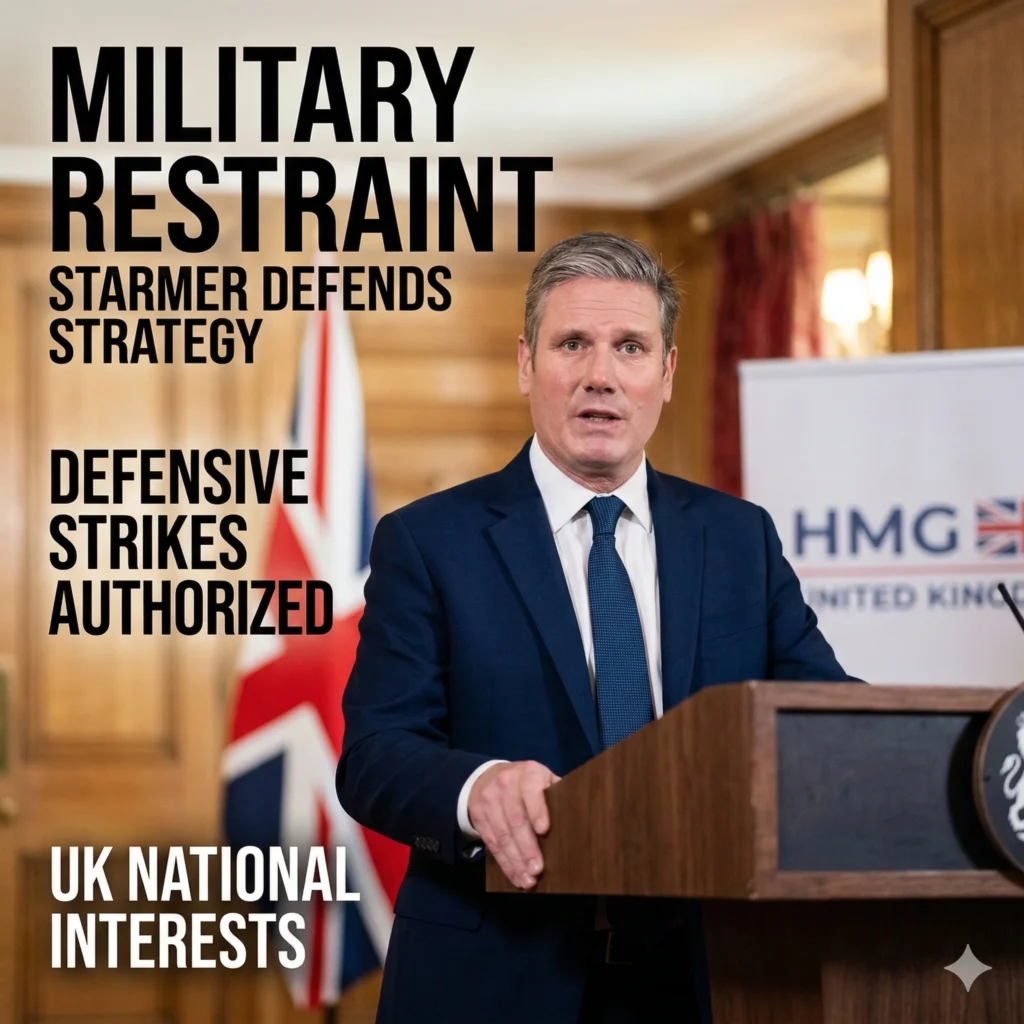
Keir Starmer Defends Limited Involvement
Keir Starmer Defends Limited Involvement by reminding Parliament of the historical lessons learned from the Iraq War and the necessity of a clearly defined legal basis for action. The Prime Minister defended the initial decision to deny the United States use of the Diego Garcia and RAF Fairford bases for offensive operations during the first wave of attacks. He argued that it is his fundamental duty to judge and act according to Britain’s specific national interests rather than following a path of unchecked military expansion. This refusal to participate in “regime change” missions has created a notable policy divide between London and the Trump administration.
The Prime Minister’s rhetoric suggests a shift toward a more cautious and objective-led military doctrine. Keir Starmer Defends Limited Involvement because the government maintains that any military involvement must have a viable, thought-through plan with achievable objectives to avoid long-term instability. By prioritizing these criteria, the UK is attempting to avoid the pitfalls of previous Middle Eastern interventions that led to decades of unforeseen consequences. The Prime Minister’s firm stance in the Commons was met with both support from his party and scrutiny from those fearing a rift with American leadership.
The Shift to Defensive Operations
While the initial stance was one of strict non-participation in offensive strikes, the policy shifted on Sunday following a massive retaliatory response from Iranian forces. Keir Starmer Defends Limited Involvement while simultaneously authorizing the use of British military facilities solely for defensive strikes. This change came after Iran launched a wave of missiles and drones targeting several nations, including Israel, Bahrain, Kuwait, Qatar, and the United Arab Emirates. The Prime Minister described this escalation as an outrageous response that necessitated a limited defensive reaction to protect regional allies and British assets.
British officials specifically reported a drone attack on RAF Akrotiri in Cyprus, which served as a catalyst for the revised rules of engagement. Keir Starmer Defends Limited Involvement by clarifying that although bases are now being utilized, they are strictly for neutralizing Iranian missile infrastructure that poses a direct threat. This nuanced approach allows the UK to contribute to collective security without endorsing the broader offensive goals of the US-led coalition. The distinction between “offensive” and “defensive” has become the central theme of the government’s communication strategy throughout this crisis.
Lessons from the Iraq War
The specter of past conflicts loomed large during the Prime Minister’s briefing to the House of Commons. Keir Starmer Defends Limited Involvement by explicitly referencing the lack of a post-war plan in previous decades as a reason for current hesitation. He noted that the British public expects a higher standard of transparency and legality before the nation commits to a new theater of war. This historical context is vital for understanding why the UK is willing to risk diplomatic friction with the White House to maintain its current posture.
Furthermore, the legal advice provided to the cabinet has emphasized the importance of international law in justifying any strike on sovereign territory. Keir Starmer Defends Limited Involvement as a way to uphold the international rules-based order which the UK has long championed. By refusing to engage in strikes aimed at regime change, the government is signaling that its military force is not a tool for political engineering. This principled stand is intended to preserve the UK’s moral standing and its ability to act as a mediator in future diplomatic negotiations.
Tensions Between London and Washington
The decision to limit British participation has not been well-received by President Donald Trump, who has expressed public disagreement with the UK’s level of support. Keir Starmer Defends Limited Involvement despite the risk of a diplomatic “cold front” developing between the two long-standing allies. The White House had reportedly expected a more robust contribution from the Royal Air Force, similar to previous joint operations in the region. This disagreement highlights a growing divergence in how the two nations view the most effective way to handle Iranian aggression in 2026.
Despite the public friction, the Prime Minister insisted that the “Special Relationship” remains functional but must be based on mutual respect for sovereign decisions. Keir Starmer Defends Limited Involvement as a necessary exercise of British autonomy in an increasingly multipolar world. The UK government is aware that a total alignment with the US strategy could lead to a domestic political backlash, especially given the current sensitivity toward foreign intervention. Navigating this relationship requires a delicate balance of cooperation on security and independence on political objectives.
The Impact of Khamenei’s Death
The recent escalation saw the death of Iran’s Supreme Leader Ayatollah Ali Khamenei during the initial joint US-Israeli military operation. Keir Starmer Defends Limited Involvement in the aftermath of this seismic event, recognizing that the power vacuum in Tehran could lead to even greater volatility. The Prime Minister argued that without a clear plan for what follows such a major leadership change, further military strikes could be counterproductive. The UK’s focus remains on preventing a total regional collapse that could trigger a humanitarian crisis of unprecedented proportions.
The death of the Supreme Leader has fundamentally changed the calculus for all players in the Middle East. Keir Starmer Defends Limited Involvement because the UK believes the focus should now be on containment and the protection of shipping lanes rather than further escalation. British intelligence suggests that the Iranian military structure may react unpredictably to the loss of its top leader, making a cautious approach the most logical choice. By staying out of the primary offensive, the UK hopes to maintain a degree of influence over the eventual diplomatic resolution.
Military Facilities and Strategic Assets
The strategic importance of British bases like Diego Garcia and RAF Fairford cannot be overstated in the context of long-range aerial operations. Keir Starmer Defends Limited Involvement by strictly controlling how these assets are integrated into the coalition’s theater plans. While these bases provide essential logistical support, the Prime Minister has set clear “red lines” regarding the types of missions that can be launched from them. This ensures that British soil is not used to facilitate actions that the government has not officially sanctioned through parliamentary oversight.
In Cyprus, the defense of RAF Akrotiri has become a priority for the Ministry of Defence following the recent drone incursions. Keir Starmer Defends Limited Involvement by shifting the focus of these Mediterranean assets to air defense and surveillance rather than bombardment. The goal is to create a “defensive shield” that protects British personnel and regional partners from retaliatory strikes. This defensive posture is seen as a way to fulfill security obligations while avoiding the label of an aggressor in the eyes of the international community.
Parliamentary Debate and Public Opinion
The House of Commons has been the site of intense debate regarding the Prime Minister’s handling of the crisis. Keir Starmer Defends Limited Involvement to a skeptical opposition that questions whether the UK is doing enough to support its closest ally. Conversely, many backbenchers have praised the Prime Minister for showing restraint and prioritizing British lives and resources. This internal political struggle reflects a wider national debate about the UK’s role on the world stage during the mid-2020s.
Public opinion polls suggest a significant portion of the British electorate is wary of any involvement that could lead to a long-term commitment in Iran. Keir Starmer Defends Limited Involvement as a direct response to this public sentiment, which favors domestic stability over foreign military adventures. The government is keen to show that it is listening to the concerns of the people while still maintaining its status as a reliable security partner. This populist-leaning pragmatism has become a hallmark of the Starmer administration’s foreign policy approach.
The Complexity of Middle Eastern Alliances
The conflict in Iran involves a complex web of regional players, including Israel and the Gulf states, each with their own agendas. Keir Starmer Defends Limited Involvement to avoid the UK becoming entangled in these local rivalries more than necessary. By limiting participation, the UK can maintain functional relationships with a broader range of regional actors who may be wary of the US-led strikes. This strategic flexibility is essential for a nation that relies on stable energy markets and open trade routes through the Strait of Hormuz.
The Prime Minister’s team has been in constant contact with leaders in Bahrain, Kuwait, and the UAE to reassure them of the UK’s commitment to their defense. Keir Starmer Defends Limited Involvement while emphasizing that the UK will not stand by if these partners are targeted by unprovoked aggression. This “defense-first” policy aims to build a coalition of stability that can withstand the shocks of the ongoing war. The challenge remains in convincing these allies that a limited role is not a sign of weakness, but a sign of focused strategic intent.
Future Objectives and Achievable Outcomes
The UK government is calling for a summit to discuss the long-term future of the region and the establishment of a sustainable peace. Keir Starmer Defends Limited Involvement as a prerequisite for participating in such talks as a credible and objective actor. The Prime Minister believes that only a political settlement can truly end the cycle of violence in the Middle East. Until a viable plan for the future is presented, the UK will continue to resist calls for a more aggressive military posture.
Looking ahead, the Ministry of Defence is preparing for various scenarios, ranging from a ceasefire to a further escalation of hostilities. Keir Starmer Defends Limited Involvement while ensuring that the British military remains at a high state of readiness for any defensive contingency. The government’s priority is to ensure that any future action is grounded in reality and supported by a clear exit strategy. This focus on “achievable outcomes” is intended to prevent the UK from being drawn into a “forever war” in the 2020s.
Regional Stability and Economic Impact
The economic impact of the war on global energy prices has already begun to be felt across the European continent. Keir Starmer Defends Limited Involvement as a way to mitigate the risks to the British economy that would come with a wider conflict. A full-scale war in the Middle East could lead to significant disruptions in gas and oil supplies, further straining the UK’s recovery. By advocating for a limited and controlled response, the Prime Minister is also acting as a steward of national economic security.
Stability in the region is also essential for managing migration patterns and preventing the rise of extremist groups that thrive in conflict zones. Keir Starmer Defends Limited Involvement to avoid the total state collapse in Iran that could lead to a massive displacement of people. The government’s view is that a controlled military response is less likely to trigger these secondary crises than a full-scale invasion or regime change mission. This holistic view of security incorporates humanitarian, economic, and military factors into a single, cohesive strategy.
Strengthening National Interests
At the heart of the Prime Minister’s argument is the belief that British interests must always come first in any decision to use force. Keir Starmer Defends Limited Involvement by demonstrating that the UK can be a loyal ally without being a submissive one. This assertion of national interest is designed to resonate with voters who want to see a Britain that is strong but sensible on the world stage. The Starmer administration is defining its era through this blend of internationalism and strategic caution.
The focus on national interests also includes the protection of British citizens living and working in the Middle East. Keir Starmer Defends Limited Involvement to minimize the risk of these individuals becoming targets for retaliation or kidnapping. The safety of the British public, both at home and abroad, remains the ultimate yardstick by which the government’s actions are measured. Through this lens, a limited involvement is not just a strategic choice, but a moral and protective one for the entire nation.
Conclusion of the Parliamentary Briefing
As the session in the House of Commons concluded, the Prime Minister reiterated his commitment to keeping Parliament informed of any further developments. Keir Starmer Defends Limited Involvement as the most responsible course of action in a situation with no easy answers. The international community continues to react to the UK’s stance, with some praising the restraint and others calling for more action. Regardless of the external noise, the British government appears set on its path of limited, defensive engagement.
The ongoing conflict in Iran will undoubtedly continue to test the resolve and the principles of the Starmer government. Keir Starmer Defends Limited Involvement as a shield against the pressures of an increasingly volatile global landscape. Whether this policy will successfully prevent the UK from being drawn deeper into the war remains to be seen. However, for now, the Prime Minister has established a clear boundary that defines the limits of British military power in the 2026 Middle East crisis.
Key Points of the UK Military Position
- The UK will not participate in offensive strikes aimed at regime change in Iran.
- Military bases like Diego Garcia were initially denied for offensive use but are now open for defensive missions.
- The policy changed following Iranian missile attacks on regional allies and RAF Akrotiri.
- Historical lessons from Iraq are being used to justify the requirement for a clear legal basis.
- Tensions remain high between the UK and the US over the level of participation in the conflict.
Keir Starmer Defends Limited Involvement through a strategy that emphasizes legality, domestic consensus, and strategic caution. By standing firm against the pressures of regime change, the Prime Minister is carving out a distinct role for the UK in the 2026 global order. The focus on defensive operations ensures that Britain remains a key player in regional security without overextending its resources. As the situation in Iran evolves, the UK’s “limited involvement” will remain a critical factor in the broader geopolitical equation.
Keir Starmer Defends Limited Involvement as a way to ensure that British military forces are used only when absolutely necessary and for clear, lawful purposes. This approach is intended to provide a stable foundation for the UK’s foreign policy for the remainder of the decade. By avoiding the errors of the past, the government hopes to lead the nation through this crisis with its security and its values intact. The debate over Britain’s role in the world is far from over, but the Prime Minister has set a clear direction for the current conflict.
For more details & sources visit: BBC News
For more updates about the United Kingdom, visit our UK news page.