
Spain Denies Military Cooperation remains the firm stance of the Madrid government following a series of controversial statements issued by the White House regarding the conflict in Iran. The Spanish administration has officially dismissed claims suggesting that it shifted its position to support United States military operations within the Middle Eastern theater. Foreign Minister Jose Manuel Albares confirmed that Spain continues to refuse the use of its strategic military bases for the ongoing war, emphasizing national sovereignty.
This categorical rejection follows a briefing where Washington officials implied a breakthrough in diplomatic negotiations over logistical support. Consequently, the diplomatic rift between the two NATO allies has deepened significantly as the White House pressures European partners for increased participation. Spain Denies Military Cooperation despite the looming threat of economic sanctions and trade restrictions recently proposed by the American presidency.
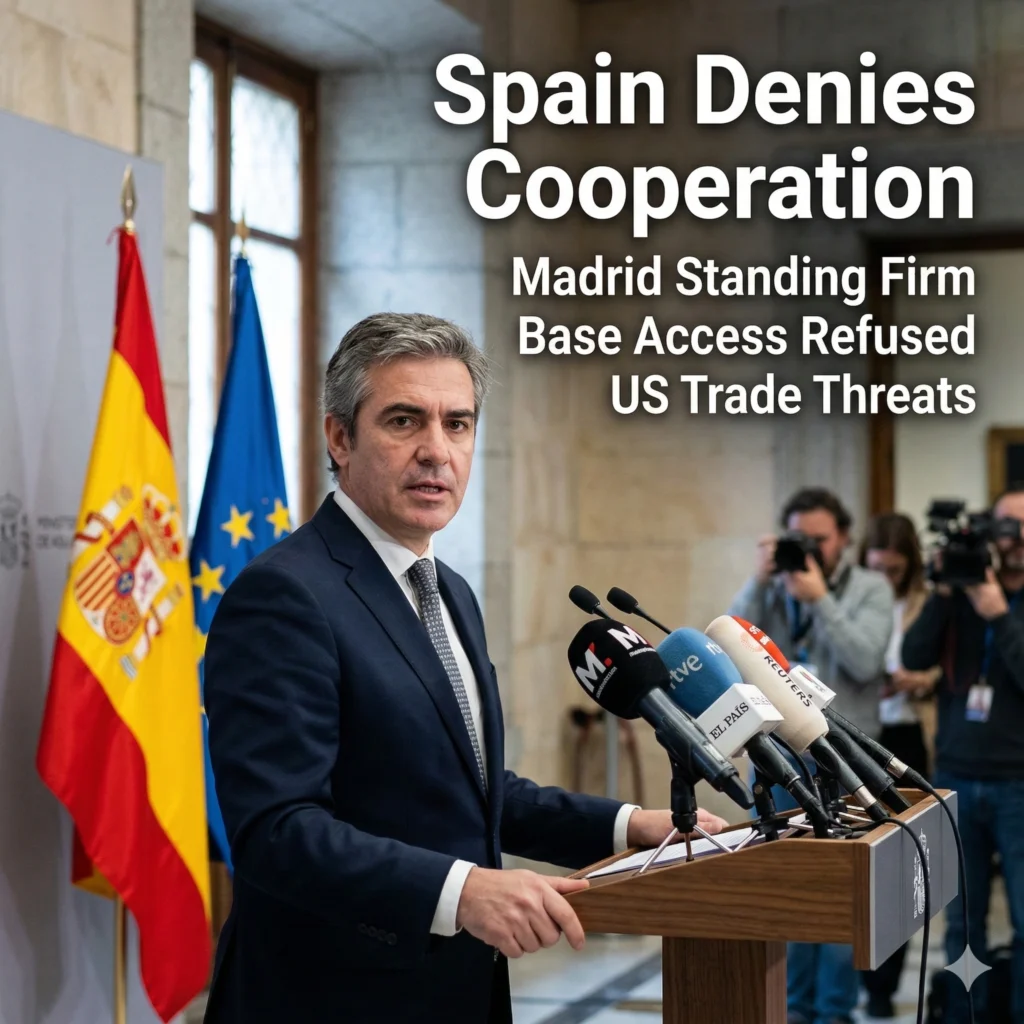
Spain Denies Military Cooperation
Spain Denies Military Cooperation to ensure that its territory is not used as a launching pad for further regional escalation in the Middle East. Foreign Minister Albares noted during a recent radio address that not a single comma of the national policy has changed regarding the refusal to join the war effort. This statement serves as a direct rebuttal to White House spokesperson Karoline Leavitt, who suggested that Spain had finally heard the president’s message. The Spanish government maintains that its primary focus is on de-escalation rather than contributing to a widening military engagement that could destabilize the Mediterranean.
The confusion began when Leavitt told reporters she believed the Spanish position on base access had evolved to favor American strategic goals. However, the rapid response from Madrid indicates a significant disconnect between the two administrations regarding bilateral military agreements. Spain Denies Military Cooperation because the government believes that a diplomatic solution remains the only viable path forward for international security. By standing firm, the Spanish leadership is signaling its independence from the aggressive foreign policy maneuvers currently being championed by the United States administration.
The Impact of White House Pressure on Madrid
The White House has been relentless in its pursuit of logistical and military assistance from European allies to bolster its operations. President Donald Trump previously lambasted Spain for its opposition to the conflict, labeling the current stance of the country as terrible and uncooperative. This rhetoric has created a tense atmosphere where economic threats are being used as a primary tool for diplomatic persuasion. Spain Denies Military Cooperation even as the possibility of a total trade cutoff remains a central talking point in Washington’s punitive strategy.
Furthermore, the American administration believes that the strategic military bases located on Spanish soil are essential for maintaining a rapid response capability. Without access to these facilities, the logistical burden on the United States military increases significantly during the ongoing Iran war. Spain Denies Military Cooperation because the domestic political climate is overwhelmingly against participating in another protracted foreign conflict. The Spanish public has shown strong support for the government’s refusal to allow foreign troops to utilize national infrastructure for offensive missions.
Strategic Importance of Spanish Military Bases
The geographical location of Spain makes its military installations highly valuable for any operation involving the Middle East and North Africa. Rota and Morón de la Frontera are two key sites that the United States has traditionally used for various international security missions over the decades. Spain Denies Military Cooperation at these specific locations to prevent being drawn into a war that it does not officially support. This refusal complicates the Pentagon’s ability to cycle troops and equipment efficiently through the European continent toward the front lines.
Washington officials had hoped that the shared history of NATO cooperation would lead to a more favorable outcome during these high-stakes negotiations. Instead, the firm “no” from Madrid has forced American planners to look for alternative hubs in the region which may be less optimal. Spain Denies Military Cooperation because the leadership views the current conflict as a deviation from the collective defense principles of the alliance. By withholding base access, Spain is asserting its right to define its own level of involvement in global military contingencies.
Economic Threats and Diplomatic Fallout
The threat to cut off all trade with Spain as a punitive measure for its lack of military support has sent shockwaves through the European Union. Economic analysts warn that such a move would not only harm the Spanish economy but also disrupt transatlantic supply chains. Spain Denies Military Cooperation despite these heavy-handed tactics, suggesting that national principles are not for sale under the threat of financial ruin. The diplomatic fallout is reaching a point where other EU nations are beginning to voice their own concerns about American trade policy.
In the halls of the United Kingdom and France, there is a growing debate about how to respond to the pressure being applied to Madrid. Spain Denies Military Cooperation as a matter of constitutional and ethical policy, which resonates with several other member states currently eyeing the conflict with skepticism. The aggressive stance taken by the White House may backfire if it leads to a unified European front against coercive military requests. Madrid’s refusal is currently the most visible sign of a broader continental hesitation to follow the current American trajectory.
Albares Reaffirms Spanish Sovereignty
Foreign Minister Jose Manuel Albares has been the most vocal figure in the cabinet regarding the preservation of Spanish sovereignty during this crisis. He stated that he had no idea what the U.S. administration might be referring to in its claims of newfound cooperation. Spain Denies Military Cooperation to ensure that the nation is not perceived as a secondary actor in a war it had no part in initiating. This clarity is intended to prevent any international misunderstanding that could lead to retaliatory actions from other regional powers in the Middle East.
The minister’s remarks have been echoed by other members of the ruling coalition who see the American claims as a form of psychological warfare. By publicly refuting the White House, Spain is attempting to regain control over its own international narrative and security profile. Spain Denies Military Cooperation because the government is accountable to a parliament that has requested transparency regarding all foreign military engagements. This internal accountability is a cornerstone of the Spanish democratic process that cannot be bypassed by external diplomatic pressure.
Growing Tensions Within the NATO Alliance
The disagreement highlights growing tensions within the NATO alliance as the conflict in the Middle East continues to widen beyond its original borders. Spain Denies Military Cooperation at a time when the alliance is already struggling to maintain a cohesive strategy toward global threats. While some member states have offered verbal support for the American mission, very few have committed the level of resources being demanded. This creates a friction point that threatens the long-term stability of the most successful military alliance in modern history.
NATO headquarters has remained relatively quiet on the specific dispute between Washington and Madrid, preferring to view it as a bilateral matter. However, the implications for collective security are clear when a major member refuses to provide logistical aid during an active war. Spain Denies Military Cooperation as a signal that the scope of NATO should not be unilaterally expanded by any single member state. This philosophical divide is likely to persist as long as the conflict in Iran remains the primary focus of American foreign policy.
Public Sentiment and Political Stability
The Spanish public has historically been wary of involvement in Middle Eastern conflicts, a sentiment that remains deeply rooted in the national psyche. Spain Denies Military Cooperation because the government understands that any other choice would lead to widespread civil unrest and political instability. Protest groups have already begun organizing rallies in major cities like Madrid and Barcelona to support the government’s neutral stance. This domestic pressure provides the administration with a strong mandate to resist the demands coming from the White House.
The political opposition in Spain has also been forced to navigate this complex issue, with many leaders agreeing that national bases should not be signed away. Spain Denies Military Cooperation with the consensus of a broad spectrum of political parties, making it a truly national decision rather than a partisan one. This unity makes it much harder for the United States to find a political entry point to change the country’s mind. The strength of this domestic consensus is perhaps the greatest defense Spain has against the escalating diplomatic pressure.
Security Implications for the Mediterranean
A widening war in the Middle East has direct security implications for the Mediterranean region, which Spain is naturally keen to protect. Spain Denies Military Cooperation to avoid becoming a target for asymmetric warfare or retaliatory strikes by regional actors aligned with Iran. The government believes that maintaining a neutral or non-combatant status is the best way to safeguard the lives of its citizens. This defensive posture is seen as a necessary precaution in an era where conflicts can quickly spill over across maritime borders.
The Spanish navy continues to patrol its own waters, but its mission remains strictly focused on national defense and maritime safety. Spain Denies Military Cooperation to ensure that its naval assets are not integrated into an offensive task force led by the United States. This distinction is vital for maintaining the balance of power in the region and preventing a total breakdown of Mediterranean security. Madrid’s priority remains the protection of its own borders and the maintenance of peaceful trade routes throughout the sea.
Future of US-Spanish Relations
The future of relations between the United States and Spain hangs in the balance as this stalemate continues without a clear resolution. Spain Denies Military Cooperation as a principled stand, but the long-term cost of this decision remains to be seen in the diplomatic arena. If the White House follows through on its trade threats, the relationship could enter a period of prolonged frostiness not seen in decades. Both nations have much to lose if the partnership dissolves, yet neither side seems willing to blink in the face of the other’s demands.
Diplomatic observers suggest that a middle ground might eventually be sought, perhaps involving humanitarian aid rather than direct military support. However, Spain Denies Military Cooperation in such a definitive way that any compromise might be seen as a retreat by the Spanish public. The American administration is also unlikely to back down quickly, given the high-profile nature of its recent public statements. This ensures that the topic of military cooperation will remain at the top of the bilateral agenda for the foreseeable future.
European Response to the Diplomatic Rift
The broader European response to this rift will be a determining factor in how much pressure the United States can effectively apply. Spain Denies Military Cooperation while looking toward its neighbors in the European Union for solidarity against economic coercion. If the EU decides to treat the trade threats against Spain as a threat against the entire bloc, the dynamic of the dispute will change. This would force the White House to reconsider its strategy of isolating individual allies to gain compliance for its military objectives.
Current discussions in Brussels suggest that there is a strong appetite for protecting the sovereign decisions of member states regarding war and peace. Spain Denies Military Cooperation with the quiet backing of several key European capitals that share similar reservations about the Iran conflict. The outcome of this dispute could set a precedent for how the EU interacts with an increasingly assertive American foreign policy. For now, Madrid stands as a primary example of a middle power refusing to be swayed by the rhetoric of a superpower.
Media Representation and Information Warfare
The role of media in this conflict has become a battleground for information, with conflicting reports emerging from both sides of the Atlantic. Spain Denies Military Cooperation despite the official White House narrative, creating a situation where the public must discern the truth from competing statements. The Spanish government has been quick to use its own media channels to ensure its message is heard clearly and without distortion. This proactive communication strategy is essential for countering the “belief” expressed by American spokespeople regarding Spanish cooperation.
Information warfare is a modern reality of international diplomacy, and this case proves that even close allies are not immune to its effects. Spain Denies Military Cooperation as a factually grounded statement that seeks to correct the record for the international community. By providing consistent and clear denials, Madrid is effectively neutralizing the impact of the White House’s speculative claims. This battle for the narrative is just as important as the strategic discussions taking place behind closed doors.
Conclusion of the Current Crisis
As the situation stands, there is no indication that the Spanish government will reverse its decision in the coming weeks. Spain Denies Military Cooperation as a fundamental pillar of its current foreign policy and will likely continue to do so. The international community is watching closely to see if other nations will follow Spain’s lead in asserting their strategic autonomy. The conflict in Iran remains a volatile and unpredictable factor that will continue to test the strength of global alliances.
The resilience of the Spanish position will ultimately depend on the government’s ability to withstand both economic and diplomatic heat. Spain Denies Military Cooperation because it believes that the path to peace does not lie through the expansion of the current war. Whether this stand will lead to a more stable Mediterranean or a more isolated Spain remains a question for the future. For today, the message from Madrid is loud, clear, and absolutely categorical regarding its military assets.
For more details & sources visit: Al Jazeera
For the latest updates from the Spain, visit our Spain news page.