
Italy is moving toward a wartime footing as Prime Minister Giorgia Meloni authorizes the deployment of advanced defense hardware to protect strategic assets in the Mediterranean and the Gulf. This decision comes at a critical juncture in the 2026 conflict, where the intersection of energy security and national defense has forced European powers to take a more proactive military stance. By sending air defense batteries and naval vessels, Rome is signaling its commitment to maintaining the flow of resources and protecting the lives of its citizens abroad during this period of extreme volatility.
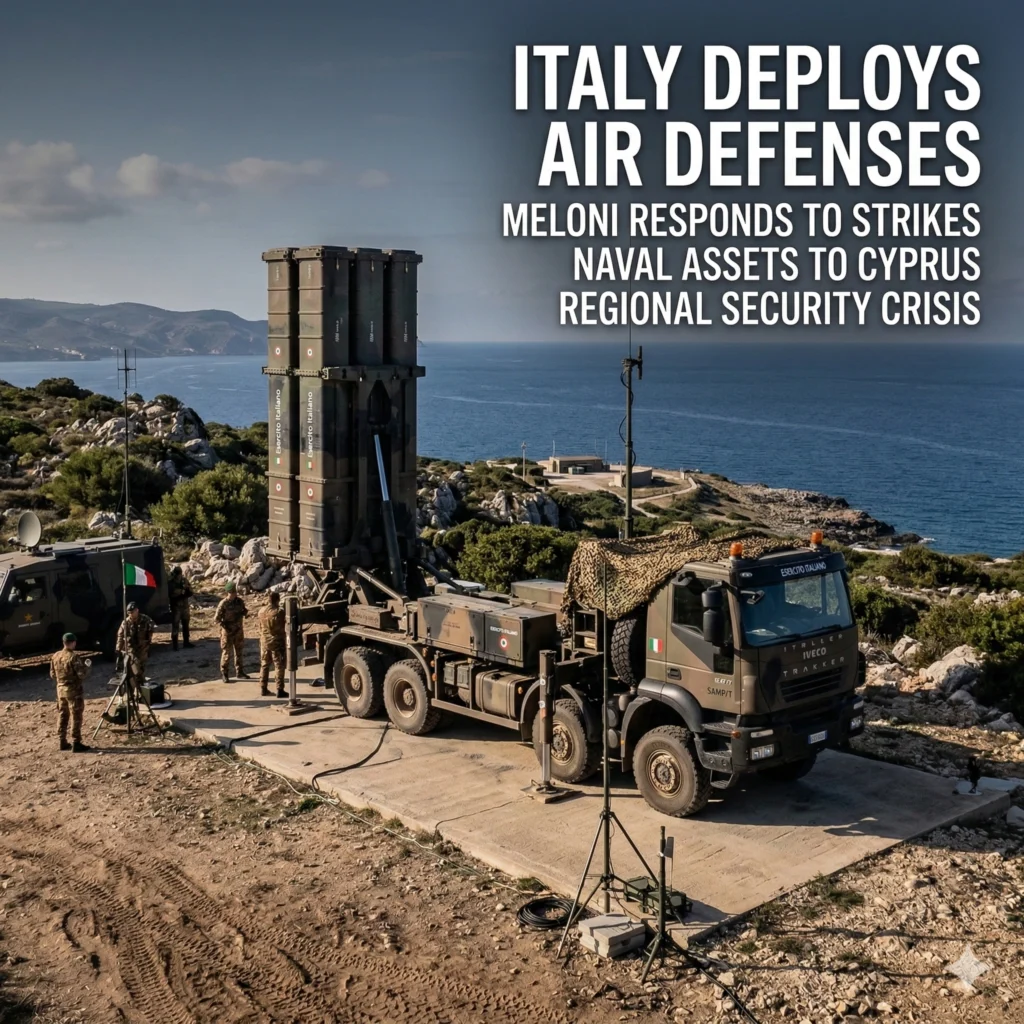
Italy Deployment Strengthens Mediterranean Security Borders
The current Italy deployment represents a significant shift in the nation’s foreign policy, prioritizing the defense of European Union maritime borders. Prime Minister Meloni emphasized that the naval support directed toward Cyprus is not just a gesture of solidarity but a necessary measure to safeguard vital underwater energy pipelines. As Iranian strikes threaten the stability of the entire Middle East, the presence of Italian frigates in the eastern Mediterranean serves as a deterrent against further regional spillover. This strategic movement ensures that European allies can maintain a unified front against unconventional threats emerging from the conflict.
The logistical complexity of the Italy deployment has been handled with high efficiency by the Ministry of Defense, ensuring that assets are positioned before any further escalation. Defense experts suggest that the naval vessels being sent are equipped with state-of-the-art radar systems capable of tracking long-range ballistic movements. By establishing this security perimeter around Cyprus, Italy is effectively creating a buffer zone that protects not only Italian interests but also the broader economic stability of the Eurozone. This proactive stance has been welcomed by regional partners who are currently facing unprecedented levels of geopolitical pressure.
Naval Support and Energy Infrastructure Protection
A primary objective of the Italy deployment is the protection of offshore drilling platforms and liquefied natural gas terminals. Given Italy’s dependence on diverse energy sources, any disruption to the infrastructure in the Mediterranean would lead to a domestic economic shock. The naval assets being dispatched include specialized anti-submarine and anti-air warfare ships designed to operate in high-threat environments. These vessels will provide a constant vigil over the transport lanes that keep the Italian economy functioning despite the chaos currently unfolding in the Gulf of Persia.
Furthermore, the Italy deployment acts as a safeguard for the thousands of Italian workers stationed at energy sites throughout the region. Meloni stated that the government’s first duty is the safety of its people, and the military presence is a physical manifestation of that promise. As the U.S.–Iran war enters its sixth day, the risk of collateral damage to neutral industrial sites has increased significantly. Italy’s decision to move its fleet into position provides a layer of insurance for the nation’s energy future during these uncertain times.
Italy Deployment
The Italy deployment is a direct response to the request for assistance from Gulf nations that find themselves under the shadow of Iranian retaliatory strikes. By providing air defense equipment, Italy is helping these nations build a “missile shield” capable of intercepting incoming drones and tactical missiles. This specialized hardware is among the most advanced in the NATO inventory, offering a high success rate in urban and industrial defense scenarios. The Italy deployment thus serves a dual purpose: stabilizing the region while strengthening Italy’s role as a major security provider in the international community.
Public support for the Italy deployment has remained steady as the administration explains the risks of inaction. Defense Minister Guido Crosetto has been vocal about the need for a high state of military readiness to prevent a broader humanitarian crisis. By sending aid to the Gulf, Italy is attempting to contain the fire of war before it spreads to more vulnerable populations. The Italy deployment is therefore characterized as a mission of containment and protection rather than one of aggression or expansionism.
Rising Air Defenses and National Readiness
Back home, the Italy deployment coincides with the raising of national air defenses to the highest possible alert level. The government is taking no chances, recognizing that modern warfare often involves cyber and long-range components that can bypass traditional borders. Crosetto informed the lower house of parliament that the military is prepared for all contingencies, including potential retaliatory actions against European interests. This domestic hardening is a necessary counterpart to the overseas Italy deployment, creating a comprehensive security architecture for the nation.
Military analysts point out that the Italy deployment showcases the rapid response capabilities of the Italian Armed Forces. The ability to mobilize both naval and air defense assets simultaneously across two different theaters of operation is a feat that few nations can achieve. This display of competence has boosted national confidence and demonstrated that Italy is ready to lead in times of crisis. The Italy deployment is a clear message to both allies and adversaries that Rome will not remain a passive observer while regional stability is under threat.
Diplomatic Coordination Within the European Union
The Italy deployment is being carried out in close coordination with other European Union member states to ensure a synchronized response. This multilateral approach prevents the duplication of efforts and allows for a more efficient distribution of military resources across the conflict zone. By aligning the Italy deployment with EU security goals, Meloni is reinforcing the importance of a common European defense policy. This cooperation is particularly important as the conflict begins to convulse global financial markets and impact international trade routes.
Diplomatic channels remain open, with Italian officials working tirelessly to advocate for a de-escalation of the conflict. However, the Italy deployment provides the necessary leverage for these negotiations, showing that Italy is prepared to back its words with action. The presence of Italian forces in Cyprus and the Gulf provides a stabilizing influence that can facilitate more productive diplomatic dialogues. In this context, the Italy deployment is seen as a tool for peace, intended to create the security conditions required for a lasting ceasefire.
Humanitarian Concerns and Tourist Evacuations
A critical component of the Italy deployment is the readiness to assist in the evacuation of foreign residents and tourists from the widening war zone. Thousands of people are currently seeking a way out of the Middle East, and Italian naval assets are well-equipped to manage maritime rescue and transport operations. The Italy deployment ensures that there is a reliable “lifeboat” available for those caught in the crossfire of the U.S.–Iran offensive. This humanitarian aspect of the mission has received praise from international aid organizations.
The government has also set up emergency coordination centers to communicate with Italians living in the Gulf. The Italy deployment provides these citizens with a sense of security, knowing that their home country is actively working to protect the region. As the war enters its second week, the logistical challenge of moving large numbers of people will only grow. The Italy deployment positions Rome to be at the forefront of these humanitarian efforts, providing a vital service to the international community in a time of great need.
Impact on Global Financial and Energy Markets
Market participants are watching the Italy deployment closely, as it represents a significant variable in the global energy security equation. The commitment of a major European economy to defend Middle Eastern and Mediterranean infrastructure has a stabilizing effect on oil and gas futures. The Italy deployment signals to the markets that the flow of energy is being protected by a capable and determined military force. This can help prevent the kind of panic selling that often accompanies the start of a major regional war.
Investment firms are re-evaluating their risk models in light of the Italy deployment, with many seeing it as a positive step toward containment. While the overall situation remains volatile, the presence of Italian defense systems reduces the likelihood of a total shutdown of key shipping lanes. The Italy deployment is thus a critical factor in the economic defense of the West, protecting the supply chains that underpin global prosperity. As long as the Italy deployment remains in effect, there is a shield against the most extreme forms of economic disruption.
Defense Industry and Technological Innovation
The Italy deployment also highlights the excellence of the Italian defense industry, which produces some of the most sought-after air defense systems in the world. By deploying this equipment in a real-world conflict scenario, Italy is demonstrating the reliability and effectiveness of its technological innovations. This has long-term implications for the nation’s industrial sector, as other countries look to upgrade their own defenses in response to the changing global threat landscape. The Italy deployment is a showcase of precision engineering and advanced digital warfare capabilities.
Research and development in the defense sector have been accelerated by the needs of the Italy deployment, with a focus on counter-drone technology and electronic warfare. These advancements will eventually benefit the entire NATO alliance, making the Italy deployment a contribution to collective security. The integration of artificial intelligence and robotics into the deployed assets represents the future of military engagement. Through the Italy deployment, the nation is proving that it remains at the cutting edge of military technology and strategic thinking.
Summary of Military Strategy and Future Outlook
In conclusion, the Italy deployment is a multifaceted response to one of the most serious geopolitical crises of the 21st century. By combining naval strength with advanced air defenses, Italy is protecting its citizens, its economy, and its international partners. The Italy deployment is a testament to the leadership of Prime Minister Meloni and the readiness of the Italian Armed Forces to meet the challenges of a dangerous and unpredictable world. As the situation in the Middle East continues to evolve, the importance of this deployment will only grow.
The eyes of the world remain on the Italy deployment as a barometer for European involvement in the U.S.–Iran conflict. Success in this mission will mean a more secure Mediterranean and a stabilized energy market for all. The Italy deployment is not just a military operation; it is a statement of national resolve and a commitment to the values of security and cooperation. As the conflict enters its next phase, Italy stands ready to adapt and expand its efforts to ensure that peace and stability are eventually restored to the region.
For more details & sources visit: Reuters
For the latest updates from the Italy, visit our Italy news page.