
Nobel laureate Paul Krugman warns that the escalating conflict with Iran introduces massive uncertainty that could accelerate a widespread economic crisis across the United States. Speaking during a high-stakes financial forum, the economist highlighted that the military offensive in Tehran has fundamentally altered the global risk landscape. Krugman noted that the absence of a clear administration timeline or exit strategy is driving market volatility and threatening long-term financial stability. This geopolitical shock, occurring during a period of already heightened inflation and trade sensitivity, creates a “perfect storm” for a potential recession that could last years.
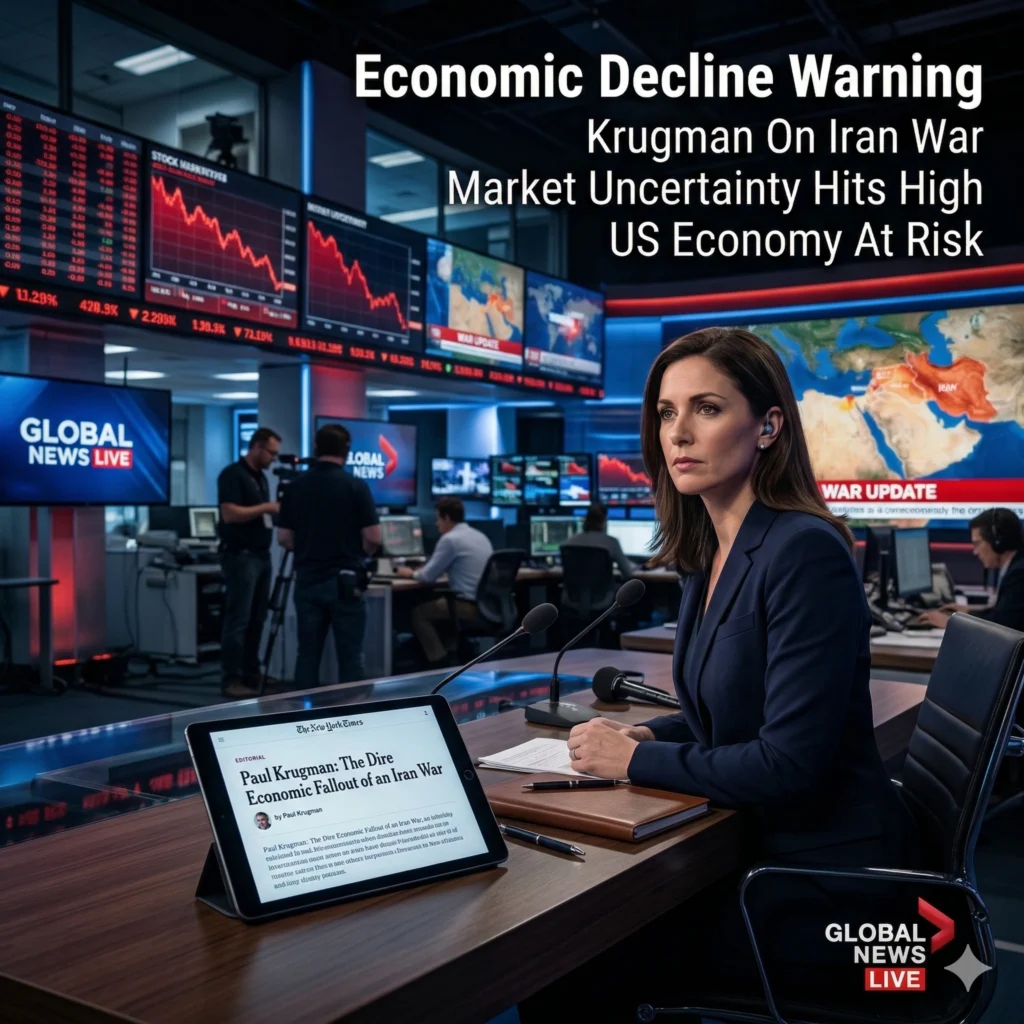
Krugman Analyzes the Impending Economic Crisis
The current economic crisis is being fueled by a lack of transparency regarding the duration of the military engagement in the Middle East. Krugman argued in his recent analysis that the Trump administration has failed to provide a coherent fiscal roadmap to account for the skyrocketing costs of a multi-front war. Without a definitive end-date, institutional investors are pullng capital out of domestic equities and seeking refuge in gold and other safe-haven assets. This flight to quality is a hallmark of a deepening economic crisis that often precedes a major stock market correction and a cooling of consumer demand.
Furthermore, Krugman pointed out that the resilient American consumer is finally showing signs of fatigue under the weight of rising energy costs. The economic crisis is exacerbated by the fact that the conflict is centered in one of the world’s most critical energy corridors. As families spend more at the pump, their ability to drive growth through discretionary spending evaporates, leading to a contraction in the retail and service sectors. Krugman’s assessment suggests that this “war tax” on the public will be the primary driver of a downturn throughout the remainder of 2026.
Military Spending and the Deficit Burden
A significant portion of the projected economic crisis stems from the uncontrolled expansion of the national deficit to fund the offensive. Krugman warned that the US is currently on a path where interest payments on the national debt could soon rival the annual defense budget itself. This fiscal imbalance leaves the government with very few tools to combat a domestic slowdown, as there is no “dry powder” left for a stimulus package. Consequently, the economic crisis is not just a result of the war itself, but a result of the fiscal fragility that preceded the first shots being fired.
The economist also highlighted that the diversion of funds from infrastructure and technology to military logistics will have a long-term “crowding out” effect on private investment. This shift ensures that the economic crisis will have a long tail, potentially stunting American innovation for a decade. Krugman believes that the current administration is ignoring these structural warnings in favor of short-term geopolitical objectives. This disconnect between military ambition and economic reality is, in his view, the most dangerous aspect of the current situation facing the Treasury and the Federal Reserve.
Economic Crisis
The economic crisis is manifesting most visibly in the energy markets, where Brent crude has seen unprecedented daily fluctuations. Paul Krugman explained that the threat to maritime trade routes in the Strait of Hormuz is a direct threat to the global supply chain. Any sustained disruption to oil tankers would send shockwaves through the manufacturing sectors of Europe and Asia, indirectly hitting the US through reduced export demand. Therefore, the economic crisis is a global phenomenon that cannot be contained within the borders of the warring nations or the Middle East.
Market participants are currently pricing in a “worst-case scenario” where the conflict expands to involve other regional powers, which would solidify the economic crisis for the foreseeable future. Krugman noted that the uncertainty is paralyzing corporate boardrooms, leading to a freeze in hiring and large-scale capital projects. When the private sector stops investing in the future, the economic crisis becomes a self-fulfilling prophecy. The Nobel laureate’s warnings serve as a stark reminder that military power cannot substitute for sound, predictable economic policy during times of international upheaval.
Trade Tariffs and the Breaking Point
Krugman previously highlighted that existing trade tariffs had already weakened the foundation of the US economic outlook before the war. The economic crisis is now the “final stressor” that breaks the resilience of a system already strained by protectionist policies and fractured trade alliances. By entering a major military conflict while simultaneously engaging in trade wars, the US has effectively isolated itself from the very partners it needs to maintain market liquidity. This isolation is a primary catalyst for the economic crisis as seen through the lens of international currency devaluations.
The economist believes the chances for a swift resolution to the regional conflict are increasingly slim given current geopolitical tensions and domestic rhetoric. As the rhetoric from Washington grows more aggressive, the economic crisis deepens because the market loses hope for a diplomatic “off-ramp.” Krugman’s data suggests that every week the war continues adds billions to the long-term cost of economic recovery. This cumulative burden is what makes the current economic crisis uniquely dangerous compared to previous downturns in the early 21st century.
Impact on American Households and Labor
The most tragic aspect of the economic crisis will be its impact on the average American household, which is already struggling with the cost of living. Krugman warned that a prolonged conflict would only increase the weight of the economic burden carried by families through higher taxes and inflation. As the labor market begins to soften in response to the economic crisis, the social safety net will face unprecedented pressure. The economist emphasized that the human cost of these financial shifts is often overlooked in favor of high-level geopolitical strategy and military data points.
In his Substack post, Krugman analyzed how the intersection of war, oil, and world finance creates a feedback loop that destroys middle-class wealth. The economic crisis is likely to hit the housing market next, as mortgage rates fluctuate in response to bond market volatility. For many Americans, their home is their primary asset, and a decline in property values would be the final blow to their financial security. Krugman’s assessment indicates that the war may be accelerating a broader economic downturn that was already in motion due to cyclical factors.
Global Finance and the Weakening Dollar
The role of the US dollar as the world’s reserve currency is also at risk during this economic crisis, according to Krugman. If international investors lose confidence in the US government’s ability to manage its finances during a time of war, they may begin to diversify into other currencies. Such a shift would significantly worsen the economic crisis by increasing the cost of imports and further fueling domestic inflation. Krugman argues that the “exorbitant privilege” of the dollar is being squandered by risky foreign policy decisions that lack a clear economic exit strategy.
Financial hubs in London, Tokyo, and Frankfurt are watching the US-Iran conflict with increasing alarm, fearing a contagion effect. The economic crisis could spread through the global banking system if energy-dependent nations begin to default on their debts. Krugman’s warnings are not limited to the US; he sees a potential for a systemic collapse if the conflict is not de-escalated immediately. This global perspective is essential for understanding why the economic crisis is being treated with such gravity by international financial institutions and Nobel-caliber economists.
Conclusion and the Path Forward
In summary, Paul Krugman’s warnings about the economic crisis provide a somber outlook for the global economy in 2026. The combination of military expenditure, energy market volatility, and a lack of clear leadership has created a volatile environment for all stakeholders. To avert a total collapse, Krugman suggests a rapid return to diplomacy and a refocusing of government resources on domestic stability. However, as it stands, the economic crisis remains the dominant narrative as the world waits for the next move in the Middle East.
The resilience of the American economy is being tested like never before, and the results of this test will define the next decade of financial history. The economic crisis is a reminder that geopolitical stability is a prerequisite for prosperity, not a byproduct of it. As the situation evolves, investors and citizens alike must prepare for a period of restricted growth and heightened risk. Paul Krugman’s analysis serves as a vital guide for navigating the complexities of an economic crisis born from the fires of war and the fog of political uncertainty.
For more details & sources visit: Business Insider
For the latest updates from the United States, visit our U.S. news page.\