
The geopolitical landscape of the Middle East has entered a precarious new phase, with Pakistan emerging as a pivotal diplomatic bridge between Tehran and the Gulf capitals. Following a weekend of unprecedented military escalation, Deputy Prime Minister Ishaq Dar addressed the Senate to clarify Islamabad’s high-stakes role in preventing a total regional collapse. By invoking a newly signed defense pact, Pakistan is signaling its commitment to its historic allies while simultaneously working to keep communication channels open with a volatile Iranian leadership. This delicate balancing act is central to maintaining the stability of the Islamic world during a time of extreme tension.
The urgency of the situation was highlighted by Iran’s massive retaliatory response to joint US-Israeli strikes, which targeted several Gulf nations but notably spared those under Pakistan’s diplomatic umbrella. Islamabad’s strategy involves a mix of firm defense reminders and back-channel assurances, designed to isolate the conflict and prevent it from engulfing the entire Arabian Peninsula. As a nuclear-armed nation with deep ties to both sides, Pakistan finds itself in a unique position to influence the calculus of war in the Middle East.
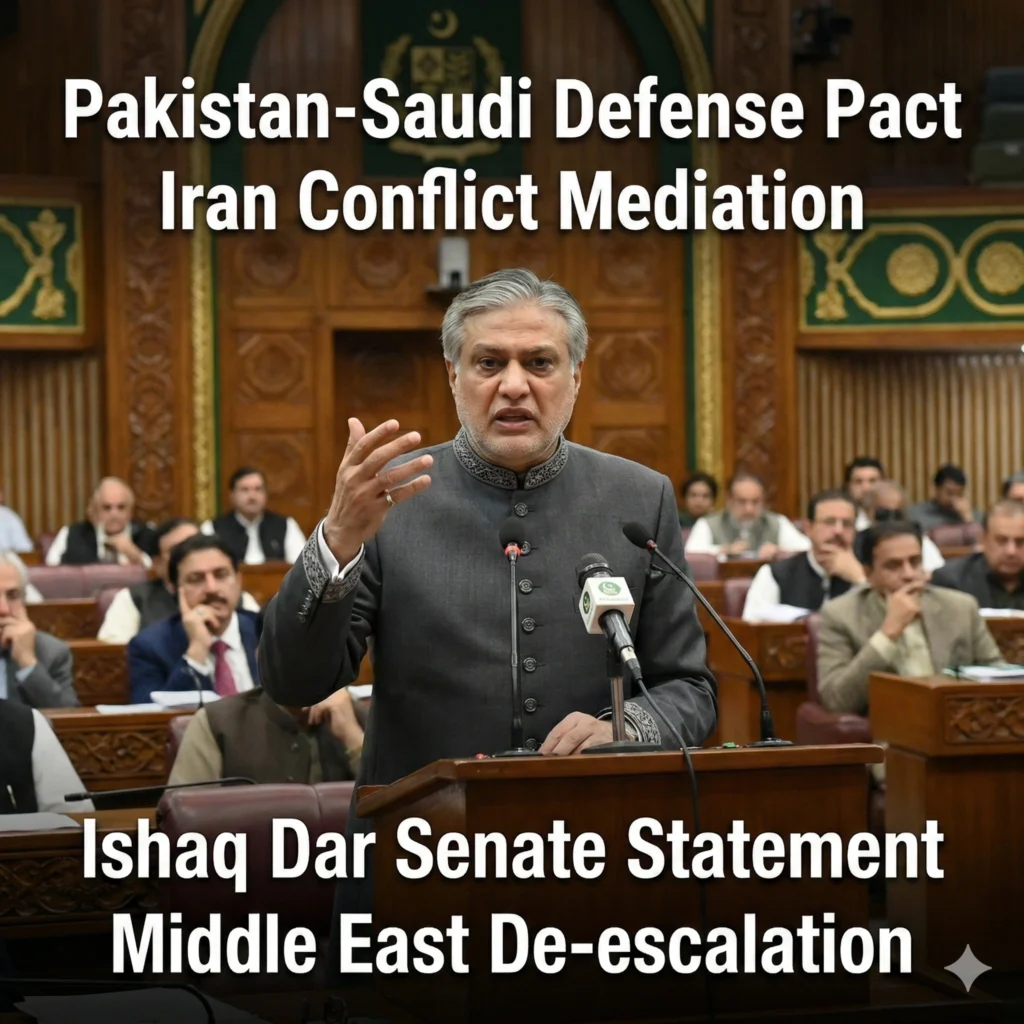
Pakistan-Saudi Defense Pact
The core of Pakistan’s current diplomatic leverage is the Strategic Mutual Defense Agreement signed with Saudi Arabia in September 2025. This pact, which Deputy Prime Minister Ishaq Dar recently highlighted to the Senate, fundamentally alters the regional security architecture. Under the terms of this sovereign agreement, any military aggression against Saudi Arabia is legally viewed as an attack against Pakistan itself. By reminding the Iranian leadership of this commitment, Islamabad has effectively drawn a “red line” around Saudi territory, raising the stakes for any further Iranian missile or drone operations in that direction.
This activation of the Pakistan-Saudi defense pact serves as a deterrent intended to contain the scope of the current conflict. During recent escalations, while several other Gulf states faced direct hits, the diplomatic pressure from Islamabad ensured a different outcome for Riyadh. Iran sought specific guarantees that Saudi soil would not be used as a launchpad for Western or Israeli strikes. Pakistan successfully mediated these assurances, creating a neutralized zone that prevented the war from expanding into a broader Sunni-Shia confrontation.
- Signatories: Pakistan and Saudi Arabia (September 2025).
- Core Clause: Aggression against one is an attack against both.
- Strategic Goal: Deterring Iranian retaliation on Saudi territory.
- Mediation Outcome: Saudi Arabia and Oman excluded from recent Iranian target lists.
Despite the formal nature of the Pakistan-Saudi defense pact, Islamabad’s approach remains one of “active mediation” rather than blind military alignment. The government is using the legal weight of the agreement not to incite war, but to force a diplomatic pause. By making the consequences of an attack on Saudi Arabia clear, Pakistan is providing the Iranian government with a rational reason to limit their retaliatory strikes to other sectors, thereby preserving the core stability of the global energy heartland.
Mediation Between Tehran and Riyadh
The role of Pakistan as a mediator between Tehran and Riyadh has become more critical following the death of Iran’s Supreme Leader during initial military operations. With the Iranian leadership in a state of flux, the risk of miscalculation is at an all-time high. Deputy Prime Minister Ishaq Dar has been utilizing encrypted messaging to maintain near-instantaneous contact with Iranian Foreign Minister Abbas Araghchi. This rapid communication allows for the “de-confliction” of military movements, ensuring that accidental escalations do not lead to a full-scale regional war.
A significant breakthrough in this mediation occurred when Pakistan conveyed Riyadh’s assurances to Tehran. Iran’s primary concern was the potential for Saudi Arabian and Omani bases to be utilized by US and Israeli bombers. By confirming that these nations remained neutral and did not facilitate the offensive strikes, Pakistan managed to steer Iranian missiles away from these specific territories. While the UAE, Bahrain, and Qatar unfortunately remained on the target list, the exclusion of Riyadh and Muscat is a testament to the effectiveness of the Pakistan-Saudi defense pact and its associated diplomacy.
- Direct Foreign Minister level communication via encrypted channels.
- Facilitation of non-aggression assurances between rival regional powers.
- Strategic shielding of Saudi and Omani airspace from retaliatory fire.
- Balancing of “Brotherly Ties” with Iran against “Strategic Ties” with Riyadh.
The groundwork for this mediation was laid during President Masoud Pezeshkian’s visit to Islamabad in August 2025. That visit established a baseline of trust that has allowed the current Pakistani administration to act as a “honest broker” in 2026. While Pakistan remains a close ally of the House of Saud, its consistent condemnation of unprovoked attacks on Iranian sovereignty gives it the credibility needed to talk to Tehran when other nations cannot. This “dual-track” diplomacy is the only current mechanism preventing a total severance of ties between the two sides of the Gulf.
Regional Escalation and Targeted Bases
The weekend of March 1, 2026, saw a dramatic shift in Middle Eastern security as Iran launched a coordinated wave of strikes across the region. While the Pakistan-Saudi defense pact kept Riyadh relatively safe, other nations experienced the full force of Iranian retaliation. Military bases in the UAE, Bahrain, Qatar, Kuwait, and Jordan were targeted by a mix of ballistic missiles and suicide drones. These attacks were a direct response to the massive US-Israeli aerial campaign that had targeted Iranian nuclear and military infrastructure just days prior.
The geography of the strikes reveals a calculated strategy by the Iranian military. By targeting countries that host significant US military assets, Tehran aimed to send a message to Washington about the vulnerability of its regional outposts. However, the selective nature of the targets—avoiding those protected by the Pakistan-Saudi defense pact—shows that Iran is still sensitive to certain diplomatic boundaries. Pakistan’s role in defining those boundaries has been instrumental in keeping the “Oman-Saudi” corridor a neutral zone amidst the chaos.
- UAE: Multiple drone incursions targeting logistics hubs.
- Bahrain: Missile strikes near naval facilities housing international fleets.
- Qatar: Interceptions reported near Al-Udeid Air Base.
- Kuwait: Heightened alert following drone sightings near border installations.
Islamabad has clarified that while it offers “defense advice” to many Middle Eastern neighbors, only Saudi Arabia is bound by the specific mutual assistance clauses of the 2025 agreement. This distinction is vital for Pakistan’s domestic politics, as it limits the scope of potential military involvement. The government remains focused on its primary duty: protecting the holy sites and the strategic integrity of its closest partner while using every diplomatic tool available to lower the temperature in Tehran.
Relations with the United States
The Pakistani government is also navigating a complex relationship with Washington, specifically through engagements with US Secretary of State Marco Rubio. The discussion centers on the future of Iran’s nuclear program and the aftermath of the recent strikes. While the US and Israel have significantly degraded Iran’s capabilities, Pakistan argues that a total collapse of the Iranian state would be a catastrophe for regional stability. The Pakistan-Saudi defense pact acts as a pillar of stability that the US can rely on, even as Islamabad publicly condemns the “coordinated attacks” on Iran.
Pakistan is positioning itself as the voice of reason that can explain Iranian motivations to the US State Department. Secretary Rubio has reportedly been in close contact with Pakistani officials to gauge the internal stability of the Iranian regime following the death of the Supreme Leader. By leveraging the Pakistan-Saudi defense pact as a stabilizer, Islamabad is showing Washington that it has the regional “clout” to manage the fallout of the conflict, provided the US does not push for a total ground invasion or further regime change.
- High-level briefings with US Secretary of State Marco Rubio.
- Advocacy for a diplomatic path regarding Iran’s nuclear status.
- Coordination of humanitarian corridors in the event of further strikes.
- Use of the 2025 pact to guarantee the safety of US-allied Saudi soil.
The tension between Islamabad’s condemnation of the US-Israeli strikes and its reliance on US technology for its own defense is a recurring theme in Pakistani foreign policy. However, the 2026 crisis has shifted the focus toward a more independent “Pakistan First” approach. By prioritizing the Pakistan-Saudi defense pact, the government is signaling that its regional alliances now carry more weight than its traditional subservience to Western strategic interests. This shift is a significant development in the “multipolar” world of the mid-2020s.
Domestic Implications and The Senate Briefing
Inside Pakistan, the invocation of the Pakistan-Saudi defense pact has been a subject of intense debate. Deputy Prime Minister Ishaq Dar’s briefing to the Senate was an attempt to build a national consensus on the country’s involvement in the Middle Eastern crisis. Many senators expressed concern that the 2025 agreement could drag Pakistan into a “forever war” if Iran and Saudi Arabia were to engage in direct combat. Dar reassured the house that the pact is primarily a “defensive shield” designed to prevent war through the credible threat of mutual assistance.
The government’s transparency regarding the Pakistan-Saudi defense pact is intended to differentiate the current situation from the 2015 Yemen crisis, where Pakistan famously opted for neutrality. In 2026, the stakes are perceived as higher, with the safety of the Saudi state directly linked to Pakistan’s own national security and economic interests. The Senate was informed that the “mutual” nature of the pact also provides Pakistan with significant security guarantees from the oil-rich kingdom, creating a reciprocal relationship that strengthens both nations.
- Senate debriefing on the legal obligations of the 2025 pact.
- Reassurance of the “defensive” nature of Pakistani deployment.
- Discussion on the economic benefits of a stable Saudi-Pakistani alliance.
- Public support for the role of mediator in the Islamic world.
Furthermore, the government is highlighting the “Assurances of Riyadh” as a major diplomatic win. By showing that Pakistan can influence Saudi policy to the point of granting non-aggression guarantees to Iran, the administration is proving the value of its “Strategic Autonomy.” This narrative is crucial for maintaining domestic stability, as it appeals to both the pro-Saudi and pro-Iran factions within the Pakistani public. The focus remains on “de-escalation” as the only sustainable path forward for the country.
Future of Regional Stability
The future of regional stability now rests on the endurance of the Pakistan-Saudi defense pact and the success of continued mediation. Islamabad has made it clear that it will not stop its efforts to de-escalate tensions between Washington and Tehran. The death of the Iranian Supreme Leader has created a “moment of maximum danger,” but also a potential opening for a new security arrangement. Pakistan’s goal is to facilitate a framework where the Gulf states and Iran can coexist without the constant threat of aerial bombardment.
Looking toward late 2026, Pakistan plans to host a regional security summit that would bring together the signatories of the Pakistan-Saudi defense pact along with Iranian and American observers. This ambitious project aims to turn the current “crisis management” into a long-term “peace architecture.” While the challenges are immense, the fact that Riyadh and Tehran are still talking through Islamabad is a sign of hope. The 2025 pact has provided the necessary “floor” for these discussions, ensuring that even at the height of a missile crisis, there are certain boundaries that remain respected.
- Proposal for a “Regional Peace Summit” in Islamabad late 2026.
- Continued role as a “Nuclear-Armed Mediator” in the Middle East.
- Focus on securing energy trade routes through the Strait of Hormuz.
- Potential expansion of the 2025 pact to include other regional partners.
The Pakistan-Saudi defense pact is more than just a military document; it is a declaration of a new regional order. As the US recalibrates its role in the Middle East, Pakistan is stepping up to fill the diplomatic vacuum. By protecting its partners and talking to its rivals, Islamabad is defining a new type of “smart power” that balances military commitment with diplomatic agility. The eyes of the world remain on the Karakoram and the Hindu Kush as the source of the next move in the Great Game of Middle Eastern politics.
Conclusion
The invocation of the Pakistan-Saudi defense pact by Deputy Prime Minister Ishaq Dar marks a definitive moment in the 2026 Middle Eastern crisis. By standing firm on its strategic commitments to Riyadh while tirelessly mediating with Tehran, Pakistan has successfully prevented a wider regional catastrophe—at least for now. The “assurances” brokered by Islamabad between the two rival powers demonstrate the unique influence of a nation that sits at the crossroads of the Islamic world.
As the conflict between Iran and the Western-backed Gulf coalition continues to simmer, the Pakistan-Saudi defense pact will remain the primary stabilizer of the region’s security. Islamabad’s dedication to de-escalation, backed by its sovereign military agreements, offers the only viable path toward a sustainable peace. The coming months will test the strength of these ties and the skill of Pakistani diplomacy as the world hopes for a resolution to a crisis that has reshaped the geopolitical map of the 21st century.
For more details & sources visit: Arab News
For the latest updates from Pakistan, visit our Pakistan news page.