
The Middle East is witnessing a strong surge in volatility as Iraqi factions escalate threats following fatal strikes in the Diyala and Babil provinces. Prime Minister Mohammed Shia’ al-Sudani is currently struggling to maintain a delicate policy of neutrality while the nation is pulled toward the center of a burgeoning regional war. This escalation follows a series of air strikes that killed several members of Iran-aligned groups, fundamentally shifting the security landscape within the Iraqi borders.
Security forces in Baghdad are currently on high alert, having successfully thwarted massive protests attempting to breach the United States Embassy in the Green Zone. As the Iraqi government attempts to navigate this crisis, the risk of a full-scale domestic conflict remains a pressing concern for international observers. The following sections provide a detailed analysis of how these developments are reshaping the future of Iraqi sovereignty and regional stability.
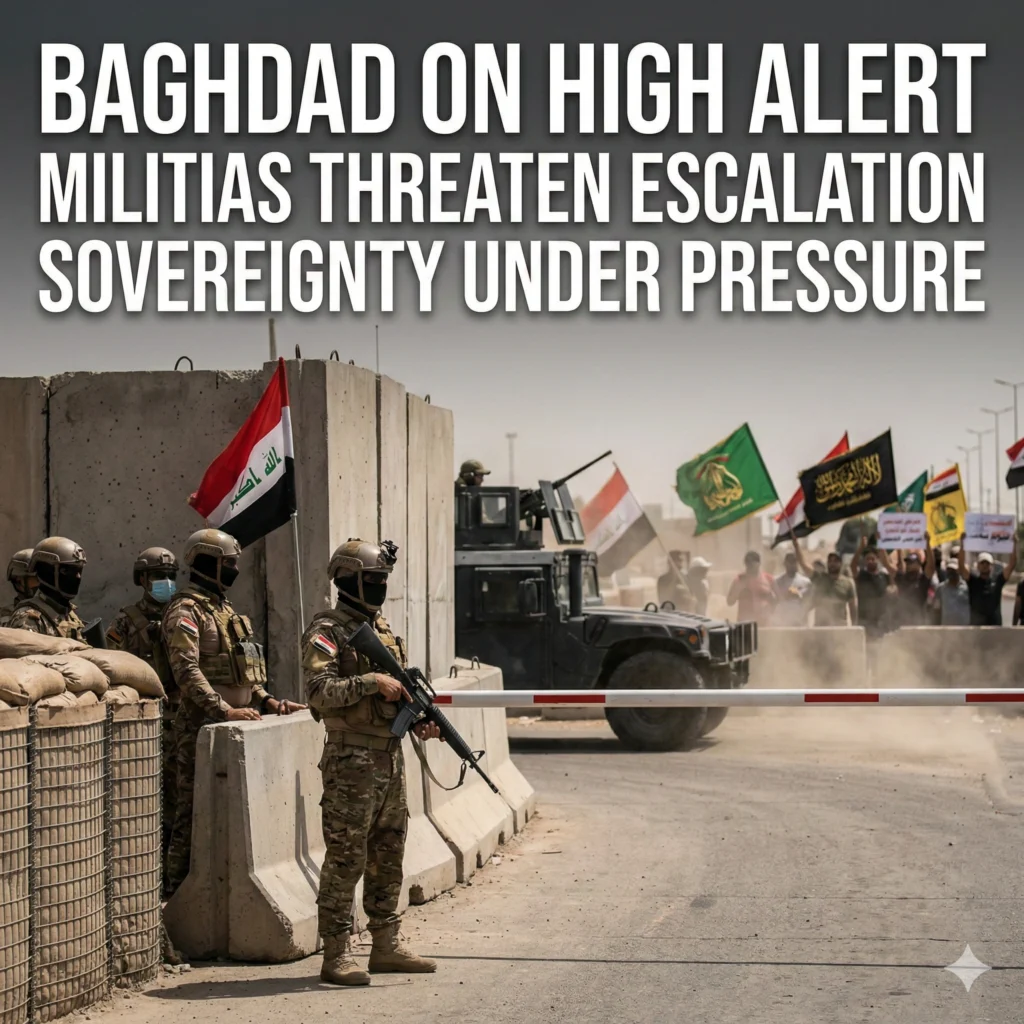
Iraqi Factions Escalate Threats Following Air Strikes
The current wave of tension began when air strikes targeted faction positions in rural provinces, leading to a swift declaration that Iraqi factions escalate threats against foreign assets. These strikes have been described by the Iraqi Ministry of Foreign Affairs as a systematic attempt to force the nation into a wider regional conflict. The loss of life among faction members has provided the necessary pretext for groups like Kataib Hezbollah to mobilize their supporters.
The rhetoric from these organizations has turned increasingly hostile, with official statements suggesting that the safety of international troops is no longer guaranteed. This shift indicates a breakdown in the informal truce that had previously kept Iraq relatively stable during neighboring conflicts. If the government cannot restrain these actors, the likelihood of retaliatory strikes on government-controlled infrastructure will likely increase in the coming days.
Furthermore, the geographical spread of the violence shows that the threat is not localized to the capital. From the borders of Diyala to the southern reaches of Babil, the footprint of the conflict is expanding rapidly. This expansion puts immense pressure on the Iraqi security apparatus, which must now defend against both external aerial threats and internal insurgent movements.
Prime Minister Sudani and the Neutrality Crisis
Prime Minister Mohammed Shia’ al-Sudani is facing his most significant political challenge as Iraqi factions escalate threats against the West. His administration had initially prioritized economic reform and regional mediation, but these goals are now being overshadowed by the drumbeat of war. Maintaining neutrality is becoming nearly impossible as local factions demand a formal response to the violation of Iraqi airspace.
The Prime Minister has engaged in a flurry of diplomatic meetings to prevent Iraqi territory from being used as a launchpad for regional attacks. However, his authority is being openly questioned by militia leaders who see the government’s caution as a sign of weakness. This internal power struggle is a primary driver of the current instability, as the state struggles to assert its monopoly on the use of force.
Moreover, the economic impact of this instability is beginning to manifest in market fluctuations and a slowdown in foreign investment. Investors are wary of a country where rocket sirens are becoming a nightly occurrence at the primary international airport. Sudani’s ability to balance these competing interests will determine whether Iraq survives this period as a unified state or descends back into a cycle of sectarian violence.
Military Preparedness as Iraqi Factions Escalate Threats
In response to the fact that Iraqi factions escalate threats, the national military has increased its presence in the Green Zone and around vital oil installations. The sounding of air-raid sirens at Baghdad International Airport serves as a grim reminder of the nation’s vulnerability to projectile warfare. Witnesses have reported unidentified rockets crossing the airspace, highlighting the chaotic nature of the current security environment.
Military commanders are particularly concerned about the use of domestically launched drones, which have already caused debris to fall in the Basra province. These drones represent a low-cost, high-impact tool for factions looking to bypass traditional air defenses. The inability to track and intercept these small-scale threats poses a significant risk to civilian populations and military personnel alike.
Technical teams are currently analyzing the wreckage of projectiles that landed in Kirkuk and Nineveh to determine their origin. While no casualties were reported in those specific incidents, the psychological toll on the residents is immense. The military must now decide whether to actively engage the factions or continue a policy of containment that many argue is no longer effective.
Diplomatic Standoff and International Pressure
The international community is watching closely as Iraqi factions escalate threats that could disrupt global energy markets. The United States and its allies have urged the Iraqi government to take decisive action against independent armed groups that operate outside of the state’s command. This pressure creates a difficult situation for Baghdad, which relies on both Western support and a working relationship with Tehran.
Diplomatic sources suggest that Iraq is being used as a pawn in a larger game of regional chess between major powers. The systematic targeting of faction members suggests a broader strategy to degrade the influence of the “Axis of Resistance” within Iraqi borders. However, this strategy often results in a backlash that further empowers the very groups it intends to weaken.
The Iraqi Ministry of Foreign Affairs is working overtime to draft a resolution that respects national sovereignty while addressing the concerns of the international community. This resolution is expected to call for an end to all unauthorized military activity on Iraqi soil. Whether this document carries any weight with the factions on the ground remains to be seen, as they continue to operate with a high degree of autonomy.
Human Rights and Civil Unrest in Baghdad
As Iraqi factions escalate threats, the impact on civil liberties and human rights is becoming a major concern for activists. The heavy security presence in Baghdad has restricted the movement of civilians and led to the closure of several key bridges and roads. While these measures are intended to prevent violence, they also create a sense of siege among the local population.
The prevention of the embassy protest was a tactical success for the government, but it has not addressed the underlying anger of the protesters. Many Iraqi youths feel caught between a government that cannot protect them and factions that are leading them toward a war they do not want. This frustration could manifest in larger, more spontaneous demonstrations that are harder to control than organized militia rallies.
Furthermore, the agricultural sectors in provinces like Kirkuk are suffering as unexploded ordnance and falling debris make farming a dangerous occupation. The government has yet to announce a compensation plan for those affected by these “malfunctioning projectiles.” As the conflict drags on, the humanitarian cost of the factions’ escalation will only continue to grow, leading to a potential internal displacement crisis.
Geopolitical Realignment and the Role of Iran
It is impossible to ignore the role of Tehran as Iraqi factions escalate threats against Western interests. The groups involved, such as Harakat al-Nujaba, have officially stated their readiness to enter the conflict on behalf of Iranian interests. This alignment suggests that Iraq’s internal security is inextricably linked to the broader foreign policy objectives of the Islamic Republic.
Analysts argue that Iran is using its proxies in Iraq to create a “buffer zone” of instability that keeps its adversaries occupied. By encouraging these factions to strike at American assets, Tehran can maintain plausible deniability while exerting significant pressure on Washington. This strategy effectively turns Iraq into a secondary theater of war, much to the dismay of the Iraqi people.
The challenge for the Iraqi government is to convince its neighbor that a stable Iraq is in everyone’s best interest. However, as long as the regional conflict continues to intensify, the temptation to use Iraqi factions as a tool of asymmetric warfare will remain strong. The coming months will reveal whether Baghdad can navigate this geopolitical minefield or if it will be consumed by the fire of regional competition.
Iraqi Factions Escalate Threats
The sudden declaration that Iraqi factions escalate threats has sent shockwaves through the regional security network. For years, these groups have operated in a gray zone, but their recent move toward open warfare marks a significant escalation. The statement that the lives of foreign troops are “mortaged” indicates a shift from defensive posturing to offensive planning.
This development is particularly dangerous because these factions possess sophisticated weaponry, including long-range drones and ballistic missiles. Unlike previous years where engagements were limited to small-arms fire, the current capability of these groups allows them to strike targets hundreds of miles away. The Iraqi government’s lack of control over these arsenals is a major point of contention in regional security dialogues.
The rhetoric of “resistance” continues to resonate with a segment of the population that feels marginalized by foreign intervention. This ideological support makes it difficult for the government to move against the factions without risking a civil war. As Iraqi factions escalate threats, the social fabric of the country is being tested in ways not seen since the height of the ISIS conflict.
Security Forces and the Green Zone Defense
The defense of the Green Zone has become a top priority as Iraqi factions escalate threats against diplomatic missions. The use of concrete barriers and elite counter-terrorism units has so far prevented a breach of the US Embassy. However, the constant threat of mortar fire and drone strikes keeps the diplomatic community in a state of perpetual anxiety.
Security forces are also tasked with monitoring the activities of faction supporters who have set up camps near the perimeter of the international zone. These supporters are often used as human shields or as a way to provoke a response from the security forces. The government must handle these situations with extreme care to avoid creating martyrs for the faction’s cause.
Despite the high tension, there have been reports of back-channel communication between the government and some faction leaders. These talks are aimed at establishing “red lines” that neither side should cross. However, as Iraqi factions escalate threats in the public sphere, these private agreements are becoming increasingly fragile and subject to the whims of regional commanders.
Impact on National Sovereignty and Governance
The most profound casualty as Iraqi factions escalate threats is the concept of Iraqi national sovereignty. When foreign powers strike targets on Iraqi soil and local factions launch drones from Iraqi territory, the central government appears to be a mere bystander. This erosion of authority is a long-term threat to the stability of the Iraqi state.
The Parliament is currently divided on how to handle the crisis, with some members calling for the immediate expulsion of all foreign forces. Others argue that such a move would leave Iraq completely vulnerable to both internal and external threats. This political deadlock prevents the government from taking a unified stance on the activities of the armed groups.
As the country draws closer to war, the basic functions of governance are being neglected. Budgets for infrastructure and healthcare are being redirected toward security and defense. The Iraqi people, who have already endured decades of conflict, are once again forced to pay the price for a war that is largely being fought for the interests of outside powers.
Future Outlook for the Iraqi State
The future looks increasingly uncertain as Iraqi factions escalate threats that could trigger a massive retaliatory response. If a faction-led attack results in significant American casualties, the response would likely be a full-scale air campaign against targets across Iraq. This scenario is what Prime Minister Sudani is working desperately to avoid.
The possibility of a regional “grand bargain” seems remote as the conflict continues to expand. Instead, Iraq appears headed for a period of prolonged instability where the government’s reach is limited to a few urban centers. The agricultural and oil-producing regions could fall under the de facto control of local militias, further weakening the central state.
However, there is a small hope that the current crisis will force a final reckoning regarding the status of the armed factions. If the government can leverage international support to integrate these groups into the national army or disarm them, Iraq could emerge with a stronger sense of national identity. Unfortunately, the path to that outcome is paved with significant risks and the potential for immense bloodshed.
The Role of Basra and the Southern Provinces
The southern provinces, particularly Basra, have become a focal point as Iraqi factions escalate threats. As a major hub for the oil industry, any instability in Basra has immediate global consequences. The recent falling of drone debris in the province has put the local government on high alert and threatened the operations of international oil companies.
Governor Asaad al-Eidani has called for increased coordination between local security forces and the central government to protect the province’s assets. There is a fear that factions might target oil pipelines as a way to sabotage the national economy and force the government’s hand. Such an act would be a catastrophic blow to the nation’s recovery efforts.
The residents of Basra are also dealing with the environmental and health impacts of the increased military activity. The noise of low-flying drones and the fear of falling ordnance have disrupted daily life. As the conflict intensifies, the south remains a critical but vulnerable theater in the struggle for Iraq’s future.
Conclusion of the Iraqi Security Report
In conclusion, the situation in Iraq is at a critical juncture as Iraqi factions escalate threats and regional powers continue to clash. The fatal strikes in Diyala and Babil have set off a chain reaction that is dragging the nation toward a war it is ill-prepared to fight. Prime Minister Sudani remains the only figure capable of holding the country together, but his options are rapidly diminishing.
The international community must support Iraq’s efforts to maintain its neutrality and protect its sovereignty. This includes putting pressure on all sides to stop using Iraqi territory for their proxy battles. Without a concerted effort to de-escalate, the record of peace that Iraq has slowly built over the last few years will be completely erased.
For more details & sources visit: Alhurra
Read more about Iraq news on 360 News Orbit – Iraq.