
Saudi Arabia denies lobbying United States for strikes amid the ongoing regional conflict that has reshaped Middle East diplomacy. The Saudi Embassy in Washington officially refuted reports that Crown Prince Mohammed bin Salman pressured President Trump to initiate the ongoing military offensive. Despite current regional escalations, Riyadh maintains that its diplomatic consistency has focused on reaching a credible deal rather than pursuing armed conflict. Saudi spokesperson Fahad Nazer stated that the kingdom never lobbied the Trump administration to adopt an offensive policy against Tehran. This clarification serves to distance the Kingdom from the immediate kinetic actions while maintaining its stance on regional stability.
The statement follows reports suggesting the Saudi Crown Prince had advocated for strikes during multiple phone calls with the United States President. Contradictory reports indicate Senator Lindsey Graham traveled to Saudi Arabia in late February to secure regional backing for the military operation. The diplomatic denial comes amid joint United States and Israeli strikes that have reportedly killed 48 high-ranking Iranian political and military leaders. Iranian authorities confirmed the deaths of IRGC Commander Mohammad Pakpour and Defense Minister Aziz Nasirzadeh during the initial waves of attacks. Saudi Arabia previously informed Iranian leadership in January that it would not permit its airspace or territory to be used for military aggression.
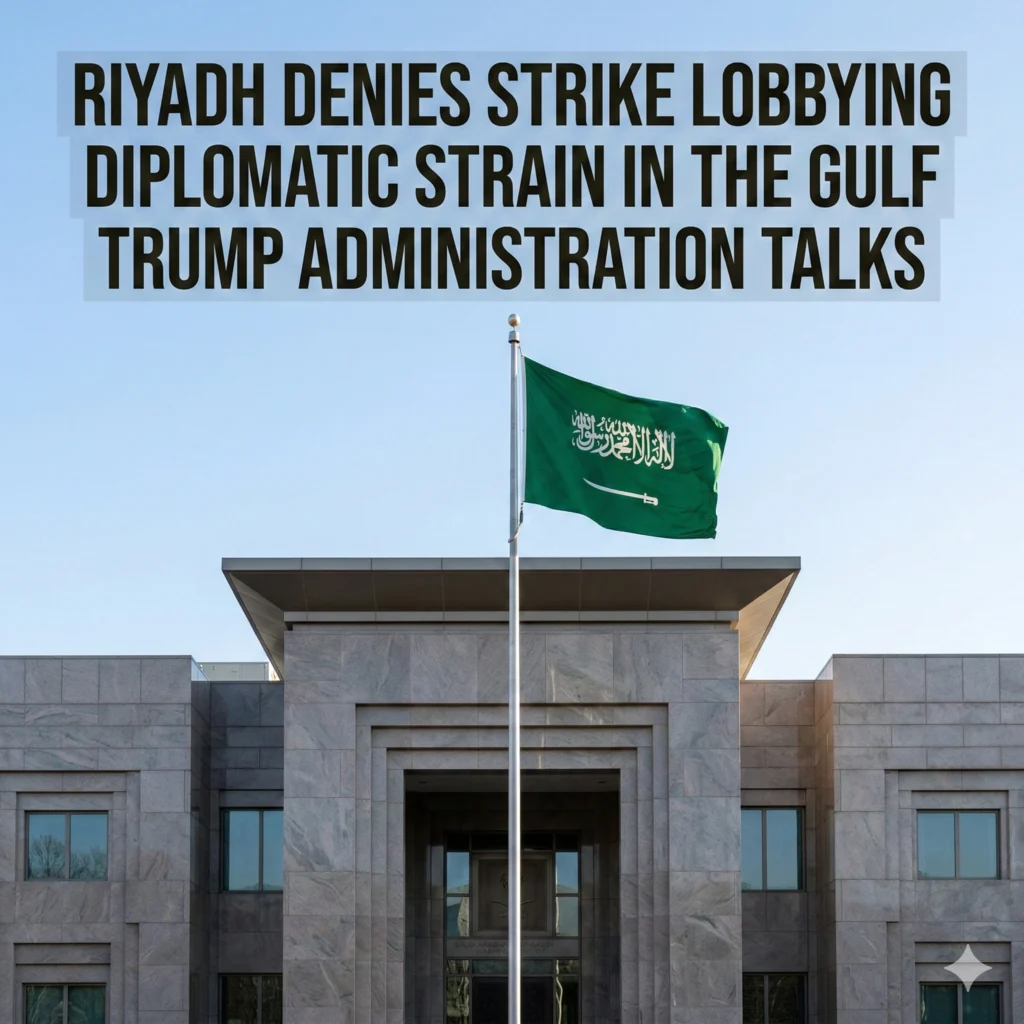
Saudi Arabia denies lobbying United States for strikes
The official communication from the Saudi Embassy highlights a significant pivot in the narrative surrounding the current military campaign. By stating that Saudi Arabia denies lobbying United States for strikes, the government is reinforcing its commitment to a diplomatic resolution. This move is intended to prevent further escalation that could jeopardize the Vision 2030 economic goals. Furthermore, the Kingdom is attempting to shield its infrastructure from the devastating retaliatory strikes seen at the Jebel Ali port. Consequently, the emphasis remains on a “credible deal” rather than a full-scale regional war.
Diplomatic sources suggest that the Kingdom’s refusal to allow its airspace for attacks was a calculated move to maintain neutrality. Even as the United States and Israel ramp up their operations, Riyadh is holding a firm line on territorial sovereignty. This strategy is designed to mitigate the risk of being labeled a direct combatant by the new Iranian leadership structure. As the IRGC vows revenge, the Saudi government is prioritizing the safety of its citizens over offensive military participation. This cautious approach reflects a deep understanding of the volatility currently gripping the Persian Gulf.
Strategic Neutrality in a Time of Regional Crisis
The recent deaths of high-ranking Iranian leaders have created a power vacuum that worries many regional observers and analysts. Because Saudi Arabia denies lobbying United States for strikes, it places the onus of the current escalation solely on Washington and Tel Aviv. This distinction is vital for Riyadh as it seeks to maintain the fragile detente established with Tehran in previous years. While the Trump administration moves forward with its objectives, the Kingdom is actively signaling that it did not pull the trigger. Such a stance is essential for preventing a direct Iranian missile barrage on Saudi oil facilities.
Furthermore, the involvement of European powers like France and the United Kingdom adds another layer of complexity to the situation. These nations have expressed a readiness to defend Gulf allies, yet Riyadh remains hesitant to embrace a total war footing. The Kingdom’s leadership understands that a prolonged conflict would drain financial resources away from domestic development projects. Therefore, the official denial of lobbying efforts is a protective measure for the national economy. It ensures that the global community views Saudi Arabia as a voice of reason amidst the chaos.
Impact of Iranian Leadership Changes on Gulf Security
The confirmation of deaths among the IRGC top brass has led to an immediate and unpredictable shift in Iranian policy. Since Saudi Arabia denies lobbying United States for strikes, it hopes to avoid the brunt of the “harsh revenge” promised by Tehran. However, the targeting of civilian sites like the Fairmont hotel suggests that Iran may not be making such fine distinctions. The GCC states are now in a precarious position where they must balance their alliance with Washington against local threats. This environment requires a sophisticated level of diplomatic maneuvering to ensure long-term survival.
Moreover, the reported passing of the Supreme Leader has triggered an internal struggle within the Iranian political establishment. This instability makes it difficult for Saudi Arabia to engage in the very “credible deal” it claims to be seeking. Without a stable interlocutor in Tehran, the prospects for peace seem increasingly dim for the foreseeable future. The Kingdom’s insistence on its non-involvement in the lobbying process is a clear message to the new Iranian cadres. It serves as an invitation to return to the negotiating table once the smoke from the current strikes clears.
Historical Context of Saudi-US Military Relations
The relationship between Riyadh and Washington has always been characterized by a blend of deep security cooperation and occasional friction. Even though Saudi Arabia denies lobbying United States for strikes, the historical precedent of their partnership often suggests a unified front. During previous administrations, the two nations frequently shared intelligence and strategic goals regarding the containment of Iranian influence. However, the current intensity of the American-led campaign appears to have surpassed the Kingdom’s desired threshold for kinetic action. This divergence marks a notable shift in how Riyadh manages its primary security guarantor.
Historically, the Kingdom has preferred a policy of maximum pressure through economic and diplomatic means rather than direct fire. The statement from Fahad Nazer reinforces this traditional preference for stability over the unpredictability of total war. By rejecting the reports of pressure on the Trump administration, Riyadh is reclaiming its narrative as a regional stabilizer. This is particularly important given the recent missions by US senators to secure regional backing for the strikes. The Kingdom is making it clear that its support for the US does not equate to a blank check for invasion.
Economic Consequences of the Ongoing Persian Gulf Conflict
The industrial sites in the Gulf, including the Jebel Ali port, are the lifeblood of the regional and global economy. As Saudi Arabia denies lobbying United States for strikes, it highlights the vulnerability of these economic hubs to retaliatory measures. A single drone strike can disrupt global supply chains and cause oil prices to spike to unprecedented levels. The Kingdom is acutely aware that its ambitious modernization plans rely on a secure and predictable maritime environment. Therefore, any action that invites retaliation against its ports is viewed as a direct threat to the national interest.
In addition to port security, the tourism sector, which is a pillar of Vision 2030, is also at risk. The Fairmont hotel incident serves as a grim reminder that high-value civilian targets are now on the frontline. If the conflict continues to broaden, the influx of foreign investment and international visitors could dry up entirely. This is why the Saudi government is so adamant about its lack of involvement in the decision to strike Iran. They are fighting a two-front battle: one for regional security and another for the continued viability of their economic transformation.
The Role of International Mediation and Defensive Actions
With the United States and Israel conducting major operations, the role of mediators like France and Germany has become crucial. While these nations are ready for defensive action, they are also looking for ways to de-escalate the broader regional tension. Because Saudi Arabia denies lobbying United States for strikes, it leaves the door open for these European partners to broker a ceasefire. Riyadh’s stance provides a diplomatic “off-ramp” that would not exist if they were openly cheering for the destruction of Tehran. This nuance is often lost in the heat of military reporting but remains vital for future peace.
The United Arab Emirates’ hint at opening bases for supporting forces indicates that not all GCC members are on the same page. This potential fragmentation within the Gulf Cooperation Council could lead to a more complex security architecture in the region. Saudi Arabia’s refusal to allow its own territory for strikes stands in contrast to the more assertive posture of its neighbors. This internal debate reflects the high stakes involved for every nation situated along the Persian Gulf’s coastline. Each country must decide how much risk it is willing to tolerate in the face of Iranian aggression.
Future Projections for Middle Eastern Geopolitics
The aftermath of the current military campaign will likely result in a fundamentally different Middle Eastern landscape. Since Saudi Arabia denies lobbying United States for strikes, it may emerge as the primary intermediary in the post-conflict era. If the Kingdom can successfully distance itself from the carnage, it will have the moral and political capital to lead reconstruction efforts. However, this depends entirely on whether the new Iranian leadership accepts Riyadh’s denials at face value. The coming months will be a period of intense testing for the Kingdom’s diplomatic corps and its strategic patience.
Analysts believe that the death of key Iranian figures will either lead to a total collapse of the regime or a more radicalized defense. In either scenario, the Kingdom of Saudi Arabia will remain the central pivot point for Western interests in the region. The decision to clarify their lack of lobbying is not just a PR move; it is a long-term strategic positioning. By staying out of the “war party,” Riyadh ensures that it remains an indispensable partner for both the East and the West. The stability of the global energy market may very well depend on the success of this delicate balancing act.
Public Perception and Media Warfare in the Gulf
In the modern era, the battle for public opinion is just as important as the battle on the ground. When Saudi Arabia denies lobbying United States for strikes, it is also addressing a domestic audience that is wary of being drawn into another war. The Saudi public is largely focused on the social and economic reforms promised by the Crown Prince. A massive military engagement would likely necessitate a return to austerity measures, which would be highly unpopular. Therefore, the government’s statement is a reassurance to its own citizens that their future remains the top priority.
Furthermore, the “media warfare” between Tehran and Riyadh has reached a fever pitch, with both sides using digital platforms to spread their narratives. The Saudi denial is a direct counter to Iranian propaganda that portrays the Kingdom as a puppet of Western imperialism. By taking a stand on its own diplomatic consistency, Riyadh is asserting its independence on the world stage. This move is intended to resonate with other Arab nations who are also skeptical of unlimited military intervention. Maintaining the “moral high ground” is a key component of the Kingdom’s broader geopolitical strategy during this crisis.
Military Readiness and Border Security Measures
Despite the diplomatic denials, the Saudi military remains on high alert to defend the Kingdom’s borders. The fact that Saudi Arabia denies lobbying United States for strikes does not mean it is unprepared for the consequences of the conflict. The Royal Saudi Air Defense Forces have been bolstered by advanced interceptor systems to protect against incoming drones and missiles. This defensive posture is consistent with the Kingdom’s claim that it seeks to protect its territory rather than attack others. Security along the northern and eastern borders has been intensified to prevent any spillover from the ongoing strikes in Iran.
The coordination with Western allies remains strictly within the framework of defensive support and intelligence sharing. Riyadh has been clear that its participation is limited to safeguarding the flow of commerce through the Bab el-Mandeb and the Strait of Hormuz. This focus on “maritime security” allows the Kingdom to cooperate with the US Navy without being seen as an aggressor. As the conflict enters a more volatile phase, the distinction between defense and offense will become increasingly difficult to maintain. However, for now, the Saudi government is sticking to its stated policy of non-interference in the offensive campaign.
The Humanitarian Aspect of the Regional Escalation
The loss of hundreds of civilians in southern Iran is a tragedy that has not gone unnoticed by the international community. As Saudi Arabia denies lobbying United States for strikes, it also expresses concern for the broader humanitarian impact of the war. The Kingdom has a long history of providing aid to conflict-stricken areas and may eventually play a role in humanitarian relief for the Iranian people. This “soft power” approach is a hallmark of Saudi foreign policy and serves to balance its more traditional security interests. Promoting a message of peace and stability is essential for maintaining Riyadh’s influence in the Islamic world.
The displacement of people and the destruction of infrastructure in Iran will have long-term consequences for the entire region. Saudi Arabia’s emphasis on a “credible deal” includes the necessity of a stable and functioning Iranian state that does not export revolution. The Kingdom understands that a failed state on its doorstep would be a permanent source of instability and extremism. Therefore, the diplomatic efforts are aimed at transforming Iran into a responsible regional actor rather than destroying it entirely. This vision for the future is what drives the current Saudi policy of restraint and diplomatic clarification.
Conclusion and Final Strategic Outlook
The situation in the Middle East remains fluid, with every day bringing new reports of strikes and counter-strikes. The clear statement that Saudi Arabia denies lobbying United States for strikes is a defining moment in this chapter of regional history. It sets the stage for a complex diplomatic dance where the Kingdom must protect its interests without becoming a target. As the Trump administration continues its campaign, the world will be watching to see if Riyadh can maintain its stance of strategic neutrality. The ultimate goal remains a peaceful and prosperous Middle East, but the path to that objective is currently fraught with peril.
In the coming weeks, the focus will likely shift to whether the new leadership in Tehran is willing to engage in talks. Saudi Arabia’s role as a potential bridge-builder cannot be understated, provided the current tensions can be de-escalated. The Kingdom’s commitment to its domestic transformation through Vision 2030 remains the primary driver of its foreign policy decisions. By avoiding the pitfalls of a direct military confrontation, Riyadh is betting on a future where economic integration replaces armed conflict. Only time will tell if this gamble will pay off in one of the world’s most volatile regions.
For more details & sources visit: Middle East Eye
For the latest updates from Saudi Arabia, visit our Saudi Arabia page.