
Canada and India Strategic Energy Reset has officially begun with a monumental $1.9 billion agreement signed, marking a definitive end to years of diplomatic friction. Prime Minister Mark Carney and Prime Minister Narendra Modi met in New Delhi to formalize a partnership that secures India’s nuclear future while providing Canada with a stable, high-value export market.
This agreement is not merely a commercial transaction; it is a calculated geopolitical pivot designed to diversify trade alliances and strengthen the Indo-Pacific corridor. By choosing to focus on energy security and critical minerals, both nations are signaling a transition toward a more pragmatic and resilient bilateral relationship. The deal serves as the centerpiece of a broader strategy to double bilateral trade and integrate the two economies through long-term structural cooperation.
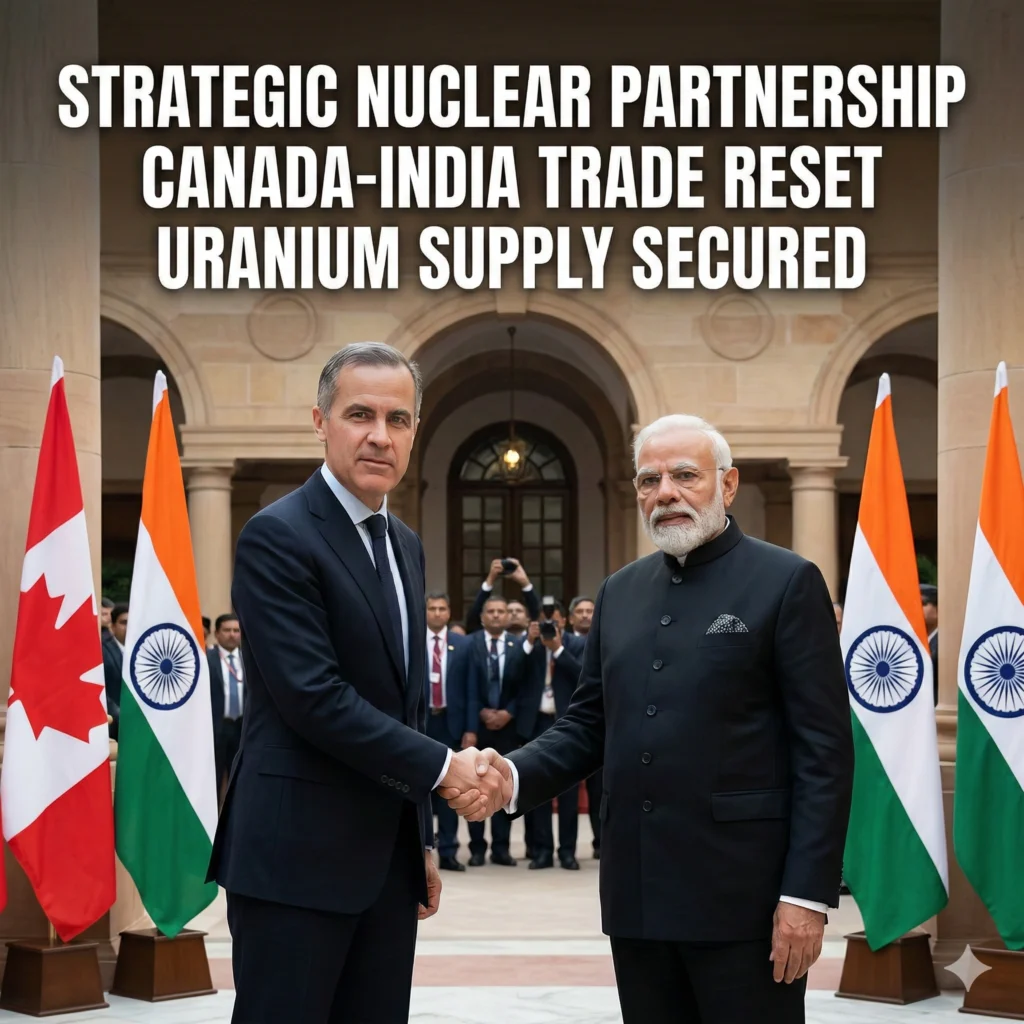
Evolution of the Canada and India Strategic Energy Reset
The Canada and India Strategic Energy Reset represents the most significant diplomatic breakthrough between the two Commonwealth nations since 2018. Following a period of cooling relations, the election of Prime Minister Mark Carney facilitated a fresh start based on shared economic interests and energy transition goals. The cornerstone of this reset is the 2.6 billion Canadian dollar contract for the supply of uranium ore concentrate to India’s rapidly growing nuclear energy sector. This agreement ensures that the Canadian firm Cameco remains a primary supplier for India’s power grid through the next decade.
Economic analysts view the Canada and India Strategic Energy Reset as a vital move for Canada to reduce its heavy reliance on the United States market. Amid rising tariff tensions in North America, Ottawa is aggressively seeking stable partners in Asia who require the vast natural resources Canada provides. India, with its massive population and surging industrial energy demand, represents the ideal partner for this diversification strategy. The visit by Carney, accompanied by executives from nine major pension funds, underscores the deep financial commitment Canada is making to the Indian market.
The strategic significance of the Canada and India Strategic Energy Reset extends beyond just the energy sector into broader economic integration. Both leaders have committed to finalizing a Comprehensive Economic Partnership Agreement (CEPA) by the end of 2026, which is expected to remove significant trade barriers. This framework is designed to facilitate smoother capital flows and increase bilateral trade to a target of $50 billion by 2030. By aligning their regulatory environments, Canada and India are creating a corridor for innovation in technology, agriculture, and infrastructure development.
Canada and India Strategic Energy Reset
The technical core of the Canada and India Strategic Energy Reset lies in the massive uranium supply deal that will see 22 million pounds of fuel delivered to India. These deliveries are scheduled to begin in 2027 and will continue through 2035, providing a decade of stability for India’s nuclear reactors. As India seeks to achieve its net-zero carbon goals, Canadian uranium provides a clean and reliable alternative to coal-fired power plants. This energy partnership is a fundamental component of India’s plan to expand its nuclear capacity to meet the needs of its burgeoning middle class.
Beyond uranium, the Canada and India Strategic Energy Reset includes a memorandum of understanding for cooperation in critical minerals and clean energy. Canada possesses some of the world’s largest reserves of lithium, cobalt, and nickel, which are essential for India’s growing electric vehicle industry. By securing a direct supply chain from Canada, India can bypass more volatile global markets and ensure its domestic manufacturing remains competitive. This synergy between Canadian resources and Indian industrial scale is the primary engine driving the new bilateral relationship forward into the late 2020s.
- Implementation of a joint working group on small modular reactors (SMRs) for rural electrification.
- Development of a “Critical Minerals Corridor” to streamline the export of battery-grade materials.
- Collaborative research into carbon capture and storage technologies at major industrial sites.
- Investment by Canadian pension funds into India’s renewable energy infrastructure projects.
Financial Integration and CEPA Goals
The success of the Canada and India Strategic Energy Reset is intrinsically linked to the successful conclusion of the Comprehensive Economic Partnership Agreement. This deal aims to slash tariffs on a wide range of goods, from Canadian pulses and timber to Indian textiles and pharmaceuticals. For Canadian investors, the CEPA provides the legal certainty required to commit billions of dollars to Indian infrastructure and technology startups. The presence of major pension fund CEOs in the Canadian delegation highlights the high level of institutional interest in India’s long-term growth trajectory.
Within the framework of the Canada and India Strategic Energy Reset, financial cooperation is also expanding into the realm of green bonds and sustainable finance. Both nations are working to harmonize their “green taxonomies” to make it easier for capital to flow into climate-positive projects. This financial alignment is crucial for funding the massive energy transition required in both countries over the next twenty years. By creating a shared financial language, Canada and India are positioning themselves as leaders in the global shift toward a more sustainable and ethical economic model.
The Canada and India Strategic Energy Reset also addresses the need for resilient global supply chains that are less dependent on single-source providers. Prime Minister Modi emphasized that this partnership reflects a deep mutual trust that is essential for maintaining stability in an increasingly fragmented world. By linking the Canadian resource sector with the Indian manufacturing base, the two nations are creating a vertical supply chain that is shielded from external geopolitical shocks. This integration is a key pillar of the “Shared Vision for the Indo-Pacific” that both leaders have endorsed.
Indo-Pacific Security and Defense Dialogue
A surprising but welcome addition to the Canada and India Strategic Energy Reset is the launch of a new high-level defense dialogue. This initiative will focus on enhancing maritime security and increasing military exchanges in the Indo-Pacific region, where both nations have significant interests. As maritime trade routes become more contested, the cooperation between the Royal Canadian Navy and the Indian Navy is seen as a stabilizing factor. This security dimension adds a layer of strategic depth to the relationship that was previously lacking during the years of diplomatic tension.
The defense component of the Canada and India Strategic Energy Reset also includes cooperation in the aerospace and cybersecurity sectors. Both nations face similar threats from non-state actors and hybrid warfare tactics, leading to a new agreement on sharing defense intelligence. This collaboration ensures that the economic gains made through the energy and trade deals are protected by a robust security framework. By aligning their defense interests, Canada and India are sending a clear signal that their partnership is a comprehensive and multi-faceted alliance.
- Joint naval exercises in the Indian Ocean to practice search and rescue and counter-piracy operations.
- Exchange programs for military officers to share expertise in arctic and high-altitude warfare.
- Collaboration on satellite-based maritime domain awareness to monitor shipping lanes.
- Development of a shared protocol for responding to cyberattacks on critical energy infrastructure.
Critical Minerals and the Clean Energy Transition
The Canada and India Strategic Energy Reset is fundamentally a forward-looking project that prioritizes the technologies of the future. As the world moves away from fossil fuels, the demand for high-purity minerals has created a new era of global competition. Canada’s commitment to supplying India with these resources ensures that the “Green Revolution” in the subcontinent has the raw materials it needs to succeed. This partnership is particularly important for India’s goal of becoming a global hub for the manufacturing of solar panels and wind turbines.
Industrial cooperation under the Canada and India Strategic Energy Reset is also fostering innovation in the hydrogen economy. Canadian expertise in hydrogen fuel cell technology is being paired with Indian industrial capacity to develop low-cost green hydrogen production facilities. These projects aim to decarbonize “hard-to-abate” sectors like steel and cement manufacturing, which are critical for India’s urbanization. By sharing technical knowledge and intellectual property, the two nations are accelerating the global transition to a low-carbon economy.
- Creation of a joint venture for the production of hydrogen-powered heavy-duty vehicles.
- Investment in deep-sea mining exploration for polymetallic nodules in international waters.
- Standardization of battery recycling processes to create a circular economy for critical minerals.
- Pilot projects for the use of Canadian-made carbon capture technology in Indian coal plants.
Diversifying Trade and Economic Resilience
The Canada and India Strategic Energy Reset serves as a blueprint for middle powers looking to navigate the complexities of a multipolar world. For Canada, the deal represents a “Third Option” strategy, reducing its vulnerability to policy shifts in the United States. For India, it provides a secure and democratic source of energy and minerals, reducing its reliance on more opaque global suppliers. This mutual desire for autonomy is what makes the partnership so resilient and strategically sound for both Ottawa and New Delhi.
As the Canada and India Strategic Energy Reset matures, the focus will shift toward the “people-to-people” ties that have always been the bedrock of the relationship. With a vibrant Indian diaspora in Canada numbering over 1.8 million, the cultural and familial links between the two countries are profound. The reset provides the political cover needed for these communities to flourish and contribute even more to the bilateral economic engine. Educational exchanges and labor mobility agreements are expected to follow the CEPA, further integrating the two societies.
- Expansion of fast-track visa programs for high-skilled workers in the tech and energy sectors.
- Establishment of joint research centers at leading universities in Toronto and Mumbai.
- Cultural exchange initiatives to promote tourism and film production between the two nations.
- Recognition of professional credentials to allow for greater mobility of engineers and scientists.
Future Outlook for Canada-India Relations
The long-term trajectory of the Canada and India Strategic Energy Reset suggests a permanent shift in the geopolitical alignment of North America and South Asia. By 2035, when the current uranium deal concludes, the two nations will likely be deeply intertwined through a web of energy, security, and trade agreements. The success of this reset depends on the continued political will of leaders in both countries to prioritize the long-term strategic benefits over short-term political gains. As it stands, the foundation for a “Golden Era” of Canada-India relations has been firmly laid.
The integration of the two economies will also have significant implications for the broader Commonwealth and the G20. As Canada and India move closer together, they can act as a bridge between the Global North and the Global South on issues like climate finance and trade reform. The Canada and India Strategic Energy Reset is not just a bilateral success; it is a model for how diverse nations can work together to solve the most pressing challenges of the 21st century. The world will be watching closely as this partnership continues to evolve.
- Potential for a “Blue Economy” partnership focusing on sustainable fishing and ocean conservation.
- Expansion of the defense dialogue into a formal “2+2” ministerial meeting format.
- Collaboration on space exploration missions to the moon and Mars through CSA and ISRO.
- Development of a unified digital trade platform to facilitate paperless customs and logistics.
Conclusion and Strategic Resurgence
In conclusion, the Canada and India Strategic Energy Reset is a masterstroke of 21st-century diplomacy that addresses the core needs of both nations. The $1.9 billion uranium deal is the catalyst for a much broader transformation that will see the two economies become increasingly interdependent. By focusing on the “new economy” of clean energy, critical minerals, and digital trade, Prime Minister Carney and Prime Minister Modi have ensured that their nations are well-positioned for the challenges of the next decade. The reset is a clear signal that the era of diplomatic frost is over.
As the deliveries of uranium begin in 2027, the world will see the tangible results of this strategic foresight. The Canada and India Strategic Energy Reset proves that even the most complex relationships can be repaired through a focus on mutual respect and shared economic prosperity. For Canada, it is a bold step toward a more diversified and globalized future. For India, it is a vital step toward securing the energy needed to power its ascent as a global superpower. Together, they are redefining the strategic map of the Indo-Pacific.
Ultimately, the Canada and India Strategic Energy Reset is a testament to the power of pragmatic leadership and the enduring strength of the Commonwealth bond. As the two nations work toward the 2030 trade targets, the benefits of this partnership will be felt by citizens in both countries through better jobs, cleaner energy, and a more secure world. The journey that began in New Delhi this March is just the beginning of a long and prosperous road for Canada and India. The reset is complete, and the future looks remarkably bright.
For more details & sources visit: The Wall Street Journal
For more updates and related stories, visit our Canada News page.