
The Iranian Missile Strikes, have marked a dark turning point in Middle Eastern history, signaling an end to regional stability. Following the reported death of the Supreme Leader in Tehran, the retaliatory focused heavily on the United Arab Emirates’ economic crown jewels. These attacks targeted the Fairmont The Palm and the Burj Al Arab, causing significant structural fires and civilian injuries. As the world watches the smoke rise over the Persian Gulf, it is clear that the Iranian Missile Strikes were designed to maximize psychological and economic terror across the globe.
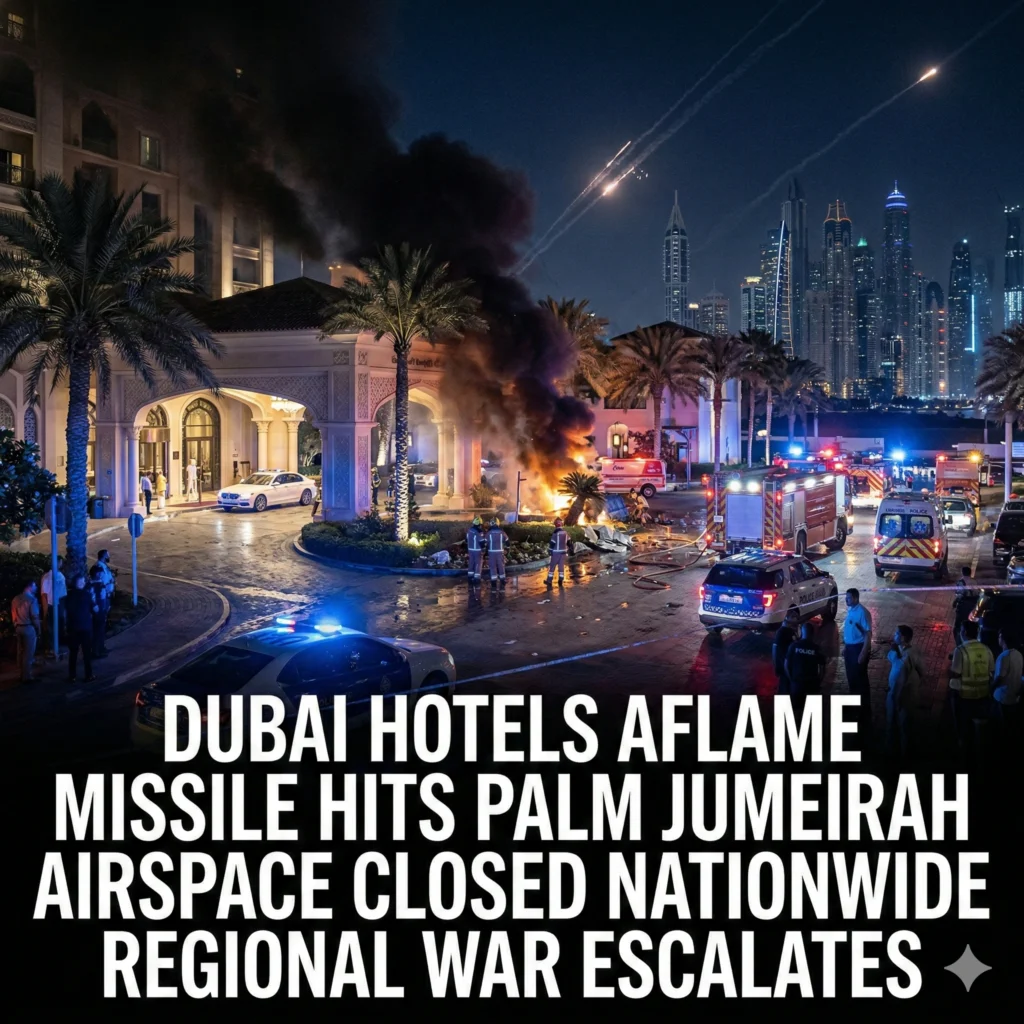
Iranian Missile Strikes Ignite Fires at Iconic Luxury Hotels
The most visible and terrifying aspect of the weekend’s events was how Iranian Missile Strikes Ignite Fires at Iconic Luxury Hotels across the city’s skyline. While the Fairmont took a direct hit, the legendary Burj Al Arab also faced a secondary crisis when intercepted drone debris struck its unique sail-shaped facade. This secondary blaze was smaller in scale but highly visible, creating a terrifying spectacle for residents and tourists watching from the coastline. The Dubai Media Office was quick to report that the fire at the Burj Al Arab was contained within minutes, and fortunately, no injuries were reported at that specific location.
These coordinated attacks demonstrate a sophisticated attempt to overwhelm the UAE’s advanced air defense networks. By launching a mix of ballistic missiles and low-flying suicide drones, the IRGC sought to ensure at least some projectiles reached high-value civilian targets. The Fairmont The Palm was unfortunately the primary victim of this saturation tactic, proving that even the most advanced defense systems have a breaking point. Residents across Dubai reported feeling their high-rise buildings shake as interceptions occurred directly over the city’s densely populated financial and residential districts.
The psychological impact of seeing the Burj Al Arab and the Fairmont in flames cannot be overstated for a city built on the promise of security. Government officials have moved to reassure the public, but the sight of smoke rising from the city’s most famous landmarks tells a different story. These Iranian Missile Strikes are being viewed by the international community as a desperate but dangerous expansion of the conflict. The UAE Ministry of Defense has now shifted to a state of total combat readiness, as more threats are detected on radar systems monitoring the Persian Gulf.
Aviation and Logistics: The Shutdown of Global Hubs
The immediate consequence of the Iranian Missile Strikes was the total paralysis of the world’s most vital aviation corridors. Both Dubai International and Zayed International airports were forced to suspend operations, leaving tens of thousands of passengers stranded across the globe. The damage to terminal concourses and the tragic loss of life at the capital’s gateway highlight the humanitarian cost of these indiscriminate attacks.
Logistical networks that rely on the UAE as a “bridge” between East and West are now facing unprecedented delays. Shipping companies have re-routed vessels away from the Strait of Hormuz, fearing that the Iranian Missile Strikes could extend to maritime targets. This disruption has caused an immediate spike in global shipping insurance and fuel surcharges, impacting consumer prices from London to New York. The closure of UAE airspace remains a necessary but costly precaution as long as the threat remains active.
- Over 400 international flights were cancelled within the first six hours of the Iranian Missile Strikes.
- Regional air defense systems remain on high alert for further low-flying drone activity.
- Major logistics firms like DHL and FedEx have suspended ground operations in high-risk zones.
- The maritime “Joint War Committee” has expanded the high-risk zone for the Persian Gulf.
The recovery of the aviation sector will depend entirely on the cessation of these Iranian Missile Strikes. If the attacks continue, the long-term viability of Dubai as a global transit hub could be compromised. For now, the silent runways of DXB stand as a testament to the devastating reach of the current military escalation and the threat of further Iranian Missile Strikes.
Economic Resilience in the Face of Regional War
The financial markets have reacted with predictable volatility to the news of the Iranian Missile Strikes. Oil prices surged past previous records as traders factored in the risk of a total blockade of the Gulf’s energy exports. For the UAE, the challenge is maintaining investor confidence while its most famous assets are literally under fire. The local stock exchange saw a sharp sell-off in the hospitality and real estate sectors as the news broke.
Local business leaders are emphasizing that the UAE has survived regional crises before, but the scale of these Iranian Missile Strikes is unique. The government’s promise of financial support for businesses affected by the strikes is a welcome move, but it cannot replace the loss of tourism revenue. If the Iranian Missile Strikes are not halted through diplomatic or military means, the economic “lost season” could extend into the coming years.
The hospitality sector, in particular, is bracing for a “lost season” as major international conferences and sporting events are being reviewed or cancelled. Following the Iranian Missile Strikes, several Fortune 500 companies have reportedly activated emergency relocation protocols for their regional headquarters staff. The cost of rebuilding and reinforcing glass skyscrapers against future Iranian Missile Strikes is estimated to run into the billions of dollars.
The Humanitarian and Domestic Impact on Residents
Beyond the headline-grabbing fires, the domestic impact of the Iranian Missile Strikes on the millions of residents in Dubai is profound. Families living in high-rise apartments across the city spent the night in hallways or underground parking garages as sirens echoed through the streets. The sense of invulnerability that once defined life in the Emirates has been replaced by a grim reality of modern warfare. Schools have been moved to remote learning indefinitely, and major public gatherings have been banned to ensure the safety of the populace.
The injuries sustained at the Fairmont The Palm and the fatality in Abu Dhabi have personalized the conflict for the local community. Blood donation centers have seen a surge in volunteers as residents look for ways to support those affected by the Iranian Missile Strikes. The government has urged for calm and warned against the spread of misinformation on social media, which could incite panic. Despite the fear, there has been a notable show of national unity, with residents of all nationalities coming together to assist those displaced by the fires.
The psychological toll of living under the threat of Iranian Missile Strikes is beginning to manifest in the daily lives of citizens. Counseling services have reported a spike in calls related to anxiety and post-traumatic stress among the youth. As the government increases its security patrols, the once-vibrant nightlife of Dubai has been replaced by an eerie silence, broken only by the sound of military jets patrolling for any signs of incoming Iranian Missile Strikes.
Global Geopolitical Repercussions and Future Outlook
The international community has condemned the Iranian Missile Strikes on civilian targets in Dubai, with leaders from London to Tokyo calling for restraint. The United Nations Security Council is scheduled to meet later today to discuss the “alarming escalation” and the potential for a wider regional war. The targeting of tourism infrastructure is being cited by many as a war crime, given its status as a strictly civilian facility. However, Tehran maintains that the Iranian Missile Strikes are a “legitimate defense” against the recent operations that killed its top leadership.
As we look toward the coming week, the potential for further Iranian Missile Strikes remains high. The UAE has not yet launched a full military retaliation, but the pressure to do so is mounting within the regional coalition. The “tit-for-tat” cycle of violence shows no signs of slowing down, and the world is watching to see if a diplomatic off-ramp can be found. The fate of the region and the stability of global energy markets now hang in a delicate balance, with the next 48 hours likely to determine the course of history.
Strategic analysts worry that if the Iranian Missile Strikes persist, the geopolitical alignment of the Middle East will be permanently fractured. The role of the United States in providing a security umbrella for its Gulf partners is under intense scrutiny. Without a decisive end to the Iranian Missile Strikes, the promise of a peaceful and prosperous “New Middle East” may remain a distant dream for generations to come.
Summary of the Crisis in Dubai
The Iranian Missile Strikes on March 1, 2026, will be remembered as the day the regional conflict truly arrived on the shores of the UAE. With fires at iconic hotels, fatalities at major airports, and a complete shutdown of the nation’s airspace, the Islamic Republic of Iran has sent a clear message to the world. The resilience of Dubai is being tested like never before, and while the physical fires may be out, the geopolitical flames continue to roar. The global community must now decide how to respond to the Iranian Missile Strikes and this unprecedented assault on one of the world’s most vital economic hubs.
For more details & sources visit: The Guardian
Read more about UAE news: 360 News Orbit – UAE.