
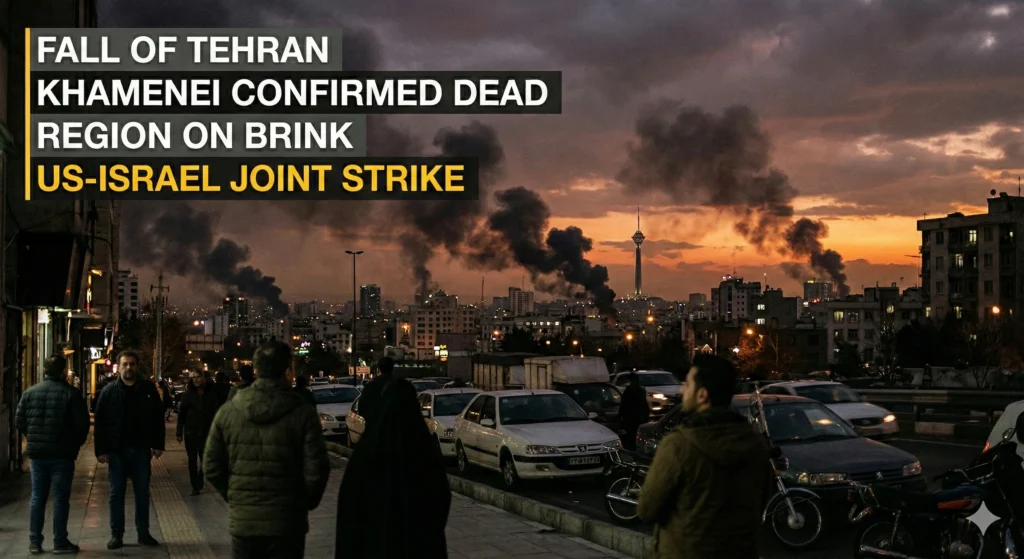
Ayatollah Ali Khamenei is dead, according to official statements from Tehran, marking a seismic shift in Middle Eastern geopolitics. The Iranian government confirmed on Sunday morning that the 86-year-old cleric was killed during a massive wave of coordinated US-Israeli airstrikes. This confirmation follows a dramatic announcement by U.S. President Donald Trump, who characterized the military operation as a decisive move toward regional peace. The loss of the Supreme Leader, who held ultimate authority since 1989, has plunged the Islamic Republic into an unprecedented leadership vacuum and ignited retaliatory strikes across the region.
Ayatollah Ali Khamenei: A Legacy of Theocratic Rule
The era of Ayatollah Ali Khamenei has come to a violent end after thirty-six years of absolute power. Rising to the position of Supreme Leader in 1989 following the death of Ruhollah Khomeini, Khamenei shaped Iran into a formidable regional power. His tenure was defined by a staunch anti-Western stance and the expansion of Iran’s “Axis of Resistance” through various proxy groups. Under his guidance, the Islamic Revolutionary Guard Corps (IRGC) grew from a paramilitary force into a massive economic and military empire that dominated every aspect of Iranian life.
The confirmation of his death via state media marks the conclusion of a historical chapter that saw Iran navigate through decades of international sanctions and domestic unrest. Khamenei was often viewed as the ultimate arbiter of Iranian policy, maintaining a rigid clerical hierarchy while suppressing reformist movements. His death during an active military conflict creates a significant challenge for the existing political structure, which has never faced a wartime transition of this magnitude. Analysts suggest that the sudden removal of such a central figure could lead to internal power struggles within the clerical establishment.
The global community is now watching closely as the transition of power begins in Tehran. While the Iranian constitution provides a framework for succession, the reality of a direct military strike on the Supreme Leader’s compound complicates matters. The loss of Ayatollah Ali Khamenei is not just a blow to the Iranian government but a transformative event for the entire Middle East. As the nation enters 40 days of mourning, the focus shifts to whether the current system can survive without its long-standing ideological anchor.
US-Israeli Airstrikes Target Tehran Leadership
The joint military operation, dubbed “Operation Epic Fury” by the Pentagon, involved a series of pinpoint strikes on high-value targets. President Donald Trump announced that the mission specifically targeted the leadership infrastructure in Tehran to eliminate what he described as imminent threats. Satellite imagery released shortly after the strikes showed extensive damage to the Supreme Leader’s fortified compound. Israeli officials confirmed that the body of Ayatollah Ali Khamenei was recovered from the rubble by rescue teams following the initial bombardment.
The scale of the US-Israeli airstrikes was unprecedented, involving a combination of stealth fighters and long-range cruise missiles. Military analysts noted that the coordination between Washington and Jerusalem was seamless, reflecting months of tactical planning. Beyond the Supreme Leader, reports indicate that several other high-ranking Iranian officials were also killed in the opening salvo. This decapitation strike was intended to paralyze the Iranian command and control structure during the early stages of the conflict.
The White House has maintained that these actions were necessary to prevent a wider escalation of nuclear capabilities. President Trump emphasized that the United States worked in total synchronicity with Israel to ensure the success of the mission. While the primary objective was the removal of top leadership, the strikes also hit ballistic missile sites and air defense systems across the country. The confirmation that Ayatollah Ali Khamenei was a casualty of these strikes has emboldened supporters of regime change while drawing condemnation from Tehran’s allies.
Retaliatory Missile Attacks Shake the Region
In the immediate aftermath of the leader’s death, Iran launched a fierce retaliatory campaign against Western interests. Pro-Iranian militias and the IRGC fired waves of drones and ballistic missiles at U.S. military bases in Iraq, Syria, and the Persian Gulf. Impacts were reported at several airfields, and sirens sounded across central Israel as air defense systems intercepted incoming projectiles. The Iranian Foreign Ministry stated that the time has come to “confront the enemy’s military assault” with full force.
The regional escalation has seen attacks on oil shipment routes, causing a sudden spike in global energy prices. In Bahrain, the U.S. 5th Fleet facility was reportedly targeted, leading to increased security measures across all maritime corridors. These retaliatory measures reflect a desperate attempt by the remaining Iranian leadership to project strength despite the loss of Ayatollah Ali Khamenei. The “Lion’s Roar” operation by the U.S. and Israel has clearly triggered a cycle of violence that international leaders fear could spiral into a total war.
Neighboring countries have expressed grave concern over the potential for a humanitarian crisis as the fighting intensifies. Iraq has already announced three days of national mourning, reflecting the deep ties between the Shiite leadership in Baghdad and Tehran. As the missiles continue to fly, the possibility of a diplomatic resolution seems increasingly remote. The death of Ayatollah Ali Khamenei has removed the one individual who could have authorized a major strategic shift, leaving the region in a state of chaotic uncertainty.
Civil Unrest and Reactions Inside Iran
The news of the Supreme Leader’s death has sparked a complex range of emotions within the Iranian populace. While state media broadcasts images of thousands of mourners gathered in Enqelab Square, unverified social media videos suggest celebrations in other parts of Tehran. Many Iranians are reportedly terrified of the ongoing bombardment, with families seeking shelter in basements and subway stations. The government has declared a seven-day public holiday, effectively locking down the country to prevent widespread civil disorder.
The reaction to the loss of Ayatollah Ali Khamenei highlights the deep divisions within Iranian society. For the hardliners, he was a saintly figure who stood against Western imperialism; for the younger generation, he was often seen as the face of an oppressive regime. Reports of a strike on a primary school, resulting in significant civilian casualties, have further fueled the anger of those protesting the military action. The atmosphere in major cities remains highly volatile as the IRGC attempts to maintain order through a visible show of force.
International observers are monitoring whether these strikes will indeed facilitate the “regime change” mentioned by President Trump. Without the presence of Ayatollah Ali Khamenei, the clerical establishment faces its greatest existential threat since the 1979 revolution. The presence of security forces on every street corner suggests that the government is taking no chances with internal dissent. Whether the Iranian people will “take back their country” remains to be seen, but the old status quo has been permanently shattered.
Global Political Fallout and Legal Debates
The international community is sharply divided over the legality and morality of the strikes that killed the Iranian leader. In the U.S. Congress, lawmakers are debating whether the White House had the authority to launch such a massive operation without a formal declaration of war. Critics argue that the assassination of a head of state violates international norms and risks a permanent state of conflict. Conversely, supporters of the action claim that the removal of Ayatollah Ali Khamenei was a preemptive necessity to ensure global security.
At the United Nations, an extraordinary meeting of the Security Council has been called to address the crisis. Russia and China have condemned the airstrikes as a “blatant act of aggression” that undermines the sovereignty of a UN member state. Meanwhile, European leaders are calling for an immediate ceasefire to prevent the conflict from engulfing the entire Middle East. The confirmation of the death of Ayatollah Ali Khamenei has forced every major power to recalibrate their diplomatic strategies regarding Iran.
The legal ramifications of the strike will likely be debated for years to come. While the U.S. administration points to intelligence suggesting an imminent threat, the lack of public evidence has fueled skepticism. The precedent set by this operation could change the way global powers interact with hostile regimes. Regardless of the legal outcome, the reality on the ground is that Ayatollah Ali Khamenei is gone, and the geopolitical map of the world is being redrawn in real-time.
The Future of the Islamic Republic
With the passing of Ayatollah Ali Khamenei, the question of succession becomes the most critical issue for the survival of the Iranian state. The Assembly of Experts is theoretically responsible for choosing a new leader, but the process is fraught with political intrigue. Potential successors like Mojtaba Khamenei or other high-ranking clerics may lack the religious legitimacy required to hold the system together. The transition period will be led by a committee including the President and the head of the Judiciary, but their authority is largely administrative.
The role of the IRGC will be pivotal in the coming days as they seek to protect their economic interests and maintain national security. Many analysts believe that the military wing of the government may take a more direct role in governance, effectively turning Iran into a military autocracy. The death of Ayatollah Ali Khamenei could be the catalyst for a total transformation of the Iranian political landscape. If the clerical system fails to produce a strong leader quickly, the vacuum could lead to further fragmentation or a complete collapse of the central government.
Furthermore, the impact on Iran’s nuclear program remains a major concern for the international community. The strikes were partly aimed at degrading these capabilities, but the remaining leadership may double down on nuclear development as a deterrent. The loss of Ayatollah Ali Khamenei might have removed a cautious strategist, potentially leaving the door open for more radical elements to take control of the country’s most dangerous weapons. The world remains on edge as the next phase of this historic conflict unfolds.
Impact on Regional Alliances and Proxies
The death of the Supreme Leader sends shockwaves through the “Axis of Resistance,” the network of militant groups supported by Tehran. Hezbollah in Lebanon, Hamas in Gaza, and the Houthi rebels in Yemen have all relied on the strategic vision and financial support provided under Ayatollah Ali Khamenei. Without his direct oversight, these groups may become more autonomous or increasingly erratic in their operations. This could lead to a surge in localized conflicts as proxies attempt to prove their relevance or exact revenge for the leader’s death.
Israel has raised its alert level to the highest possible degree, anticipating a multi-front war involving these proxy forces. Prime Minister Benjamin Netanyahu hailed the operation as a victory for civilization, but the security challenges for the Jewish state have only intensified. The removal of Ayatollah Ali Khamenei might have weakened the heart of the network, but the “tentacles” remain capable of inflicting significant damage. Regional stability now depends on whether these groups choose to escalate or if they will be weakened by the sudden loss of their primary patron.
Arab nations in the Gulf are also walking a tightrope, balancing their desire for a weakened Iran with the fear of being caught in the crossfire. The strikes on oil shipment routes have already demonstrated that no one in the region is immune to the fallout. The death of Ayatollah Ali Khamenei has fundamentally changed the security calculus for every capital from Riyadh to Abu Dhabi. As the smoke clears in Tehran, the long-term consequences for regional alliances will become clearer, but for now, the Middle East is in the grip of a historic transformation.
Conclusion and Summary of Events
The world is witnessing the end of an era with the confirmed death of Ayatollah Ali Khamenei. The coordinated US-Israeli airstrikes have achieved a tactical objective that seemed impossible for decades, yet the strategic outcome remains uncertain. Tehran’s confirmation of the loss marks a turning point that will affect global politics, energy markets, and regional security for generations. As the 40-day mourning period begins, the focus remains on the escalating military exchanges and the potential for a new leadership to emerge from the shadows of the old regime.
The legacy of Ayatollah Ali Khamenei will be remembered as one of defiance and theocratic rigidity. His departure from the stage leaves a void that no single individual may be able to fill. Whether this leads to the “peace” envisioned by the White House or a more prolonged and bloody conflict is the question that currently hangs over the international community. For today, the headline remains clear: the Supreme Leader is dead, and the future of Iran is more uncertain than ever before.
For more details & sources visit: Al Jazeera
Read more on Iran news: 360 News Orbit – Iran.