
The world stands at a critical geopolitical crossroads today as President Donald Trump announces death of Iranian Supreme Leader Ayatollah Ali Khamenei. This historic declaration follows a massive and coordinated military offensive conducted by the United States and Israel against the Islamic Republic. The operation, has fundamentally altered the power structure in the Middle East within a matter of hours. President Trump utilized social media to confirm that the long-time leader was neutralized during a high-stakes aerial bombardment.
This transition of power occurs as the United States and Israel execute what they describe as a necessary mission to ensure regional stability. The President described the strike as a liberation for the Iranian people, offering them a chance to reclaim their sovereign nation. According to official reports, the mission utilized the most advanced tracking systems and military intelligence available to modern warfare. As the dust settles in Tehran, the international community is bracing for the long-term implications of this sudden leadership vacuum.
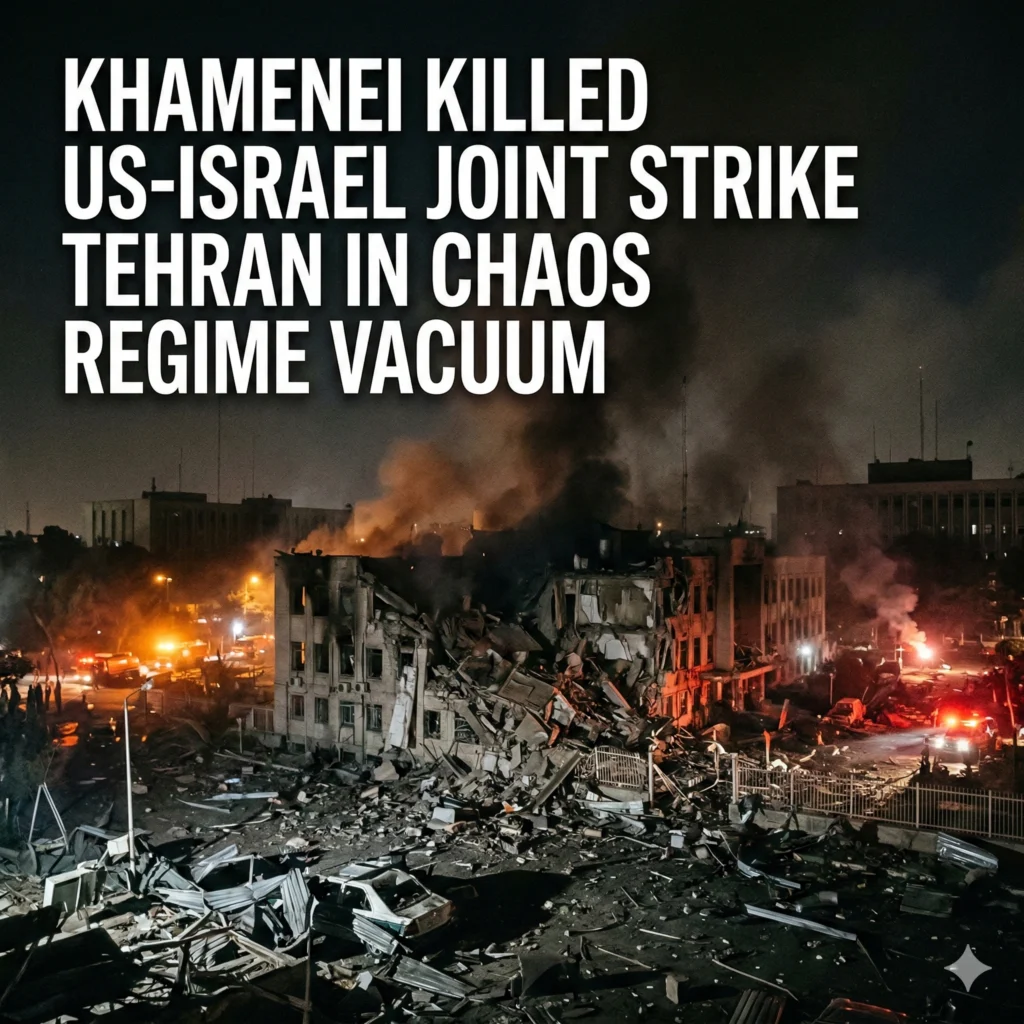
Death of Iranian Supreme Leader
President Donald Trump took to Truth Social early Sunday to provide the formal confirmation that the world had been anticipating. He stated that the joint military operation successfully targeted the compound where the 86-year-old cleric was located during the initial waves of the attack. Trump characterized the Supreme Leader as a figure of global instability whose removal was essential for the preservation of international peace and security.
The military coordination between Washington and Jerusalem appears to have been seamless throughout the planning and execution phases of this mission. Intelligence sources indicate that over thirty precision-guided munitions were dropped on the specific complex where the Iranian leadership had gathered. This strike did not just target the Supreme Leader but reportedly eliminated several other high-ranking officials within the Iranian government and the Revolutionary Guard.
The White House has emphasized that the primary objective of these strikes was to degrade Iran’s nuclear ambitions and missile capabilities. By removing the top tier of the Iranian regime, the administration hopes to disrupt the command and control structure of proxy groups across the region. President Trump’s announcement has been met with both celebration among opposition groups and intense scrutiny from various international diplomatic bodies.
Strategic Details of the Aerial Bombardment
The aerial campaign, which the administration has dubbed Operation Epic Fury, involved hundreds of advanced fighter jets and unmanned aerial vehicles. These assets targeted at least twenty-four of Iran’s thirty-one provinces, focusing heavily on missile launch sites and air defense systems. The sheer scale of the operation suggests months of clandestine preparation by both the United States and Israeli defense forces.
Reports from the ground in Tehran describe a scene of massive explosions and significant infrastructure damage near government hubs. The pinpoint nature of the bombing was designed to minimize civilian casualties while maximizing the destruction of military assets. Despite these efforts, the Iranian Red Crescent has reported hundreds of casualties across the country as the conflict continues to escalate.+1
The continued use of stealth technology allowed the coalition forces to bypass many of Iran’s aging air defense networks. This technological superiority was a key factor in the success of the mission that led to the death of Iranian Supreme Leader. Military analysts suggest that the suppression of enemy air defenses was achieved within the first hour of the combat operations.
Retaliatory Strikes and Regional Escalation
Iran did not remain silent in the face of this unprecedented assault on its sovereignty and leadership. Within hours of the initial strikes, the Islamic Revolutionary Guard Corps launched a series of drone and missile attacks. These retaliatory measures were directed at Israel as well as several United States military installations located throughout the Persian Gulf.
The reach of the Iranian response extended to neighboring monarchies, creating a tense atmosphere for the entire region. Missile debris and drone strikes were reported in Bahrain, Kuwait, and the United Arab Emirates, leading to immediate condemnations from these governments. The escalation has forced global markets to brace for significant disruptions in oil supplies and maritime trade routes.
- Iran targeted the U.S. Fifth Fleet headquarters in Bahrain with drone swarms.
- Missile barrages were directed at central Tel Aviv and northern Israeli districts.
- Strategic airbases in Qatar and Kuwait reported incoming fire and interceptions.
- Regional airspace closures have left thousands of international travelers stranded.
Emergency Session at the United Nations
The United Nations Security Council convened an emergency session to address the rapidly deteriorating situation in the Middle East. Secretary-General Antonio Guterres addressed the council, warning that the military actions could ignite an uncontrollable chain of events. He called for an immediate cessation of hostilities and a return to diplomatic negotiations to prevent a full-scale regional war.
During the session, U.S. Ambassador Mike Waltz defended the legality of the strikes, citing them as a preemptive measure against an existential threat. He argued that the Iranian regime’s pursuit of nuclear weapons and its support for global terrorism left no other choice. The exchange between Waltz and the Iranian representative was described by observers as one of the most tense in recent history.
The news regarding the death of Iranian Supreme Leader dominated the floor as various nations debated the consequences of the strike. Russia and China expressed strong opposition to the military intervention, characterizing it as a violation of international law. The Russian delegation requested a separate special session of the International Atomic Energy Agency to discuss the strikes.
Leadership Vacuum and Domestic Unrest
The confirmed death of Iranian Supreme Leader has created an immediate and profound leadership vacuum within the Islamic Republic. For the first time since 1989, the central pillar of the Iranian political and religious system is no longer in place. This uncertainty has led to reports of both spontaneous celebrations and intense crackdowns by remaining security forces in various cities.
President Trump’s call for the Iranian people to “take back their country” has resonated with many who have long opposed the regime. However, the presence of the Revolutionary Guard and other loyalist factions suggests that a peaceful transition is far from guaranteed. The coming days will be crucial in determining whether the country moves toward a new form of governance or descends into civil conflict.
The administration has indicated that the “heavy and pinpoint bombing” will continue until all regional objectives are met. This suggests that the death of Iranian Supreme Leader was only one component of a much larger strategy to reshape the Middle East. The U.S. military remains on high alert for further retaliatory actions from Iranian proxies in Lebanon, Yemen, and Iraq.
Impact on Global Energy Markets
The conflict has sent shockwaves through the global economy, specifically regarding oil prices and energy security. As the Strait of Hormuz becomes a potential battleground, the risk to the world’s primary oil artery has never been higher. Traders are concerned that any prolonged closure of the strait could lead to a global energy crisis and record-high fuel prices.
International shipping companies have already begun rerouting vessels away from the Persian Gulf to avoid the risk of missile strikes or seizures. This shift in logistics is expected to increase the costs of goods and commodities globally. The United States and its allies are working to ensure that maritime trade can continue, though the security situation remains highly volatile.
- Oil prices surged by over 12% in the first few hours following the news.
- Insurance premiums for cargo ships in the Middle East have tripled overnight.
- Strategic petroleum reserves are being evaluated by major economies for release.
Future of U.S. Foreign Policy in the Middle East
The decision to facilitate the death of Iranian Supreme Leader marks a radical shift in American foreign policy. It signals an end to the era of containment and a move toward direct regime destabilization. This bold strategy reflects President Trump’s “America First” approach, prioritizing the removal of long-term threats over traditional diplomatic patience.
Critics of the operation argue that the move could lead to decades of instability and a power vacuum that extremist groups might exploit. They point to previous interventions in the region as cautionary tales of the unintended consequences of regime change. However, supporters of the administration believe that the removal of the Ayatollah was the only way to truly break the cycle of violence.
The White House maintains that it is acting in the interest of global security and the liberation of the Iranian people. As the military operations proceed, the world is watching closely to see how the remaining Iranian leadership responds. The possibility of a wider conflict involving other regional powers remains a significant concern for diplomats worldwide.
Humanitarian Concerns and Civilian Safety
The scale of the bombardment following the death of Iranian Supreme Leader has raised questions about the humanitarian impact on the population. Reports of damage to schools and residential areas have begun to surface, though the coalition forces deny targeting non-military sites. The United Nations has called for corridors of humanitarian aid to be established to assist those injured.
The Iranian Red Crescent is struggling to cope with the influx of casualties due to the restricted movement and damaged infrastructure. Medical supplies are reportedly running low in several major cities as the bombing campaign enters its second day. International aid organizations are urging all parties to respect the lives of non-combatants during this period of intense military activity.
- Emergency medical teams are being mobilized by international relief agencies.
- Calls for a temporary ceasefire to allow for the evacuation of the wounded.
- Concerns over the long-term displacement of families in heavily bombed districts.
The Role of Israel in the Joint Operation
Israel’s involvement in the operation was crucial, providing both intelligence and significant aerial strike capabilities. Prime Minister Benjamin Netanyahu stated that the “signs were clear” that the death of Iranian Supreme Leader had been achieved. He emphasized that Israel would continue to act with its allies to remove any threat to its national existence.
The Israeli Air Force conducted what is being called the largest military flyover in its history during the strikes. By targeting the missile arrays and defense systems, Israel has significantly reduced Iran’s ability to launch a sustained counteroffensive. This cooperation represents the peak of the strategic alliance between the United States and Israel in the modern era.
The death of Iranian Supreme Leader is seen in Jerusalem as a major victory against the “axis of resistance.” For years, Israel has campaigned against the Iranian nuclear program and its support for groups like Hezbollah and Hamas. With the top leadership removed, the strategic calculus for these proxy groups has been fundamentally altered, potentially leading to their eventual decline.
International Response and Diplomatic Fallout
The global reaction to the death of Iranian Supreme Leader has been sharply divided along traditional geopolitical lines. European allies have expressed a mix of support for the removal of a dictator and deep concern over the resulting escalation. Many capitals are calling for restraint to avoid a total collapse of regional order that could lead to a massive refugee crisis.
In the Middle East, the reaction is equally complex, with some nations quietly supporting the move while others publicly condemn the violation of sovereignty. The regional balance of power is being recalibrated in real-time as nations decide how to align themselves in the new post-Khamenei era. Diplomacy is currently taking a backseat to military developments as the bombing continues.
The Trump administration has remained firm in its stance, dismissing calls for a halt to the operations. The President has stated that the mission will only end when the threat from the Iranian regime is permanently neutralized. This resolve suggests that the world should prepare for a period of prolonged military activity and diplomatic tension in the months to come.
Technical Superiority of the Military Strikes
The success of the mission that led to the death of Iranian Supreme Leader was largely due to technological advancements. The use of hypersonic missiles and next-generation stealth aircraft allowed the coalition to strike with unprecedented speed and accuracy. These weapons systems are designed to penetrate the most hardened bunkers and underground facilities.
Cyber warfare also played a significant role in the operation, with reports of Iranian communication networks being disabled just before the physical strikes began. This “digital decapitation” left the Iranian military unable to coordinate an effective defense in the opening stages of the campaign. The integration of cyber and kinetic force has set a new standard for modern high-intensity conflict.
As the conflict moves into its next phase, the focus will likely shift to maintaining air superiority and preventing the regrouping of Iranian forces. The United States has deployed additional carrier strike groups to the region to provide continuous support for the ongoing operations. The military pressure is intended to force the remaining elements of the regime to surrender or face total destruction.
Implications for Iranian Internal Security
Following the death of Iranian Supreme Leader, the internal security apparatus of Iran is facing its greatest challenge. The Basij and Revolutionary Guard forces are attempting to maintain order while their command structure is in disarray. Reports of defections within the regular army suggest that the regime’s grip on power may be slipping faster than anticipated.
Domestic protestors have taken to the streets in several major cities, emboldened by the news of the leadership’s demise. These demonstrations are being met with varying degrees of force as local commanders decide whether to remain loyal to a fractured government. The world is watching to see if these protests will evolve into a full-scale revolution that changes the country forever.
The lack of a clear successor to the Supreme Leader further complicates the internal situation for the Islamic Republic. While a council of leaders may attempt to take control, the lack of a single unifying figure makes internal power struggles inevitable. This fragmentation is exactly what the U.S. and Israeli strategists hoped to achieve with their precision strike.
The Global Struggle for Influence
The death of Iranian Supreme Leader has sparked a global struggle for influence in the vacuum left behind. Major powers like Russia and China are concerned about losing a key regional partner and are moving to protect their interests. This could lead to a more direct diplomatic or even military confrontation between the East and the West.
Washington is working to build a coalition of regional partners to help manage the transition in Iran. This involves reaching out to traditional allies in the Gulf who have long felt threatened by Iranian expansionism. The goal is to create a stable, non-hostile government in Tehran that can reintegrate into the international community.
Economic sanctions are also being re-evaluated in light of the changing circumstances on the ground. There is a debate within the administration about whether to offer sanctions relief as an incentive for a more moderate government to emerge. However, for the moment, the primary focus remains on the military aspect of the transition.
Religious Consequences of the Vacancy
The death of Iranian Supreme Leader also carries significant religious implications for the Shiite world. Khamenei held a position that combined political authority with spiritual leadership for millions of followers. His passing creates a crisis of authority that will be felt far beyond the borders of Iran.
Clerical circles in Qom and Najaf are currently debating the future of the office of the Supreme Leader. Some believe that the role should be abolished in favor of a more democratic system, while others are searching for a replacement. This theological debate will play a major role in how the Iranian people view the legitimacy of any new government.
The removal of the spiritual head of the regime could weaken the ideological foundation of proxy groups throughout the Middle East. Groups like Hezbollah rely on the Supreme Leader’s religious decrees to justify their actions and maintain their funding. Without this central authority, these organizations may find it difficult to maintain their internal cohesion.
Long-Term Regional Stability Prospects
While the death of Iranian Supreme Leader is a major milestone, it does not guarantee long-term stability. The region is filled with deep-seated animosities and unresolved conflicts that could flare up in the absence of a central power. The international community must remain engaged to prevent the situation from spiraling into further chaos.
Efforts are being made to establish a regional security framework that includes all major stakeholders. This would involve regular dialogue and cooperation to manage threats and resolve disputes peacefully. However, building trust in a region defined by decades of war and intervention is a monumental task.
The success of such a framework depends on the willingness of the new Iranian leadership to engage with its neighbors. If a moderate government emerges, there is a chance for a new era of cooperation and prosperity in the Middle East. If a more radical faction takes control, the cycle of violence is likely to continue for years to come.
Conclusion and the Road Ahead
The announcement that the death of Iranian Supreme Leader has occurred marks the beginning of an uncertain new chapter. While the removal of the Ayatollah is a significant tactical achievement, the long-term political consequences remain to be seen. The international community is now tasked with managing the fallout of this massive shift.
Whether this leads to a more peaceful and democratic Iran or a wider regional catastrophe is the defining question. The United States and its allies have taken a monumental risk in pursuit of a new regional order. As the week progresses, the true impact of Operation Epic Fury will become clearer to the world.
The Iranian people now face a historic opportunity to determine their own future in the absence of the clerical regime. The support of the international community will be vital in ensuring that this transition does not lead to further bloodshed. For now, the focus remains on the ongoing military operations and the immediate security of the region.
The legacy of this event will be studied by historians for generations to come as the moment the Middle East changed forever. The death of Iranian Supreme Leader has removed the primary obstacle to change, but the path forward is fraught with danger. Only time will tell if this bold action achieves the lasting peace the world so desperately seeks.
As military operations continue, the global community must remain vigilant and prepared for any eventuality. The end of the Supreme Leader’s reign is not the end of the story, but merely the end of a long and difficult chapter. The world now waits to see what the next chapter will bring for the people of Iran and the world.
For more details & sources visit: PBS News
For the latest updates from the United States, visit our U.S. news page.