
The Gaza Stability Restoration efforts have reached a critical diplomatic milestone following the high-level summit between King Abdullah II and Indonesian President Prabowo Subianto. Two leaders convened at Basman Palace in Amman to synchronize their strategies for regional peace and humanitarian recovery. This meeting signifies a major shift in the peacekeeping landscape, as Indonesia prepares to take a leading role in the International Stabilization Force. The talks underscored a shared commitment to a two-state solution, emphasizing the urgent need to protect Palestinian civilians while establishing a sustainable governance framework.
This latest move toward Gaza Stability Restoration involves a massive logistical and military commitment from Jakarta, which has been appointed as a deputy commander of the international force. President Prabowo confirmed that Indonesia is ready to deploy up to 8,000 personnel to ensure security and facilitate reconstruction in the enclave. King Abdullah II praised this proactive stance, noting that Indonesia’s global political standing is essential for the success of any multinational intervention. The cooperation between the Hashemite Kingdom and the world’s most populous Muslim-majority nation serves as a powerful diplomatic signal to the international community.
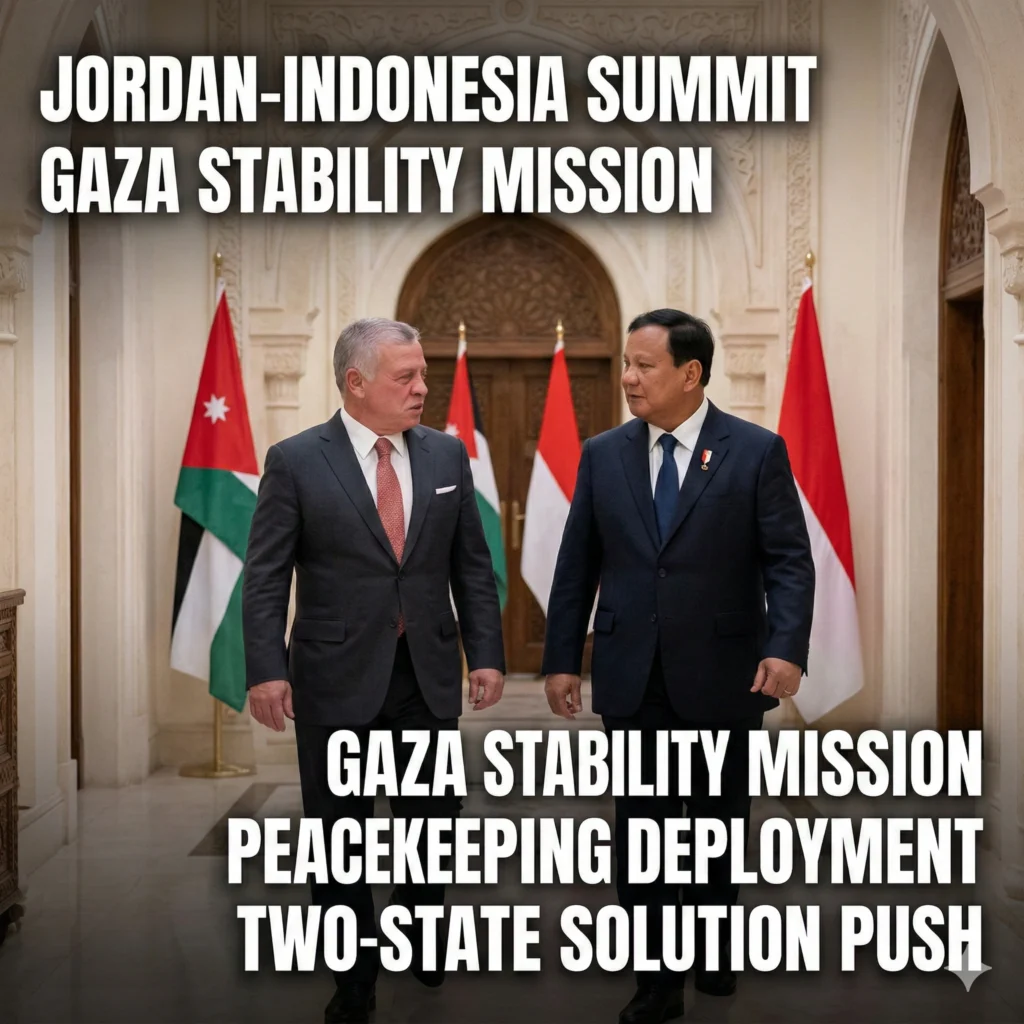
Indonesian Leadership in the International Stabilization Force
The framework for Gaza Stability Restoration hinges on the successful integration of Indonesian peacekeepers into the existing regional security architecture. Jordan has pledged its full institutional support to assist Jakarta in the future deployment of these troops, leveraging its unique geographical and diplomatic position. This partnership is viewed as a vital component of the recovery phase, as Indonesian forces are widely respected for their neutrality and professional conduct in previous UN missions. The inclusion of a non-Arab, Muslim-majority power adds a layer of broader legitimacy to the stabilization efforts.
Furthermore, the Gaza Stability Restoration plan includes a detailed roadmap for civilian protection and infrastructure rebuilding. The leaders discussed the importance of securing humanitarian corridors to allow for the free flow of medical supplies and construction materials. With Indonesia serving as deputy commander, the force will focus on maintaining order during the transition to a local administrative authority. This multilateral approach is designed to prevent a security vacuum that could lead to further escalations. The commitment of 8,000 personnel represents one of the largest single-country contributions to recent regional peace efforts.
Strategic talks also delved into the 75-year history of diplomatic relations between Jordan and Indonesia, using this foundation to build modern defense and energy ties. The Gaza Stability Restoration summit was not limited to military concerns; it also covered advancements in science, technology, and public health. Both nations recognize that long-term stability in the Middle East requires a holistic approach that includes economic cooperation and intellectual exchange. By strengthening these bilateral pillars, Jordan and Indonesia are creating a resilient alliance that transcends immediate crisis management.
Gaza Stability Restoration
The implementation of the Gaza Stability Restoration strategy requires careful coordination with various regional actors and international bodies. King Abdullah II highlighted the necessity of reducing tensions related to Iran and supporting the sovereignty of neighboring states like Syria and Lebanon to ensure the mission’s success. A fragmented regional environment would complicate the deployment of Indonesian troops, making diplomatic de-escalation a prerequisite. The Crown Prince and several key cabinet ministers were present to finalize the technical aspects of these strategic agreements.
At the heart of the Gaza Stability Restoration initiative is the unwavering support for a sovereign Palestinian state based on the two-state solution. Indonesia’s President Prabowo reaffirmed that Jakarta’s involvement is strictly aligned with international law and the aspirations of the Palestinian people. This ideological alignment with Jordan ensures that the peacekeeping force will act as a facilitator of peace rather than an occupying entity. The personal escort of President Prabowo to the airport by King Abdullah served as a poignant symbol of the deep mutual respect and shared vision between the two leaders.
Moreover, the Gaza Stability Restoration efforts are expected to set a precedent for South-South cooperation in conflict resolution. Traditionally, Middle Eastern stability has been brokered by Western powers, but the emergence of Indonesia as a primary security provider suggests a shift toward a more multipolar world. The use of diplomatic channels to navigate the complex interests of regional powers remains a priority for the Jordanian monarch. This summit marks the beginning of a new chapter where Asian and Middle Eastern nations take direct ownership of their collective security challenges.
Military and Logistics Coordination
The Gaza Stability Restoration plan involves a multi-phased deployment of Indonesian personnel, focusing initially on medical and engineering units. These first responders will be tasked with clearing debris and setting up field hospitals to address the immediate needs of the population. Jordan’s experience in managing humanitarian logistics will be invaluable in guiding these units through the difficult terrain of the enclave. The synergy between Jordanian intelligence and Indonesian manpower is expected to create a highly efficient stabilization mechanism.
The success of Gaza Stability Restoration also depends on the financial support of the international community to sustain a force of 8,000 personnel. Discussions in Amman included the establishment of a dedicated fund for the International Stabilization Force, ensuring that the mission is well-equipped for a long-term presence. President Prabowo emphasized that Indonesia’s contribution is a reflection of its constitutional mandate to participate in world peace. This sense of duty, combined with Jordan’s tactical expertise, provides a solid foundation for the upcoming operations.
Key Components of the Peace Plan
- Deployment of 8,000 Indonesian peacekeepers under the International Stabilization Force.
- Establishment of joint Jordan-Indonesia command centers for humanitarian logistics.
- Commitment to the two-state solution as the only viable path for permanent peace.
- Collaborative projects in energy and science to support the long-term Gaza economy.
As the Gaza Stability Restoration mission prepares for its first phase, the world is watching the growing influence of the Jordan-Indonesia axis. The ability of these two nations to harmonize their military and diplomatic assets could serve as a blueprint for future stabilization efforts in other global conflict zones. The emphasis remains on a “peace-first” approach, where security is a means to an end—that end being a thriving, independent, and stable Palestinian society.
Enhancing Regional Sovereignty
A significant portion of the Gaza Stability Restoration talks was dedicated to the protection of regional borders and the prevention of spillover violence. King Abdullah II reiterated that the stability of Gaza is inextricably linked to the security of Lebanon and Syria. By stabilizing the enclave, the International Stabilization Force hopes to reduce the pretext for external interventions that often exacerbate regional tensions. This focus on “sovereignty-first” is a core tenet of the Jordanian-Indonesian peace philosophy.
Indonesia’s role in Gaza Stability Restoration is also a point of national pride in Jakarta, reflecting President Prabowo’s vision of a globally active Indonesia. The deployment will involve specialized units trained in urban peacekeeping and community engagement, ensuring a sensitive approach to the local population. This human-centric focus is intended to build trust between the stabilization force and the residents of Gaza. Without this trust, no amount of military presence can achieve lasting peace or meaningful reconstruction.
Challenges for the Peacekeeping Mission
- Navigating the complex political landscape and various internal factions within Gaza.
- Coordinating with international partners to ensure a unified chain of command.
- Managing the logistics of a large-scale troop deployment across international borders.
- Ensuring the safety of peacekeepers in a post-conflict environment with active risks.
Despite these hurdles, the Gaza Stability Restoration project remains the most promising path forward for the region. The combined weight of Jordan’s historical legitimacy and Indonesia’s modern military capacity offers a unique solution to an age-old problem. The leaders have signaled that they are prepared for a multi-year commitment, recognizing that stability is not achieved overnight. This long-term perspective is what distinguishes the current initiative from previous, more fleeting peace efforts.
Future Projections for 2026 and Beyond
The impact of the Gaza Stability Restoration summit will be felt throughout the 2026 fiscal year as the first waves of Indonesian troops arrive in the region. Analysts expect a measurable decrease in localized skirmishes as the International Stabilization Force establishes its presence. This improved security environment will, in turn, encourage international donors to release the funds needed for the “Great Gaza Reconstruction” project. The role of the Hashemite Kingdom as the gateway for this reconstruction cannot be overstated.
Looking further ahead, the Gaza Stability Restoration framework may expand to include other ASEAN nations, further diversifying the peacekeeping coalition. President Prabowo has already begun discussions with regional partners to gauge interest in supporting the Indonesian-led effort. If successful, this could lead to the largest and most diverse stabilization mission in Middle Eastern history. The focus will always remain on the welfare of the Palestinian people and the realization of their national aspirations within a secure environment.
The 2026 summit has successfully laid the groundwork for a historic intervention. The Gaza Stability Restoration mission is now a tangible reality, supported by the political will of two major regional powers. King Abdullah II and President Prabowo Subianto have shown that through cooperation and shared values, even the most entrenched conflicts can be addressed. As the first Indonesian boots hit the ground, they carry with them the hopes of millions for a peaceful and stable future in the Gaza Strip.
The Gaza Stability Restoration initiative is a testament to the power of strategic diplomacy. By bringing together the Middle East and Southeast Asia, Jordan and Indonesia have created a formidable partnership for peace. The road ahead will undoubtedly be challenging, but the foundation laid at Basman Palace provides the clarity and strength needed to succeed. The world remains hopeful that this 2026 intervention will finally bring the lasting stability that the region has sought for decades.
Ultimately, the Gaza Stability Restoration efforts redefine what is possible in international relations. It is no longer just about the major superpowers; it is about regional leaders taking responsibility and acting with courage. Jordan and Indonesia have stepped into that role with conviction, setting a new standard for global peacekeeping. As the stabilization force begins its work, the focus will remain on the two-state solution and the restoration of dignity to a war-torn population.
For more details & sources visit: Arab News
Read more about Jordan news on 360 News Orbit – Jordan.