
US Baseline Tariff shockwaves are currently reverberating through the global economy following a landmark decision by the Supreme Court. President Donald Trump officially announced the implementation of a 10 percent universal import levy after the judicial branch invalidated previous emergency trade actions. This shift represents a significant departure from earlier proposals of 15 percent, yet the lower rate still threatens to dismantle long-standing trade agreements. For emerging markets like Nigeria, this policy change creates a formidable barrier to non-oil export strategies and currency stabilization efforts.
The US Baseline Tariff serves as a protectionist measure designed to bolster domestic manufacturing while simultaneously narrowing the trade deficit. Economists argue that while the intent is to protect American jobs, the reality often involves increased costs for the end consumer. The Supreme Court ruling was the catalyst for this specific 10 percent figure, as it limited the executive branch’s ability to unilaterally impose higher emergency levies. Consequently, the administration pivoted to this baseline approach to ensure legal compliance while maintaining its America First trade stance.
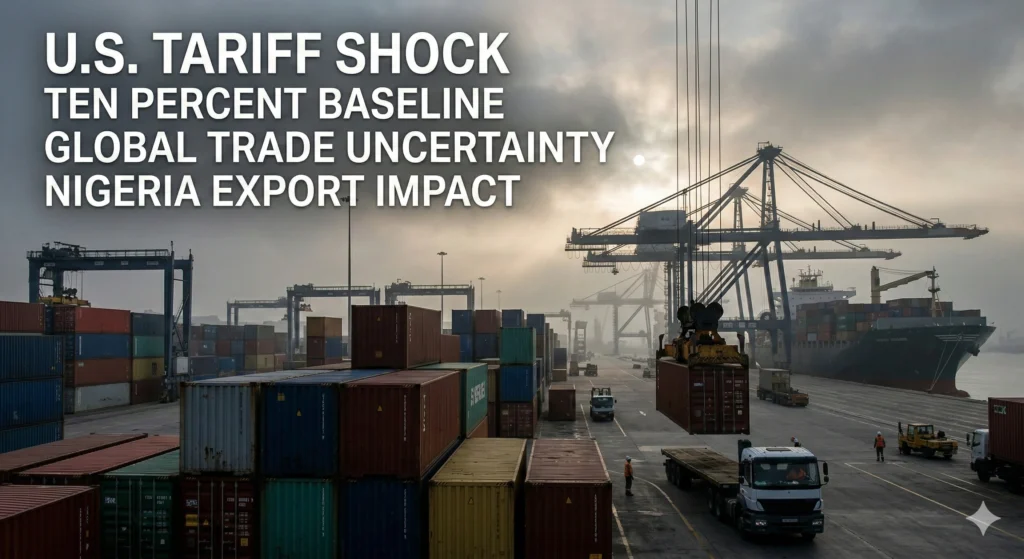
Historical Context of Universal Import Duties
The evolution of American trade policy has moved rapidly from targeted duties to this current US Baseline Tariff structure. Throughout 2025, various legal challenges delayed the implementation of universal levies, leading to a period of intense market volatility. The Supreme Court eventually intervened to clarify the limits of the International Emergency Economic Powers Act in relation to broad trade barriers. This clarification forced the administration to calibrate the current 10 percent rate as a sustainable legal compromise.
Understanding the transition from specific sector tariffs to a US Baseline Tariff requires looking at the geopolitical shifts of the last decade. Previous administrations utilized the Generalized System of Preferences to encourage growth in developing nations. However, the current mandate prioritizes domestic revenue generation and the repatriation of supply chains. This shift signals the end of an era where duty-free access was a standard tool of American diplomacy and economic cooperation.
Global trade analysts emphasize that the US Baseline Tariff is not merely a fiscal tool but a geopolitical lever. By applying a blanket rate, the United States simplifies its customs enforcement while creating a significant hurdle for foreign competitors. This simplicity, however, comes at the cost of strained relations with historic trading partners who relied on stable export environments. The move has already prompted several nations to file grievances with international trade bodies, though domestic legal backing remains firm.
Impact on Nigerian Non-Oil Exports
Nigeria finds itself in a precarious position as the US Baseline Tariff directly affects its third-largest export destination. For years, Nigerian exporters have benefited from the African Growth and Opportunity Act, which provided a pathway for duty-free trade. The new 10 percent baseline effectively dilutes these advantages, making Nigerian agricultural products less competitive in the American market. Cocoa, sesame seeds, and cashew nuts are among the primary commodities now facing these increased entry costs.
The timing of the US Baseline Tariff is particularly challenging for the Nigerian government’s current economic diversification roadmap. Policymakers had banked on increasing non-oil revenue to help stabilize the naira and build robust foreign exchange reserves. With a 10 percent wall now in place, the volume of exports to the United States is expected to see a measurable decline. This contraction could lead to a wider trade deficit for Nigeria and put further pressure on the local currency.
Investors are watching closely to see how the Nigerian private sector adapts to the US Baseline Tariff environment. Large-scale agribusinesses that previously focused on the North American corridor are now forced to re-evaluate their logistics and pricing models. Many are finding that their profit margins cannot absorb the additional 10 percent cost without losing market share to domestic American producers. This reality is sparking a renewed urgency for Nigeria to enhance its internal value-added processing capabilities.
US Baseline Tariff
The introduction of the US Baseline Tariff has fundamentally altered the cost-benefit analysis for global supply chain managers. Shipping a container of textiles or processed food into a US port now requires an immediate 10 percent capital outlay that was not present previously. This creates a liquidity crunch for smaller exporters who operate on thin margins and lack deep credit facilities. Over time, this could lead to a consolidation of the export market, where only the largest players survive.
Furthermore, the US Baseline Tariff acts as a silent inflation driver within the American retail sector. While the tariff is collected at the border from the importer, those costs are almost invariably passed down to the shelf price. This means American families may soon pay more for everyday items, from clothing to electronics, that were once cheaply imported. Critics of the policy point to this as a “hidden tax” that disproportionately affects lower-income households.
Advocates of the US Baseline Tariff argue that it provides a necessary incentive for “near-shoring” or “on-shoring” production. If foreign goods are 10 percent more expensive, local manufacturers suddenly find themselves on a more level playing field. The administration believes this will spark a renaissance in American factories, creating thousands of high-paying industrial jobs. Whether the domestic capacity can scale fast enough to meet demand remains the central question for the coming fiscal year.
Currency Stabilization Risks for Emerging Markets
For the Nigerian Central Bank, the US Baseline Tariff represents a significant hurdle in the quest for naira stability. A reduction in export proceeds means fewer dollars entering the Nigerian economy, which is essential for defending the currency’s value. As the dollar supply tightens, the gap between the official and parallel exchange rates often widens, leading to speculative behavior. This volatility can discourage foreign direct investment and complicate long-term infrastructure planning.
The US Baseline Tariff also complicates the repayment of dollar-denominated debts for many developing nations. When export earnings drop due to higher trade barriers, the ratio of debt service to revenue increases significantly. Nigeria, which has been managing a delicate balance of external debt, may find its fiscal space shrinking as a result of these American policy shifts. This creates a ripple effect that touches everything from social services to national security funding.
Economic analysts suggest that the US Baseline Tariff could lead to a “beggar-thy-neighbor” cycle of devaluations. If Nigeria cannot compete in the US market at current exchange rates, there may be internal pressure to allow the naira to depreciate further. While a weaker currency makes exports cheaper, it also makes essential imports like machinery and refined fuel more expensive. This delicate balancing act is made infinitely harder by the sudden imposition of universal trade barriers.
Diversification and the Pivot to Asia
In response to the US Baseline Tariff, many Nigerian trade associations are actively encouraging a pivot toward Asian markets. China and India already represent massive consumers of Nigerian raw materials, and their trade policies currently appear more predictable. By diversifying the destination of its exports, Nigeria hopes to reduce its systemic vulnerability to policy shifts in Washington. This strategic realignment is already visible in the increased frequency of trade delegations to Beijing and New Delhi.
The US Baseline Tariff is also accelerating Nigeria’s commitment to the African Continental Free Trade Area (AfCFTA). If global markets become more protectionist, the logic of strengthening intra-African trade becomes undeniable. Reducing reliance on trans-Atlantic routes by building robust regional value chains could provide a permanent buffer against Western tariff hikes. However, this requires significant investment in cross-border infrastructure and the harmonization of customs regulations across the continent.
Strategic Adjustments for Exporters
- Transitioning focus from raw agricultural exports to semi-processed goods to capture higher value.
- Exploring secondary markets in the European Union where specific trade preferences still remain active.
- Implementing cost-cutting technologies in the supply chain to offset the 10 percent duty impact.
- Utilizing digital trade platforms to find niche buyers who are less sensitive to price fluctuations.
Despite the challenges of the US Baseline Tariff, there is an opportunity for Nigeria to improve its “economic complexity.” Currently ranked low in global complexity indices, the country has relied too heavily on primary commodities. The pressure of a 10 percent tariff might be the catalyst needed to transition into manufacturing and industrial processing. If Nigeria can export finished goods rather than just raw seeds, it can command prices that easily absorb the new tariff costs.
Legal and Political Hurdles in Washington
The path to implementing the US Baseline Tariff was paved with intense legal battles that reached the highest court. Various chambers of commerce argued that such a broad application of tariffs exceeded the executive’s constitutional authority over interstate commerce. The Supreme Court’s decision to allow a 10 percent rate while blocking higher figures suggests a narrow legal window for trade intervention. This precedent will likely govern American trade policy for the remainder of the decade.
Politically, the US Baseline Tariff remains a divisive issue within the United States Congress. Some lawmakers fear that retaliatory tariffs from trading partners will hurt American farmers who export soy and corn. We have already seen hints of “tit-for-tat” measures from major economies, which could spiral into a global trade war. The administration, however, maintains that the revenue generated from the US Baseline Tariff is essential for balancing the national budget.
As we move further into 2026, the long-term efficacy of the US Baseline Tariff will be measured by its impact on the trade deficit. If the deficit narrows without causing a recession, the policy will likely be hailed as a success by its proponents. Conversely, if it leads to stagnant growth and high inflation, it may face a renewed round of legislative challenges. For now, the global market must adapt to a world where a 10 percent entry fee is the new baseline for American trade.
Future Outlook for Global Trade Relations
The ripple effects of the US Baseline Tariff are expected to redefine international commerce for years to come. Multilateral organizations like the World Trade Organization are struggling to maintain relevance in an era of unilateral baseline duties. The shift toward bilateral “managed trade” seems almost inevitable as nations seek to negotiate specific exemptions from the universal 10 percent rate. These negotiations often come with heavy political strings attached, further complicating the global landscape.
Nigeria’s resilience in the face of the US Baseline Tariff will depend on its ability to reform domestic production. High energy costs and logistical bottlenecks currently make Nigerian goods expensive even before they reach a US port. If the government can address these structural issues, the 10 percent tariff might become a manageable hurdle rather than a dead end. The focus must remain on creating an environment where the private sector can innovate and compete on a global scale.
Key Economic Indicators to Watch
- Monthly non-oil export volumes from Nigeria to US ports following the tariff implementation.
- Changes in the consumer price index within the United States for imported household goods.
- The frequency and scale of retaliatory trade measures from Nigeria’s regional partners.
- Fluctuations in the naira-to-dollar exchange rate as trade proceeds begin to shift.
In summary, the US Baseline Tariff is a transformative policy that demands a strategic response from the international community. For Nigeria, it is a wake-up call to accelerate economic diversification and reduce dependence on any single foreign market. While the 10 percent levy presents a significant challenge, it also offers a moment for reflection and restructuring. The coming months will reveal which nations can pivot effectively and which will succumb to the pressures of a new, more protectionist global order.
Ultimately, the US Baseline Tariff reflects a broader trend toward economic nationalism that is unlikely to disappear soon. Businesses must build more flexibility into their models to survive sudden shifts in trade law. Whether through new technology or new markets, the goal remains the same: sustainable growth in a volatile world. Nigeria’s journey through this new reality will be a litmus test for the entire African continent’s economic future.
The 10 percent US Baseline Tariff is now a fixed reality of the global market. As the Supreme Court has cleared the legal path, the focus shifts to the economic fallout and the resulting geopolitical realignments. Nigeria and other emerging economies must now play a complex game of chess to ensure their growth remains on track. With the right mix of policy and private sector ingenuity, the impact of these tariffs can be mitigated, leading to a more self-reliant and diversified economy.
For more details & sources visit: BusinessDay
Read more on Nigeria news: 360 News Orbit – Nigeria.