
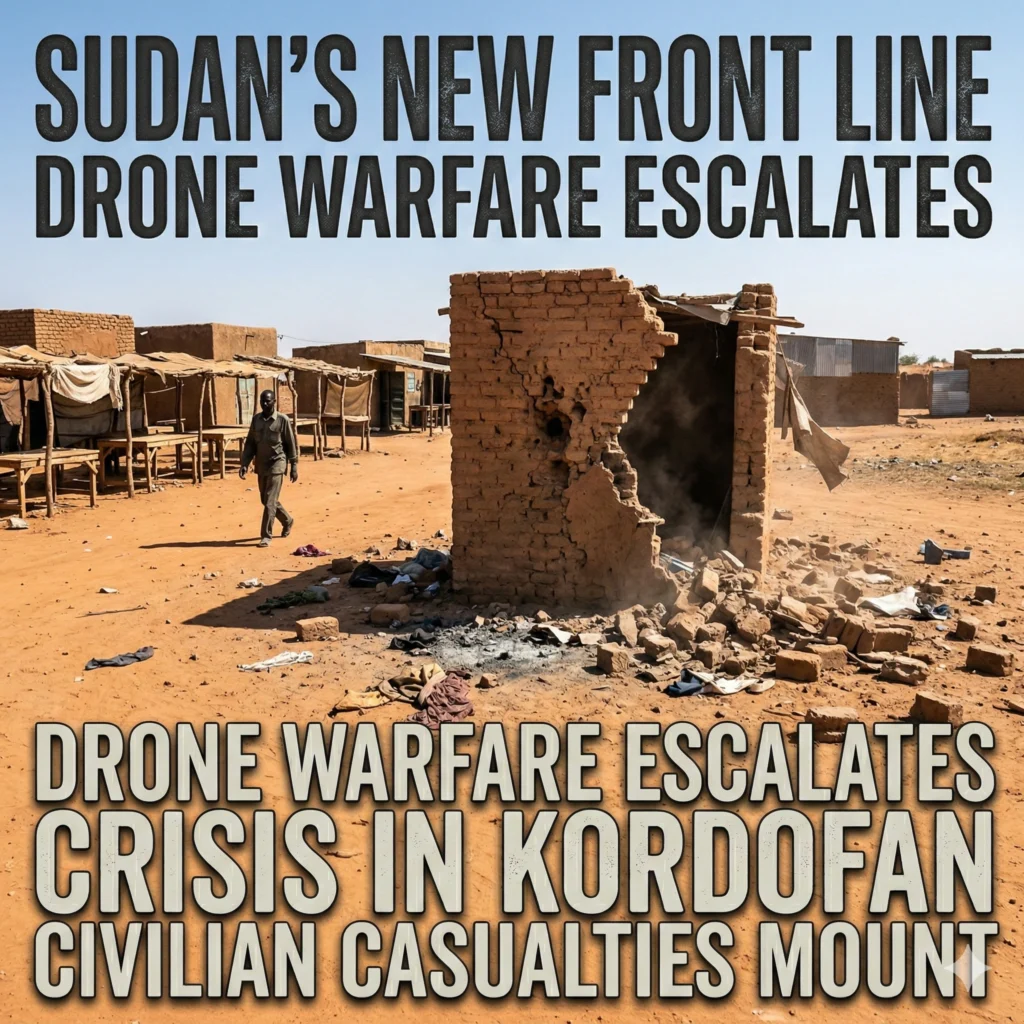
Sudan Drone Casualties are surging as a new front line in the south-central Kordofan region becomes the epicenter of the nation’s brutal civil war on February 27, 2026. This strategic shift has turned markets and healthcare facilities into targets, leading to a devastating loss of life among non-combatants. As the regular army and paramilitary forces struggle for control over resource-rich territories, the humanitarian cost continues to climb at an alarming rate. United Nations officials have voiced unprecedented outrage regarding the deliberate use of civilian infrastructure for military purposes.
The escalation in Sudan Drone Casualties follows a period where both warring factions consolidated their gains in other major battlefields, such as Darfur and Khartoum. Now, the focus has shifted to Greater Kordofan, a vital geographic axis that connects the western regions to the capital city. The Kordofan states are not only geographically significant but also contain the nation’s most valuable reserves of gold and oil. Consequently, the struggle for this corridor has become a fight for the economic heart of the country.
5 Critical Reasons for Rising Sudan Drone Casualties
The primary driver behind the increase in Sudan Drone Casualties is the low-cost accessibility of drone technology for both warring parties. Unlike traditional air power, drones can be deployed with minimal infrastructure, allowing for rapid strikes in remote areas like Kordofan. This has lowered the barrier for aerial bombardment, leading to more frequent attacks in densely populated markets. The precision promised by drone technology is rarely seen on the ground, as inaccurate targeting often hits residential blocks.
Another factor is the strategic importance of the Kordofan corridor, which acts as a bridge between the RSF strongholds in Darfur and the contested capital. Control over this region would allow the paramilitary forces to secure a continuous supply line and solidify their parallel government. Because the stakes are so high, both sides are willing to utilize extreme measures, including heavy drone use, to gain a tactical advantage. This total-war mentality directly results in the rising Sudan Drone Casualties reported by international observers.+1
Furthermore, the involvement of local rebel groups has complicated the battlefield dynamics in Kordofan. A local rebel faction has recently allied with the RSF to gain access to experienced fighters and strategic border crossings. This alliance has introduced new combatants into the region who are often less trained in international humanitarian law. The resulting chaos further elevates the risk to civilians who are caught between multiple competing armed groups.
Sudan Drone Casualties
The human toll of the conflict is most visible in the overcrowded health facilities that are now struggling to treat Sudan Drone Casualties under constant threat of attack. When medical centers are targeted, the survival rate for those injured in strikes drops significantly. This creates a secondary crisis where even minor injuries become fatal due to the lack of safe medical environments. International humanitarian organizations are currently demanding a total cessation of hostilities near these essential life-saving zones.
The Strategic Battle for Kordofan’s Resource Wealth
Kordofan’s status as a resource-rich territory is a major reason why Sudan Drone Casualties are concentrated in this specific region. The presence of significant gold mines and oil fields makes it a prize that neither side is willing to forfeit. Profits from these resources are used to fund the purchase of more weaponry, including the very drones that are devastating the population. This “resource curse” has turned a once-productive region into a landscape of ruins and mourning.
The RSF’s efforts to establish a parallel government depend heavily on controlling these economic hubs. By seizing the Kordofan corridor, they hope to gain the financial leverage needed to achieve international recognition or at least maintain their military operations indefinitely. The regular army, meanwhile, views the defense of Kordofan as essential for the survival of the state. This irreconcilable struggle ensures that Sudan Drone Casualties will remain a tragic feature of the conflict for the foreseeable future.
Moreover, the division of the country into de facto zones of control has made the delivery of aid nearly impossible. Humanitarian corridors are frequently blocked by drone activity or ground fighting, leaving civilians without food or water. The persistence of Sudan Drone Casualties is therefore compounded by a growing famine that threatens to kill more people than the bombs themselves. The international community is struggling to find a diplomatic solution as the military leaders show no sign of compromise.
Human Rights Violations and the Failure of Diplomacy
The continued targeting of civilian objects is a clear violation of international law, yet Sudan Drone Casualties continue to mount without accountability. The UN has documented numerous instances where drones were used to strike areas with no clear military presence. These actions suggest a strategy of displacement, where populations are forced to flee to make way for military movements. Such tactics have turned the Kordofan region into a ghost land of abandoned villages and scorched earth.
Diplomatic efforts to broker a ceasefire have repeatedly failed since the power struggle began in April 2023. Every time a peace talk is proposed, a new offensive is launched, often preceded by a wave of drone strikes. The leaders of the regular army and the RSF appear to believe that a total military victory is still possible. This belief is what fuels the daily reports of Sudan Drone Casualties that have become a grim routine for news outlets worldwide.
The failure of the global community to enforce an arms embargo has allowed sophisticated drone technology to flow into Sudan. Various regional actors are suspected of supplying these weapons to their preferred factions, further prolonging the agony of the Sudanese people. Until the supply of these lethal machines is cut off, the numbers of Sudan Drone Casualties will likely continue to break records. The situation requires a much more robust international intervention than what has been offered so far.
Impact on Health Facilities and Medical Personnel
Healthcare workers in Kordofan are operating under conditions that are nothing short of heroic as they deal with Sudan Drone Casualties. Many hospitals have been partially destroyed, yet doctors continue to perform surgeries by flashlight or in makeshift basements. The psychological trauma for medical personnel is immense, as they often become targets themselves while trying to save lives. The loss of a single doctor in these regions can deprive thousands of people of medical care for years.
The strikes on health facilities are often excused by military forces as “accidents” or “collateral damage,” but the frequency of these hits suggests otherwise. By destroying the medical infrastructure, the warring parties weaken the social fabric of the opposing side’s territory. This cruel tactic ensures that the Sudan Drone Casualties are not just limited to those in the immediate blast zone. It creates a long-term public health disaster that will take decades to repair.
- Emergency rooms are constantly overwhelmed by shrapnel-related injuries.
- Shortages of blood and anesthesia have reached critical levels in Kordofan.
- Specialized trauma care is almost non-existent outside of the major cities.
- Mobile clinics are being utilized but are easily spotted and targeted by drones.
The Role of Rapid Support Forces in Regional Instability
The Rapid Support Forces have significantly altered the nature of the war through their aggressive use of drones, leading to high Sudan Drone Casualties. Originally a paramilitary force, the RSF has evolved into a sophisticated military entity with its own air capabilities and international backers. Their presence in Kordofan has disrupted the lives of hundreds of thousands of people who previously lived in relative peace. Their goal is to create a corridor of control that stretches from the western borders deep into the heart of Sudan.
By establishing a parallel government, the RSF has effectively split the nation in two. This division makes any unified response to the Sudan Drone Casualties impossible, as there is no central authority to coordinate relief efforts. The paramilitary forces use drones not just for combat, but for reconnaissance to monitor civilian movements and prevent people from leaving their zones of control. This has turned many parts of Kordofan into an open-air prison for its residents.
The alliance between the RSF and local rebel groups has also fueled ethnic tensions within the region. In some cases, drone strikes are used to clear specific ethnic groups from resource-rich land. This dimension of the conflict adds a layer of complexity to the Sudan Drone Casualties, as the violence is often motivated by both political power and ethnic cleansing. The international community has expressed fear that Kordofan could follow the same tragic path as Darfur.
Geographic Significance of the Kordofan Corridor
Kordofan is the strategic “bridge” of Sudan, and its fall would change the entire trajectory of the civil war. This geographic importance explains why Sudan Drone Casualties are so high in this area compared to other rural provinces. If the RSF can hold Kordofan, they can effectively cut off the regular army’s access to the southern and western parts of the country. This would isolate the government in a small enclave, making their position increasingly untenable.
The terrain in Kordofan is a mixture of savannah and desert, which provides little cover for civilians from aerial surveillance. Drones can easily spot any movement on the open plains, making it dangerous for people to even go out to collect water or tend to their crops. The Sudan Drone Casualties are often the result of this total lack of cover. People are essentially “sitting ducks” in a landscape that has been turned into a high-tech killing field.
The regular army has responded by increasing its own drone presence, leading to a “drone war” where the sky is filled with competing machines. For the civilians on the ground, it often does not matter whose drone is overhead; the result is the same. The competing strikes have turned the Kordofan corridor into a zone of permanent destruction where no one is safe. The Sudan Drone Casualties are a direct consequence of this obsession with geographic dominance.
Future Outlook for the Sudanese Civil War in 2026
As we move further into 2026, the outlook for Sudan remains bleak as long as the Kordofan front remains active. The persistence of Sudan Drone Casualties suggests that neither side is ready to move toward a peaceful settlement. Instead, they are doubling down on military technology that prioritizes destruction over precision. The civilian population is being treated as an obstacle to be cleared rather than a citizenry to be protected.
The international community must move beyond statements of outrage and take concrete steps to protect the people of Sudan. This could include the establishment of “no-fly zones” for drones or the deployment of international peacekeepers to guard healthcare facilities. Without such interventions, the Sudan Drone Casualties will continue to mount, and the Kordofan region will become another chapter in the long history of Sudan’s unresolved tragedies. The time for meaningful action was months ago, but every day of delay costs more lives.
Ultimately, the resolution of the conflict will require the military leaders to realize that they are ruling over a graveyard. The Sudan Drone Casualties are not just statistics; they are the lost potential of a nation. If the current trends continue, there will be very little left of Sudan to govern when the smoke finally clears. The world must not look away from the suffering in Kordofan, as the lessons learned here will be vital for preventing similar drone-based conflicts in the future.
Challenges in Humanitarian Aid Delivery to Kordofan
Delivering aid to mitigate the suffering of Sudan Drone Casualties is currently one of the most dangerous missions for international NGOs. Aid convoys are frequently targeted or caught in the crossfire of drone strikes, leading to the deaths of humanitarian workers. This has forced many organizations to suspend their operations in Kordofan, leaving millions without food, medicine, or clean water. The lack of humanitarian access is directly contributing to the rising death toll in the region.
The warring factions often use the denial of aid as a weapon of war. By preventing supplies from reaching civilian populations in “enemy” territory, they hope to force a surrender. This tactic is a clear violation of international law and significantly worsens the impact of Sudan Drone Casualties. When people are malnourished and dehydrated, they are much less likely to survive the injuries sustained during an aerial attack.
- Aid workers are increasingly relying on local volunteers to distribute supplies.
- Digital platforms are being used to track drone activity and warn civilians in real-time.
- Airdrops of food have been considered but are risky due to anti-aircraft fire.
- Negotiated “windows of silence” are desperately needed to allow for evacuations.
The Role of International Law and Accountability
Accountability is the only long-term solution to end the cycle of Sudan Drone Casualties. The International Criminal Court (ICC) has already begun gathering evidence of war crimes in Sudan, including the deliberate targeting of civilians. However, the process of bringing military leaders to justice is slow and often takes years. In the meantime, the people of Kordofan need immediate protection from the drones that circle their skies daily.+1
Sanctions on the individuals and companies that supply drone components to Sudan are an essential part of the accountability process. Many of these drones are assembled using parts from global technology markets, making it difficult to trace their origin. A more rigorous tracking of “dual-use” technology is required to prevent these components from ending up in the hands of the Sudanese military. Reducing the supply of drones is the most direct way to reduce Sudan Drone Casualties.
Furthermore, regional powers that are providing political cover for the warring factions must be pressured to change their stance. The division of Sudan is not in the long-term interest of any of its neighbors, as it creates a vacuum for extremism and migration crises. A unified regional approach is needed to force the regular army and the RSF to the negotiating table. The lives of those at risk of becoming Sudan Drone Casualties depend on this collective political will.
Final Thoughts on the Kordofan Crisis
The crisis in Kordofan is a stark reminder of the changing nature of modern warfare. The prevalence of Sudan Drone Casualties shows that even in the world’s most remote regions, high-tech weaponry can be used to devastating effect. The international community’s response must evolve at the same pace as the technology of war. Protecting civilians in the age of the drone requires new strategies, new laws, and a renewed commitment to human life.
The people of Sudan have endured decades of conflict, but the current civil war is perhaps the most dangerous in its history. The focus on Kordofan and the resulting Sudan Drone Casualties are a tragedy that should have been prevented. As we look toward the future, the only hope for the region lies in a comprehensive ceasefire and a return to civilian rule. Until then, the drones will continue to hum over the markets of Kordofan, and the list of victims will continue to grow.
Every death recorded in Sudan is a failure of the global security architecture. We must demand better for the children and families who are currently hiding in trenches to avoid the next strike. The Sudan Drone Casualties are a call to action for everyone who believes in the sanctity of human life and the power of peace. Let us not allow Kordofan to become a forgotten front in a forgotten war.
For more details & sources visit: BBC News
Read more on Sudan news: 360 News Orbit – Sudan.