
Trump Global Tariff Regime changes have sent shockwaves through the international trade community following a landmark US Supreme Court ruling on February 26, 2026. The judicial decision struck down the emergency powers previously utilized by the Trump administration to enforce a broad international tax framework. This ruling effectively invalidated billions of dollars in collected levies, forcing the executive branch to pivot toward alternative legal justifications to maintain its protectionist trade agenda.
In the wake of this significant legal setback, President Trump signed a new executive order implementing a 10% global tariff as an immediate stop-gap measure. This specific action utilizes a different legislative authority that allows the president to impose import taxes for a duration of 150 days without seeking prior approval from Congress. The rapid transition between legal frameworks highlights the administration’s determination to keep the Trump Global Tariff Regime active despite intense judicial scrutiny.
While the court’s decision created immediate confusion for international exporters and manufacturers, the administration remains undeterred in its “America First” economic policy. During recent public remarks and his State of the Union address, the President criticized the court’s intervention and vowed that the trade barriers would remain. The shifting legal landscape has now forced major corporations to reassess their global supply chains as they wait for more permanent guidance from Washington.+2
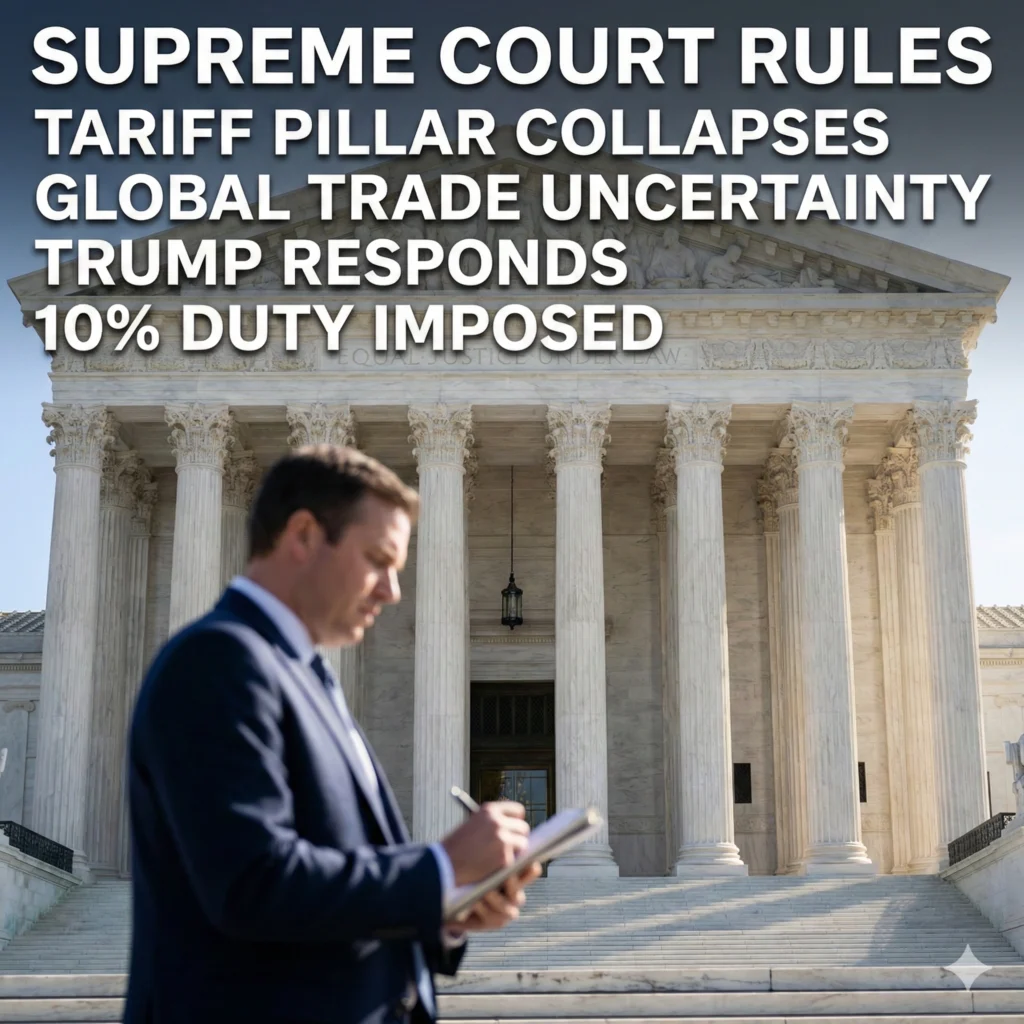
Trump Global Tariff Regime and the Supreme Court Ruling
The Trump Global Tariff Regime faced its toughest challenge yet when the Supreme Court ruled that the emergency powers law cited by the administration did not authorize such broad trade policies. This ruling was not just a procedural hiccup; it was a fundamental rejection of the executive branch’s interpretation of trade emergency statutes. Consequently, the judicial branch has forced a rethink of how tariffs can be legally applied without a formal declaration from the legislative body.
This judicial invalidation has left billions of dollars in limbo, as duties paid under the old regime are now being contested in court. The ruling emphasized that the President cannot indefinitely bypass Congress for economic shifts of this magnitude. As a result, the Trump Global Tariff Regime must now find a narrow path through existing trade laws to survive the inevitable wave of follow-up litigation from affected industries.
The immediate aftermath of the ruling saw a flurry of activity within the Department of Justice and the Office of the US Trade Representative. Lawyers scrambled to find alternative statutes that could provide a temporary “life raft” for the administration’s trade goals. This led to the selection of a 150-day emergency provision, which serves as the current foundation for the Trump Global Tariff Regime as the administration prepares for a longer legislative battle.
Executive Orders and the 10% Stop-Gap Measure
President Trump reacted swiftly to the court’s decision by signing a new executive order that established a 10% duty on all global imports. This 10% global tariff is designed to prevent a sudden flood of foreign goods into the US market while the legal teams finalize a more permanent strategy. By using a 150-day window, the administration has bought itself time to either negotiate with Congress or find a more robust legal footing for the Trump Global Tariff Regime.
Despite the President’s public suggestions that the rate could eventually climb to 15%, official documents confirmed the current rate at 10% as of Tuesday morning. This lower rate is seen by some analysts as an attempt to minimize further judicial pushback while still fulfilling campaign promises to protect domestic manufacturing. The Trump Global Tariff Regime is thus currently in a state of “controlled aggression,” balancing political goals with legal reality.
- The new order targets all categories of manufactured goods and raw materials.
- Exceptions for specific strategic allies are currently under review by the trade office.
- The 150-day clock began officially on the day of the signing.
- Customs and Border Protection have already updated their electronic systems to the new rate.
The use of this alternative authority is a calculated risk, as it has rarely been used for such a comprehensive global application. Critics argue that the Trump Global Tariff Regime is stretching the intent of this law beyond its original purpose. However, supporters of the administration believe that the executive branch must have the flexibility to respond to what they perceive as unfair global trade imbalances.
Impact on Logistics and Global Manufacturing
The ongoing shifts in the Trump Global Tariff Regime have caused severe business uncertainty for logistics companies and manufacturers across Asia. Shipping giants like FedEx have already filed lawsuits seeking full refunds of duties paid under the now-invalidated regime. This litigation represents just the tip of the iceberg, as hundreds of other firms are expected to seek compensation for what they view as illegally collected taxes.
Manufacturers in major hubs like Vietnam, Thailand, and South Korea report that the lack of policy clarity is making it impossible to finalize long-term contracts. Many businesses are choosing to delay major investment decisions, fearing that the Trump Global Tariff Regime could shift again without warning. This “wait and see” approach is slowing down the global trade recovery and leading to increased costs for consumers at the end of the supply chain.
Exporters are also warning that the volatility of US trade policy may inadvertently reinforce the dominance of China. As the US market becomes more difficult to navigate, some manufacturers are refocusing their efforts on the Chinese domestic market or intra-Asian trade blocks. This unintended consequence of the Trump Global Tariff Regime could eventually weaken the US’s economic leverage in the very region it seeks to influence.
US Trade Representative and the 15% Rate Proposal
US Trade Representative Jamieson Greer has been a vocal defender of the administration’s actions, stating that a 15% global tariff remains an option for the near future. Greer argued that the 10% rate is a baseline and that the Trump Global Tariff Regime will apply higher rates where deemed appropriate to counter specific trade practices. This “variable rate” strategy adds another layer of complexity for businesses trying to calculate their future tax liabilities.+1
The potential jump to 15% is viewed as a leverage tool for upcoming trade negotiations with major partners. By keeping the threat of a higher rate on the table, the administration hopes to force concessions on market access and intellectual property rights. However, the Trump Global Tariff Regime faces the challenge of maintaining this pressure without triggering a full-scale global trade war that could damage the US economy.
Greer’s office is currently flooded with petitions from US companies seeking exemptions for critical components that cannot be sourced domestically. Managing these “exclusion requests” is a massive administrative task that further complicates the implementation of the Trump Global Tariff Regime. The trade office must balance the need for domestic protection with the reality of globalized supply chains where many American products rely on foreign parts.
Corporate Lawsuits and the Refund Crisis
The invalidation of the previous tariff pillar has created a massive fiscal liability for the US government. With companies like FedEx leading the charge, the Department of the Treasury is facing demands for billions of dollars in refunds. The Trump Global Tariff Regime is now entangled in a “refund crisis” that could take years to resolve through the court system, potentially impacting the federal budget and trade deficit figures.+1
- FedEx’s lawsuit claims the emergency powers were used unconstitutionally.
- Other retail giants are forming coalitions to file class-action refund suits.
- Legal experts predict a surge in “Section 301” and “Section 232” litigation.
- The government may attempt to pass legislation to retroactively legalize the collected duties.
This legal turmoil is a significant distraction for an administration that wants to focus on economic growth. Every dollar spent on legal defense or paid out in refunds is a dollar that isn’t supporting the stated goals of the Trump Global Tariff Regime. Furthermore, the uncertainty regarding these refunds makes it difficult for corporations to accurately report their earnings, leading to volatility in the stock market.
The judicial branch’s willingness to strike down a core executive policy has emboldened other industries to challenge various aspects of the trade agenda. We are likely to see a period of intense “lawfare” where every new executive order related to the Trump Global Tariff Regime is immediately met with an injunction request. This cycle of policy and litigation is becoming the new normal for American trade relations in 2026.
State of the Union and the Political Battle
During his State of the Union address, President Trump made it clear that the battle for his trade policy is far from over. He framed the Trump Global Tariff Regime as a necessary tool for national survival and criticized the “unelected judges” who seek to limit his power. This rhetoric suggests that the administration will continue to push the boundaries of executive authority to keep the tariffs in place.
The President’s defiant stance has solidified his support among his political base, particularly in the manufacturing heartland. For many voters, the Trump Global Tariff Regime is a symbol of a government that is finally standing up for American workers. This political support provides the administration with the “air cover” it needs to continue its aggressive trade maneuvers despite the legal and economic risks involved.
However, the political battle is also playing out in Congress, where some lawmakers are considering legislation to curb the President’s tariff powers permanently. The Trump Global Tariff Regime has created a rare moment of tension between the executive branch and some members of the President’s own party who favor traditional free trade. The outcome of this legislative-executive tug-of-war will determine the long-term viability of the administration’s trade legacy.
Global Supply Chain Shifts and Chinese Dominance
One of the most profound effects of the Trump Global Tariff Regime is the forced restructuring of global supply chains. Companies that once relied on “just-in-time” manufacturing are now moving toward “just-in-case” strategies, building up larger inventories to hedge against sudden tariff changes. This shift is increasing the cost of goods and contributing to inflationary pressures in the US and abroad.+1
As companies look for alternatives to avoid the Trump Global Tariff Regime, many are finding that China’s infrastructure and scale are still unmatched. In some cases, the tariffs have simply led to “transshipment,” where Chinese goods are sent through third countries to mask their origin. This practice undermines the effectiveness of the Trump Global Tariff Regime and makes it difficult for customs officials to enforce the rules accurately.
- Relocation of assembly lines to Southeast Asian nations with lower trade barriers.
- Increased investment in domestic US automated manufacturing to bypass labor costs.
- Diversification of raw material sources to reduce dependence on single-country suppliers.
- Development of “near-shoring” hubs in Mexico and Canada to take advantage of USMCA.
While the administration hopes these shifts will eventually lead to a “reshoring” of American industry, the immediate reality is a fragmented global trade system. The Trump Global Tariff Regime is acting as a catalyst for a new era of regionalism, where trade is governed by geopolitical alliances rather than purely economic efficiency. This transition period is likely to be characterized by lower global growth and higher consumer prices.
Future of the 150-Day Emergency Authority
The 150-day window provided by the alternative legislative authority is a ticking clock for the Trump Global Tariff Regime. Once this period expires, the administration will either need to let the tariffs lapse or find yet another legal justification. This “cliff edge” is creating a sense of urgency in Washington to find a permanent solution that can survive both judicial review and congressional scrutiny.
There is speculation that the administration may attempt to declare a formal “national economic emergency” to extend the tariffs beyond the 150-day limit. However, given the Supreme Court’s recent ruling, such a move would likely be challenged immediately. The Trump Global Tariff Regime is thus in a race against time to prove its economic benefits and win over enough legislative support to codify the duties into law.
For businesses, this 150-day period is a critical window to adjust their operations. Many are using this time to lobby for specific carve-outs or to accelerate the movement of goods before any potential increase to 15%. The uncertainty surrounding what happens after day 150 is perhaps the biggest challenge currently facing the Trump Global Tariff Regime and the global economy.
Impact on US-Asia Trade Relations
The Trump Global Tariff Regime has particularly strained relations with Asian trading partners who have built their economies around exports to the US. Nations like Japan and South Korea, which are key security allies, are finding themselves in a difficult position as they try to navigate the new trade barriers. The administration’s “one size fits all” 10% tariff does not distinguish between strategic partners and economic rivals, leading to diplomatic friction.+1
In response, some Asian nations are accelerating their participation in regional trade agreements that exclude the US, such as the RCEP. This “de-coupling” from the US trade orbit could have long-term consequences for American influence in the region. The Trump Global Tariff Regime is thus a double-edged sword: it seeks to protect domestic industry but risks isolating the US from the world’s fastest-growing economic zone.
The administration argues that these allies should do more to reduce their trade surpluses with the US. By using the Trump Global Tariff Regime as a blunt instrument, Washington is signaling that it is no longer willing to trade economic access for security cooperation on the old terms. This shift is redefining the geopolitical landscape of the Indo-Pacific, creating a more transactional and volatile environment for all players involved.
Conclusion: The Precarious Future of Trade Policy
The invalidation of the key tariff pillar has left the Trump Global Tariff Regime in a precarious position. While the 10% stop-gap measure provides temporary relief for the administration, the long-term legal and economic challenges are immense. The Supreme Court has signaled that there are limits to executive power in trade, and the business community is prepared to fight every step of the way.
As we move through 2026, the Trump Global Tariff Regime will continue to be the most significant factor in global trade. Whether it leads to a revitalized American manufacturing sector or a fragmented and expensive global economy remains to be seen. The coming 150 days will be a defining period for the administration’s trade legacy and the future of international commerce.
In the end, the Trump Global Tariff Regime represents a fundamental challenge to the globalized order of the last thirty years. It is a bold experiment in economic nationalism that is currently being tested in the highest courts and the most competitive markets in the world. The outcome of this struggle will shape the economic destiny of the United States and its partners for decades to come.
For more details & sources visit: BBC News
For the latest updates from the United States, visit our U.S. news page.