
Palestinian Trade Deficit Risk grows as the latest economic data from the Palestinian Central Bureau of Statistics reveals a widening gap in registered goods. During December 2025, the imbalance between imports and exports reached a staggering 500.9 million dollars, marking a 15 percent increase compared to the previous year. This surge in the commercial gap highlights the deep structural challenges facing the local economy as it struggles to balance its commercial ledger.
While total exports saw an encouraging rise of 16 percent, the sheer volume of imports overshadowed these gains. The Palestinian Trade Deficit Risk is exacerbated by a heavy reliance on a single trading partner, making the economy vulnerable to external shocks. As the gap expands, policymakers are faced with the difficult task of diversifying trade routes and boosting local production to mitigate long-term financial instability.
Economic experts suggest that the current trajectory requires immediate intervention to foster industrial independence. The Palestinian Trade Deficit Risk serves as a critical indicator of the region’s purchasing power versus its manufacturing output. Without a strategic shift toward internal production, the reliance on foreign goods will continue to drain local capital and stifle long-term growth prospects.
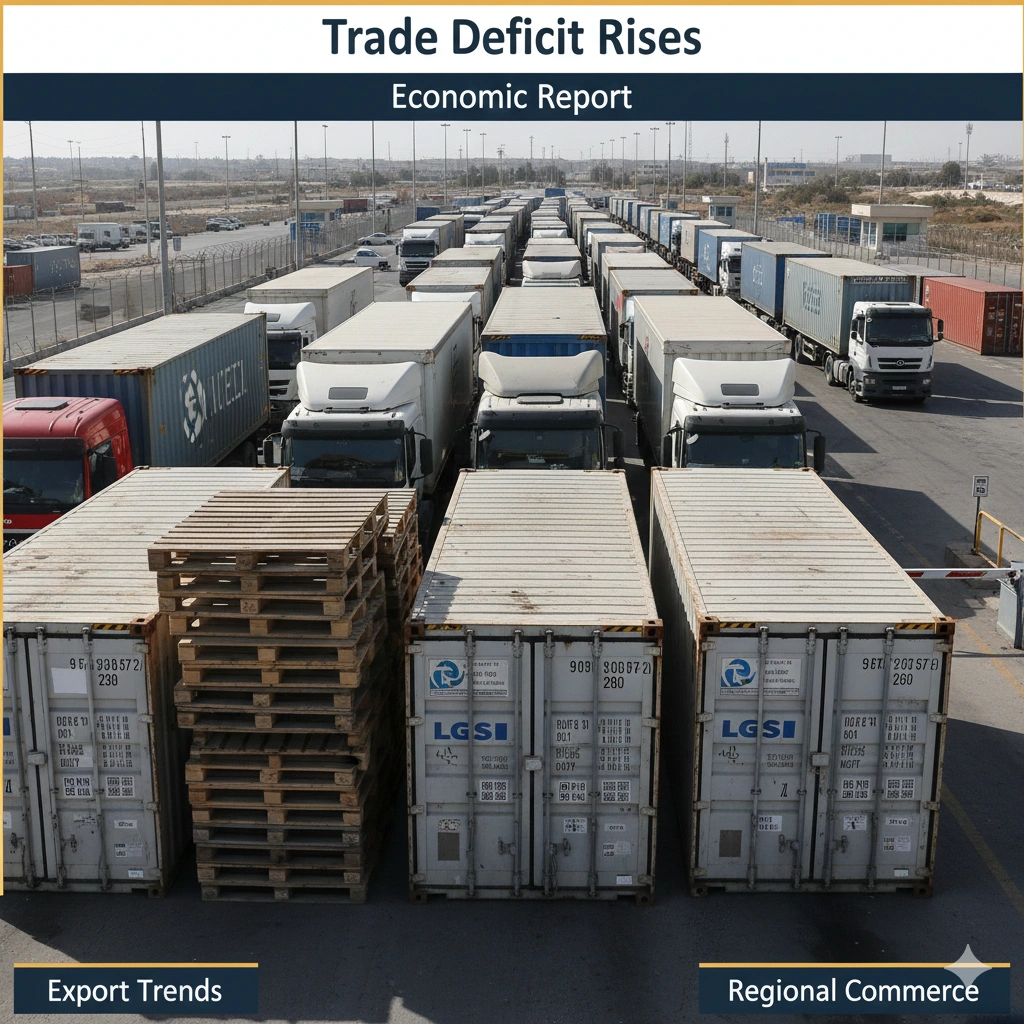
Palestinian Trade Deficit Risk
The most striking aspect of the current financial situation is its 15 percent annual growth, a figure that signals increasing consumption over local production. This deficit represents the difference between the value of goods imported and the value of goods exported during a specific timeframe. When the shortfall hits the 500 million dollar mark in a single month, it places immense pressure on the national currency reserves.
A deeper look at the data shows that while exports are growing, they are not keeping pace with the rapid influx of foreign goods. This imbalance in the fiscal ledger is largely fueled by the high demand for industrial materials and consumer products that cannot currently be manufactured locally. Consequently, the trade gap remains a persistent hurdle for economic planners in Ramallah who seek to stabilize the balance of payments.
Moreover, the Palestinian Trade Deficit Risk is heavily influenced by the costs of logistics and transit. Because the region lacks direct control over all its borders, the cost of bringing in goods remains high, further inflating the import bill. Addressing the gap will require not only a boost in exports but also a strategic reduction in the cost of importing essential commodities.
Heavy Reliance on the Israeli Market
A primary factor contributing to the regional economic strain is the overwhelming dominance of trade with Israel. In December 2025, trade with Israel accounted for a massive 89 percent of the total export volume. This concentration of trade creates a localized vulnerability, as any fluctuations in the Israeli economy directly impact Palestinian commercial stability and market access.
Exports destined for the Israeli market saw a 22 percent increase, which is a positive sign for bilateral business relations. However, this also deepens the Palestinian Trade Deficit Risk by making the Palestinian economy less diversified. When nearly nine-tenths of exports go to a single neighbor, the lack of geographic diversity becomes a strategic vulnerability that can lead to sudden economic contractions.
Conversely, imports from Israel grew by 24 percent, making up 59 percent of the total import volume. This means the current fiscal imbalance is fundamentally tied to Israeli supply chains. To reduce the Palestinian Trade Deficit Risk, there is a clear need to explore more international markets, though current data shows a worrying 19 percent decline in exports to other global nations.
Export Performance and Global Challenges
While the 16 percent increase in total exports is a silver lining, it does not fully mask the ongoing economic hurdles. The growth was almost entirely driven by the Israeli market, while international outreach struggled significantly. This decline in global exports further cements the current situation as a regionalized issue rather than a global success story for local manufacturers.
The 19 percent drop in exports to non-Israeli markets suggests that Palestinian goods are facing stiff competition or logistical barriers abroad. For the Palestinian Trade Deficit Risk to shrink, local businesses must find ways to penetrate European, American, and Arab markets more effectively. Without a diversified export base, the imbalance will likely continue its upward trajectory throughout 2026.
Despite these challenges, certain sectors like stone, marble, and agricultural products continue to show resilience. However, the commercial gap remains high because these traditional exports are often low-value compared to the high-tech and processed goods being imported. Shifting toward high-value manufacturing is one proposed method to combat the growing fiscal strain in the coming years.
Analysis of Import Trends and Growth
The total import bill of 691.1 million dollars is the largest component of the current economic equation. A 15 percent year-on-year rise in imports indicates a robust demand for foreign products, which is often a sign of a developing economy. However, when not matched by export growth, it simply feeds the Palestinian Trade Deficit Risk, leading to a net outflow of capital.
Imports from global nations outside of Israel saw a modest increase of 5 percent, which is significantly lower than the growth seen in Israeli imports. This disparity shows that the commercial imbalance is becoming increasingly localized. The heavy import of fuel, electricity, and water from across the Green Line remains a fixed cost that keeps the Palestinian Trade Deficit Risk at elevated levels.
The Palestinian Central Bureau of Statistics noted that the total trade deficit for December reached 500.9 million dollars. This specific figure is a benchmark for the region’s health, representing a significant portion of the monthly economic activity. Monitoring these import trends is vital for understanding how much of the local wealth is being spent on foreign-made goods.
Economic Impacts of a Widening Gap
A widening commercial gap has several immediate impacts on the local economy, most notably on the availability of credit and the stability of local businesses. When the Palestinian Trade Deficit Risk grows, it often leads to a shortage of foreign exchange, making it harder for importers to pay their suppliers. This cycle can lead to inflation and higher costs for everyday consumers.
Furthermore, the imbalance limits the government’s ability to invest in public infrastructure. Since a large portion of the national wealth is leaving the country to pay for the deficit, there is less capital available for schools, hospitals, and roads. Reducing this gap is therefore not just a matter of trade, but a matter of national development and long-term prosperity.
- Reduced liquidity in the local banking sector.
- Higher dependency on international aid to cover fiscal gaps.
- Increased vulnerability to changes in Israeli trade policies.
- Pressure on the Palestinian Authority to increase tax revenues.
These factors combine to make the Palestinian Trade Deficit Risk a top priority for economic analysts. Every percentage point increase in the deficit represents millions of dollars that are not staying within the local circular economy. Addressing the issue will require a multifaceted approach involving both private sector innovation and public sector policy adjustments.
Strategic Moves to Diversify Trade
To combat the commercial strain, many experts suggest a “Pivot to the World” strategy that reduces the 89 percent reliance on a single market. Diversifying trade partners is the most effective way to lower the Palestinian Trade Deficit Risk over time. By establishing stronger ties with Jordan, Egypt, and the European Union, the Palestinian economy can create a buffer.
The current situation could be mitigated by the implementation of new trade agreements that provide duty-free access for Palestinian goods. Currently, the lack of such agreements with major economies outside of the region keeps the commercial gap high. Enhancing the quality and packaging of local products to meet international standards is another critical step in reducing the Palestinian Trade Deficit Risk.
- Promoting “Made in Palestine” campaigns for local consumers.
- Offering tax incentives for companies that export to new markets.
- Investing in digital trade and service-based exports.
These initiatives are designed to chip away at the imbalance by creating new streams of revenue. While the Israeli market will always be a major partner due to proximity, the Palestinian Trade Deficit Risk will only reach manageable levels when the economy stands on more than one pillar. Diversification is the key to turning the trade deficit into a trade surplus.
Role of the Palestinian Central Bureau of Statistics
The Palestinian Central Bureau of Statistics (PCBS) plays a crucial role in documenting the national economic trends. By providing accurate and timely data from their headquarters in Ramallah, the PCBS allows for data-driven decision-making. Their December 2025 report is the primary source of the 15 percent growth figure that defines the Palestinian Trade Deficit Risk.
Without the diligent work of the PCBS, the true scale of the fiscal imbalance would be unknown. Their reports cover registered goods, customs data, and international commercial trends, providing a holistic view of the economy. Policymakers rely on this data to track whether their efforts to reduce the Palestinian Trade Deficit Risk are actually yielding results.
The accuracy of these statistics is essential for maintaining the trust of international donors and investors. When the PCBS highlights a 15 percent rise in the gap, it serves as a wake-up call for the global community. It provides the empirical evidence needed to argue for more support for Palestinian businesses and more open trade corridors.
Logistic Barriers and the Deficit
Logistics remain a major hurdle in the fight against the widening trade gap. High transit fees, long wait times at crossings, and complex security checks all add to the cost of doing business. These “hidden costs” are a significant part of the Palestinian Trade Deficit Risk, as they artificially inflate the price of both imports and exports.
Improving the efficiency of the “Back-to-Back” trucking system and other border protocols could significantly lower the fiscal pressure. When it takes longer and costs more to move a container from Nablus to a port than it does to ship it across the ocean, the Palestinian Trade Deficit Risk is bound to suffer. Infrastructure improvements are a direct investment in reducing this deficit.
- Modernization of storage facilities at commercial crossings.
- Implementation of electronic pre-clearance for trusted traders.
- Development of dedicated industrial zones near border areas.
These logistical upgrades are often overlooked but are vital for a healthy trade balance. If Palestinian exporters can move their goods faster and cheaper, they can better compete in the global market, thereby reducing the Palestinian Trade Deficit Risk. The physical constraints of trade are just as important as the economic ones.
Comparison with Historical Data
When looking at the current situation in a historical context, the December 2025 figures show a concerning trend. Over the last decade, the deficit has generally trended upward, but the 15 percent spike in 2026 is particularly sharp. This suggests that the structural issues causing the Palestinian Trade Deficit Risk are becoming more entrenched.
Comparing current data to 2024 shows that while both imports and exports are growing, the gap is widening at an unsustainable rate. In 2024, the commercial imbalance was significant, but it had not yet crossed certain psychological thresholds that it has now surpassed. This historical trajectory indicates that without intervention, the Palestinian Trade Deficit Risk will continue to break records.
The persistence of the gap highlights the need for a radical shift in economic policy. Incremental changes have not been enough to reverse the trend. To truly address the Palestinian Trade Deficit Risk, a concerted effort to build a self-sustaining industrial base is required. Looking back at historical data proves that “business as usual” will not solve the underlying problems.
Future Outlook for 2026 and Beyond
The outlook for the national trade balance for the remainder of 2026 remains cautious. While there is potential for export growth in the tech and olive oil sectors, the high demand for imported goods is unlikely to subside. Therefore, the Palestinian Trade Deficit Risk is expected to remain a dominant theme in the region’s economic discourse for the foreseeable future.
If global inflation continues to cool, the cost of imports might stabilize, offering some relief to the fiscal balance. However, if energy prices rise, the import bill will swell once again, pushing the Palestinian Trade Deficit Risk to new heights. The year 2026 will be a testing ground for the resilience of Palestinian exporters in the face of these fluctuating global conditions.
- Potential for new trade routes through neighboring Arab countries.
- Growth in the digital services sector, which bypasses physical borders.
- Continued focus on agricultural self-sufficiency to reduce food imports.
Ultimately, the national fiscal health is a puzzle with many pieces. Solving it will require a combination of local innovation, international cooperation, and political stability. As the 2026 fiscal year progresses, the monthly reports from the PCBS will be the ultimate scorecard for how well the economy is managing the Palestinian Trade Deficit Risk.
The 15 percent annual increase is a call to action for all stakeholders. It is a reminder that while growth is happening, it must be balanced and sustainable. The Palestinian Trade Deficit Risk is a challenge that can be overcome, but only with a clear vision and a commitment to long-term structural reform.
The data presented by the Palestinian Central Bureau of Statistics serves as the foundation for this analysis. With exports at 190.2 million and imports at 691.1 million, the mission is clear: narrow the gap and strengthen the local economy. The Palestinian Trade Deficit Risk is more than just a number; it is a roadmap for future economic policy.
As we move further into 2026, the focus must remain on empowering local producers. By supporting the artisans, farmers, and factory workers of Palestine, the Palestinian Trade Deficit Risk can be transformed from a burden into a catalyst for change. The journey to a balanced trade ledger starts with a single step toward economic independence and global integration.
For more details & sources visit: WAFA
For the latest updates from Palestine, visit our Palestine news page.