
The Turkish Cocoa Market Growth 2026 has reached unprecedented heights as Iraq solidifies its position as a primary global destination for processed chocolate and confectionery. According to the Turkish Statistical Institute, Iraq’s imports of these specific luxury food items surged to a staggering $175 million throughout the 2025 fiscal year. This strategic trade relationship is a cornerstone of Turkiye’s broader economic mission to dominate the regional food processing industry. While the United States remains the top importer, Iraq’s consistent demand has propelled the Turkish cocoa sector to a historic global export value of $1.66 billion. Analysts suggest that this growth is a testament to the sophisticated value-added processing capabilities developed within Turkish borders.
This remarkable surge in the Turkish Cocoa Market Growth 2026 highlights the resilience of bilateral trade despite fluctuations in other economic sectors. Although Turkiye does not produce raw cocoa beans domestically, its industrial facilities have become world-class hubs for refining imported raw materials into premium finished products. The Iraqi market serves as a critical pillar for these exporters, providing a consistent and high-volume outlet for Turkish chocolate and cocoa powder. By focusing on quality and regional taste preferences, Turkish manufacturers have successfully captured a significant share of the Iraqi consumer market. This sector’s success provides a much-needed boost to Ankara’s overall export portfolio during a period of global trade shifts.
Turkish Cocoa Market Growth 2026
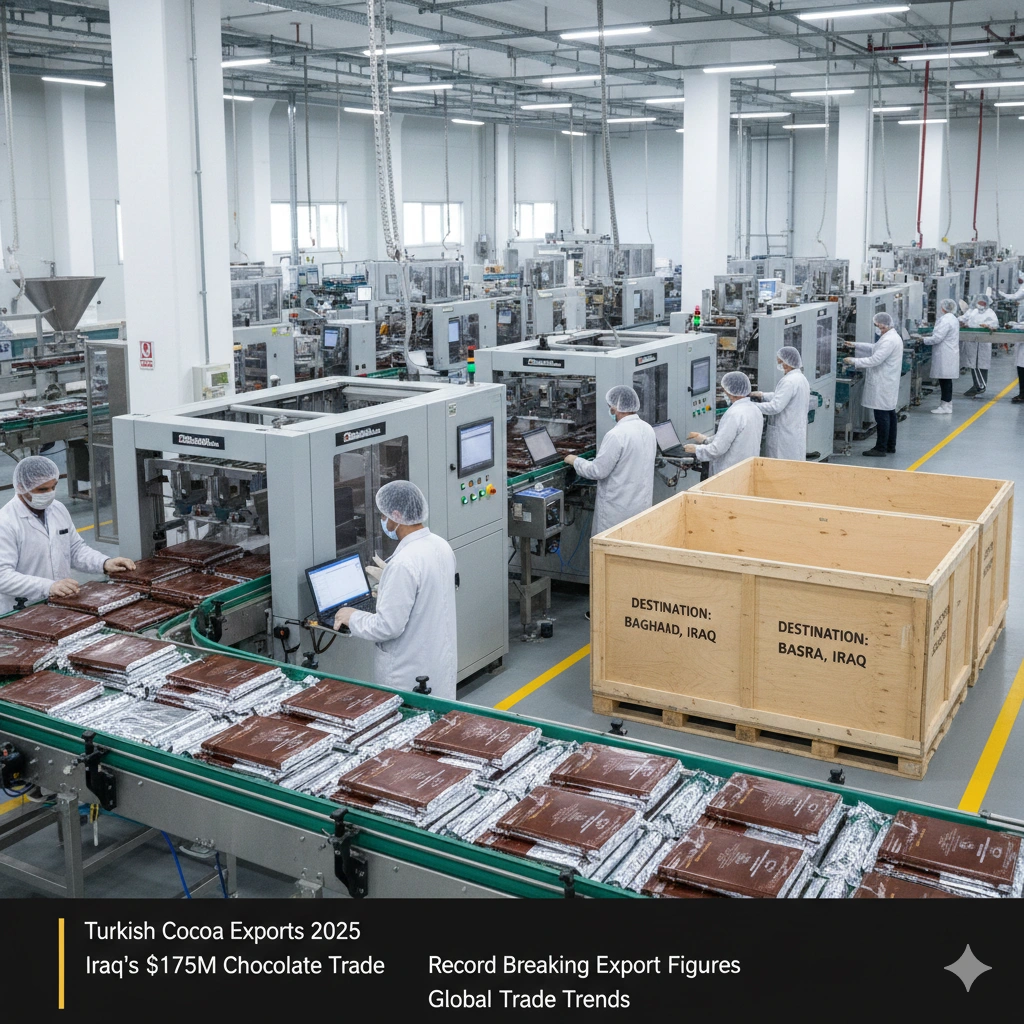
The physical distribution of these cocoa products across the border is a key driver of the Turkish Cocoa Market Growth 2026 and regional integration. Despite a slight overall decline in total bilateral trade volume between the two nations, the confectionery segment has shown remarkable counter-cyclical strength. Logistics networks connecting Turkish processing plants to Iraqi retail hubs have been optimized to handle the sensitive nature of chocolate products. This ensures that the goods arrive in peak condition, maintaining the brand prestige that Turkish exporters have worked hard to establish. As Iraqi demand for high-quality sweets grows, the cocoa trade is expected to remain a bright spot in the bilateral economic landscape.
Strategic Importance of the Iraqi Consumer Market
The decision for Turkish firms to prioritize the Iraqi market is a central pillar of the Turkish Cocoa Market Growth 2026 strategy to offset stagnation elsewhere. For years, Iraq has been one of Ankara’s most reliable trade partners, consistently ranking as a top-five export destination across all sectors. In 2025, total Iraqi imports from Turkiye were valued at $12.38 billion, underscoring the deep economic interdependency between the two neighbors. While this total represents a 5 percent decrease from 2024, the specific growth in cocoa products indicates a shift in Iraqi consumer habits. People are increasingly choosing Turkish brands for their perceived value and cultural proximity.
Furthermore, the Turkish Cocoa Market Growth 2026 illustrates how specialized industries can thrive even when broader trade figures face a downward trend. The data shows that while total imports dropped nearly 10 percent compared to 2022 levels, the appetite for Turkish grains and cocoa remains robust. This resilience is vital for Turkish manufacturers who view the Iraqi market as a stable foundation for their international expansion plans. By tailoring their marketing efforts to the Iraqi demographic, these companies have built a loyal customer base that withstands general economic cooling. This localized focus is a primary reason why Turkiye continues to outperform its rivals in the region.
International analysts are closely monitoring the Turkish Cocoa Market Growth 2026 to see if the processing model can be replicated in other sectors. Turkiye’s ability to import raw cocoa and export $1.66 billion in finished goods is a masterclass in industrial value-addition. If this model continues to succeed, it will provide a roadmap for Turkiye to become a dominant “processing kitchen” for the entire Middle East. This transition from a transit economy to a manufacturing powerhouse is essential for the long-term stability of the Turkish lira. Without a strong export-oriented industrial base, the nation would be far more vulnerable to global commodity price shocks.
Analyzing the 2025 Global Export Milestone
As part of the Turkish Cocoa Market Growth 2026, the sector has achieved a historic milestone that places it among the top global contenders. Reaching $1.66 billion in total global exports required a massive scaling of production facilities and aggressive entry into new markets like the United States and Iran. This global reach allows Turkish firms to mitigate the risks associated with relying on a single trade partner like Iraq. By diversifying their export destinations, they ensure that the Turkish Cocoa Market Growth 2026 remains sustainable even if regional tensions arise. This strategic diversification is a key component of Ankara’s “Century of Turkiye” economic vision.
The data released by the Turkish Statistical Institute is a critical component of the Turkish Cocoa Market Growth 2026 as it provides the roadmap for future investments. Industry leaders are using these figures to identify which processed goods—such as chocolate bars, cocoa butter, or industrial powder—are performing best in specific regions. Iraq’s preference for finished chocolate products has led to increased investment in retail-ready packaging lines. Meanwhile, exports to the United States often focus on bulk cocoa ingredients for their domestic food industry. This dual-track strategy allows Turkiye to satisfy both retail consumers and industrial buyers simultaneously.
Efforts are also underway to enhance the sustainability of the Turkish Cocoa Market Growth 2026 through ethical sourcing and green logistics. As global consumers become more conscious of supply chain ethics, Turkish processors are working with international certification bodies to ensure their raw materials are responsibly sourced. This move not only protects the environment but also opens doors to high-end European markets that have strict import regulations. Successfully navigating these social and environmental standards will be a major victory for the Turkish food industry’s global reputation. The goal is to make “Made in Turkiye” a hallmark of both quality and ethical integrity.
Economic Integration Between Neighboring Nations
The Turkish Cocoa Market Growth 2026 is also being used as a tool for deeper diplomatic and economic ties between Ankara and Baghdad. Despite historical fluctuations, the trade in food products like cocoa, grains, and fruits acts as a stabilizing force in the relationship. By providing essential goods that the Iraqi market needs, Turkiye reinforces its role as a vital economic partner and a source of regional stability. This trade integration is not one-way; it fosters a business environment where Iraqi distributors and Turkish manufacturers work in close harmony. Such deep-rooted commercial ties are often more resilient than political agreements.
- Turkish manufacturers are opening representative offices in Baghdad and Erbil.
- Joint trade fairs in Istanbul are focusing specifically on Iraqi food importers.
- Simplified customs procedures for food products are helping maintain trade speed.
- Iraqi demand for Turkish confectionery peaks during seasonal and religious holidays.
This expansion of the Turkish Cocoa Market Growth 2026 ensures that the economic benefits of the trade are felt by logistics companies and wholesalers on both sides of the border. It allows the Turkish government to collect better data on regional demand, which is vital for planning future industrial zones near the border. The presence of high-quality Turkish food products in Iraqi households also creates a “soft power” effect, enhancing the cultural image of Turkiye. As the two nations continue to cooperate on infrastructure projects like the Development Road, the cocoa trade will benefit from even faster transport times. This infrastructure growth is a clear indicator of the long-term potential for bilateral commerce.
Managing the Value-Added Industrial Model
The success of the Turkish Cocoa Market Growth 2026 is closely tied to the efficiency of the nation’s manufacturing and processing zones. By creating tax incentives for food processors, the Turkish government has encouraged a wave of private investment into the cocoa sector. This allows firms to import raw beans from West Africa and transform them into expensive chocolate products for the Iraqi market. This transparent management of the industrial supply chain is a key reason why the sector has reached $1.66 billion in global value. Without a clear focus on the value-addition process, Turkiye would just be another transit point for global commodities.
- Chocolate production capacity has increased by 15 percent in the last two years.
- New specialized industrial parks in Gaziantep are focusing on export-grade sweets.
- R&D centers are developing heat-resistant chocolate specifically for the Middle Eastern climate.
Integrating these industrial advancements into the framework of the Turkish Cocoa Market Growth 2026 provides a buffer against global economic uncertainty. It allows Turkish brands to maintain higher profit margins than countries that only export raw agricultural products. This synergy between industrial R&D and export marketing is what sets the Turkish cocoa industry apart from its regional competitors. As the global chocolate market continues to grow, Turkiye’s specialized infrastructure will allow it to capture an even larger piece of the pie. This cycle of investment and export success is the ultimate goal of the current trade strategy.
Future Outlook for Turkish-Iraqi Trade Relations
Financial authorities believe that the Turkish Cocoa Market Growth 2026 is the essential bridge needed to revitalize overall trade between the two nations. While total trade volume saw a slight dip in 2025, the growth in specialized sectors suggests that the quality of trade is actually improving. The new reforms in Iraq’s banking sector and Turkiye’s export credit systems are designed to make it easier for small businesses to engage in cross-border commerce. As Turkish firms prove their reliability in the cocoa sector, trust will grow in other categories like machinery and construction materials. This reconnection is vital for the private sector in both countries.
The Turkish Cocoa Market Growth 2026 also includes plans for digital trade upgrades to make the export process more efficient and transparent. By encouraging the use of electronic certificates of origin and digital payment gateways, both governments aim to reduce the time goods spend at the border. This shift toward a digital trade corridor is a hallmark of modern economic policy and will help reduce the costs for Iraqi importers. Electronic tracking of shipments also makes it easier to ensure food safety standards are met throughout the journey. These technical improvements are being implemented alongside the physical expansion of production lines.
- Introduction of a digital portal for Iraqi buyers to connect with Turkish factories.
- Partnerships with regional banks to facilitate faster L/C (Letter of Credit) processing.
- Investment in cold-chain logistics to prevent chocolate melting during transit.
- Public-private partnerships to promote Turkish food brands at international expos.
Ultimately, the Turkish Cocoa Market Growth 2026 is about more than just sweets; it is about the industrial maturation of a nation. The proactive approach taken by the Turkish cocoa sector signals a transition from domestic supply to a global manufacturing powerhouse. While trade challenges remain, the successful export of over $170 million in cocoa products to Iraq alone is an optimistic sign. If Turkish manufacturers can maintain this momentum and continue to innovate, they will secure their place as the “chocolate capital” of the region. The road ahead is paved with opportunities for growth and deeper economic cooperation.
Sustaining the Momentum of Turkish Exports
The long-term success of the Turkish Cocoa Market Growth 2026 will depend on the industry’s ability to navigate fluctuating raw material prices. Since cocoa is a global commodity, Turkish processors must be adept at hedging their costs to keep their finished products affordable for Iraqi consumers. Maintaining a consistent price point is essential for keeping the loyalty of the middle-class demographic in Baghdad and beyond. Industry leaders have indicated that they will continue to invest in warehouse automation to lower operational overheads. This vigilant approach to cost management is necessary to prevent inflation from eroding the competitive edge of Turkish chocolate.
As the Turkish Cocoa Market Growth 2026 moves into its next phase, the focus will shift toward building global brand equity that rivals established Swiss or Belgian names. A stable and high-quality product means that the “Made in Turkiye” label will carry a premium in the eyes of international shoppers. This brand stability is just as important as the trade volume, as it ensures that the sector remains profitable in the long run. The government’s commitment to funding export promotion should also improve the visibility of Turkish sweets in new markets like Southeast Asia. By linking the sector’s value to actual quality and innovation, Turkiye is building a resilient industrial future.
In conclusion, the Turkish Cocoa Market Growth 2026 stands as a bold success story in the regional food industry. Through a combination of industrial value-addition, strategic focus on the Iraqi market, and global diversification, Turkiye has turned a lack of raw materials into a billion-dollar success. The export of $175 million in cocoa goods to Iraq in 2025 is a strong indicator of what is possible when neighbors trade effectively. As the global appetite for chocolate continues to rise, Turkiye is well-positioned to remain at the forefront of the industry. For the workers and business owners in both countries, this growth offers a clear path toward a more integrated and prosperous future.
For more details & sources visit: Shafaq News
Read more about Iraq news on 360 News Orbit – Iraq.