
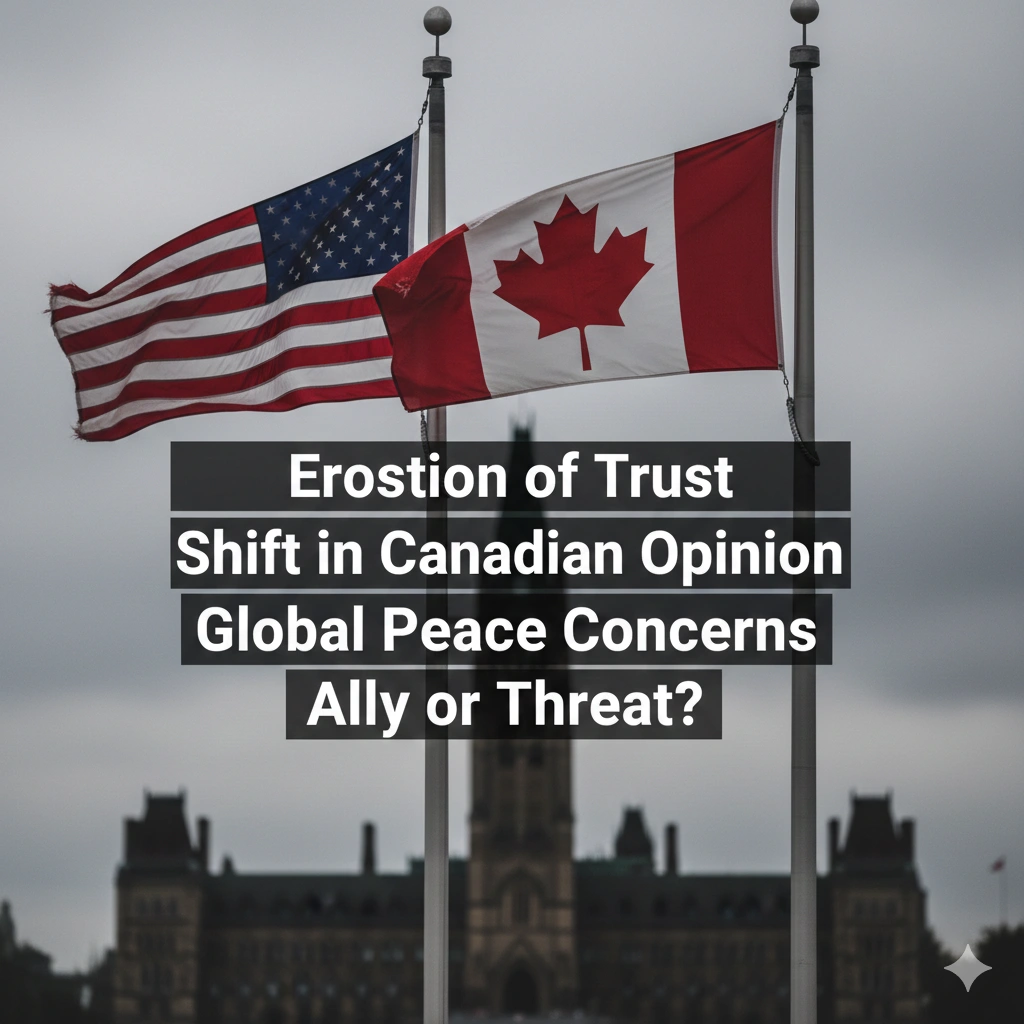
Trump leadership threat is now viewed by nearly half of the Canadian population as a more significant danger to global peace than the traditional adversarial posture of Russia. This startling shift in public opinion emerges from the latest polling data released in February 2026, marking a historic low point in North American diplomatic relations. As the geopolitical landscape shifts, citizens north of the border are expressing profound concerns regarding the predictability of their southern neighbor.
The narrative of the United States as a protective shield has been replaced by a perception of exposure and risk. Understanding why a traditional ally would rank a democratic partner as a greater hazard than a nuclear-armed autocracy requires a deep dive into the current socio-political climate. This analysis explores the multifaceted reasons behind this erosion of trust and the potential long-term consequences for the international order.
Historical Context of the Canada-US Alliance
The relationship between Canada and the United States has long been considered the gold standard of bilateral cooperation and integrated continental security. For decades, both nations shared the world’s longest undefended border and collaborated closely within the framework of NATO and NORAD. However, the recent emergence of the Trump leadership threat has fundamentally altered the psychological landscape of this partnership for many Canadians. This shift is not merely a policy disagreement but represents a deeper emotional break in how Canadians perceive their place in the world.
While previous administrations occasionally clashed over trade or environmental regulations, the fundamental trust in American stability remained largely intact. The current data suggests that the “neighborly” dynamic has shifted toward a state of high-alert observation from the Canadian public. Consequently, the perception of the United States as a guarantor of the liberal international order is currently facing its most significant challenge since the mid-20th century. Analysts suggest that the unpredictability of current American rhetoric is the primary driver behind these negative public sentiments.
Trump Leadership Threat
The Trump leadership threat is characterized by a governing style that frequently prizes disruption over traditional diplomacy and established international protocols. Canadians surveyed specifically pointed to the volatility of executive decision-making as a source of global instability that rivals or exceeds external pressures from Russia. Because the United States sits at the center of the global financial and security systems, its internal fluctuations cause immediate and widespread shockwaves. This systemic importance means that any perceived instability in Washington is felt more acutely by allies than the actions of distant rivals.
Respondents in the latest poll noted that while Russia pressures the international system from the outside, a volatile America impacts it from the very core. This distinction is crucial to understanding why nearly 50 percent of Canadians now view the current American administration as a primary danger. The sentiment has moved from a sense of being shielded by a superpower to a feeling of being exposed to its whims. This perceived volatility has led to a dramatic reassessment of what constitutes a “threat” in the modern geopolitical era.
The Erosion of Trust in Security Guarantees
A majority of Canadians now express the belief that the United States can no longer be relied upon to provide assistance during a major international crisis. This skepticism strikes at the heart of the collective defense principles that have underpinned Western security for over seventy years. When the Trump leadership threat is perceived as an internal instability, the reliability of treaty obligations like Article 5 of the NATO charter becomes a subject of public debate. This lack of confidence marks a historic rupture in the diplomatic narratives that previously defined the cross-border relationship.
The fear is not necessarily one of direct aggression but rather one of abandonment or erratic withdrawal from shared security responsibilities. If Canadians feel they can no longer count on their primary ally, the necessity for a shift in independent defense spending and foreign policy becomes more urgent. This psychological distancing is a direct byproduct of the combative rhetoric often directed at allies by the current administration in Washington. As a result, the Canadian public is increasingly looking toward a “middle power” strategy that relies less on the American security umbrella.
Economic Pressures and Trade Instability
Trade disputes and the frequent implementation of tariffs have further strained the relationship between these two closely integrated North American neighbors. The Trump leadership threat extends into the economic sphere, where the threat of sudden policy shifts creates an environment of permanent uncertainty for Canadian businesses. Since the United States remains Canada’s largest trading partner, any disruption in the flow of goods and services has immediate consequences for the Canadian middle class. The weaponization of trade policy for political leverage has left a lasting impression on the Canadian electorate.
- Tariffs on essential materials like steel and aluminum have increased costs for Canadian manufacturers.
- Threats to dismantle existing trade agreements have forced Canadian policymakers to seek alternative global markets.
- The use of economic sanctions as a primary tool of diplomacy has created secondary effects for Canadian firms operating internationally.
- Public discourse in Canada has become increasingly wary of the deep economic integration that once seemed like an unalloyed benefit.
These economic factors contribute significantly to the overall perception of the United States as a source of global instability. When the world’s largest economy becomes unpredictable, the ripples are felt in every sector of the Canadian economy. Therefore, the economic dimension of the Trump leadership threat is just as influential as the military or diplomatic dimensions in shaping public opinion.
Comparing Global Risks: Russia vs. The United States
The fact that nearly half of Canadians rank the United States as a larger threat than Russia is a staggering statistical revelation. Historically, Russia has been viewed as the primary antagonist to Western stability, particularly concerning its actions in Eastern Europe and cyberspace. However, the Trump leadership threat is perceived differently because of the sheer scale of American influence and the perceived erosion of democratic norms. Canadians seem to be weighing the intentional aggression of Russia against the perceived structural instability of the current American administration.
This comparison highlights a unique moment in history where a primary ally is scrutinized with the same intensity as a traditional rival. The survey results suggest that Canadians are increasingly concerned about the “internal” health of the American republic and its impact on foreign policy. If the United States is seen as moving away from its role as a stable leader, the vacuum left behind is perceived as a greater risk than the actions of a known adversary. This nuanced view of global risk reflects a sophisticated, albeit pessimistic, outlook from the Canadian public.
The Psychological Impact of Combative Rhetoric
The evaporation of trust is frequently attributed to a governing style that prizes disruption and uses combative rhetoric as a standard tool of communication. The Trump leadership threat is amplified by the speed at which policy can be announced or changed via social media, bypassing traditional diplomatic channels. For Canadians, who generally value consensus and multilateralism, this approach feels inherently dangerous and destabilizing. The language of “America First” is often interpreted by neighbors as “America Alone,” leaving little room for the collaborative efforts that defined the past century.
- Diplomatic insults directed at Canadian leaders have personalized the political tension for the average citizen.
- The rejection of multilateral climate and security agreements is seen as a withdrawal from global responsibility.
- A preference for bilateral “deals” over rules-based international systems undermines the stability of smaller nations.
These factors combined have led to a sense of alienation among the Canadian public, who previously viewed the border as a formality between friends. Now, the border is increasingly viewed as a boundary between two different visions of how the world should be governed. The Trump leadership threat is thus as much a cultural and rhetorical issue as it is a matter of hard policy.
Future Implications for North American Cooperation
Despite the souring public mood and the perceived Trump leadership threat, the United States remains Canada’s most vital collaborator in continental security. This creates a tension between public sentiment and the practical necessities of governance and defense. Canadian officials must balance the skepticism of their voters with the reality that their economy and security are inextricably linked to the United States. This “decoupling” of public opinion from institutional reality creates a challenging environment for future diplomatic negotiations.
Looking ahead to the remainder of 2026, the perception of the Trump leadership threat will likely dictate the tone of bilateral discussions on everything from border security to environmental protection. If the Canadian public continues to view the United States with suspicion, it will become politically difficult for Canadian leaders to align closely with American initiatives. This could lead to a more independent, and perhaps more isolated, Canadian foreign policy. The long-term impact on the North American alliance depends on whether this shift in perception is a temporary reaction or a permanent change in the Canadian national identity.
Conclusion and National Sentiment
The current polling data represents a historic rupture in the diplomatic narratives of North America, fueled by the persistent Trump leadership threat. As Canadians grapple with the reality of a more unpredictable southern neighbor, the focus has shifted toward national resilience and international diversification. While the United States will always be a central player in Canadian life, the era of unquestioned trust appears to have reached a significant turning point. The challenge for both nations will be navigating this period of instability while maintaining the essential ties that keep the continent secure and prosperous.
For more details & sources visit: La Voce di New York
For more updates and related stories, visit our Canada News page.