
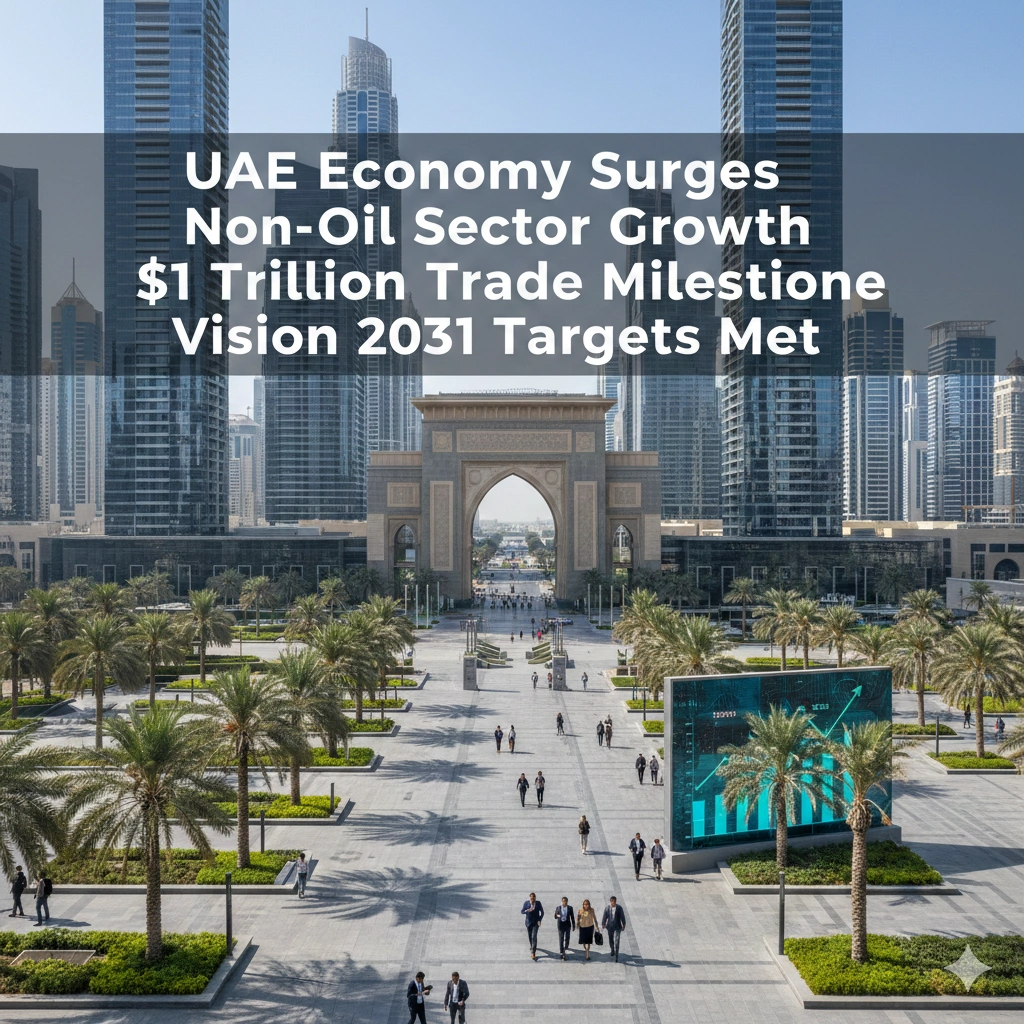
UAE Economy Growth reached a staggering 5.1 percent in the first nine months of 2025, signaling a historic transformation in the nation’s financial landscape. This surge brought the total national value to Dh1.4 trillion, driven by a strategic move away from hydrocarbon reliance. As the country moves toward its 2031 economic vision, these figures represent a massive win for diversification. The federal data confirms that the Emirates are no longer just an oil power but a global hub for trade and finance.
The most impressive aspect of the UAE Economy Growth is the 6.1 percent expansion within the non-oil sector alone. This specific segment contributed over Dh1 trillion to the national GDP for the first time in history. Leadership in Abu Dhabi and Dubai has expressed significant confidence in these numbers as proof of structural resilience. By reaching these milestones, the UAE is effectively decoupling its future prosperity from the volatility of global crude oil prices.
The Financial Engine Powering National Prosperity
The financial and insurance sectors have emerged as the fastest-growing pillars within the broader UAE Economy Growth narrative. Recording a 9 percent increase, these services are benefiting from an influx of global capital and a robust regulatory environment. International firms are increasingly choosing the UAE as their regional headquarters, drawn by the world-class infrastructure. This growth in finance provides the necessary liquidity to fund other large-scale national infrastructure projects.
Moreover, the UAE Economy Growth in the financial sector is supported by a surge in digital banking and fintech innovation. The Central Bank has played a pivotal role in maintaining stability while encouraging the adoption of new technologies. This dual approach has made the Emirates a magnet for high-net-worth individuals and institutional investors alike. As insurance services also expand to cover new industrial risks, the financial sector’s dominance continues to solidify.
UAE Economy Growth
The UAE Economy Growth is currently on track to hit an annual target of 5.2 percent according to the latest Central Bank projections. This momentum is sustained by a record-breaking performance in non-oil foreign trade, which exceeded the $1 trillion mark. Such a feat was achieved five years ahead of the original 2031 schedule, showcasing the efficiency of the national strategy. The government’s ability to sign new Comprehensive Economic Partnership Agreements has been a key catalyst for this success.
This particular phase of UAE Economy Growth is also characterized by a 6.9 percent expansion in the manufacturing sector. Industrial zones across the emirates are now producing high-value goods for export, reducing the need for expensive imports. This shift toward “Made in the UAE” products is a core component of the industrial diversification plan. As manufacturing grows, it creates sustainable jobs and fosters a culture of innovation within the local workforce.
Real Estate and Construction Success Stories
Construction and real estate remain vital contributors to the UAE Economy Growth, with growth rates of 8.7 percent and 7.9 percent respectively. The demand for luxury residential properties and commercial office spaces has never been higher in cities like Dubai. New mega-projects are being launched monthly, reflecting the high level of investor confidence in the long-term market. These sectors combined now provide more than a quarter of the non-oil GDP contribution.
The UAE Economy Growth in real estate is further bolstered by updated residency laws that attract long-term foreign talent. By offering “Golden Visas” to investors and professionals, the government has ensured a steady demand for high-end housing. Construction firms are also pivoting toward sustainable building practices to align with the nation’s “Net Zero” commitments. This modernization of the building sector ensures that the current boom is both profitable and environmentally responsible.
Wholesale and Retail Trade Dominance
Wholesale and retail trade remains the largest single component of the non-oil economy, accounting for 16.1 percent of the total. This sector is a primary beneficiary of the UAE Economy Growth, as increased consumer confidence leads to higher spending. The tourism surge has also played a massive role, with millions of visitors flocking to the nation’s world-famous malls. Retailers are reporting record sales figures across both luxury and essential goods categories.
- The expansion of e-commerce platforms has integrated seamlessly with traditional brick-and-mortar retail stores.
- New logistics hubs have reduced the time and cost associated with moving goods through the country’s major ports.
- Tourism-driven retail continues to benefit from a calendar of high-profile international events and shopping festivals.
This vibrancy in trade is a direct reflection of the overall UAE Economy Growth and the nation’s status as a global transit point. As supply chains stabilize, the wholesale sector is finding new opportunities to export goods to emerging markets. The synergy between trade and the nation’s advanced logistics infrastructure creates a virtuous cycle of growth. This ensures that the retail sector remains a resilient cornerstone of the national wealth strategy.
Hydrocarbon Sector Reversal and OPEC+ Dynamics
While the focus remains on diversification, the hydrocarbon sector also saw a 5.4 percent expansion in early 2026. This part of the UAE Economy Growth was fueled by a faster-than-expected reversal of oil production cuts by OPEC+. As global demand for energy remains high, the UAE has optimized its production capacity to maximize revenue. This “oil-funded” diversification allows the government to reinvest energy profits back into green technology and non-oil industries.
The UAE Economy Growth benefits from this balanced approach where oil is used as a springboard for future-proofing. By maintaining high efficiency in extraction, the nation ensures it remains a competitive player in the energy market. At the same time, the transition toward renewable energy sources is being accelerated using these very profits. This dual-track strategy is what sets the Emirates apart from other resource-rich nations in the region.
Manufacturing and Industrial Diversification Efforts
The success of the “Operation 300bn” initiative is evident in the manufacturing sector’s 13.9 percent contribution to the non-oil GDP. This segment of the UAE Economy Growth is driven by aerospace, defense, and pharmaceutical production. Local companies are now competing on a global stage, exporting sophisticated technology to international partners. The government’s support for small and medium-sized industrial enterprises has also been a major factor in this success.
- Industrial hubs like Kizad and Jafza are operating at near-full capacity to meet global demand for UAE goods.
- Investment in artificial intelligence has optimized production lines, making UAE manufacturing highly efficient.
- New incentives for green manufacturing are attracting eco-conscious international corporations to set up factories.
The ongoing UAE Economy Growth in manufacturing is creating a “knowledge-based” economy that prioritizes skills and technology. By moving up the value chain, the Emirates are ensuring that their industrial sector remains relevant in the age of automation. This diversification is not just about numbers; it is about building a sustainable future for the next generation of Emiratis. The manufacturing boom is a clear sign that the nation’s economic vision is being realized ahead of schedule.
Trade Agreements and International Investment Flows
The UAE continues to sign new Comprehensive Economic Partnership Agreements (CEPAs) to further boost international trade. These agreements are a primary driver of the UAE Economy Growth, as they remove barriers and reduce tariffs with key global partners. By fostering open trade, the Emirates have become a preferred gateway for businesses looking to enter the Middle East and Africa. These partnerships have directly led to the 26 percent annual surge in non-oil foreign trade.
Investment flows into the country have reached record levels, particularly in the tech and renewable energy sectors. The UAE Economy Growth is increasingly fueled by Foreign Direct Investment (FDI) from both Western and Eastern markets. This diversified portfolio of investors protects the national economy from regional shocks and global downturns. As the UAE signs more CEPAs, its role as a global economic mediator and trade hub will only continue to strengthen.
Future Outlook and the 2031 Economic Vision
Looking ahead, the UAE Economy Growth is expected to remain robust as the nation enters the next phase of its 2031 vision. Vice President Sheikh Mohammed bin Rashid has noted that nearly all trade targets are being met years in advance. This accelerated progress allows the government to set even more ambitious goals for the coming decade. The focus will likely shift toward deep-tech, space exploration, and advanced biotech as the next frontiers of growth.
The current UAE Economy Growth provides a solid foundation for these future aspirations. With a GDP that is increasingly independent of oil, the nation is well-positioned to lead the post-carbon world. The 5.1 percent growth rate is more than just a statistic; it is a testament to the nation’s adaptability and foresight. As the global economy continues to evolve, the UAE remains a shining example of how a nation can reinvent itself for the better.
Final Analysis of the UAE’s Record Expansion
In conclusion, the UAE Economy Growth witnessed in 2025 and early 2026 is a historic milestone for the region. The 6.1 percent rise in the non-oil sector proves that the strategy of diversification is working effectively. From finance and real estate to manufacturing and trade, every sector is contributing to a more resilient national structure. The $1 trillion non-oil trade mark is a symbol of a country that has successfully transitioned into a modern economic powerhouse.
The UAE Economy Growth story is one of visionary leadership and strategic execution. By reinvesting oil wealth into sustainable industries, the Emirates have secured their place on the world stage for years to come. As the 2031 targets draw closer, the nation is likely to continue breaking records and setting new standards for excellence. The world will be watching closely as the UAE continues to redefine what is possible for a desert nation in the 21st century.
For more details & sources visit: The National
Stay informed with the latest United Arab Emirates news on 360 News Orbit – UAE.