
US Military Strikes in Nigeria have commenced following a rapid and unexpected shift in diplomatic relations between President Donald Trump and President Bola Tinubu. What began as a period of intense friction over religious freedom concerns has transformed into a high-stakes counter-terrorism partnership. The Department of War, acting under the Trump administration’s new aggressive foreign policy, initiated these operations to address long-standing security vacuums. Initial reports indicate that the primary targets were insurgent hubs in the northwest region. This military intervention marks a significant departure from previous years of cautious diplomatic engagement in West Africa.
The sudden execution of US Military Strikes in Nigeria was preceded by months of escalating rhetoric from Washington. President Trump had initially threatened the Nigerian government with severe financial sanctions, citing a failure to protect Christian communities from genocide. This pressure placed Nigeria on the “Countries of Particular Concern” watchlist, a move that usually signals a breakdown in relations. However, in a strategic maneuver, the Tinubu administration pivoted from defensive denials to an outright invitation for American intervention. This shift effectively turned a potential adversary into a direct military partner on the ground.
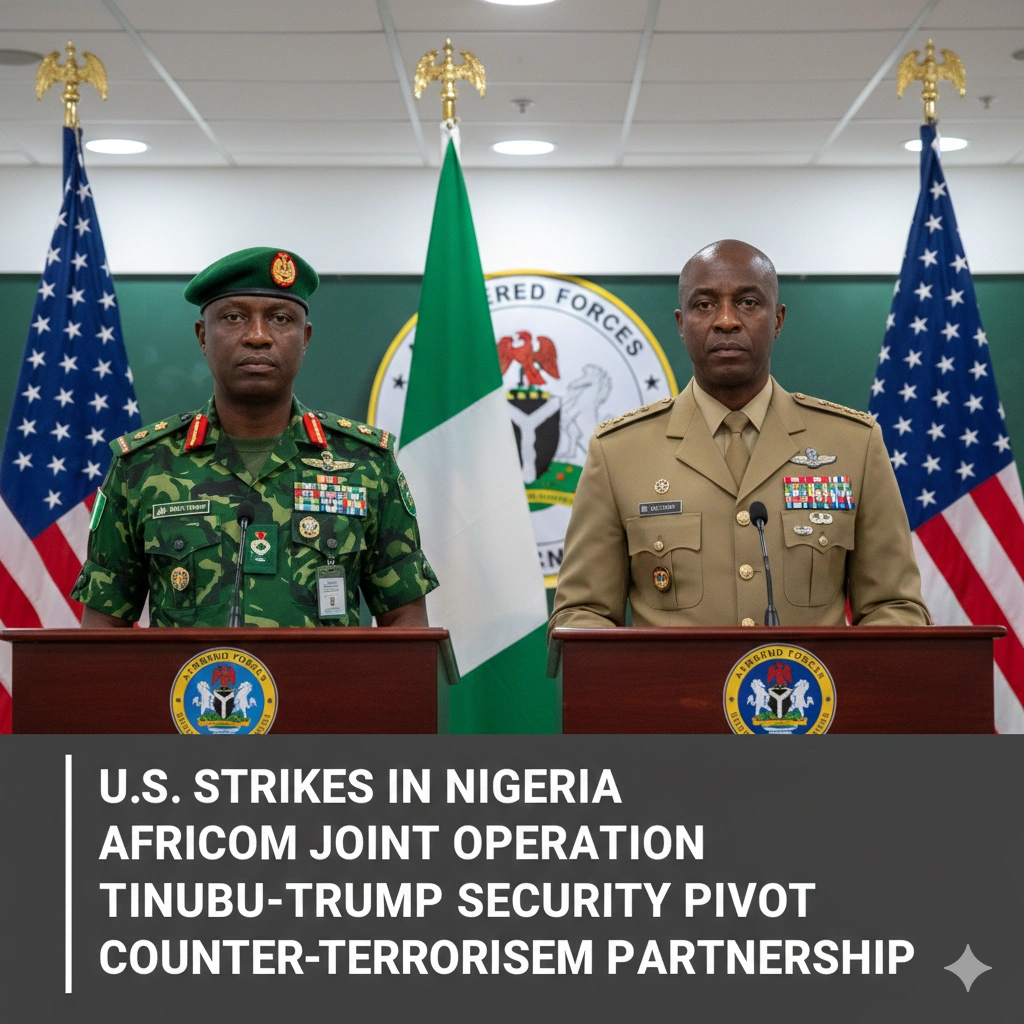
The Evolution of the 2026 Nigeria-US Defense Pact
The path toward US Military Strikes in Nigeria was paved by a series of intense negotiations held throughout late 2025. President Trump’s administration had accused Abuja of negligence regarding the targeted killings of religious minorities in rural areas. While President Tinubu initially argued that the violence affected all Nigerians regardless of faith, the threat of aid cuts loomed large. Facing the possibility of unilateral American action, the Nigerian government chose to formalize cooperation. By requesting assistance, Nigeria regained a semblance of control over the narrative surrounding the foreign military presence.+1
This formal request for US Military Strikes in Nigeria was confirmed by U.S. Africa Command (AFRICOM) as the legal basis for the operations. On the night of December 25, 2025, powerful air assets were deployed to strike locations identified as bandit strongholds. Analysts suggest that this partnership was a tactical “disarming” of President Trump’s aggressive stance. By welcoming the strikes, Tinubu avoided the humiliation of an uninvited bombing campaign while gaining advanced military support. The efficacy of these strikes has since been praised by the White House as a necessary step for regional stability.
US Military Strikes in Nigeria
The execution of US Military Strikes in Nigeria on Christmas night sent shockwaves through the African Union and neighboring West African states. These operations specifically targeted the northwest region, where armed groups have long operated with relative impunity against local populations. The precision of the American strikes was intended to degrade the command-and-control structures of these non-state actors. While the tactical success of the mission is being highlighted by military officials, the long-term political consequences remain uncertain. The presence of U.S. kinetic power in Nigeria represents a massive shift in the continent’s security architecture.
Furthermore, the US Military Strikes in Nigeria are being viewed as a template for the Trump administration’s “Department of War” philosophy. This approach favors direct, high-impact military intervention over protracted nation-building or soft-power diplomacy. For the Nigerian government, the strikes provide a temporary reprieve from the relentless pressure of internal insurgencies. However, critics argue that relying on foreign airpower does not solve the underlying socio-economic causes of the violence. The Nigerian public remains divided on whether this intervention is a restoration of order or a compromise of national sovereignty.
Trump’s Ultimatums and the Threat of Sanctions
Before the first US Military Strikes in Nigeria occurred, the diplomatic atmosphere was defined by a series of harsh ultimatums. The Trump administration’s focus on religious freedom was not merely rhetorical; it was backed by the threat of total economic isolation. Being placed on the watchlist for “Countries of Particular Concern” meant that Nigeria faced the immediate loss of hundreds of millions in security assistance. This “maximum pressure” campaign forced the Tinubu administration to reconsider its defensive posture. The pivot toward cooperation was a direct result of these credible threats to Nigeria’s financial stability.
The threat of sanctions was replaced by the reality of US Military Strikes in Nigeria once the formal agreement was reached. President Trump’s praise for the strikes suggests that the administration is satisfied with Nigeria’s new level of compliance. By shifting from a critic to a combat partner, the U.S. has gained a significant foothold in a region where Russian and Chinese influence has been growing. This maneuver demonstrates the transactional nature of the 2026 American foreign policy. Nigeria’s acceptance of the strikes served as a pressure valve, releasing the tension that had been building since the November accusations.
Regional Reactions and the African Union’s Response
The reaction to the US Military Strikes in Nigeria across the African continent has been characterized by deep-seated anxiety. The African Union has scheduled emergency sessions to discuss the implications of increased American military involvement in West Africa. Many regional leaders fear that this sets a precedent for unilateral or quasi-invited interventions in other sovereign states. There is a concern that the “security vacuum” cited by Trump could become a justification for a wider U.S. military footprint across the Sahel. Nigeria’s neighbors, particularly those facing their own insurgencies, are watching the outcome closely.
- The African Union is emphasizing the need for African-led solutions to regional security challenges.
- Neighboring countries like Niger and Chad are concerned about the potential spillover of displaced armed groups.
- Human rights organizations are calling for transparency regarding civilian casualties during the Christmas night operations.
While the US Military Strikes in Nigeria were requested by Abuja, the lack of a broader regional consensus remains a point of contention. The “Department of War” approach often bypasses traditional multilateral institutions in favor of bilateral military deals. This has led to a fragmented security landscape where different nations host competing foreign military powers. The success of the Nigerian model will likely determine if other nations in the region seek similar “partnerships” to avoid the stick of American sanctions.
The Tactical Nature of Northwest Nigerian Operations
The specific geography of the US Military Strikes in Nigeria focuses on the rugged terrain of the northwest. This area has been plagued by “bandits”—a catch-all term for various armed groups involved in kidnapping, cattle rustling, and mass killings. These groups have proven difficult for the Nigerian military to pin down using traditional ground-based tactics. The introduction of U.S. aerial surveillance and precision-guided munitions changed the dynamic of the conflict overnight. By targeting the logistics hubs of these groups, the U.S. aims to break the cycle of violence that has displaced thousands.
- Satellite intelligence was used to track movement in the dense forests where insurgents typically hide.
- Drone technology provided real-time data to minimize collateral damage while maximizing the impact on high-value targets.
- Specialized munitions were employed to destroy underground caches and fortified encampments.
Despite the technical superiority shown during the US Military Strikes in Nigeria, the “whack-a-mole” nature of insurgency persists. Military experts warn that airpower alone cannot hold territory or provide governance in the wake of the strikes. The Nigerian government must now follow up with civil services and a permanent security presence to ensure the gains are not lost. The partnership with the U.S. has provided a window of opportunity, but the burden of long-term stabilization still rests on the shoulders of the Tinubu administration.
Assessing the “Genocide” Accusations and Religious Freedom
The core of the initial dispute that led to the US Military Strikes in Nigeria was the accusation of state-sanctioned or negligent genocide. The Trump administration’s “Countries of Particular Concern” designation was based on reports of systematic attacks on Christian farming communities. While Nigeria’s government argued that the conflict was primarily an environmental and economic struggle over land, Washington maintained a religious lens. This ideological clash nearly severed ties between the two nations before the military pivot. The focus on religious freedom remains a central pillar of U.S. engagement in the region.
Interestingly, the narrative surrounding the US Military Strikes in Nigeria has shifted away from religious persecution toward general counter-terrorism. By rebranding the armed groups as “regional threats,” both governments found common ground that allowed for military cooperation. However, the groups targeted in the strikes are the same ones previously accused of religious cleansing. This indicates that while the rhetoric has changed, the targets remain the same. The U.S. continues to monitor the situation of religious minorities as a condition for ongoing military support and the eventual removal of Nigeria from the watchlist.
Economic Implications of the US-Nigeria Military Partnership
The move toward US Military Strikes in Nigeria has significant economic undertones that go beyond the battlefield. Nigeria is Africa’s largest economy, and its stability is vital for global energy markets and regional trade. The threat of sanctions would have devastated the Naira and deterred foreign direct investment. By agreeing to the military partnership, President Tinubu secured a degree of economic protection. The Trump administration has signaled that successful cooperation on security could lead to future trade incentives and infrastructure investment under a “security-first” economic model.
- Energy companies have expressed cautious optimism that the strikes will secure pipelines in the southern regions by proxy.
- The Nigerian stock market saw a brief rally following the announcement of the formal military cooperation agreement.
- U.S. defense contractors are expected to see increased orders for equipment and training modules for the Nigerian military.
However, the cost of hosting foreign military operations is not purely financial. The US Military Strikes in Nigeria carry a political cost for Tinubu, who must manage perceptions of national independence. If the strikes are seen as effective in restoring the economy of the northwest, the move will be vindicated. If they lead to prolonged foreign presence without economic improvement, the backlash could be severe. For now, the economic “disarming” of Washington’s threats remains the primary victory for the Nigerian presidency.
The “Department of War” and West African Stability
The creation of the “Department of War” under the second Trump term has fundamentally altered how the U.S. interacts with African nations. The US Military Strikes in Nigeria are the first major test of this new doctrine in West Africa. This department prioritizes rapid kinetic results over long-term social engineering. In Nigeria, this meant bypassing years of stalled diplomatic talks in favor of a 10-day ultimatum that resulted in a military request. The efficiency of the strikes is being used as a benchmark for future operations in other parts of the world.
Critics of this approach worry that the US Military Strikes in Nigeria may only provide a temporary solution. The “Department of War” is designed for destruction, not for the messy work of rebuilding judicial systems or local police forces. Without a concurrent “Department of State” effort to address the roots of banditry, the violence may simply evolve. Nevertheless, the Trump administration argues that security is the prerequisite for all other forms of development. The Nigerian experiment will serve as a case study for whether this aggressive posture can truly stabilize a volatile region or if it simply fuels further resentment.
Looking Ahead: The Future of US Involvement in Nigeria
As the smoke clears from the initial US Military Strikes in Nigeria, the question of “what comes next” looms large. Both Washington and Abuja have committed to an ongoing partnership that includes intelligence sharing and further targeted operations. The African Union’s upcoming summit will likely produce a formal stance on this involvement, potentially influencing how other nations interact with the U.S. military. For the people of northwest Nigeria, the immediate hope is for a reduction in the terror caused by armed groups, regardless of who is dropping the bombs.
The long-term success of the US Military Strikes in Nigeria will be measured by the return of displaced persons to their homes and the reopening of trade routes. President Trump has indicated that he will not hesitate to withdraw support if he feels the Nigerian government is not holding up its end of the bargain. This “transactional” security means that Nigeria must remain in constant alignment with U.S. interests to maintain the umbrella of protection. The 2026 strategic pivot has fundamentally changed the relationship between these two nations, turning a period of crisis into a controversial but potent military alliance.
For more details & sources visit: Al Jazeera
Read more on Nigeria news: 360 News Orbit – Nigeria.