
President Trump announced a new ten percent global tariff on Friday, signaling a radical shift in American trade policy following a pivotal Supreme Court intervention. This move is designed to reassert executive authority over international commerce after the judiciary struck down previous, more aggressive trade measures. By implementing this blanket levy, the administration aims to protect domestic industries while creating a fresh baseline for future trade negotiations with both allies and adversaries.
The announcement has sent ripples through global markets as businesses scramble to understand the implications of the new ten percent global tariff before it takes effect. Scheduled for February 24, the start date intentionally coincides with the State of the Union address, providing a high-profile platform for the President to defend his “America First” economic vision. While the policy appears broad, the inclusion of specific exemptions suggests a calculated approach to maintaining critical supply chains while pressuring foreign exporters.
Global leaders are now forced to navigate a landscape where the new ten percent global tariff serves as a central pillar of American economic engagement. Although some temporary relief has been granted to North American partners, the overarching message from the White House is clear: the era of unrestricted free trade is being replaced by a more transactional model. This development marks a significant turning point in the 2026 economic calendar, setting the stage for a period of intense diplomatic and financial volatility.
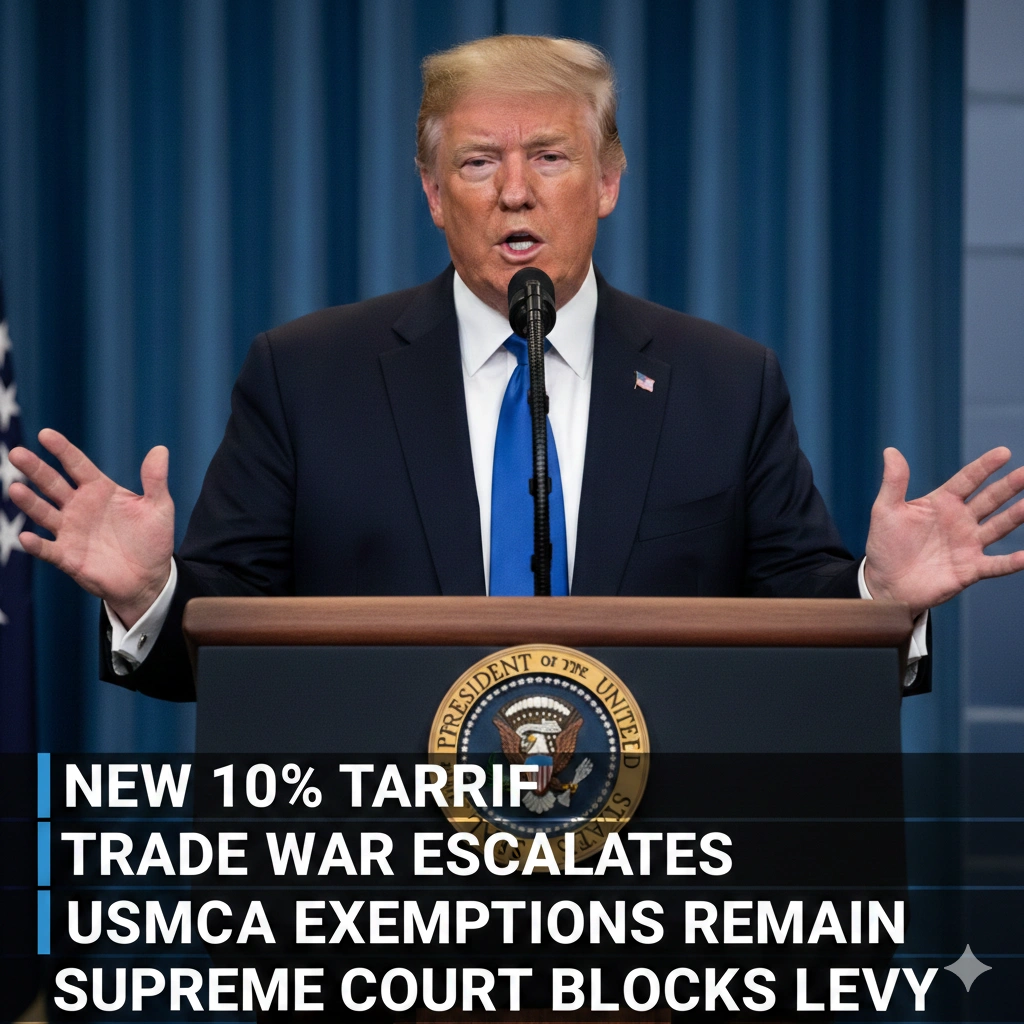
New Ten Percent Global Tariff
The introduction of the new ten percent global tariff comes as a direct response to the Supreme Court ruling that limited the President’s previous tariff powers. Administration officials view this updated levy as a legally resilient mechanism to achieve their trade objectives without violating the court’s latest constitutional boundaries. By setting the rate at a flat ten percent, the White House hopes to avoid the legal pitfalls that plagued their earlier attempts to impose 25% or 35% taxes on specific regions.
Washington has emphasized that this new ten percent global tariff is necessary to address long-standing trade imbalances that have supposedly disadvantaged American workers. The United States Trade Representative, Jamieson Greer, stated that the administration is seeking continuity and stability with this new trade order, despite the obvious disruptions it causes. This narrative seeks to frame the tariff not as a radical departure, but as a necessary correction to the global trade status quo.
International response to the new ten percent global tariff has been swift, with various nations contemplating retaliatory measures or legal challenges at the World Trade Organization. However, the Trump administration remains undeterred, suggesting that the threat of tariffs is their most effective tool for securing better deals for the United States. The geopolitical stakes have never been higher as the world prepares for the official implementation of this sweeping economic mandate.
Supreme Court Ruling Reshapes Trade Power
The recent Supreme Court decision was the primary catalyst for the new ten percent global tariff, as it forced the executive branch to rethink its legislative strategy. The court’s ruling essentially struck down emergency economic measures that the administration had previously used to target Canadian and Mexican imports. This judicial check on presidential power was initially seen as a victory for free trade advocates, but it quickly led to the current, broader tariff proposal.
By pivoting to the new ten percent global tariff, the administration is testing the limits of its remaining statutory authority to regulate foreign commerce. Legal experts are currently debating whether this global approach will withstand the same level of scrutiny that dismantled the more specific, country-based levies. The President’s legal team argues that a general global tariff is a matter of national security and economic stability, which traditionally falls under executive purview.
The judicial battle has created a sense of uncertainty for multinational corporations that rely on predictable trade laws. While the Supreme Court provided a temporary roadblock, the rapid introduction of the new ten percent global tariff shows that the White House has a deep “arsenal of tools” to bypass judicial setbacks. This ongoing struggle between the branches of government will likely define the legal landscape of American trade for the remainder of the President’s term.
USMCA Exemptions and Temporary Relief
In a surprising twist, the White House confirmed that many goods shipped under the USMCA would remain exempt from the new ten percent global tariff. This carve-out is vital for the North American economy, as it allows critical resources like oil and automotive parts to cross borders without the additional ten percent burden. Before this change, non-exempt products from Mexico and Canada were facing daunting taxes of 25% and 35%, respectively.
The exemption for USMCA partners is seen by many as a strategic move to prevent an immediate collapse of the North American supply chain. By sparing these neighbors from the new ten percent global tariff, the administration maintains access to essential inputs for American manufacturing. However, this relief is widely considered temporary, as the President has already hinted at using other trade tools to gain further leverage over Ottawa and Mexico City.
Canadian and Mexican officials have reacted with a mix of relief and caution, knowing that their status could change at any moment. The new ten percent global tariff still looms as a threat for any products not strictly covered by the USMCA’s core protections. This “carrot and stick” approach ensures that while North American trade continues, it does so under the constant shadow of potential executive action and tariff escalation.
Risk of Escalation to Fifteen Percent
Despite the initial ten percent announcement, President Trump has already suggested via social media that the global tariff rate could be raised to 15%. This potential increase serves as a warning to nations that might consider retaliating against the new ten percent global tariff. By signaling a willingness to go higher, the President is maintaining a high-pressure environment for all international trade partners.
An escalation to 15% would significantly increase the inflationary pressure on American consumers, as the cost of imported electronics, clothing, and machinery would rise accordingly. Critics of the new ten percent global tariff argue that such a jump would stifle economic growth and lead to a global trade war. Proponents, however, believe that the threat of a higher rate is the only way to force foreign governments to the negotiating table.
The volatility of the tariff rate makes it difficult for businesses to plan long-term investments or pricing strategies. If the new ten percent global tariff is merely a starting point, the global economy could be facing a period of prolonged instability. This uncertainty is a deliberate part of the administration’s strategy to keep foreign competitors off-balance while they seek to renegotiate existing trade treaties.
Impact on the Automotive and Energy Sectors
The automotive and energy sectors are the most vulnerable to shifts in trade policy, even with the current USMCA exemptions. Because these industries rely on highly integrated cross-border supply chains, any change to the new ten percent global tariff structure could cause massive logistical headaches. A single car often contains parts that have crossed the North American borders multiple times during the manufacturing process.
While oil remains exempt for now, the energy market is closely watching for any signs that the new ten percent global tariff could be applied to refined products or specialized equipment. The administration’s focus on energy independence means that trade policy is often used to favor domestic production over foreign imports. This creates a complex environment for energy companies that operate across the US-Canada and US-Mexico borders.
- Manufacturers may shift production facilities to the US to avoid future tariff risks.
- Supply chain managers are seeking to diversify their sources away from non-exempt nations.
- Consumer prices for new vehicles could rise if the new ten percent global tariff is eventually expanded.
The long-term health of these sectors depends on a stable trade relationship that the new ten percent global tariff currently threatens to upend. Even with exemptions, the fear of future policy changes is enough to drive significant shifts in corporate strategy. The automotive industry, in particular, remains the “canary in the coal mine” for the broader success or failure of the President’s trade initiatives.
Canadian Response to the Trade Order
Canadian officials have been vocal in their opposition to the administration’s aggressive trade tactics, citing the recent Supreme Court ruling as validation of their stance. They argue that the emergency tariffs previously imposed were unjustified and violated the spirit of the USMCA. The news of the new ten percent global tariff has only strengthened their resolve to defend Canadian economic interests through legal and diplomatic channels.
Despite the current exemptions, Canada remains wary of the “large arsenal of tools” that the US administration still possesses. Prime Minister Trudeau’s government is reportedly preparing a list of retaliatory targets should the new ten percent global tariff ever be applied to Canadian exports. The diplomatic relationship between Ottawa and Washington is under significant strain as both sides prepare for a potentially long-drawn-out trade conflict.
- Canada is emphasizing its role as a reliable supplier of critical minerals and energy.
- Legal teams in Ottawa are reviewing the new ten percent global tariff for WTO compliance.
- Domestic pressure is mounting on the Canadian government to stand firm against US demands.
The outcome of this trade dispute will have a profound impact on the Canadian economy, which is heavily reliant on access to the American market. For now, the USMCA exemptions provide a necessary breathing room, but the new ten percent global tariff remains a constant source of anxiety for Canadian businesses. The next few months will be critical in determining whether the two nations can find a path toward stable cooperation.
Mexico’s Diplomatic Mission to Washington
Mexico is taking a proactive approach to the new ten percent global tariff, with Economy Minister Marcelo Ebrard planning a high-level visit to the United States. The goal of this mission is to secure more permanent protections for Mexican exports and to address the underlying tensions that led to the tariff announcement. Mexico is particularly concerned about the automotive sector and the potential for the new ten percent global tariff to disrupt their growing manufacturing base.
Ebrard’s visit comes at a time when Mexico is also dealing with domestic political pressures to respond strongly to American trade threats. The Mexican government has emphasized that the USMCA is a legally binding document that should protect its members from the new ten percent global tariff. However, they also recognize the reality of the President’s “America First” agenda and the need for pragmatic negotiations.
The diplomatic dance between Mexico City and Washington will be a central theme of the 2026 trade landscape. As the new ten percent global tariff takes effect on other nations, Mexico will be fighting to ensure it remains in the exempt category. The success of Ebrard’s mission could determine the future of the tripartite trade deal and the stability of the entire North American region.
Consumer Impact and Inflationary Pressures
One of the biggest concerns regarding the new ten percent global tariff is its impact on the American consumer. Tariffs are essentially taxes paid by domestic importers, who often pass those costs on to shoppers in the form of higher prices. From electronics to everyday household goods, the new ten percent global tariff could lead to a noticeable increase in the cost of living for many American families.
Economists warn that a broad ten percent levy could reignite inflationary pressures that have only recently begun to stabilize. If the tariff is raised to 15%, the impact on consumer purchasing power would be even more severe. The administration argues that these costs are a small price to pay for bringing manufacturing jobs back to the United States and reducing reliance on foreign adversaries.
- Prices for imported consumer electronics are expected to rise by late February.
- Retailers may be forced to reduce their profit margins or raise prices before the spring shopping season.
- Low-income households will likely feel the greatest impact of the new ten percent global tariff.
The political fallout of higher prices will be a major factor in how the new ten percent global tariff is perceived by the public. If the policy leads to significant job growth, the administration may maintain popular support despite the rising costs. However, if inflation becomes a dominant issue, the President may face increased pressure to scale back the new ten percent global tariff or provide more extensive exemptions.
Global Supply Chain Realignment
The new ten percent global tariff is forcing a massive realignment of global supply chains as companies seek to avoid the added costs. Nations that are not exempt from the tariff are seeing a decrease in demand for their exports to the United States. This shift is benefiting countries with more favorable trade terms or those that can offer domestic alternatives to imported goods.
Logistics managers are currently working overtime to reroute shipments and renegotiate contracts in light of the new ten percent global tariff. The uncertainty surrounding which products might be targeted next is making long-term planning nearly impossible for many multinational firms. This environment favors larger companies with the resources to adapt quickly, while smaller businesses may struggle to absorb the tariff costs.
This realignment is exactly what the administration hopes to achieve, as it pressures companies to “near-shore” or “home-shore” their production. By making imports more expensive through the new ten percent global tariff, the government is incentivizing investment in American factories. Whether this strategy will lead to a sustainable manufacturing renaissance or simply a more expensive and less efficient global economy remains to be seen.
The Future of the USMCA and Tripartite Trade
The most significant long-term risk associated with the new ten percent global tariff is the potential dissolution of the USMCA. The President has repeatedly suggested that he is willing to radically alter or even cancel the deal if he feels it no longer serves American interests. The current exemptions are a sign that the deal still holds value, but the threat of the new ten percent global tariff remains a powerful bargaining chip.
Analysts warn that if the administration uses the “large arsenal of tools” at its disposal to target Canada and Mexico, the entire tripartite trade structure could collapse. This would lead to a return to the pre-NAFTA era of high tariffs and limited regional cooperation. The new ten percent global tariff is essentially a shot across the bow for North American trade partners, signaling that the existing rules are no longer guaranteed.
The coming months will be a period of intense negotiation as the three nations try to find a way to preserve their economic ties. The new ten percent global tariff has fundamentally changed the power dynamic in North America, placing the United States in a position of significant leverage. The survival of the USMCA will depend on whether Canada and Mexico can offer enough concessions to satisfy the administration’s “America First” requirements.
Strategic Sovereignty and National Security
The administration has consistently framed the new ten percent global tariff as a matter of strategic sovereignty and national security. By reducing dependence on foreign goods, the United States aims to insulate itself from global supply chain shocks and the geopolitical whims of other nations. The new ten percent global tariff is seen as a tool to ensure that essential items are produced within American borders or by highly trusted partners.
This focus on national security provides a legal and political shield for the new ten percent global tariff, making it harder for critics to dismiss the policy as purely protectionist. The idea is that a nation cannot be truly sovereign if it relies on its rivals for basic necessities or critical technology. This philosophy is a driving force behind many of the administration’s most controversial trade and foreign policy decisions.
As the new ten percent global tariff is implemented, the concept of “trusted trade” will become increasingly important. Nations that align their policies with American interests may find themselves exempt, while those that don’t will face the full weight of the new ten percent global tariff. This approach is reshaping global alliances and turning trade into a primary instrument of national power in the 21st century.
Analyzing the 2026 Trade Outlook
As we look toward the remainder of 2026, the new ten percent global tariff will likely remain the most influential factor in international commerce. Its impact on inflation, employment, and diplomatic relations will be closely monitored by experts and policymakers alike. The success or failure of this bold experiment will determine the trajectory of the American economy for years to come.
If the new ten percent global tariff succeeds in reshoring jobs without causing a major economic downturn, it could become a permanent fixture of US policy. However, if it leads to a global recession or a breakdown in essential alliances, the pressure to reform the system will be immense. For now, the world is bracing for the February 24 deadline and the official start of a new era in global trade.
The new ten percent global tariff is more than just a tax; it is a statement of intent from a White House determined to rewrite the rules of the global economy. Whether you view it as a necessary correction or a dangerous escalation, there is no denying that the new ten percent global tariff has changed the world forever. The “America First” agenda has found its most powerful economic weapon yet, and its effects are only just beginning to be felt.
For more details & sources visit: Bloomberg
Read more on Mexico news: 360 News Orbit – Mexico