
Imran Khan’s prison health crisis has ignited a firestorm across Pakistan as reports emerge of his rapidly deteriorating medical condition. His legal team recently informed the Supreme Court that the former Prime Minister is suffering from significant vision loss in his right eye. This news has acted as a catalyst for widespread civil unrest and political defiance. Supporters of the Pakistan Tehreek-e-Insaf (PTI) have taken to the streets to demand immediate specialist intervention for their leader.
The current situation represents a critical turning point in the ongoing political saga that has gripped the nation since August 2023. While the government maintains that standard protocols are being followed, the opposition claims a deliberate campaign of medical neglect is underway. This friction has led to blocked highways and intense parliamentary sit-ins that threaten to paralyze the national administration. As the world watches, the intersection of human rights and high-stakes politics creates an increasingly volatile environment in Islamabad and beyond.
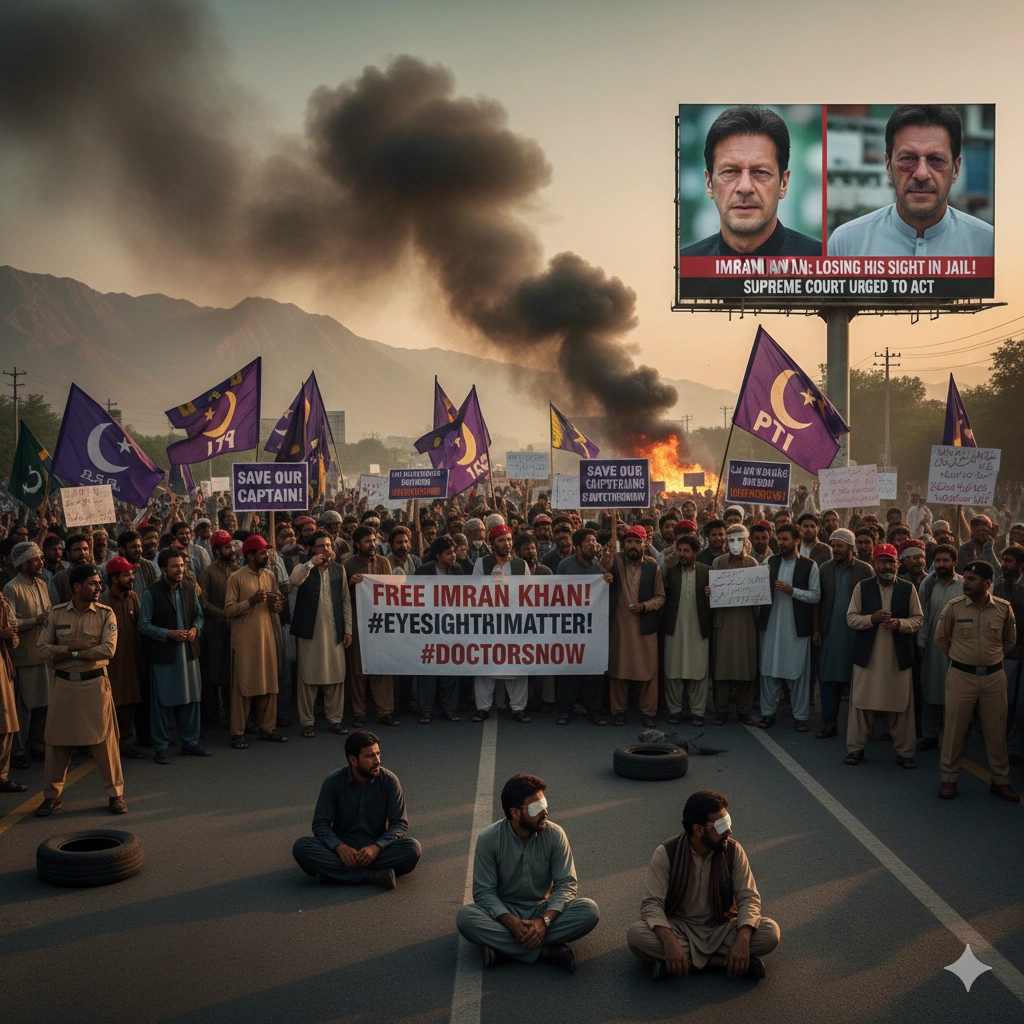
The Medical Reality of Imran Khan’s Prison Health Crisis
Recent medical assessments conducted within the confines of the prison suggest a dire prognosis for the incarcerated former leader. Reports indicate that he is battling central retinal vein occlusion, a serious condition that can lead to permanent blindness if not managed by specialists. The lack of consistent access to his personal physicians has exacerbated fears regarding the long-term viability of his eyesight.
Public concern reached a fever pitch after his lawyers presented evidence of his declining health to the highest judicial authorities in the country. They argued that the specialized equipment required for such a delicate ocular condition is simply not available within the current detention facility. Consequently, the legal battle has shifted from corruption charges to the fundamental right to life and health.
The psychological impact of prolonged isolation has also been cited as a contributing factor to his overall physical decline. Observers note that the combination of restricted movement and limited natural light may be accelerating the degradation of his vision. This has prompted international human rights organizations to call for an independent medical board to evaluate the true nature of Imran Khan’s prison health crisis.
Nationwide Protests Paralyze Major Traffic Arteries
In response to the news, thousands of PTI loyalists have organized massive demonstrations across the Khyber Pakhtunkhwa province and major cities. These protesters have successfully blocked several strategic highways, demanding that the government grant immediate medical bail to their chairman. The scale of the mobilization suggests a deep-seated resentment toward the current administration’s handling of the situation.
Security forces have been deployed in large numbers to clear the roads and restore order, often leading to tense standoffs. In many instances, the protesters refused to budge until they received assurances that the judicial intervention would be respected. This grassroots movement highlights the enduring popularity of the former cricket star despite the ongoing Imran Khan’s prison health crisis.
The economic impact of these blockades is starting to be felt as supply chains for essential goods face significant disruptions. Business leaders have expressed concern that continued instability could further derail the country’s fragile economic recovery. However, the protesters maintain that the survival of their leader is more important than temporary commercial inconveniences or financial losses.
Imran Khan’s Prison Health Crisis
The legal team representing the former Prime Minister has been working tirelessly to secure his release for medical reasons. They have filed multiple petitions asserting that the state is failing in its duty of care toward a high-profile prisoner. These filings detail the specific instances where court orders regarding family visits and medical check-ups were reportedly ignored by prison staff.
According to the legal documents, the refusal to allow private doctors to examine him constitutes a violation of both domestic law and international treaties. The lawyers emphasize that time is of the essence, as every day without proper treatment increases the risk of irreversible damage. This legal strategy aims to put pressure on the judiciary to act as a guardian of fundamental rights during Imran Khan’s prison health crisis.
Furthermore, the defense argues that the charges against him are politically motivated and designed to keep him out of the electoral process. By highlighting the medical urgency, they hope to bypass some of the procedural hurdles that have kept him behind bars for over two years. The court’s decision on this matter will likely have profound implications for the future of Pakistani democracy and judicial independence.
International Reactions and the Role of Global Icons
The global community has not remained silent regarding the reports of medical neglect in a Pakistani prison. Several legendary international cricketers have taken to social media to express their solidarity with their former colleague and contemporary. Their voices have added a unique layer of pressure on the Pakistani government to ensure humane treatment during Imran Khan’s prison health crisis.
Diplomatic circles in Washington and London are also reportedly monitoring the situation with increasing concern for regional stability. While many foreign governments are hesitant to interfere in internal legal matters, the humanitarian aspect of the vision loss is harder to ignore. This external scrutiny makes it difficult for the state to maintain a purely domestic narrative regarding his detention.
Human rights groups have issued statements reminding the Pakistani authorities of the Standard Minimum Rules for the Treatment of Prisoners. They argue that regardless of the nature of the crimes alleged, every detainee is entitled to the highest attainable standard of health. The intersection of global celebrity and human rights advocacy has turned Imran Khan’s prison health crisis into a major international headline.
Parliamentary Sit-ins and Political Alliances
Inside the halls of power, the Tehreek-i-Tahafuz-i-Ayin-i-Pakistan alliance has spearheaded a series of dramatic sit-ins. These lawmakers have successfully disrupted legislative proceedings to bring attention to the health status of their incarcerated leader. Their actions demonstrate a unified front among various opposition factions against the current ruling coalition.
The alliance argues that the government’s “reckless” neglect of the former Prime Minister is a strategic move to silence the opposition. By staging these protests within the parliament, they are forcing the government to address the medical crisis on the record. This tactic has led to heated debates and occasional walkouts, reflecting the deep polarization surrounding Imran Khan’s prison health crisis.
Despite the intensity of the protests, the government remains steadfast in its position that the law must take its course. Ministers have accused the opposition of using health issues as a pretext to avoid legal accountability for corruption. This rhetorical battle shows no signs of slowing down as both sides dig in for a protracted struggle over the narrative of the crisis.
Strategic Points of the PTI Protest Movement
- Supporters have focused on blocking the M-1 and M-2 motorways to disrupt inter-city commerce and travel during the unrest.
- Youth wings of the party are utilizing encrypted social media platforms to coordinate flash protests and avoid police detection.
- Protesters are demanding that a neutral, international medical team be allowed to perform a comprehensive diagnostic scan.
- The opposition is threatening a complete national shutdown if the government does not provide a transparent update on his vision.
The logistical coordination of these protests reveals a sophisticated organizational structure that remains intact despite the arrest of many top leaders. It appears that Imran Khan’s prison health crisis has provided a fresh sense of purpose for a base that had been somewhat demoralized. The determination of the activists suggests that the current wave of unrest is not a fleeting phenomenon.
Judicial Intervention and the Path Forward
The Supreme Court of Pakistan has recently begun to take a more active interest in the conditions of the former Prime Minister’s detention. Following the reports of vision loss, the judiciary has requested detailed records of all medical examinations conducted over the last six months. This move is seen by many as a necessary check on executive power during Imran Khan’s prison health crisis.
Judges have expressed concern that the non-compliance with previous court orders regarding family visits could undermine public trust in the legal system. They have directed the prison authorities to explain why specific medical recommendations were not followed in a timely manner. This judicial scrutiny provides a glimmer of hope for the supporters who believe their leader is being mistreated.
However, the path forward remains fraught with legal and political obstacles that could delay necessary treatment. The state has indicated it will contest any move to move the prisoner to a private hospital, citing security risks and potential escape plots. Balancing the requirements of justice with the urgent needs of health remains a complex challenge for the bench during Imran Khan’s prison health crisis.
Impact of Vision Loss on the Political Future
The possibility of permanent blindness for the former Prime Minister has significant implications for his future political career. A leader who is physically incapacitated may face challenges in leading a vigorous campaign or managing the complex affairs of state. His supporters, however, argue that Imran Khan’s prison health crisis will only cement his status as a martyr for the cause of civilian supremacy.
Internal party discussions are reportedly underway to determine how to manage the transition if he is unable to return to active leadership soon. While he remains the undisputed figurehead of the PTI, the practicalities of a vision-impaired leadership are being quietly considered. This adds a layer of existential urgency to the demands for his immediate release and treatment.
Conversely, some analysts believe that Imran Khan’s prison health crisis could lead to a humanitarian pardon or a “soft exit” from the political scene. If the government perceives him as no longer being a viable political threat due to health, they might be more inclined to show leniency. Yet, given the history of Pakistani politics, a clean break from such a dominant figure seems unlikely.
Summary of the Current Medical and Legal Standoff
- The diagnosis of central retinal vein occlusion requires immediate laser therapy to prevent permanent damage.
- Government medical boards have claimed his condition is stable, contradicting the reports provided by his personal legal counsel.
- The Supreme Court is currently reviewing the legality of his continued isolation and the denial of specialized medical consultations.
The disconnect between official reports and the claims of the defense team has created a massive information vacuum. In this space, rumors and conspiracy theories flourish, further destabilizing the public mood regarding Imran Khan’s prison health crisis. Clarity from an independent source is desperately needed to settle the dispute and ensure that medical ethics are upheld.
Examining the Claims of Reckless Neglect
The PTI leadership has consistently used the term “reckless” to describe the state’s approach to their chairman’s wellbeing. They point to the fact that over 100 charges have been filed against him as evidence of a coordinated effort to keep him incapacitated. In their view, Imran Khan’s prison health crisis is not an unfortunate accident but a calculated outcome of systemic pressure.
Government officials, on the other hand, dismiss these claims as “political theater” designed to win sympathy from the international community. They argue that every prisoner in Pakistan is subject to the same medical protocols and that no special treatment should be afforded. This clash of narratives defines the current political discourse surrounding Imran Khan’s prison health crisis.
The truth likely lies somewhere in the complex machinery of the Pakistani penal system, which has often struggled with high-profile detainees. Historical precedents of other leaders falling ill in prison provide a grim backdrop to the current situation. Regardless of the intent, the objective reality of the vision loss remains a physical fact that requires a physical solution.
Future Implications for Pakistan’s Democratic Stability
The outcome of Imran Khan’s prison health crisis will likely dictate the temperature of Pakistani politics for years to come. If his health continues to fail, the resulting anger could lead to a level of civil unrest that the state might find difficult to contain. The memory of past political leaders who died or suffered in custody looms large in the public consciousness.
For the democratic process to function, there must be a sense that the rules are applied fairly and that the basic humanity of political opponents is respected. The current crisis suggests a breakdown in these norms, which could lead to a more authoritarian approach to governance. Restoring faith in the system will require a transparent resolution to Imran Khan’s prison health crisis.
As the legal battles continue and the protests grow, the fundamental question remains: can the state balance its legal requirements with its humanitarian obligations? The answer to this question will determine whether Pakistan moves toward a path of reconciliation or further into a national crisis. For now, the eyes of the nation are fixed on the prison gates, waiting for news regarding Imran Khan’s prison health crisis.
The Role of Media in Shaping the Health Narrative
In the digital age, the news of the vision crisis has spread with unprecedented speed, often bypassing traditional state-controlled channels. Independent journalists and social media influencers have played a crucial role in documenting the protests and sharing updates from the legal team. This decentralized information flow has made it impossible for the government to fully control the story of Imran Khan’s prison health crisis.
However, the proliferation of unverified information also poses a risk of escalating tensions unnecessarily. Both supporters and detractors often cherry-pick facts to support their pre-existing biases, leading to a highly fractured public understanding. Professional journalism that prioritizes medical facts over political rhetoric is more necessary than ever during Imran Khan’s prison health crisis.
The international media’s focus on the story has also put a spotlight on the broader human rights situation in the country. Reports by major outlets have ensured that Imran Khan’s prison health crisis remains a global concern. This external pressure is often the only effective check on the actions of the state in high-stakes political cases.
Conclusion of the February 2026 Protest Wave
As of February 21, 2026, the protests show no signs of abating as more sectors of society join the call for medical justice. Students, lawyers, and civil society activists have begun to align with the PTI supporters, creating a broader coalition of dissent. The government is facing a difficult choice between maintaining its hardline stance and making concessions regarding Imran Khan’s prison health crisis.
The image of a former national hero losing his sight in a prison cell is a powerful symbol that resonates far beyond his political base. It touches on themes of justice, mortality, and the abuse of power that are universal in their appeal. How the state chooses to handle the next 48 hours will be critical in determining the trajectory of Imran Khan’s prison health crisis.
Ultimately, the resolution of this standoff will require more than just a medical intervention; it will require a political one. Until there is a dialogue that acknowledges the legitimacy of the medical concerns, the streets of Pakistan are likely to remain a battleground. The legacy of Imran Khan’s prison health crisis will be written in the actions taken by the judiciary and the government today.
For more details & sources visit: Nikkei Asia
For the latest updates from Pakistan, visit our Pakistan news page.