
India National Security Strategy is a critical requirement for 2026 as the South Asian geopolitical landscape undergoes a massive and dangerous transformation. While the nation has historically relied on ad-hoc responses to regional crises, the current state of collapse in neighboring states like Pakistan and the rise of radicalism in Bangladesh demand a more structured approach.
The absence of a formal document leaves India in a reactive posture, often catching the military and diplomatic corps off guard when external shocks occur. Critics argue that without a defined set of interests, the country risks legitimizing hostile actors who seek to destabilize the subcontinent’s fragile peace. This is why many defense analysts believe that the implementation of a comprehensive India National Security Strategy is the only way to safeguard long-term interests.
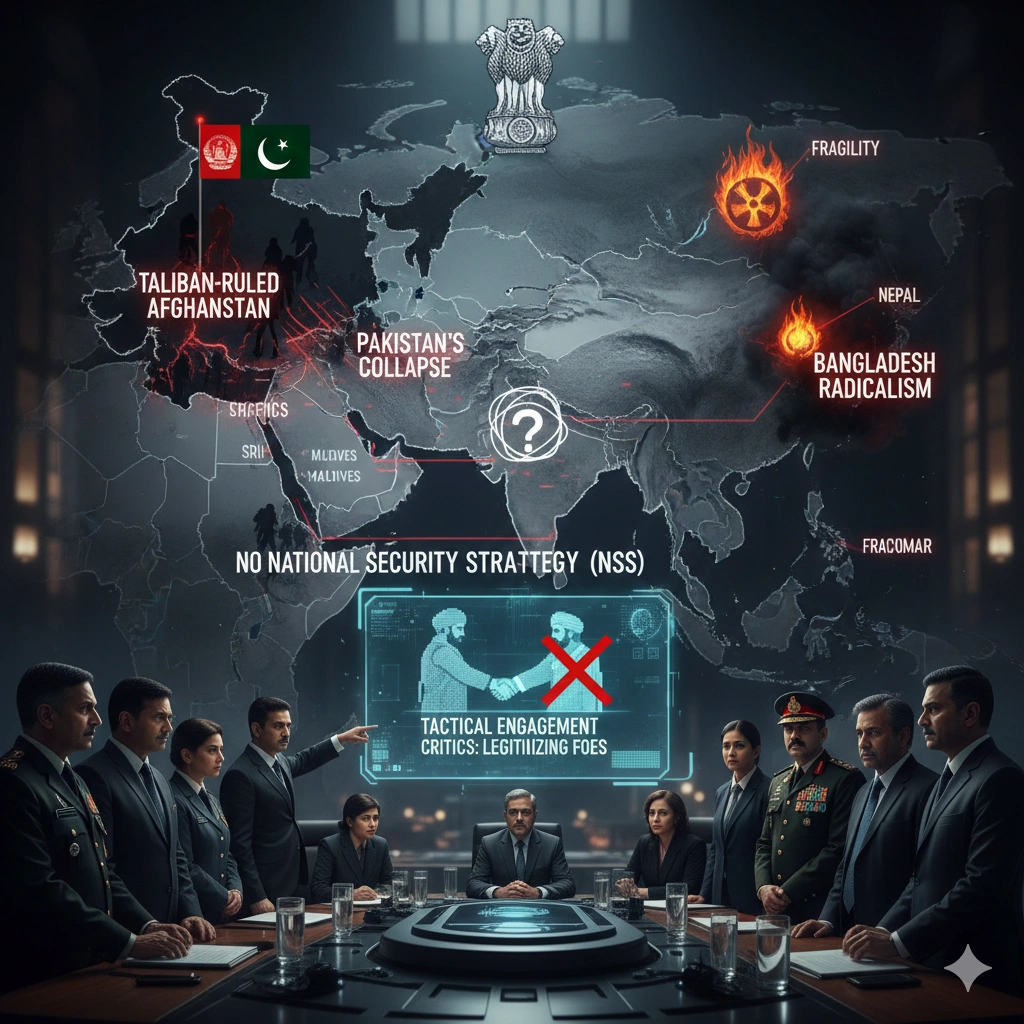
India National Security Strategy
The urgent adoption of an India National Security Strategy has become the focal point of defense debates following the recent spillover of militancy from Afghanistan. Since the 2021 handover, the region has seen a resurgence of groups that directly target Indian infrastructure and personnel both at home and abroad. A formal strategy would integrate military power, economic statecraft, and diplomatic outreach into a singular, cohesive framework for the first time in the republic’s history. By outlining clear red lines and response protocols, New Delhi can signal its resolve to both allies and adversaries, reducing the risk of miscalculation. The current reliance on the National Security Council’s 2018 mandate is no longer sufficient to address the multi-domain threats of 2026.
Addressing the Collapse of Pakistan
The ongoing economic and political freefall in Pakistan represents one of the most significant external threats to Indian stability today. As the central authority in Islamabad weakens, the risk of non-state actors gaining access to strategic assets or increasing cross-border infiltration rises exponentially. An India National Security Strategy would provide a roadmap for managing a fractured neighbor, focusing on border hardening and intelligence gathering. This proactive planning is essential to prevent a repeat of the 1989-style militancy surge that previously fueled decades of unrest in the Kashmir valley. Without a clear doctrine, India remains vulnerable to the unpredictable whims of a failing state that remains nuclear-armed.
Countering Radicalism in Bangladesh
The rise of groups like Jamaat-e-Islami and Hizbut-Tahrir in Bangladesh has created a new security headache for India’s eastern flank. These organizations, often linked to external intelligence agencies, have increasingly targeted minority communities and sought to undermine the secular fabric of the region. An India National Security Strategy would prioritize the protection of the “Chicken’s Neck” corridor and enhance cooperation with secular elements in Dhaka. Security agencies need a mandate that goes beyond simple border policing to include counter-radicalization and cyber surveillance of extremist networks. The economic instability in Bangladesh further complicates the situation, as it provides fertile ground for recruitment by anti-India forces.
The Taliban Challenge and Tactical Shifts
India’s recent tactical engagement with the Taliban, including high-level visits, has sparked a fierce debate among the strategic community in New Delhi. While some view these moves as necessary realism, others fear they legitimize a regime that remains deeply connected to hostile regional players. An India National Security Strategy would define the exact parameters of engagement with de facto regimes to ensure that national interests are not compromised for short-term gains. It would also outline the conditions under which India would provide humanitarian aid or economic assistance to the Afghan people. Having a transparent strategy prevents the perception of ad-hocism and ensures that all branches of government are aligned in their approach.
Maritime Security and the Indian Ocean
The Indian Ocean Region (IOR) is seeing unprecedented great-power rivalry as various nations compete for control over vital sea lanes. From the Maldives to Sri Lanka, the presence of foreign naval assets and “debt-trap” infrastructure projects poses a direct challenge to India’s maritime primacy. An India National Security Strategy would articulate a “Security and Growth for All in the Region” (SAGAR) policy with more teeth and clarity. This includes the expansion of naval bases, increased underwater domain awareness, and deeper maritime partnerships with like-minded democracies. Protecting trade-critical regions is not just a military task but an economic necessity for a country aiming for a multi-trillion-dollar GDP.
Cyber Warfare and Space Defense
Modern warfare has moved beyond traditional borders into the realms of cyberspace and outer space, where India faces sophisticated state-sponsored actors. The frequent targeting of power grids, financial systems, and satellite communications requires a defense-in-depth strategy that only a formal document can provide. An India National Security Strategy would mandate the creation of integrated commands that can respond to “grey-zone” tactics in real-time. This involves closer collaboration between the private tech sector and the Ministry of Defence to build resilient digital infrastructure. As the world moves toward 6G and AI-driven warfare, the lack of a formal space and cyber doctrine is a glaring hole in the national defense posture.
Integrating Economic and Military Power
True national security is built on a foundation of economic strength, which allows for the sustained modernization of the armed forces. An India National Security Strategy would link industrial policy with defense requirements, promoting “Atmanirbhar Bharat” in critical military hardware. This ensures that the country is not dependent on foreign suppliers during times of high-intensity conflict or global supply chain disruptions. Furthermore, the strategy would outline how economic tools, such as trade agreements and sanctions, can be used as leverage in diplomatic negotiations. A holistic view of power allows the nation to project influence far beyond its immediate geographical borders.
Theaterization and Military Reform
The transition to integrated theater commands is a long-awaited reform that is essential for modern battlefield management. An India National Security Strategy would provide the necessary political and legal framework to accelerate this process across the Army, Navy, and Air Force. This structural change would eliminate redundancies and ensure that all three services are operating under a single operational plan during a crisis. Special forces units also need to be reorganized to focus on strategic missions rather than just local counterinsurgency operations. The move toward theaterization is a key component of being a “smart power” in an era of rapid technological change.
- Establishment of the Chief of Defence Staff (CDS) was the first step toward this integration.
- New theater commands would focus on specific fronts: Northern, Western, and Maritime.
- Cross-service training programs are being scaled up to improve interoperability.
- Budgetary allocations are being shifted toward high-tech surveillance and long-range precision strike capabilities.
Human Security and Internal Stability
Security is not just about defending borders but also about ensuring the internal stability and well-being of the population. Issues like climate change, pandemics, and internal migration have become “non-traditional” security threats that can destabilize the nation from within. An India National Security Strategy would address these challenges by integrating health security and disaster management into the broader defense framework. This ensures that the state can respond effectively to large-scale emergencies without diverting critical military resources. Strengthening the social fabric and reducing regional disparities also makes the country less vulnerable to foreign-funded internal subversion.
Managing Relations with Myanmar and Nepal
The instability in Myanmar and the political fragility in Nepal represent unique challenges that require a delicate balance of “soft” and “hard” power. In Myanmar, the ongoing civil war has led to a surge in refugees and the potential for insurgent groups to find safe havens across the border. An India National Security Strategy would provide a clear policy on border management and engagement with ethnic armed organizations. Similarly, in Nepal, the strategy would focus on maintaining traditional ties while countering the growing influence of rival powers in the Himalayas. Consistent policy in these “buffer states” is essential for maintaining the integrity of India’s land borders.
The Role of Intelligence Agencies
A robust intelligence network is the eyes and ears of any national security apparatus, and its coordination is vital for preemptive action. An India National Security Strategy would streamline the sharing of information between R&AW, IB, and military intelligence to prevent “siloed” thinking. This involves creating a unified intelligence dashboard that provides a real-time common operating picture for decision-makers. The strategy would also emphasize the need for advanced signals intelligence and satellite reconnaissance to monitor troop movements across the LAC and LoC. Investment in human intelligence (HUMINT) remains a priority, especially in the volatile regions of the Af-Pak border.
Space as a Strategic Frontier
As India’s space program achieves new milestones, the protection of its orbital assets becomes a matter of national survival. The potential for anti-satellite (ASAT) weapons and electronic jamming in space means that the country must develop both defensive and offensive capabilities. An India National Security Strategy would define space as a critical warfighting domain, alongside land, sea, and air. This includes the development of “space situational awareness” to track every piece of debris or hostile craft that could threaten Indian satellites. International collaboration on space norms is also necessary to prevent a chaotic arms race in the cosmos.
- The Defence Space Agency (DSA) is currently being upgraded to a full command structure.
- Joint exercises with partners like the US and France focus on satellite protection.
- Private startups are being incentivized to develop low-cost, rapidly deployable small satellites.
- Indigenous GPS (NavIC) is being integrated into all military and civilian navigation systems.
Diplomatic Reach and Global Alliances
In a multipolar world, the ability to forge strategic partnerships is as important as the number of tanks or aircraft a nation possesses. An India National Security Strategy would outline the criteria for entering into “quadrilateral” or other plurilateral security arrangements. It would balance the need for strategic autonomy with the benefits of sharing technology and intelligence with major world powers. India’s role as a “Vishwa Mitra” (friend to the world) can be leveraged to build a coalition of states that support a rules-based international order. This diplomatic agility is a force multiplier that allows the nation to punch above its weight in global forums.
The Importance of a War Doctrine
A National Security Strategy is the “what” and “why,” but a National War Doctrine is the “how” of national defense. Once the NSS is established, the military must follow with a doctrine that guides how it will fight and win future conflicts. This includes everything from nuclear deterrence theory to the use of swarming drones in urban combat environments. An India National Security Strategy provides the political guidance that the military needs to draft these operational manuals. Without this top-down direction, the different branches of the military might prepare for different types of wars, leading to chaos on the battlefield.
Strengthening the National Security Council
The National Security Council (NSC) needs to be more than just a consultative body; it must have the power to enforce its recommendations across various ministries. An India National Security Strategy would empower the National Security Advisor (NSA) to oversee the implementation of the strategy through a formal monitoring mechanism. This ensures that the goals set out in the document are translated into actual budget line items and operational shifts. Regular audits of the strategy would allow for mid-course corrections as the regional and global environment evolves. A more professionalized and permanent secretariat for the NSC is a prerequisite for this success.
Financial Sustainability of Defense
The modernization of the armed forces requires a massive financial commitment that must be sustained over decades, not just through individual budget cycles. An India National Security Strategy would suggest a multi-year funding model that protects critical defense projects from short-term fiscal fluctuations. This allows the defense industry to plan long-term investments in research and manufacturing with the certainty of government orders. The strategy would also explore innovative funding mechanisms, such as defense bonds or public-private partnerships, to bridge the funding gap. Financial security is the fuel that keeps the engine of national defense running smoothly.
- Defense exports have reached an all-time high, helping offset the cost of domestic procurement.
- The “Positive Indigenization Lists” have forced local manufacturers to improve quality and scale.
- Simplification of the Defense Acquisition Procedure (DAP) has reduced the time for contract awards.
- Special focus is being given to the manufacturing of aero-engines and high-end semiconductors.
Conclusion and the Path Forward
The year 2026 marks a turning point where India can no longer afford the luxury of strategic ambiguity in a neighborhood on fire. An India National Security Strategy is not just a document for the archives but a living roadmap for the nation’s survival and growth. By defining its threats and integrating its various elements of power, the country can transform from a reactive regional player into a proactive global leader. The shift from tactical responses to strategic planning will be the hallmark of a “New India” that is confident in its ability to shape its own destiny. The time for deliberation has passed; the time for a cohesive national strategy is now.
For more details & sources visit: Fair Observer
For the latest updates from India, visit our India news page.