
The Atlantic Council US-Guatemala Trade event marks a pivotal moment in Central American commerce following the transformative January 2026 trade agreement. As both nations move to solidify their economic alliance, this hybrid gathering on February 24 aims to bridge the gap between policy and private sector execution. The session serves as a roadmap for U.S. firms looking to capitalize on streamlined export processes and infrastructure projects fueled by recent legislative updates in Guatemala.
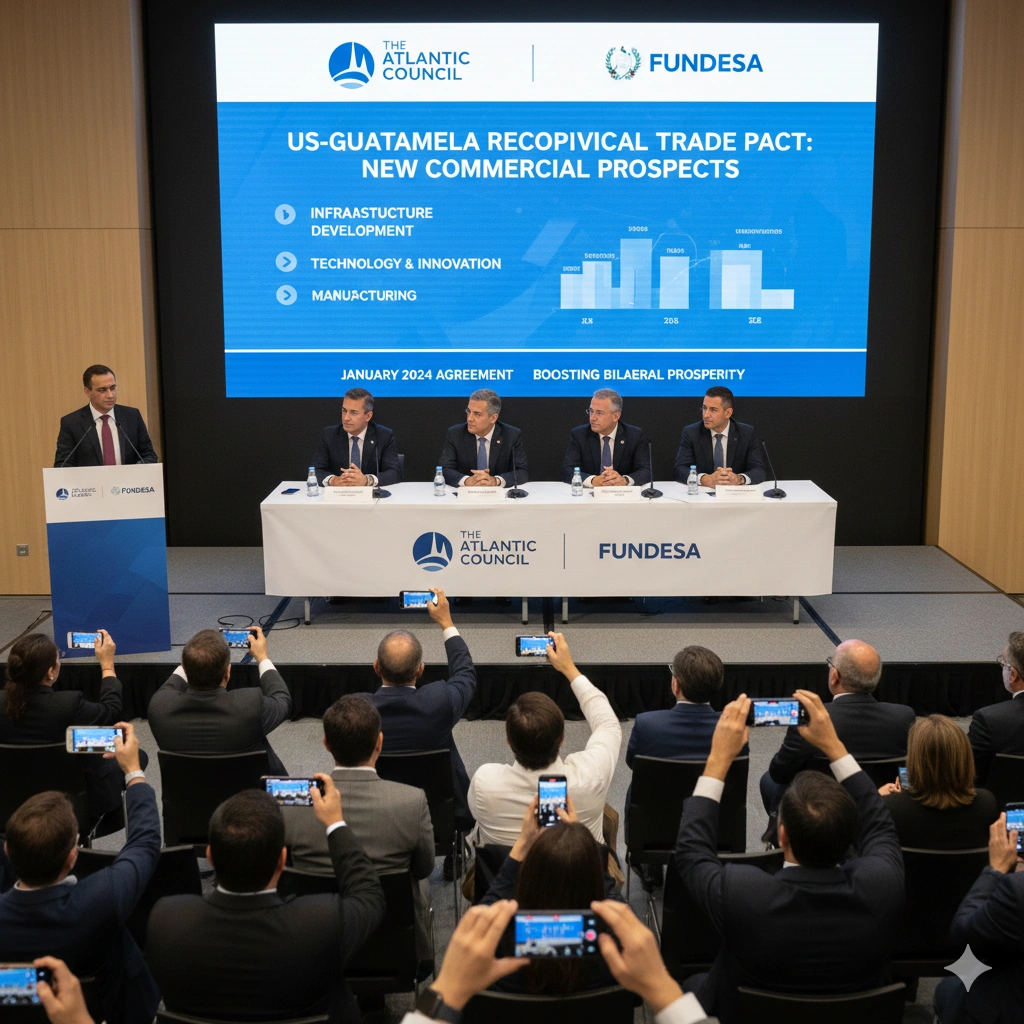
The collaboration between the Atlantic Council’s Adrienne Arsht Latin America Center and Guatemala’s Fundesa highlights a shared vision of regional prosperity. By focusing on “nearshoring” and supply chain resilience, the event positions Guatemala as a strategic hub for U.S. manufacturing and logistics. This focus is particularly timely as both governments seek to leverage the $12.3 billion in trade recorded in 2024 into a more robust, long-term economic partnership.
At the heart of the discussion is the implementation of new Public-Private Partnership (PPP) laws designed to remove historical bottlenecks in infrastructure development. These legal reforms are expected to unlock billions in potential investment for roads, ports, and energy grids. The Atlantic Council US-Guatemala Trade event will provide the necessary technical clarity for investors navigating this new regulatory environment while reinforcing the geopolitical importance of the U.S.-Guatemala corridor.
Atlantic Council US-Guatemala Trade
The Atlantic Council US-Guatemala Trade initiative is designed to maximize the impact of the Reciprocal Trade Agreement signed on January 30, 2026. This landmark pact, only the second of its kind in the Western Hemisphere, addresses long-standing non-tariff barriers that have historically hindered U.S. exporters. By aligning technical standards and regulatory approvals, the agreement creates a “fast track” for American goods entering the Guatemalan market.
One of the most significant breakthroughs in the Atlantic Council US-Guatemala Trade framework is the automatic recognition of U.S. safety and quality standards. For the first time, U.S.-made vehicles, pharmaceuticals, and medical devices can be sold in Guatemala without undergoing redundant local testing. This alignment not only reduces costs for businesses but also ensures that Guatemalan consumers have faster access to world-class technology and healthcare products.
Furthermore, the Atlantic Council US-Guatemala Trade discussions will delve into the removal of reciprocal tariffs on key industrial and agricultural sectors. The U.S. has committed to zero-tariff treatment for Guatemalan textiles and apparel that meet CAFTA-DR origin rules, while Guatemala is streamlining access for U.S. farmers. This reciprocal approach is intended to create a more balanced and sustainable trade relationship that benefits workers in both nations.
Infrastructure and PPP Law Updates
Guatemala’s recent overhaul of its Law on Partnerships for the Development of Economic Infrastructure (Decree 21-2025) is a cornerstone of the new trade strategy. This reform significantly streamlines the approval process for public-private partnerships by removing the requirement for Congressional approval for projects that do not involve public debt. Such a change is expected to drastically reduce the “time-to-market” for critical infrastructure projects across the country.
The new legislation also allows for “unsolicited proposals,” permitting private firms to pitch innovative projects directly to the government. This opens the door for U.S. engineering and construction firms to lead the development of high-tech logistics hubs and renewable energy plants. During the February 24 session, legal experts will explain how these updates create a more transparent and predictable environment for international capital.
Key infrastructure priorities identified by the Ministry of Economy include:
- Modernization of Puerto Quetzal and Santo Tomás de Castilla.
- Expansion of the national highway network to improve connectivity with Mexico and El Salvador.
- Development of a multimodal rail system connecting industrial zones to major ports.
- Upgrades to the national electrical grid to support increased manufacturing capacity.
Resilient Supply Chains and Nearshoring
As global trade patterns shift, the concept of “nearshoring” has become central to the Atlantic Council US-Guatemala Trade dialogue. Guatemala’s proximity to the United States offers a significant logistical advantage, allowing for shorter lead times and reduced carbon footprints compared to Asian manufacturing hubs. The January 2026 agreement specifically targets supply chain security to ensure that critical components remain within the Western Hemisphere.
To support this transition, Guatemala has committed to robust environmental and labor standards, ensuring that its growth does not come at the expense of social or ecological health. By prohibiting the import of goods produced through forced labor and strengthening forest governance, Guatemala is positioning itself as a “clean” and ethical alternative for U.S. brands. This alignment on values is a key selling point for ESG-conscious investors.
Moreover, the agreement includes a permanent moratorium on customs duties for electronic transmissions, fostering a thriving digital trade ecosystem. U.S. software and service providers can now operate in Guatemala without the threat of discriminatory digital taxes. This digital infrastructure is the backbone of modern supply chains, enabling real-time tracking and seamless cross-border financial transactions.
Agricultural Prospects and Market Access
Agriculture remains a vital component of the bilateral relationship, with the Atlantic Council US-Guatemala Trade event highlighting new protections for U.S. food products. A major win for U.S. exporters is Guatemala’s commitment to not restrict market access based on common meat and cheese terms. This ensures that American producers of “parmesan” or “salami” can continue to compete fairly in the Guatemalan market.
On the reciprocal side, Guatemalan exporters of traditional products like coffee, bananas, and ornamental plants will see reinforced zero-tariff benefits. The agreement aims to modernize the agricultural supply chain by implementing science-based regulatory frameworks. This move reduces the likelihood of arbitrary sanitary or phytosanitary barriers that have previously disrupted the flow of perishable goods.
The focus on agriculture extends to technology transfer, where U.S. firms are encouraged to invest in Guatemalan ag-tech. By introducing advanced irrigation systems and sustainable farming techniques, the partnership seeks to boost productivity and resilience against climate change. This holistic approach ensures that the benefits of the trade pact reach the rural communities that form the heart of Guatemala’s economy.
Strategic Economic and National Security
The January 2026 trade pact is not merely about commerce; it is a strategic tool for regional security. By strengthening economic ties, the U.S. and Guatemala are working to address the root causes of migration and combat the influence of non-market actors in the region. The Atlantic Council US-Guatemala Trade event will feature discussions on how private sector investment can serve as a stabilizer for the entire Northern Triangle.
A key provision of the new agreement is the alignment on investment security and export controls. Both nations have agreed to cooperate on screening foreign investments that could pose a risk to national security. This defensive measure is paired with offensive strategies to promote innovation in critical sectors like semiconductors and advanced telecommunications.
Guatemala has also committed to aligning its central-government procurement processes with those of the U.S., favoring partners within the free trade network. This shift discourages “predatory lending” and “debt traps” by ensuring that public projects are awarded through transparent, competitive bidding. These measures protect Guatemala’s sovereignty while providing a level playing field for American companies.
Atlantic Council Event Logistics and Registration
The “Unlocking New Opportunities” session on February 24 is a must-attend for executives, policymakers, and analysts focused on Latin American markets. Hosted at the Atlantic Council’s headquarters in Washington, D.C., the event features a hybrid format to accommodate a global audience. For those attending in person, strict security protocols, including pre-registration and valid government ID checks, will be in effect.
The agenda includes:
- Opening remarks on the January 2026 Trade Pact.
- Panel discussion: Navigating Guatemala’s new PPP laws.
- Sector spotlight: Opportunities in medical devices and automotive parts.
- Q&A session with U.S. and Guatemalan trade officials.
By bringing together high-level stakeholders, the Atlantic Council US-Guatemala Trade event serves as the premier forum for understanding the future of the bilateral relationship. Participants will gain firsthand insights into the implementation timeline of the trade agreement and the specific incentives available for early movers in the Guatemalan market. This session is the first of many planned for 2026 to ensure the trade pact’s success.
For more details & sources visit: Atlantic Council
Read more on global developments: 360 News Orbit – Extended Orbit