
The strategic landscape of Southeast Asian innovation is shifting as Tehran intensifies its diplomatic and scientific outreach toward Jakarta. The Iran-Indonesia technology cooperation represents a significant move by the Islamic Republic to bypass traditional Western-aligned trade routes and establish a robust footprint in one of the world’s fastest-growing economies. Iranian Ambassador Mohammad Boroujerdi has formally extended an invitation for a deep-rooted partnership, emphasizing that Iran’s decades-long experience under international sanctions has forced it to develop a self-reliant and highly sophisticated technological ecosystem.
This burgeoning relationship is not merely about the exchange of goods but focuses heavily on the transfer of “know-how” and the localization of production. By offering technology transfer deals and joint factories, Iran aims to integrate its advanced knowledge-based firms directly into the Indonesian industrial sector. The focus spans critical sectors including nanotechnology, biotechnology, and agricultural drones, reflecting a shared vision for food and energy security. As both nations look toward frameworks like BRICS to diversify their global alliances, this cooperation marks a turning point in South-South relations.
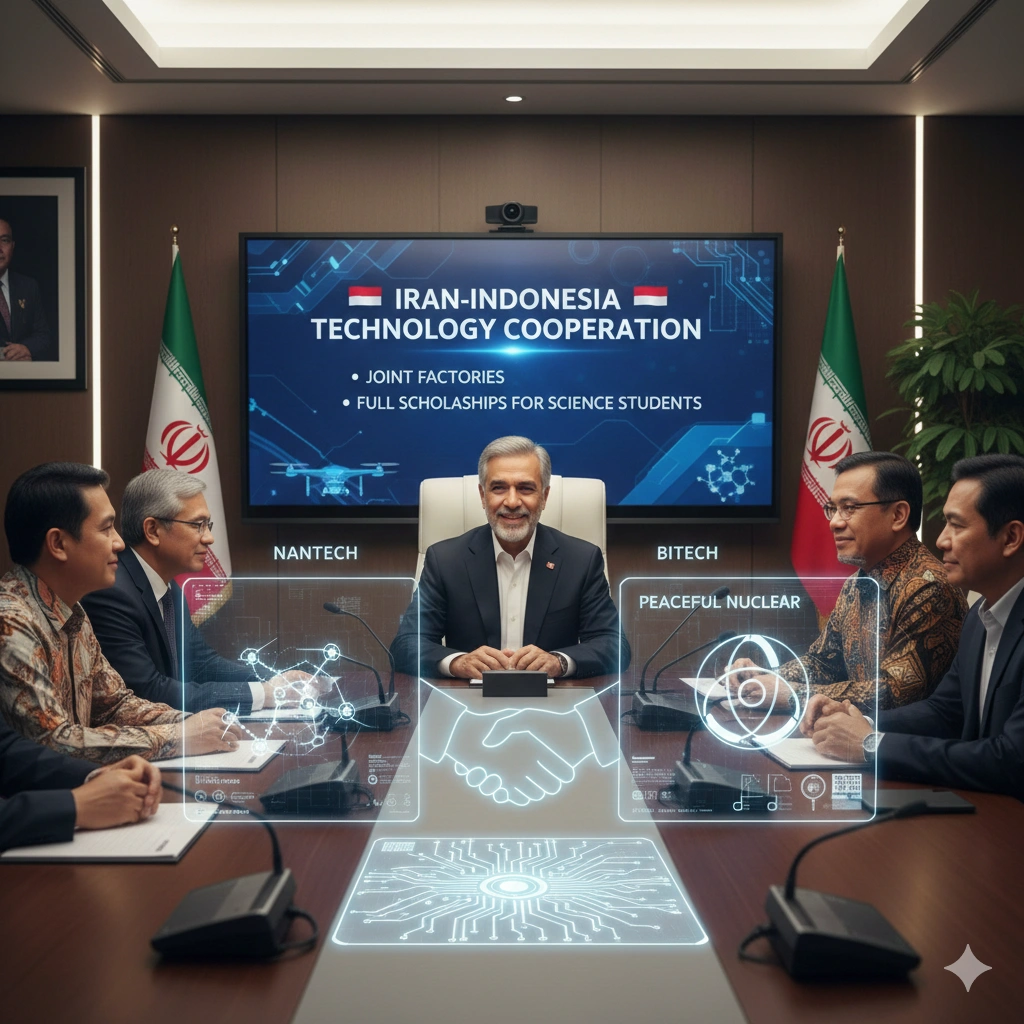
Bridging the Gap in Nanotechnology and Biotech
The core of the Iran-Indonesia technology cooperation lies in the high-tech fields where Iran has achieved global recognition despite external pressures. Iranian nanotechnology products are currently exported to over 40 countries, and the Ambassador has expressed readiness to share this expertise with Jakarta. In the biotechnology sector, the focus is on the production of essential vaccines and advanced medical equipment. This collaboration is particularly timely as Indonesia continues to modernize its healthcare infrastructure and seeks to reduce its reliance on expensive Western imports.
Joint research initiatives are already being discussed between Iranian “knowledge-based” firms and Indonesian state institutions. These discussions often take place at the Iran House of Innovation and Technology (iHiT) in Jakarta, a dedicated hub designed to facilitate business-to-business networking. By establishing a physical presence in the Indonesian capital, Iran has created a permanent gateway for its scientists and entrepreneurs to interact with their Indonesian counterparts. This proximity allows for a more fluid exchange of ideas and a faster transition from conceptual research to commercial application.
- Nanotech applications in water purification and construction materials.
- Biotech ventures focusing on affordable pharmaceutical production.
- Collaborative clinical trials for new medical devices and diagnostic tools.
- Strategic workshops at the iHiT center to align technical standards.
Iran-Indonesia technology cooperation
The most ambitious aspect of the current diplomatic push is the proposal for the construction of joint manufacturing facilities on Indonesian soil. Unlike traditional trade agreements where products are simply imported, the Iran-Indonesia technology cooperation model emphasizes “localized production.” This means Iranian companies are prepared to build factories in Indonesia, employing local workers and utilizing local raw materials while providing the advanced machinery and technical blueprints. This approach directly aligns with Indonesia’s “Vision 2045” goal of becoming a global industrial powerhouse.
These joint factories are expected to focus on high-demand sectors such as agricultural machinery and healthcare hardware. For instance, the use of drones in agriculture—a sector where Iran has developed significant domestic expertise—is a priority for Indonesia’s food security goals. By manufacturing these drones locally, Indonesia can tailor the technology to its unique archipelago geography while benefiting from Iranian engineering. This level of cooperation demonstrates a high degree of trust between Jakarta and Tehran, as it involves the sharing of sensitive industrial intellectual property.
Ambassador Boroujerdi has highlighted that the Iranian Embassy is actively working to remove any bureaucratic hurdles for Indonesian firms interested in these ventures. Through a series of webinars and reciprocal trade missions, the two countries are identifying specific industrial zones where these joint factories could be established. The end goal is to create a sustainable industrial ecosystem that benefits both the Iranian economy through royalties and exports, and the Indonesian economy through job creation and technological advancement.
Peacefully Navigating the Nuclear and Drone Sectors
A key highlight of the Iran-Indonesia technology cooperation is the focus on peaceful nuclear applications and drone technology. While drones are often associated with military use, the Iranian proposal focuses specifically on their utility in agriculture, environmental monitoring, and disaster management. Iran’s drones have been refined to operate in diverse climates, making them ideal for Indonesia’s tropical and often rugged terrain. This technology transfer would allow Indonesian farmers to monitor crop health and optimize irrigation with unprecedented precision.
In the realm of nuclear technology, the cooperation is strictly centered on peaceful applications such as medicine and energy. Iran has developed significant capabilities in the production of radiopharmaceuticals used in cancer treatment, an area where Indonesia is looking to expand its domestic capacity. The proposal includes training programs for Indonesian nuclear scientists and the potential for joint development of small-scale research reactors. These initiatives are framed within the context of scientific progress and the enhancement of public health services in Southeast Asia.
- Drone technology for precision spraying and soil analysis in remote areas.
- Radiopharmaceutical production to boost Indonesia’s oncology departments.
- Joint safety workshops and regulatory alignment for nuclear medicine.
- Development of sensors and imaging tech for environmental surveillance.
Empowering Indonesian Students via Full Scholarships
To ensure the longevity of the Iran-Indonesia technology cooperation, Tehran has launched an aggressive educational campaign. The offer of full scholarships for Indonesian students to study at top-tier Iranian universities is a strategic move to build a “technological bridge” between the two nations. These scholarships are not limited to classroom learning but include internships at Iranian factories and research labs. This hands-on experience ensures that Indonesian graduates return home with practical skills that are directly applicable to the joint ventures currently being planned.
The Indonesian government has been formally briefed on these programs, which target high-achieving students in fields like aerospace engineering, chemistry, and artificial intelligence. By integrating Indonesian talent into the Iranian innovation ecosystem, Tehran is creating a cadre of professionals who can act as intermediaries for future projects. This educational exchange also fosters cultural understanding, which is essential for the success of long-term bilateral agreements. The ambassador emphasized that human capital is the most valuable resource in the modern digital economy.
Leveraging BRICS and Trade Agreements for Growth
The geopolitical context of the Iran-Indonesia technology cooperation is shaped by both nations’ interest in a more multipolar world order. Iran’s membership in BRICS and Indonesia’s potential path toward joining the bloc provide a multilateral framework for their bilateral goals. By trading in local currencies and utilizing alternative financial messaging systems, both countries hope to insulate their technological partnership from the volatility of Western sanctions. The existing preferential trade agreement (PTA) between Jakarta and Tehran serves as the legal foundation for this increased economic activity.
This alignment is particularly important as Indonesia seeks to diversify its sources of high technology beyond its traditional partners. The Iranian offer presents an alternative that is often more cost-effective and comes with fewer political strings attached regarding technology transfer. For Iran, Indonesia represents a massive market of over 280 million people and a gateway to the wider ASEAN region. The synergy between Iran’s technical depth and Indonesia’s market scale and geographical importance creates a powerful economic incentive for both sides to deepen their ties.
- Utilizing the PTA to reduce tariffs on high-tech machinery and components.
- Exploring local currency settlement systems for joint venture investments.
- Aligning scientific standards within the D-8 organization framework.
- Participating in joint technology exhibitions to attract private sector interest.
Strengthening Food and Energy Security Together
At the heart of the Iran-Indonesia technology cooperation is a commitment to addressing the fundamental needs of their respective populations. Food security is a top priority for Jakarta, and Iranian agricultural technology—ranging from soil enrichment nanotech to automated irrigation systems—offers concrete solutions. Similarly, in the energy sector, Iran’s expertise in oil and gas infrastructure, combined with new research into renewable energy, provides Indonesia with multiple avenues for collaboration. Both nations recognize that technological self-reliance is the only way to ensure long-term stability.
The ambassador pointed out that the “sanction-tested” nature of Iranian technology makes it particularly resilient. This durability is highly valued in the developing world, where infrastructure must often perform under challenging conditions. By sharing these “battle-hardened” innovations, Iran is positioning itself as a reliable partner that understands the specific challenges faced by emerging economies. The cooperation extends to the digital economy as well, with joint projects in cybersecurity and fiber-optic networking being discussed to protect national data and improve rural connectivity.
- Joint ventures in the production of bio-fertilizers and pest-resistant seeds.
- Cooperation in refinery modernization and petrochemical technology.
- Development of localized cybersecurity protocols for critical infrastructure.
- Expansion of telecommunications reach through Iranian satellite expertise.
Challenges and Regional Pressure on Partnerships
Despite the optimistic outlook for the Iran-Indonesia technology cooperation, the ambassador acknowledged that regional pressures and foreign “threats” remain a factor. Some global powers are wary of Iran expanding its influence in Southeast Asia, particularly in sensitive sectors like drones and nuclear energy. However, Boroujerdi stressed that Indonesia is a sovereign nation that prioritizes its own national interests and innovation goals. The commitment to this partnership is seen as a test of Jakarta’s independent and active foreign policy.
To mitigate these pressures, both countries are focusing on the “peaceful” and “civilian” nature of their technological exchange. By maintaining transparency and adhering to international guidelines, they aim to demonstrate that their cooperation is a force for regional development rather than a security concern. The focus remains on “knowledge-based” diplomacy, where the success of the partnership is measured by the number of students trained, factories built, and technological problems solved. This approach seeks to normalize Iran’s role as a global technology provider.
- Navigating international banking restrictions through specialized trade channels.
- Ensuring compliance with global non-proliferation and safety standards.
- Maintaining a clear distinction between civilian and military tech applications.
- Strengthening diplomatic dialogue to preemptively address regional concerns.
Future Outlook for the Tehran-Jakarta Tech Axis
The future of the Iran-Indonesia technology cooperation looks increasingly integrated as both nations move from dialogue to implementation. The success of the iHiT in Jakarta has proven that there is significant appetite among Indonesian businesses for Iranian innovation. As more joint factories come online and the first batch of scholarship students returns to Indonesia, the impact of this partnership will become visible in the country’s industrial landscape. The “Tehran-Jakarta axis” is poised to become a significant player in the global technology market.
Ambassador Boroujerdi remains confident that the momentum will continue to build, especially as the D-8 Summit in April 2026 approaches. This event will provide another high-level platform for both countries to showcase their joint achievements and invite other developing nations to join their innovation-led initiatives. The story of Iran and Indonesia is a testament to the fact that when two nations align their strategic priorities, even the most complex technological barriers can be overcome through mutual respect and shared goals.
- Anticipating a 25% increase in bilateral high-tech trade by the end of 2026.
- Planning for the second Iran House of Innovation in a major Indonesian city.
- Expanding the scholarship program to include vocational training for technicians.
- Launching a joint “Innovation Fund” to support startups in both countries.
Conclusion and Strategic Summary
The Iran-Indonesia technology cooperation is a multi-dimensional strategy that addresses the urgent need for innovation in the Global South. By combining Iran’s technical ingenuity with Indonesia’s dynamic economic growth, the two nations are creating a model for scientific partnership that is independent of traditional Western influence. From the microscopic world of nanotechnology to the expansive reach of agricultural drones, the scope of this collaboration is as broad as it is ambitious.
As we look ahead, the success of this partnership will depend on the continued political will of both governments and the ability of their private sectors to seize the opportunities presented by the iHiT and the PTA. The offer of scholarships ensures a human-centric approach to technology, while the joint factories provide the physical infrastructure for growth. The Iran-Indonesia technology cooperation is more than just a series of deals; it is a vision for a shared future of prosperity, security, and technological independence.
For more details & sources visit: ANTARA News
For the latest updates from Indonesia, visit our Indonesia news page.