
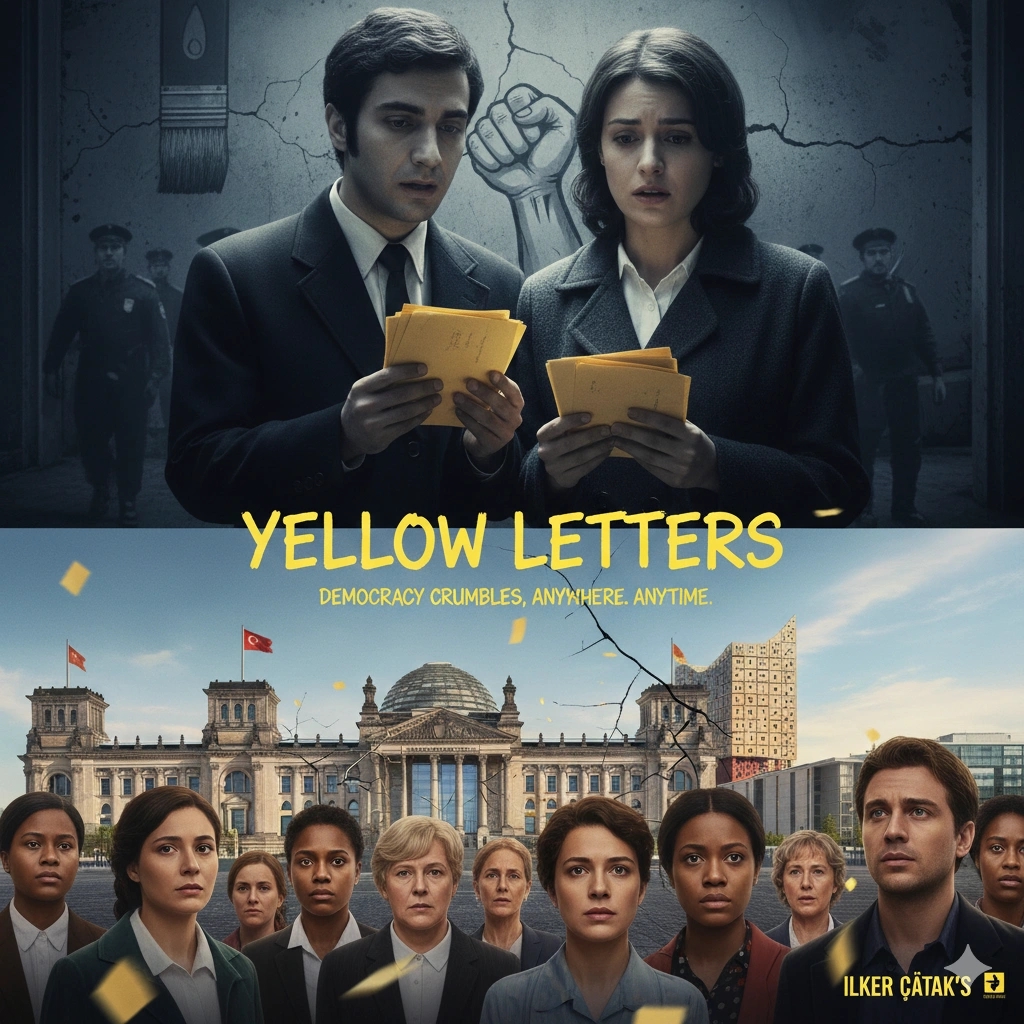
The democratic backsliding highlighted in Ilker Çatak’s latest cinematic masterpiece, Yellow Letters, serves as a harrowing wake-up call for the global West. Premiering at the 2026 Berlinale, this intimate marriage drama strips away the clinical detachment of political science to reveal the raw, human cost of eroding civil liberties. As audiences in Berlin and Hamburg watch a middle-class Turkish couple lose everything to state repression, the film poses a chilling question: could this happen here?
By blurring the lines between Ankara and the streets of Germany, Çatak forces a confrontation with the fragility of our own institutions. This article explores how the film uses the domestic sphere to illustrate the macro-pressures of authoritarianism and why its message is vital for the survival of modern democracy.
The Human Face of Political Persecution
At its core, Yellow Letters is not merely a political manifesto but a deeply personal exploration of how state power infiltrates the bedroom. The story follows a married duo—an actor and a playwright—whose lives are upended when a single social media post triggers a domino effect of professional and personal ruin. This narrative choice is deliberate; by focusing on the artistic class, Çatak highlights how the first casualties of democratic backsliding are often those who provide the cultural heartbeat of a nation.
The brilliance of the performances by Özgü Namal and Tansu Biçer lies in their portrayal of “ordinary” success. They are not radical revolutionaries; they are professionals who believed their status protected them. This sense of security is precisely what the film seeks to dismantle. When the husband is targeted for his online critiques, the subsequent loss of employment and housing illustrates that the state doesn’t need to use physical bars to create a prison. Economic strangulation is a far more efficient tool for silencing dissent in the 21st century.
As the couple moves from their comfortable apartment to the fringes of society, the audience witnesses the psychological toll of uncertainty. The film meticulously documents the erosion of trust, not just between the citizens and the state, but between the husband and wife. Every decision becomes a survival tactic, and every conversation is shadowed by the fear of further retaliation. It is this granular look at suffering that makes the warning of democratic backsliding so potent for Western viewers who might otherwise feel insulated from such “foreign” problems.
Democratic Backsliding
The phenomenon of democratic backsliding is often discussed in the context of distant regimes or historical anecdotes, yet Yellow Letters insists on its immediate presence. Ilker Çatak utilizes the setting of Berlin and Hamburg to represent Turkish cities, a stylistic choice that serves a profound psychological purpose. It forces the European viewer to superimpose the face of authoritarianism onto their own familiar neighborhoods. This visual displacement suggests that the mechanisms of repression are universal and that the “it can’t happen here” mentality is the greatest ally of the autocrat.
The film draws clear parallels to contemporary Turkish politics, specifically the crackdown on figures like Istanbul Mayor Ekrem İmamoğlu. However, it transcends local reportage. By showcasing how quickly a democratic society can pivot toward censorship and fear, the movie acts as a mirror for Western nations currently grappling with polarization and the rise of populist rhetoric. The “Yellow Letters” of the title refer to the official notifications of investigation or dismissal, documents that turn a citizen into a pariah overnight.
In many Western democracies, the signs of democratic backsliding are often subtle—a weakened judiciary, the demonization of the press, or the tightening of protest laws. Çatak’s film argues that these are not isolated incidents but symptoms of a systemic rot. The film suggests that once the safeguards of free expression are compromised, the descent into state-mandated silence is remarkably swift. The artistic couple in the film finds themselves in a vacuum where their previous accolades and social standing offer zero protection against a bureaucracy turned hostile.
The Artistic Resistance Against State Pressure
Art has long been the primary target of authoritarian regimes because it possesses the unique power to humanize statistics. In Yellow Letters, the protagonists’ background in theater is essential to the film’s message. Their work is about truth-telling, and in an era of democratic backsliding, truth becomes a liability. The film portrays the arts not as a luxury, but as a frontline defense for civil society. When the couple is stripped of their right to perform and write, the film illustrates the cultural death that precedes a political one.
Director Ilker Çatak, coming off the success of The Teachers’ Lounge, continues his streak of exploring institutional failure. He understands that the most effective way to criticize power is to show how it fractures the smallest unit of society: the family. The resistance shown by the couple is not one of grand gestures but of quiet persistence. They struggle to maintain their dignity and their bond even as the state attempts to turn them against one another. This internal resistance is a key theme, suggesting that the fight against democratic backsliding begins with the refusal to let fear dictate one’s personal relationships.
The film also addresses the role of the international community. While the couple suffers in Ankara (represented by Berlin), the global audience watches. This meta-commentary highlights the passivity of the West, which often expresses “concern” about human rights abuses while maintaining strategic and economic ties with the offending regimes. The film challenges the viewer to move beyond empathy and toward a more active defense of democratic norms, both at home and abroad, to prevent the spread of democratic backsliding.
Why the West is Not Immune to Authoritarianism
A central pillar of Çatak’s cautionary tale is the deconstruction of Western exceptionalism. Many citizens in established democracies believe that their historical foundations are too strong to be shaken by the winds of democratic backsliding. Yellow Letters argues that this is a dangerous fallacy. The film highlights how the legal and bureaucratic tools used to suppress the Turkish couple are not fundamentally different from the laws that govern modern Western states.
- Surveillance Overreach: The use of social media posts to ruin a career is a reality that transcends borders.
- Economic Vulnerability: The film shows how the “gig economy” and precarious housing markets make individuals easier to control through state pressure.
- Institutional Decay: When the courts and employers side with the narrative of the state, the individual has no recourse.
These factors are present in London, Paris, and Washington just as much as in Istanbul. The film suggests that democratic backsliding does not always arrive with a coup or a military parade; it often arrives through the gradual normalization of “safety” over “liberty.” By the time the characters realize the environment has changed, the trap is already set. This realization is what Çatak wants his Western audience to take home: the price of freedom is eternal vigilance, and that vigilance must be directed inward.
The blurring of geography in the film further emphasizes this point. By seeing German landmarks as the backdrop for Turkish repression, the audience is stripped of their geographical safety net. The visual language of the film insists that the erosion of rights is a global contagion. If democratic backsliding can take root in a country with a long history of secularism and a desire for EU integration, it can certainly find purchase in any nation where the public becomes complacent or divided.
Impact on Families and Social Cohesion
The most heartbreaking aspect of Yellow Letters is the disintegration of the couple’s social circle. As the state intensifies its pressure, friends and colleagues begin to distance themselves. This social isolation is a classic tactic used to accelerate democratic backsliding, as it breaks down the communal bonds that might otherwise form a resistance. The film shows how fear turns neighbors into strangers and turns a community into a collection of fearful individuals.
As the couple deals with the “Yellow Letters,” they find that their plight is contagious. People are afraid to be seen with them, afraid to offer them work, and afraid to speak on their behalf. This “social death” is a powerful tool of the state, as it requires no formal execution or imprisonment—just the quiet withdrawal of support by one’s peers. The film portrays this as the ultimate tragedy of democratic backsliding: the way it poisons the well of human kindness and replaces it with a cold, calculated instinct for self-preservation.
Furthermore, the film explores the generational impact of political trauma. While the focus is on the couple, the shadow of their struggle falls on their future and their sense of belonging. When a state begins the process of democratic backsliding, it doesn’t just steal the present; it mortgages the future of its citizens by creating a culture of silence that will take decades to undo. The emotional weight of the film lies in this realization that even if the couple eventually escapes, the scars on their marriage and their psyches are permanent.
Conclusion: A Call to Defend Global Democracy
Yellow Letters ends not with a resolution, but with a lingering sense of urgency. The film makes it clear that the fight against democratic backsliding is not a spectator sport. By presenting this story at the Berlinale, one of the most prestigious film festivals in the world, Ilker Çatak is using his platform to sound an alarm that cannot be ignored. The intimate drama of a failing marriage becomes a microcosm for a failing world order, where the values we take for granted are under constant assault.
The power of the film lies in its refusal to offer easy answers. It does not provide a roadmap for revolution, but it does offer a mirror. It asks the audience to look closely at the “Yellow Letters” in their own lives—the moments where they stayed silent, the times they prioritized comfort over principle, and the ways in which they might be contributing to the very democratic backsliding they claim to fear.
Ultimately, the message of the Berlinale entry is that democracy is not a static achievement but a living process that requires constant nourishment and defense. As the credits roll, the audience is left with the haunting image of a couple whose only crime was their creativity and their conscience. Their story is a reminder that the line between a free citizen and a political refugee is thinner than we like to believe. In the face of global democratic backsliding, Yellow Letters is an essential, albeit painful, viewing experience for anyone who believes in the power of the human spirit to resist the darkness of the state.
For more details & sources visit: The Arab Weekly
For the latest news from Germany, visit our Germany news page.