
The Labour government’s highly anticipated Representation of the People Bill is facing a significant Labour’s Foreign Interference Bill Crisis as the UK’s electoral watchdog warns of systemic vulnerabilities. While the legislation was marketed as a “zero-tolerance” crackdown on illicit influence, Electoral Commission chief executive Vijay Rangarajan has sounded the alarm, suggesting the door remains wide open to oligarch cash.
This Labour’s Foreign Interference Bill Crisis stems from proposed funding rules that allow companies to donate based on turnover rather than domestic profit, potentially enabling foreign actors to use UK-registered “front” firms to funnel millions into the political system. As the bill moves through Parliament, the pressure is mounting on ministers to close these gaps before the integrity of British democracy is permanently compromised by sophisticated external threats and unregulated financial flows
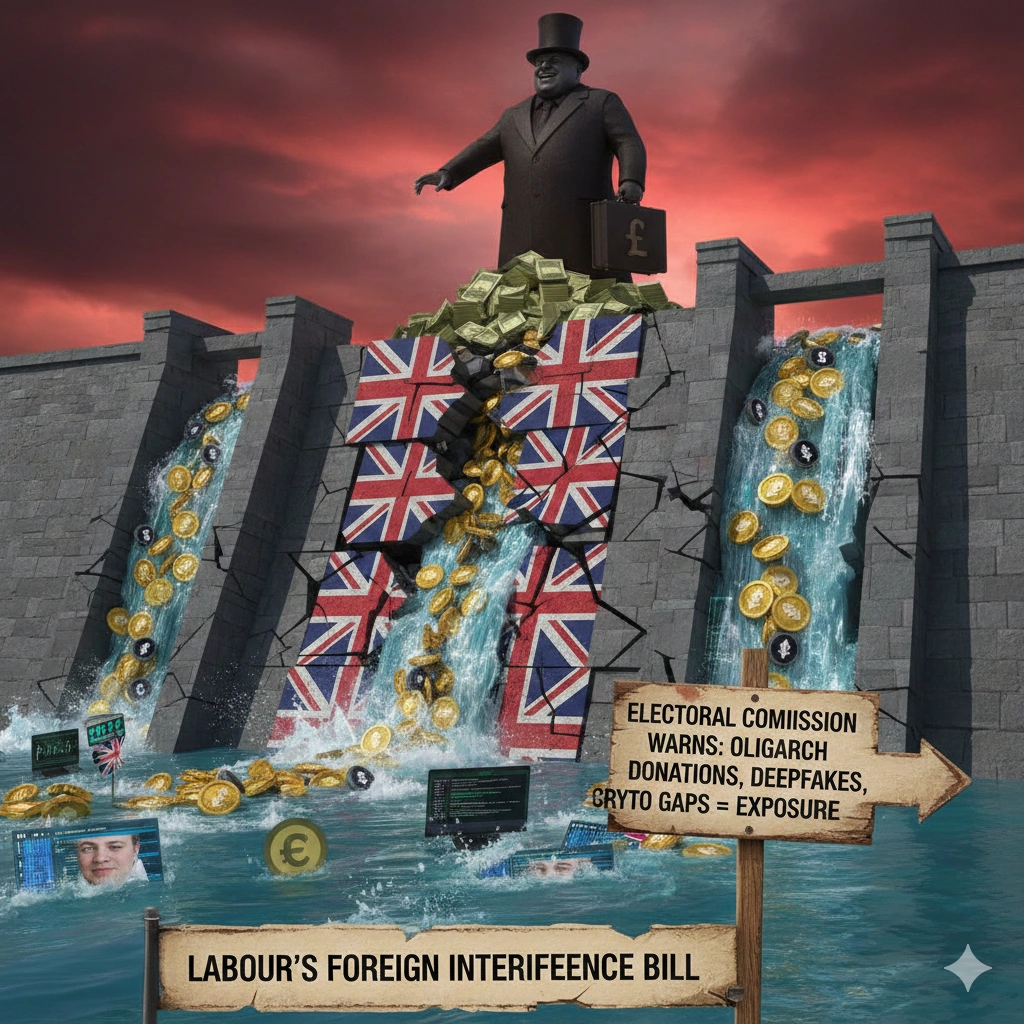
The Revenue Loophole: Why Turnover Tests Fail
At the heart of the Labour’s Foreign Interference Bill Crisis is a technical but devastating flaw in how political donations are vetted. Under the current draft, companies owned or controlled by UK citizens can donate based on a multiple of their total turnover. Critics argue this metric is far too easy to manipulate. An entity could generate massive revenue through international transactions while paying negligible UK tax, yet still qualify to inject significant capital into British political parties.
Vijay Rangarajan has been vocal about this specific weakness, noting that a revenue-based test is a gift to those seeking to mask the true origin of their wealth. If a firm acts merely as a pass-through for overseas capital, the turnover figures reflect global movements rather than genuine UK-based economic activity. To resolve this Labour’s Foreign Interference Bill Crisis, the Electoral Commission is advocating for a profits-based test. By linking donation eligibility to UK-taxed profits, the government could ensure that only businesses with a legitimate, tangible stake in the British economy are permitted to influence its leadership.
Without this change, the “zero-tolerance” promise appears hollow. Anti-corruption campaigners have echoed these sentiments, pointing out that the current wording does “nowhere near” enough to tackle the systemic risks that have plagued Westminster for decades. The fear is that without a “know-your-donor” requirement that pierces the corporate veil, the UK remains a playground for offshore interests.
Labour’s Foreign Interference Bill Crisis
The government must acknowledge that a Labour’s Foreign Interference Bill Crisis exists not because of intent, but because of execution. By failing to implement a rigorous profit-linked donation cap, the bill inadvertently creates a legal pathway for the very interference it claims to prohibit. If the legislation passes in its current form, the UK risks entering an era where political influence is effectively auctioned off to the highest bidder, provided they can set up a high-turnover shell company on British soil.
Industry experts suggest that the Labour’s Foreign Interference Bill Crisis could be mitigated by requiring full transparency regarding the ultimate beneficial owners of any donating entity. Currently, the “front firm” model allows individuals who are not UK residents to exert influence through proxies. This creates a shadow system where the source of funds is obscured by layers of corporate bureaucracy. Addressing this requires more than just better accounting; it requires a fundamental shift in how the state views the relationship between capital and democratic participation.
The Deepfake Threat: AI and Information Warfare
Beyond the financial aspects, the Labour’s Foreign Interference Bill Crisis extends into the digital realm. The rise of generative AI and deepfakes represents a frontier of interference that the current bill barely touches. As we look toward future elections, the ability of hostile actors to create hyper-realistic audio and video of political figures is a clear and present danger.
- Algorithmic Manipulation: Hostile actors can use AI to flood social media with synthetic content designed to suppress voter turnout or spread misinformation.
- Rapid Response Gaps: Current laws do not provide a framework for the immediate removal of deepfakes during the sensitive “purdah” period before an election.
- Attribution Challenges: Tracing the origin of AI-generated content is notoriously difficult, making it the perfect tool for foreign intelligence services.
The Electoral Commission has warned that the Labour’s Foreign Interference Bill Crisis will only deepen if deepfakes are not addressed with specific, enforceable regulations. MPs are currently scrambling to draft amendments that would force social media platforms to take greater responsibility for identifying and labeling synthetic media. However, technology often moves faster than legislation, leaving the UK’s democratic processes in a perpetual state of catch-up.
Cryptocurrency: The Invisible Funding Stream
Another pillar of the Labour’s Foreign Interference Bill Crisis is the unresolved status of cryptocurrency donations. While traditional bank transfers leave a paper trail, crypto assets can be moved with a high degree of anonymity. The Commission is concerned that if crypto is not explicitly banned or heavily regulated within the bill, it will become the preferred method for illicit funding.
Proponents of a full ban argue that unmanaged crypto flows could drive political money “underground,” making it nearly impossible for the Electoral Commission to trace the true source of a donation. The Labour’s Foreign Interference Bill Crisis is exacerbated by the fact that crypto markets are global and decentralized. A foreign actor could theoretically donate Bitcoin to a UK-based intermediary, who then converts it to Sterling for a political party, effectively laundering the influence.
To prevent this Labour’s Foreign Interference Bill Crisis from spiraling, some MPs are pushing for a total prohibition on digital asset donations. They argue that the risks to national security far outweigh any perceived benefit of financial “innovation” in political life. Until the government provides clarity on this issue, the financial borders of the UK’s democracy remain porous.
The Demographic Shift: Voting at 16 and 17
While much of the Labour’s Foreign Interference Bill Crisis centers on defense, the bill also includes an offensive move: extending the vote to 16- and 17-year-olds. While this has been a long-standing Labour policy aimed at increasing engagement, it adds a new layer of complexity to the security debate. Younger voters are more digitally active and, consequently, more exposed to the digital interference tactics mentioned earlier.
The Labour’s Foreign Interference Bill Crisis regarding younger voters is twofold. First, there is the risk of targeted disinformation campaigns aimed at an impressionable demographic. Second, the administrative burden of registering hundreds of thousands of new voters overnight could create clerical vulnerabilities that foreign actors might exploit to cast doubt on election results.
Critics argue that by focusing on franchise expansion while leaving financial loopholes open, the government is prioritizing political optics over national security. A truly robust bill would secure the perimeter before expanding the interior. The Labour’s Foreign Interference Bill Crisis won’t be solved by simply adding more people to the voter rolls; it requires a fundamental hardening of the systems those voters rely on.
Closing the Loopholes: The Path Forward
To resolve the Labour’s Foreign Interference Bill Crisis, the government must listen to the Electoral Commission’s “90% there” assessment and address the remaining 10%. This means moving away from a “headline-only” approach and engaging with the gritty details of corporate law and financial forensics.
- Implement a Profits Test: Ensure donations come from genuine domestic economic success.
- Mandate Transparency: Require disclosure of ultimate beneficial owners for all corporate donors.
- Regulate AI: Create a legal framework to identify and ban malicious deepfakes during election cycles.
- Ban Crypto Donations: Eliminate the risk of untraceable “underground” funding.
- Strengthen Watchdog Powers: Give the Electoral Commission the resources and legal teeth to prosecute violations effectively.
The Labour’s Foreign Interference Bill Crisis is a test of the government’s resolve. If they ignore the warnings of the very body tasked with overseeing our elections, they risk presiding over a period of unprecedented foreign meddling. The integrity of the 2029 General Election and beyond depends on the decisions made in the coming weeks.
A Comparative Look at Proposed vs. Required Standards
| Feature | Proposed Bill | Commission Recommendation | Risk Level |
| Donation Basis | Turnover | UK-Taxed Profit | High |
| Digital Content | Vague Guidelines | Strict AI/Deepfake Labels | Critical |
| Crypto Assets | No Specific Ban | Total Prohibition | Medium |
| Vetting | Basic Checks | Enhanced “Know Your Donor” | High |
The data suggests that the Labour’s Foreign Interference Bill Crisis is rooted in a discrepancy between political ambition and practical security. Without aligning the bill with the Commission’s recommendations, the “zero-tolerance” stance remains a rhetorical device rather than a legislative reality. The Labour’s Foreign Interference Bill Crisis is not just a policy debate; it is a battle for the sovereignty of the British ballot box.
As the debate continues, the public must remain vigilant. The Labour’s Foreign Interference Bill Crisis affects every citizen, as the source of political funding directly influences the direction of national policy. Whether it is a trade deal, an environmental regulation, or a defense strategy, the “oligarch cash” the Commission warns about could be the silent hand behind the scenes.
Conclusion
The Labour’s Foreign Interference Bill Crisis represents a pivotal moment for UK democracy. The government has the opportunity to create a world-leading framework for electoral security. However, if they fail to close the gaps on turnover-based donations, deepfakes, and crypto, they will have merely built a more expensive door with a missing lock. The Labour’s Foreign Interference Bill Crisis must be resolved now, or the UK will face the consequences for decades to come.
The current Labour’s Foreign Interference Bill Crisis highlights the ease with which sophisticated actors can bypass simple checks. The proposed bill’s reliance on turnover is a glaring oversight. For a country that prides itself on the “Mother of Parliaments,” allowing such a Labour’s Foreign Interference Bill Crisis to persist is unacceptable. Ministers must act to ensure that the “zero-tolerance” brand is backed by zero-vulnerability legislation.
Every time a loophole is left open, the Labour’s Foreign Interference Bill Crisis grows. The public expects their leaders to be accountable to them, not to anonymous donors hiding behind corporate structures. Solving the Labour’s Foreign Interference Bill Crisis is the only way to restore trust in a system that many feel is already tilted toward the wealthy and the powerful.
Ultimately, the Labour’s Foreign Interference Bill Crisis is a reminder that democracy is fragile. It requires constant maintenance and protection from those who would see it undermined for their own gain. By addressing the Labour’s Foreign Interference Bill Crisis head-on, the Labour government can prove it is serious about national security. Failure to do so will leave a legacy of vulnerability that no amount of spin can cover up.
The Labour’s Foreign Interference Bill Crisis is currently the most significant threat to our democratic health. We must ensure that the “Representations of the People” are exactly that—the people, not the profits of foreign oligarchs. The Labour’s Foreign Interference Bill Crisis needs a definitive resolution before the next time we head to the polls.
For more details & sources visit: The Observer
For more updates about the United Kingdom, visit our UK news page.