
The landscape of Chinese AI governance is undergoing a profound transformation as of February 2026, moving far beyond simple top-down authoritarian control. While global observers often view Beijing’s regulatory framework as a rigid monolith, a nuanced reality is emerging where state power, market incentives, and societal norms intersect.
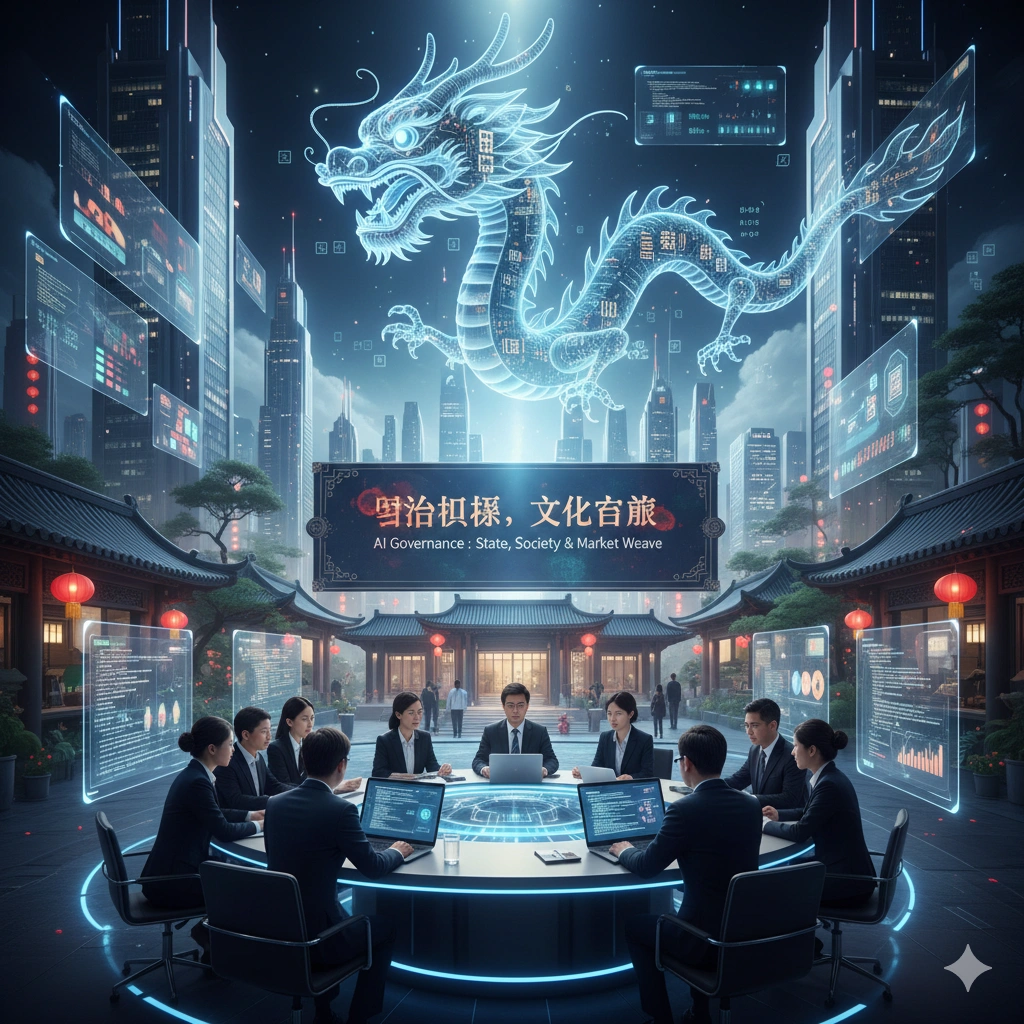
New research from Northeastern University and Lancaster University suggests that the development of Chinese AI governance is a co-productive process. This means that while the Cyberspace Administration of China (CAC) sets the legal boundaries, private tech giants like ByteDance and emerging players like DeepSeek are actively shaping the guardrails. These firms are not merely reacting to decrees; they are proactively navigating a complex web of cultural expectations and commercial risks. By examining how Chinese AI governance functions in practice, we can see a hybrid model that prioritizes social stability and economic competitiveness simultaneously. This intricate balance defines the current era of technological oversight in East Asia.
The Myth of Purely Top-Down Control in Beijing
For years, the international community has characterized the Chinese approach to technology as a simple matter of government command. However, the latest academic findings challenge this “stereotypical narrative” by highlighting the agency of non-state actors. In the realm of Chinese AI governance, companies are often the first movers in establishing safety protocols. They do this to avoid public backlash and the heavy hand of formal regulatory punishment. This proactive stance creates a feedback loop where industry standards eventually inform national policy.
Furthermore, the absence of a single, comprehensive AI statute—similar to the European Union’s AI Act—has allowed for a more flexible, sectoral approach. Instead of one giant law, Chinese AI governance relies on a patchwork of draft measures, registration requirements, and specific rules for generative content. This modularity allows regulators to pivot quickly as new technologies like large language models (LLMs) evolve. It also places a heavy burden of proof on developers, who must demonstrate that their systems do not cause psychological harm or social disruption.
Chinese AI Governance
The effectiveness of Chinese AI governance is deeply rooted in the concept of “socialist governance with digital characteristics.” This involves a unique blend of political loyalty and market-driven efficiency. While the state maintains the ultimate “kill switch” for any technology deemed a threat to national security, day-to-day management is largely delegated to the platforms themselves. This delegation is a cornerstone of Chinese AI governance, as it allows the state to maintain oversight without stifling the technical innovation required to compete with Western rivals like OpenAI and Anthropic.
In 2026, we see that Chinese AI governance also functions as a tool for industrial policy. By setting clear standards for data handling and algorithm transparency, the government provides a predictable environment for investors, even if those rules are strict. Firms like Glority and Zuoyebang have found success within these boundaries, proving that innovation can thrive under high-pressure regulatory scrutiny. The real challenge for Chinese AI governance remains the balance between strict censorship and the creative freedom needed to develop world-leading artificial intelligence.
Cultural Norms and the Protection of Minors
One of the most overlooked aspects of Chinese AI governance is the role of parental pressure and traditional values. Chinese society places an extraordinary emphasis on the education and psychological health of children. This cultural priority has translated into some of the world’s first targeted rules on generative AI content for minors. Regulators are not just worried about political dissent; they are responding to a genuine social demand for “clean” digital environments.
- Platforms must implement “youth modes” that limit usage time and filter content.
- AI tutors and educational tools are subject to rigorous “truthfulness” audits to ensure accuracy.
- Algorithms are prohibited from encouraging addictive behaviors or “vulgar” social trends.
These measures show that Chinese AI governance is responsive to the domestic electorate’s concerns regarding the moral fiber of the next generation. By aligning regulatory goals with parental expectations, the state garners broader public support for its oversight of the tech sector. This social contract is a vital component of the broader governance strategy.
Market Incentives for Proactive Self-Regulation
In the competitive landscape of the Chinese internet, a regulatory scandal can be fatal for a company’s valuation. Therefore, market forces are a primary driver of Chinese AI governance. Tech giants use self-censorship as a form of risk management. By filtering politically sensitive topics and restricting harmful content before the state intervenes, companies protect their brand reputation and ensure uninterrupted service.
This “preventative compliance” is a hallmark of the modern Chinese tech firm. For example, ByteDance and DeepSeek have developed internal ethics committees that mirror the requirements of the CAC. These committees ensure that every update to an LLM aligns with the latest “core socialist values” directives. Consequently, Chinese AI governance is baked into the very code of the products being released. This alignment of commercial survival and state compliance creates a highly disciplined, yet innovative, market.
Comparing Chinese and Global AI Standards
While the U.S. leans toward a decentralized, market-first approach and the EU favors a rights-based framework, Chinese AI governance occupies a unique middle ground of “securitized development.” It prioritizes the security of the state and society above individual data rights, yet it is more interventionist than the American model. This distinction is crucial for global firms trying to navigate the Chinese market.
| Feature | Chinese AI Governance | EU AI Act | U.S. Framework |
| Primary Driver | Social Stability | Fundamental Rights | Innovation/Markets |
| Enforcement | Proactive/State-Led | Post-Market/Legalistic | Voluntary/Sectoral |
| Content Focus | Political & Moral | Privacy & Bias | Safety & Security |
As shown in the table, Chinese AI governance is uniquely focused on the moral and political implications of AI outputs. This has led to a highly specialized set of requirements for “alignment” that differs significantly from Western notions of AI safety. While Western safety focuses on preventing existential risks or technical hallucinations, Chinese governance focuses on preventing social disharmony.
Revenue Gaps and the Future of Tech Competition
Despite the robust framework of Chinese AI governance, there remains a significant financial gap between Chinese and American AI leaders. Industry data indicates that Chinese developers currently account for 23 of the world’s 100 largest AI products by annual recurring revenue (ARR). However, their combined revenue of roughly $447 million still pales in comparison to the billions generated by U.S.-based OpenAI and Anthropic. This suggests that while governance is stable, the commercial “breakthrough” moment for Chinese AI is still approaching.
The future of Chinese AI governance will likely focus on closing this revenue gap while maintaining social control. Regulators are aware that overly burdensome rules could stifle the very industry they hope will lead the “Fourth Industrial Revolution.” Therefore, we can expect a more “encouragement-based” governance style in the coming years, where the state provides subsidies and data access to firms that demonstrate exemplary compliance and technical prowess.
Conclusion: A Co-Produced Future for AI
Ultimately, Chinese AI governance is a living system that reflects the complexities of a modern superpower. It is a mistake to view it as a one-way street of state oppression. Instead, it is a sophisticated negotiation between the Communist Party, billionaire tech founders, and a demanding public. As researchers continue to study this model, the question is no longer whether the state is in control, but rather how much influence the market and society exert on the state’s final decisions.
The evolution of Chinese AI governance will serve as a template for other nations looking to balance rapid technological growth with social stability. Whether this model can produce a global leader to rival GPT-5 or Claude 4 remains to be seen, but the structural foundations are now firmly in place. Understanding these dynamics is essential for any stakeholder in the global AI ecosystem.
For more details & sources visit: Northeastern Global News
For more China-related updates, visit our China News page.