
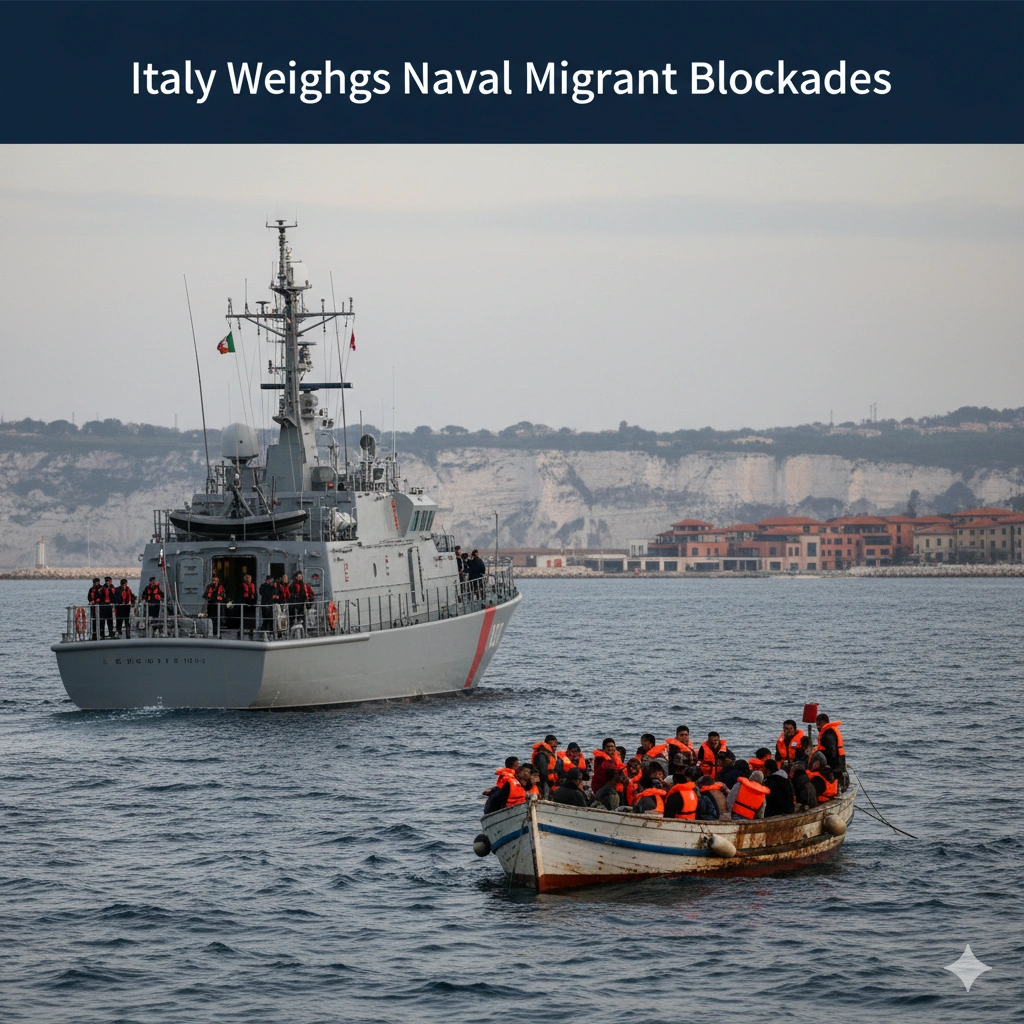
Italy migration bill developments are reshaping the country’s border strategy after the cabinet approved legislation allowing temporary naval blockades against migrant boats. The measure, backed by the government of Giorgia Meloni and affecting policy in Italy, still requires parliamentary approval but already signals a major shift in migration enforcement across southern Europe.
The bill authorizes authorities to impose naval blockades during periods of what officials describe as “exceptional migratory pressure” or threats to national security and public order. These blockades could initially last 30 days, with possible extensions under specific emergency conditions.
Alongside maritime controls, the proposal broadens deportation powers and increases penalties for vessels violating the new rules, including fines reaching tens of thousands of euros and potential ship confiscation.
How the Italy Migration Bill Fits Into Tougher EU Asylum Policies
The Italy migration bill aligns closely with broader reforms underway across the European Union. European lawmakers have recently pushed forward new asylum rules that expand the use of “safe third country” policies and accelerate deportations in certain cases.
Under these evolving EU frameworks, member states can increasingly reject asylum claims if migrants passed through or could have sought protection in countries deemed safe. New rules also allow faster processing for nationals from countries placed on EU-wide safe origin lists.
Supporters say these measures will reduce pressure on overwhelmed asylum systems and discourage irregular migration routes. Critics argue they could send vulnerable people to countries where protection is limited or inconsistent.
Security, Enforcement and Humanitarian Concerns
Supporters of the Italy migration bill say it is necessary to strengthen border control and prevent smuggling networks from exploiting migrants. Officials also point to reduced sea arrivals compared with previous periods as evidence that stricter policies can act as deterrents.
However, humanitarian organizations warn the policy could raise risks for migrants and complicate rescue operations in the Mediterranean. Advocacy groups argue that restricting rescue ships and expanding expulsion grounds may expose vulnerable people to greater danger at sea or after deportation.
The legislation could also impact NGO vessels that repeatedly violate new navigation restrictions, potentially facing heavy fines or confiscation if caught operating in restricted zones.
Political Context Behind the Italy Migration Bill
The Italy migration bill reflects campaign promises by Meloni’s government to reduce irregular sea arrivals and strengthen border security. Since taking office, the administration has combined tougher domestic rules with international agreements aimed at limiting departures from North Africa.
The proposal also connects to Italy’s broader migration strategy, including attempts to process migrants in third countries outside the EU. Some initiatives, such as offshore processing centers, have faced legal and political challenges but remain central to Rome’s long-term migration approach.
What Happens Next
For the Italy migration bill to become law, it must pass both houses of the Italian parliament. If approved, it would give authorities expanded tools to control sea migration and could influence how other European states approach maritime arrivals.
At the same time, the bill’s progress will likely remain controversial, as governments across Europe continue balancing border control goals with humanitarian obligations and international refugee protections.
The outcome could shape migration policy debates across Europe throughout 2026 and beyond, especially as new EU asylum frameworks begin implementation in the coming months.
For more details & sources visit: Al Jazeera
For the latest updates from the Italy, visit our Italy news page.